


If you're one of the millions of people now working from home, you might be able to claim a bit of tax relief on your extra household bills. This guide will walk you through exactly how working from home tax deductions work in the UK, helping you figure out if you're eligible, what you can claim, and how to get it right with HMRC.
Your Guide to Claiming Homeworking Tax Relief

The big shift to remote working has left many contractors and employees wondering, "Can I actually knock anything off my tax bill for my home office costs?" The answer is often yes, but you need to know the rules. Here at UmbrellaCompany.com, we want to cut through the jargon and make this whole process clear for you.
This guide is your roadmap to understanding working from home tax deductions. We will cover everything you need to know, from checking if you qualify in the first place to calculating what you’re owed and putting in the claim correctly. Our aim is to give you simple, practical advice so you can claim with confidence.
The Rules Have Changed
It is very important to know that the rules for claiming homeworking tax relief have become a lot stricter. During the COVID-19 pandemic, the government introduced temporary, much more relaxed rules. Between 2020 and 2022, almost any employee who worked from home could claim tax relief, even if it was just for one day.
That all stopped on 5 April 2022. Now, the eligibility criteria are much tighter. You can only claim if you have to work from home (not just because you choose to) and you are paying for extra household costs your employer does not reimburse you for.
Who This Guide Is For
Whether you are a PAYE employee, a sole trader, or a director running your own limited company, this guide is for you. The rules can be slightly different depending on your situation, and we will point out those differences as we go. We will cover:
- Eligibility criteria: The key conditions HMRC insists you meet.
- Allowable expenses: A straightforward list of what you can and cannot claim for.
- Calculation methods: How to work out your claim using either the simple flat rate or your actual costs.
- The claims process: A step-by-step walkthrough for sending your claim to HMRC.
We are here to give you the trustworthy, supportive information you need to maximise your tax savings without the headache. By following the advice in this post, you will have everything you need to handle your working from home tax deductions accurately. This will make sure you get the relief you are entitled to while staying on the right side of UK tax regulations. Let's get started.
Checking If You Qualify for Tax Relief

Before you think about finding receipts or tackling any forms, the first, most important question is a simple one: are you actually eligible for working from home tax deductions? HMRC has some very clear rules on this, and getting them straight from the start is the key to a successful, hassle-free claim.
The entire process hinges on one crucial point: whether you are required to work from home, or if you simply choose to. This single distinction is the most important factor in determining if you can make a claim. A personal preference for remote work, even if your employer agrees, will not be enough.
The 'Required' vs 'Choice' Test
So what does HMRC mean by 'required'? Think of it as a necessity, not a perk. It means your job simply cannot be done at your employer's premises, usually because they do not have a suitable office space for you.
A classic example is when an employer is fully remote and has no physical office at all. Another is if your assigned office is so far away that a daily commute is completely unreasonable. In these situations, your home becomes your workplace by default, and that is what makes you eligible.
However, modern hybrid working makes this tricky. If your employer provides you with a desk at an office but you have an agreement to work from home a few days a week, you typically do not qualify. This is because you have the option of going into the office, making your homeworking a choice.
How Eligibility Varies for Different Workers
Your employment status also changes how the rules apply. The requirements shift slightly depending on whether you are a PAYE employee, a sole trader, or running your own limited company.
PAYE Employees: Your employer must have explicitly told you to work from home, and this must have caused you to incur extra household costs. If your employer already reimburses you for these specific costs, you cannot claim tax relief on them again.
Sole Traders: If you're self-employed, you get a bit more flexibility. You can claim for your home office expenses provided you use part of your home exclusively for business. This means a dedicated office room is fine, but trying to claim for working at the kitchen table probably is not.
Limited Company Directors: You can claim expenses much like a sole trader, but the costs must be "wholly and exclusively" for the business. You will also need a formal rental agreement between yourself (as the property owner) and your limited company to keep things compliant.
The core principle is always the same: tax relief is there to cover necessary costs that arise because your home is your workplace, not to subsidise a convenient working arrangement. For contractors, in particular, knowing every available relief can make a big difference, which is why we explain how to pay less tax as a contractor in our detailed guide. Making sure you meet the criteria from the outset will save you time and prevent any issues with HMRC later on.
How to Calculate Your Homeworking Claim
Now that you have confirmed you are eligible for the working from home tax deduction, the next big question is: how much can you actually claim?
HMRC gives you two ways to work this out. There's a simple, no-fuss flat rate, and then there's a more detailed calculation based on your actual costs. The best one for you really depends on how much your bills have gone up and whether you mind a bit of admin.
The Simple Flat Rate Method
The easiest route is using HMRC's flat rate. This lets you claim a fixed amount without finding a single receipt or bill. It is designed to be quick and painless.
For the current tax year, the flat rate is £6 per week, which works out to £312 per year. The actual cash you get back depends on which income tax band you fall into. Basically, the higher your tax rate, the more this claim is worth to you.
Let's break that down into real money. A basic rate taxpayer (20%) will get relief of £1.20 a week, or £62.40 over the year. If you are a higher rate taxpayer (40%), that doubles to £2.40 a week, or £124.80 annually. For additional rate taxpayers (45%), it's £2.70 a week, adding up to £135 for the year.
This table gives you a quick at-a-glance view of what you can expect.
Your Annual Tax Relief Using the Flat Rate
| Income Tax Band | Tax Rate | Weekly Relief | Annual Relief |
|---|---|---|---|
| Basic Rate | 20% | £1.20 | £62.40 |
| Higher Rate | 40% | £2.40 | £124.80 |
| Additional Rate | 45% | £2.70 | £135.00 |
As you can see, it is a straightforward way to get a bit back without any complicated maths.
The Actual Costs Method
If you believe your extra household costs from working at home are well over £6 a week, you might be better off with the actual costs method. This approach lets you claim for a portion of your genuine household bills, but it does mean you will need to stay on top of your record-keeping.
With this method, you work out the business-use portion of bills like heating, electricity, and even your broadband. One thing to remember: you cannot claim for fixed costs that you would be paying anyway, like your mortgage, rent, or council tax.
You will need a fair and reasonable way to calculate this. A common method is:
- Count your rooms: Add up the total number of rooms in your house (but exclude bathrooms and hallways).
- Pinpoint your workspace: Identify how many of those rooms you actually use for work.
- Work out the time: Calculate what percentage of the time that room is used for your job.
Let’s walk through an example. Say your house has 5 main rooms, and you use one exclusively as your home office. Your total monthly utility bills for gas and electricity are £150.
Calculation Example:
- Room proportion: 1 office / 5 total rooms = 20% of the bills are for that space (£30).
- Business use: If you only use that room for work, you can claim the full £30.
- Apportioned use: If you use it for personal things half the time, you would claim 50% of that £30, which comes to £15 per month.
This infographic gives a good sense of where those home office expenses often come from.
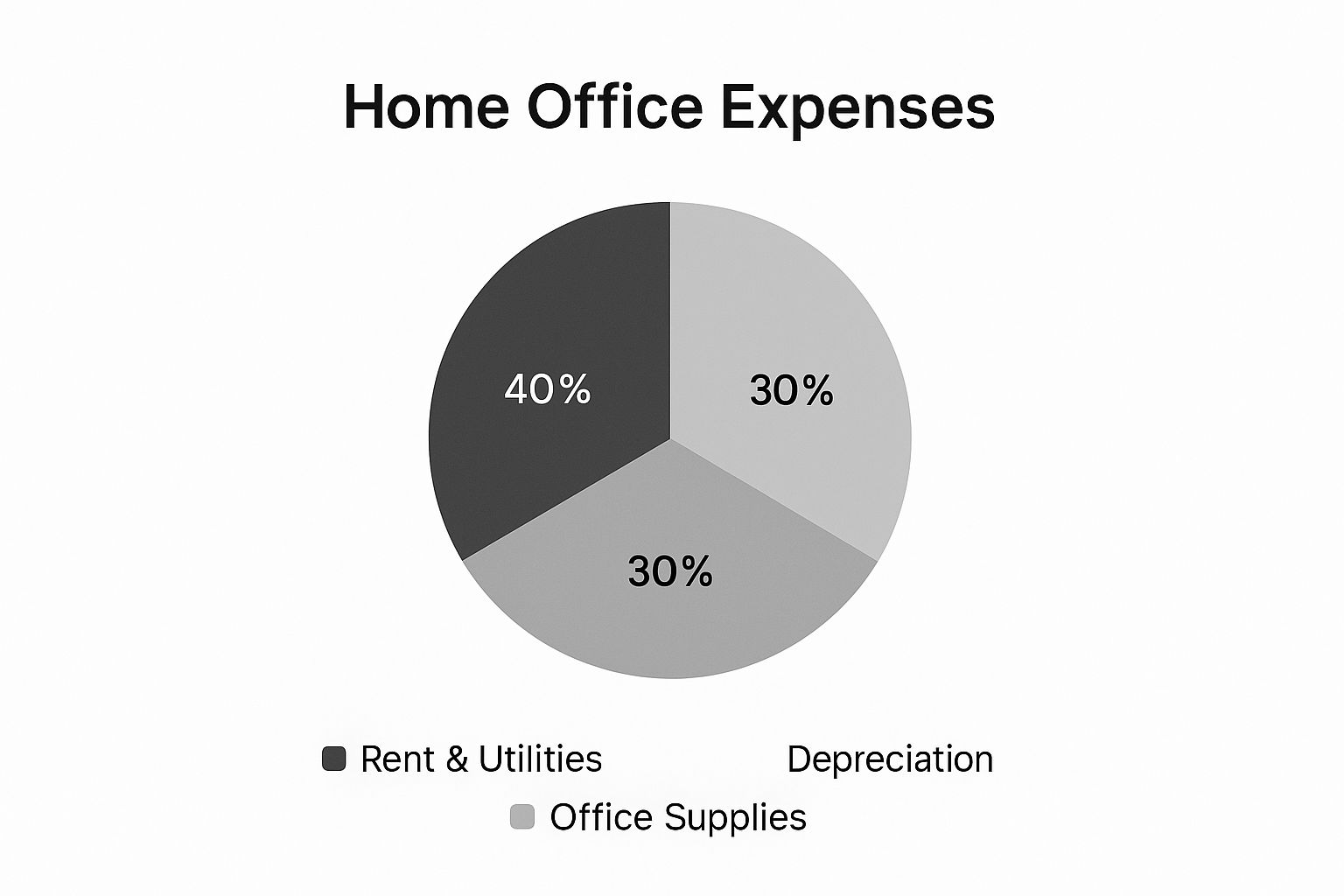
As you can see, a large portion of homeworking costs can be tied to household bills, which is why an accurate calculation can make a real difference. For an even more detailed breakdown, this guide on how to claim home office expenses is a fantastic resource for sole traders and company directors.
What Can You Actually Claim For?
You are eligible, which is great, but that is only half the battle. Now we need to get into the details of which specific working from home tax deductions you can actually make. Getting this right is what separates a successful, compliant claim from one that could cause problems with HMRC.
Here is the golden rule you must remember: you can only claim for costs that have genuinely increased because you work from home. This means you cannot touch any fixed costs you would be paying anyway, whether you were commuting to an office or working from your kitchen table.
This principle immediately rules out some of your biggest household bills. Things like your mortgage interest, rent, and council tax are not eligible. You were always going to pay those. HMRC is only interested in the extra costs your work has created.
Household Running Costs
This is where the bulk of most claims come from. It is all about the extra utilities you are using throughout the working day.
- Extra Heating and Power: This is the big one. You can claim for the additional gas and electricity needed to heat and light your workspace. It is often the most significant extra cost, especially in the winter months.
- Metered Water: If your water bill is based on usage (i.e., you have a water meter), you can claim for the extra business-related portion. But if you just pay a fixed annual charge, it does not count.
The key word here is "apportioned." You cannot just claim your entire winter heating bill. You have to work out the part that is a direct result of you being at home working when you otherwise would not have been.
Communications Expenses
Your phone and internet bills are another key area to look at for legitimate working from home tax deductions. The rules here really depend on who the contract is with and how it is used.
- Business Phone Calls: The cost of any calls made purely for work on your personal landline or mobile are claimable.
- Broadband Internet: This one is tricky. You can only claim the business portion of your broadband if you can clearly show a split between business and personal use. This can be such a headache to prove that many people just opt for the simple £6 per week flat rate instead.
For your home office to run smoothly, a decent connection is a must. It is worth looking into what constitutes an ideal internet speed for working from home to make sure you are not held back by slow service.
Office Supplies and Equipment
This category covers all the small day-to-day things you need to do your job from home. They might seem minor, but they really add up over a tax year.
- Stationery: Any pens, paper, notebooks, and other items you have had to buy specifically for work.
- Printer Ink and Cartridges: If you are using your personal printer for work tasks, the cost of the ink you use is a valid expense.
It is vital to remember that you can only claim for things your employer has not already reimbursed you for. Claiming an expense that has already been paid back is not allowed and will cause problems with HMRC.
To help you get a clear picture, here is a quick reference table to keep you on the right track.
Allowable vs Non-Allowable Homeworking Expenses
This table is a handy guide to quickly see which common household expenses you can and cannot include in your tax relief claim.
| Expense Category | Generally Allowable (Apportioned) | Generally Not Allowable |
|---|---|---|
| Utilities | Additional gas & electricity for heating/lighting, metered water | Fixed-rate water charges, sewerage |
| Housing | None | Mortgage interest, rent, council tax, home insurance |
| Communications | Business-only phone calls, business-use portion of broadband | Line rental for a shared phone/broadband line, TV licence |
| Office Supplies | Stationery (pens, paper), printer ink and cartridges bought for work | Items your employer has reimbursed you for |
| Furniture & Equipment | Business equipment bought by you (if not provided by employer and essential) | Furniture or equipment that has significant personal use |
Remember, this is about identifying the additional costs incurred solely for business purposes.
Understanding these categories is a solid start. For more advanced strategies, our guide on the best ways to reduce tax as a contractor in the UK digs even deeper.
Submitting Your Claim to HMRC Correctly
You have done the hard work of figuring out if you are eligible and calculating what you can claim. Now for the final step: getting that claim submitted correctly to HMRC.
The right way to do this depends on how you are employed, and it is important to follow the correct process to get your claim processed without any issues. Let's walk through how to do it, whether you are a PAYE employee, a sole trader, or a limited company director.
How PAYE Employees Can Claim
If you're an employee paid through PAYE, there are two main routes for claiming your working from home tax deductions. It all depends on whether you already file a Self-Assessment tax return.
For claims under £2,500: The most straightforward method is using HMRC’s online P87 form. It is a simple process where you enter details about your job and the expenses you are claiming. You will need your National Insurance number, your employer’s PAYE reference number (you can find this on your payslip or P60), and the total amount you are claiming.
For claims over £2,500: If your total employment expenses go over this threshold, you must register for Self-Assessment and file a tax return. It is a bit more involved, but it is a firm requirement from HMRC for larger claims.
Once your claim is approved, HMRC usually adjusts your tax code. This is good news, as it means you will pay a little less tax each month for the rest of the tax year. In some situations, particularly for a claim from a past tax year, you might get a one-off tax rebate instead.
The Process for Sole Traders and Limited Company Directors
For the self-employed, whether you are a sole trader or run your own limited company, the process looks a bit different. You do not use the P87 form.
Instead, your homeworking expenses become part of your annual Self-Assessment tax return. Sole traders will add these costs to the ‘business expenses’ section of the SA103 form. If you are a limited company director, you will declare the expenses in the company’s accounts and, where relevant, your personal tax return.
Missing the Self-Assessment filing date triggers automatic penalties from HMRC, so staying organised is non-negotiable. Knowing your key dates is crucial. Our guide on the self-employed tax return deadline has all the information you need to file on time and avoid any fines.
Submitting your claim correctly is the final piece of the puzzle. Follow these steps, and you can be confident you are reporting your expenses properly and getting the tax relief you are entitled to.
Keeping Your Ducks in a Row: Records for a Compliant Claim
Good record-keeping is your best line of defence against any future HMRC queries. It is especially crucial if you skip the flat rate and decide to claim your actual costs. Having everything organised provides the proof you need and shows that your working from home tax deductions are both accurate and legitimate.
This is not about getting bogged down in complex spreadsheets or drowning in paperwork. It is simply about forming a few consistent habits. A little effort now will save you a world of stress later, leaving you confident and prepared in your claim.
What to Keep and How to Organise It
Keeping everything in order does not have to be a chore. The goal is to create a clear, logical trail that justifies your figures if HMRC ever has questions.
Here are a few practical tips to get you started:
- Go Digital: Set up a dedicated folder on your computer or cloud drive named something like "Homeworking Expenses [Tax Year]". This is where you will save digital copies of all your utility bills, phone and broadband statements, and receipts for any office supplies.
- Use a Simple Spreadsheet: A basic spreadsheet is perfect for tracking your calculations. Just list each expense, the total amount, and the maths you used to work out the business portion. It creates a record that is incredibly easy to follow.
- Scan as You Go: If you have a paper receipt, use your phone to scan it and save it straight into your digital folder. Doing it immediately means it will not get lost or fade.
How Long to Keep Your Records
HMRC is quite specific about how long you need to hold onto your financial records. For Self-Assessment tax returns, the rule is you must keep everything for at least five years after the 31st January submission deadline for that tax year. If you are a PAYE employee making a simple claim, holding onto records for 22 months from the end of the tax year is usually enough.
As a rule of thumb, it is wise to keep everything for six years just to be safe. This ensures that if HMRC ever opens an enquiry into a past tax year, you have all the necessary paperwork ready to go without any last-minute panic.
Remember, the value of your claim is also directly tied to your income. UK tax bands determine how much relief you actually get. With the current basic rate at 20% (£12,571 to £50,270) and the higher rate at 40% (£50,271 to £125,140), a higher earner will see more significant savings from the exact same claim, making those accurate records even more valuable.
Staying on the right side of HMRC is a fundamental part of contracting. If you're looking for more tailored support, check out our dedicated services for accounting for contractors, which are designed to help you manage your finances with ease. By keeping organised records, you build a solid foundation for a compliant and stress-free tax claim.
Your Homeworking Tax Relief Questions Answered
To make sure everything is crystal clear, let's run through some of the most common questions we hear about claiming tax relief for working from home. This will give you the confidence to get your claim right.
Can I Claim If I Choose to Work from Home?
This is a common question, and the short answer is, probably not. Since the rules were tightened after the pandemic, tax relief is now only for people who are required to work from home.
What does that mean in practice? It means your employer does not have a suitable office space for you. If there is a desk available for you at the office, but you simply prefer a hybrid or fully remote setup, you will not qualify for the tax relief.
What Happens If My Employer Gives Me an Allowance?
If your employer is already paying you a specific homeworking allowance to help with your costs, you cannot claim tax relief on those same expenses. Most of the time, this allowance is paid tax-free up to the £6 per week limit.
However, what if your bills are genuinely higher than the allowance you get? In that case, you might be able to claim tax relief on the difference. This does mean you will need to use the 'actual costs' method, which involves keeping meticulous records to prove your spending to HMRC.
Can I Claim for Previous Tax Years?
Yes, absolutely. It is often possible to backdate a claim for working from home tax relief. Generally, you can go back for the past four tax years.
So, if you were eligible in previous years but never got around to claiming, you can submit a separate claim for each of those years. This is especially relevant for the 2020-21 and 2021-22 tax years, when the rules were much looser because of the pandemic. Many more people were eligible back then.
Do I Need Receipts to Make a Claim?
This all comes down to which method you use for your claim.
- Flat Rate Method: If you are claiming the standard £6 per week, you do not need any receipts or records. It is designed to be simple.
- Actual Costs Method: If you're arguing your costs are higher than the flat rate, you must keep all the relevant receipts, bills, and your calculations. This is your evidence for HMRC.
Choosing the right method is really a trade-off between simplicity and a potentially bigger claim. For most people, the flat rate is a hassle-free way to get a bit of tax back without drowning in paperwork.
Navigating contractor finances can be complex, but you do not have to do it alone. UmbrellaCompany.com makes it easy to compare trusted umbrella companies, ensuring you find the perfect fit for your needs. Get started in just one minute.


