


You've been offered a six-month contract at a day rate that looks far better than your permanent salary. The recruiter wants an answer quickly, but you're already wondering who'll handle tax, whether the role falls inside IR35, and why every contractor seems to have a different answer.
Working as a self-employed contractor can offer control, variety and stronger gross earnings, but only if you choose the right structure before signing. This guide explains your legal status, the main ways to operate, how IR35 changes the tax treatment, how to read an umbrella payslip, and the practical checks that help you get paid compliantly.
What It Really Means to Work as a Self-Employed Contractor in the UK
A permanent employee usually has an ongoing role, a regular salary and a defined place in the organisation. A contractor sells specialist skills for a project, assignment or fixed period. The client hires you to deliver an outcome, rather than giving you a permanent seat in its headcount plan.
That distinction explains why contracting exists. Businesses need experienced people for transformation programmes, construction projects, technology implementations and specialist assignments, but they may not want a permanent employment commitment. Contractors provide that flexibility, while accepting responsibility for their own tax position, insurance, benefits and gaps between assignments.
The UK has a substantial self-employment base. ONS recorded just over 4.2 million self-employed people, equal to 13.0% of total employment, between January and March 2022. The number of people working for themselves had also fallen by 14.6%, from 3.5 million between January and March 2020 to 2.9 million between January and March 2022, showing both the scale and volatility of this labour-market category (ONS analysis of changes in UK self-employment).
Practical rule: Treat the day rate as business income, not personal salary. Your structure determines how much reaches you and who carries the compliance work.
More than one decision
“Self-employed contractor” isn't a complete legal answer. It can describe a genuine sole trader, a director working through a personal service company, or a person employed by an umbrella company while completing a contract for an end client.
Those routes differ in legal status, tax collection, administration and risk. Our guide to the benefits of being self-employed can help you assess the lifestyle side, but the financial decision must start with the contract terms and its IR35 position.
The sensible order is straightforward:
- Understand the work: Check who controls the assignment, how delivery is measured and whether the engagement is project-based.
- Confirm the structure: Decide between sole trader, umbrella and limited company after reviewing the contract, not before.
- Model the cash flow: Allow for tax, accountancy, insurance, pension saving, unpaid leave and time between assignments.
- Document the relationship: Keep the contract, working practices and status decision aligned.
A higher rate can be worthwhile, but it doesn't automatically compensate for weak rights, uncertain demand or poor payroll transparency.
The Legal Status of a Self-Employed Contractor Explained
A self-employed contractor runs a business and supplies services to clients. Think of a freelance plumber engaged to replace a boiler, rather than a salaried engineer who works on the employer's rota, uses its systems and reports to its manager every day.
The plumber agrees the job, supplies or controls the necessary equipment, carries responsibility for correcting defective work and may serve other customers. A genuine contractor relationship should show comparable independence, although HMRC looks at the full facts rather than one label in a contract.
The indicators that matter
HMRC commonly examines several practical features of the relationship:
- Substitution: Can you provide a suitably qualified substitute, subject to reasonable checks, or must the client receive your personal labour?
- Financial risk: Can you make a profit or loss through pricing, rework, equipment costs or the way you organise delivery?
- Integration: Do you operate as an independent supplier, or are you embedded in the client's organisation through its hierarchy, benefits, internal processes and staff structure?
Control also matters. A client can specify the result, deadline and required standards without directing every detail of your working method. Mutuality of obligation is relevant too. A genuine business contract normally defines a specific service, rather than creating an open-ended obligation for you to accept work and the client to provide it indefinitely.
A self-employed individual usually invoices the client, keeps business records and pays Income Tax and National Insurance through Self Assessment. They don't normally receive employee benefits such as paid holiday or statutory redundancy protection. Pension planning is also their responsibility, rather than something automatically built through an employer arrangement.
Worker status isn't the same as self-employment
UK employment status has important middle ground. Employees have the strongest employment rights. Workers generally have rights including holiday pay, with the baseline for many worker rights established in 2021. Self-employed people operate independently and don't receive the same statutory protections.
The label on an agreement cannot fix a relationship that operates like employment. Status affects who collects PAYE, who submits returns, who pays National Insurance and who faces the compliance consequences if HMRC later reaches a different conclusion. Before accepting an assignment, compare the written terms with what the client will expect you to do.
Main Ways to Operate as a Contractor
Your operating model determines where administration sits and how tax reaches the authorities. There are three mainstream routes, and none is automatically right for every assignment.
Sole trader
A sole trader is the simplest structure. You register with HMRC for Self Assessment, invoice clients, calculate taxable profit and pay Income Tax and National Insurance personally. You can claim allowable business expenses, but you remain personally responsible for business debts and contractual liabilities.
This route suits straightforward work with genuine independence and limited commercial risk. It becomes less attractive where the assignment is long, the client expects employee-like control, or the work carries meaningful liability.
Umbrella company
An umbrella company employs you and pays you through PAYE. It contracts through the agency or supply chain, receives the funds for your assignment, processes your timesheet and issues a payslip. You get simpler administration, but the assignment rate must cover employment costs, payroll deductions and the umbrella's margin.
The model often suits first-time contractors, short assignments and roles assessed inside IR35. You should still compare providers carefully. Employment by an umbrella doesn't make an unsuitable assignment compliant, and a large advertised take-home figure can conceal deductions.
Limited company
A limited company, often called a personal service company or PSC, contracts with the client or agency. You become a director and shareholder, manage the company's accounts and decide how to extract income, usually through a salary and dividends where appropriate.
A PSC can offer greater control and may be tax-efficient where the contract is outside IR35. It also brings Companies House duties, Corporation Tax, payroll, dividend records, accounting fees and exposure to personal responsibility for director decisions. Read our explanation of what a personal service company is before incorporating.
Compare the practical trade-offs
| Factor | Sole Trader | Umbrella Company | Limited Company |
|---|---|---|---|
| Administrative effort | Low to moderate | Low for the contractor | High |
| Tax handling | Personal Self Assessment | PAYE payroll | Company accounts, Corporation Tax and personal tax |
| IR35 exposure | Status still matters | PAYE employment model | Directly relevant to the PSC |
| Cost | Basic accounting and insurance costs | Provider margin and employment costs | Accountancy, filing, payroll and banking costs |
| Personal risk | Personally liable | Employer carries payroll duties | Company separation, but directors retain legal duties |
Choose the structure that matches the assignment, not the one that sounds most advanced. Contract length, day rate, sector practice and your willingness to manage a company should all influence the decision.
How IR35 Shapes Your Tax and Take-Home Pay
IR35 is the common name for the UK off-payroll working rules. HMRC designed them to ensure that someone who would have been an employee if engaged directly pays broadly the same Income Tax and National Insurance as an employee. The rules apply where the intermediary arrangement disguises an employment relationship, and they don't apply to self-employed workers (HMRC's contractor factsheet on IR35).
The decision turns on the actual nature of the engagement. Examine substitution, control and mutuality of obligation, alongside the wider contract and working practices. A contract that says "outside IR35" won't protect you if the client controls your hours, directs your method and expects your personal service in practice.
Inside and outside are different tax journeys
For a PSC assignment assessed inside IR35, the fee payer applies PAYE to the relevant payment. Your company may still exist, but the expected company tax advantages are largely removed and the arrangement produces an employee-equivalent deduction profile.
For an outside-IR35 assignment, the intermediary remains responsible for Corporation Tax Self Assessment and Income Tax Self Assessment on business income. You can then consider salary, dividends, pension contributions and legitimate expenses with professional advice (HMRC guidance for contractors affected by the off-payroll rules).
A £500 daily rate doesn't produce a universal take-home figure. The result depends on working days, expenses, pension decisions, tax bands, company costs, dividend availability and whether the rate is an assignment rate or an umbrella employment rate. Any comparison that ignores those variables is marketing, not accounting.
| Item | Inside IR35, Ltd Co | Outside IR35, Ltd Co | Umbrella Employee |
|---|---|---|---|
| Tax collection | PAYE applied to the relevant payment | Company and personal tax processes | PAYE payroll |
| Company involvement | PSC may receive payment, with restricted tax advantages | PSC invoices and manages business income | Umbrella receives assignment funds |
| Administration | Still requires company compliance | Full company administration | Provider handles payroll administration |
| Main decision | Whether retaining the PSC is worthwhile | Whether the independence is genuine and documented | Whether deductions and payslip are transparent |
Large and medium-sized clients generally make the status determination in relevant engagements, while the contractor must still challenge an inaccurate decision and keep evidence. Save the status determination statement, contract, scope, substitution wording, invoices, timesheets and correspondence about working practices. Public-sector contracting has largely moved towards arrangements where an umbrella or other fee payer handles PAYE, because the status process and payroll responsibility sit more visibly in the supply chain.
For a practical explanation of the rules, see our IR35 guide for contractors. Don't incorporate a company purely because a recruiter quotes a higher rate. First establish whether the role supports genuine independence.
Umbrella Company or Limited Company
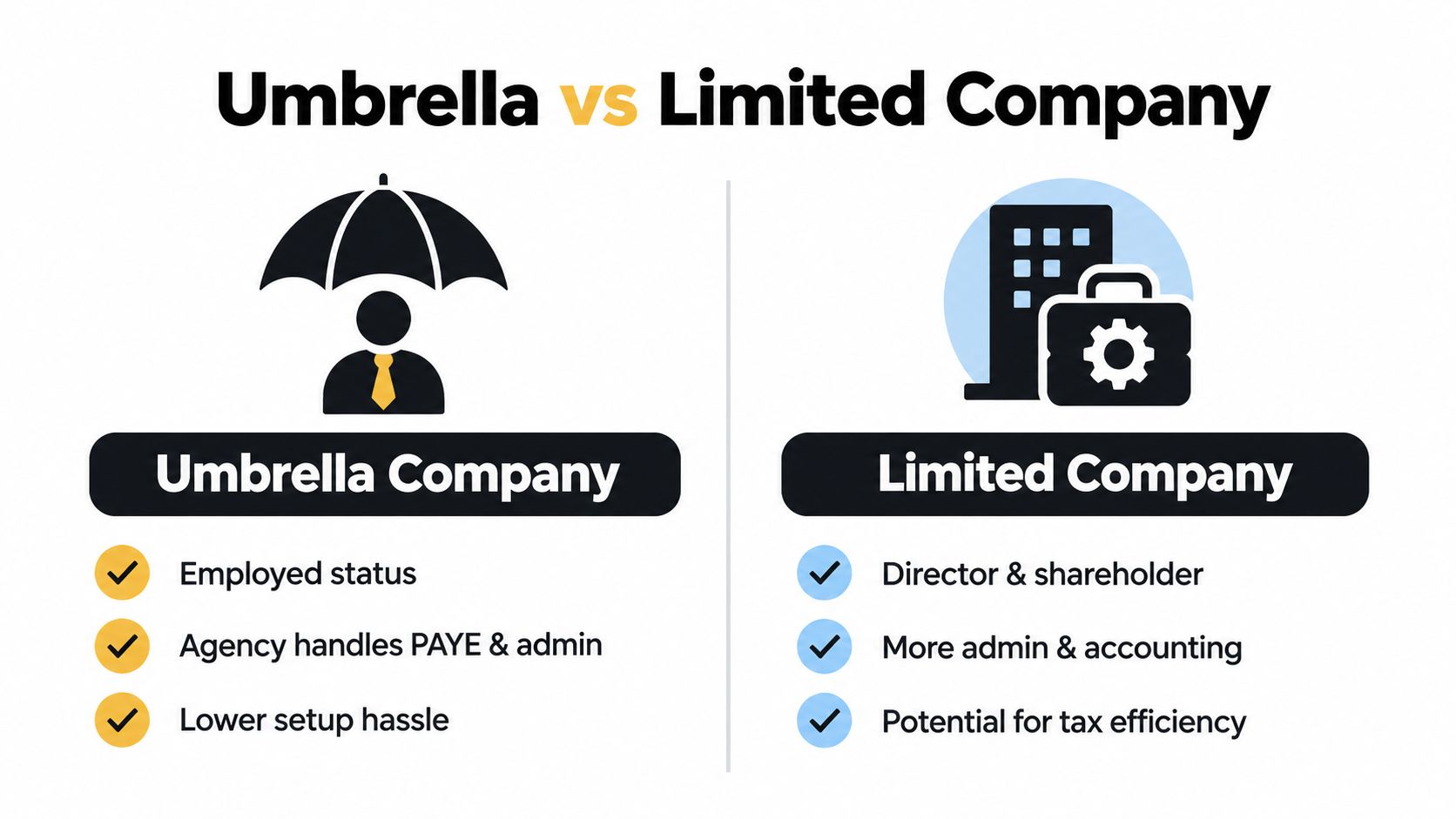
The umbrella route wins on simplicity. You become an employee of the umbrella, submit timesheets and receive a payslip showing deductions. PAYE, Income Tax and National Insurance administration sit with the employer, which makes the model attractive for short contracts, first assignments and roles inside IR35.
The limited company route wins on control when the contract is outside IR35 and likely to justify the administration. You become responsible for company records, payroll, accounts, filings and dividend decisions. You can manage legitimate business expenses and plan income extraction, but you also carry the consequences of poor records or an incorrect status assessment.
The real cost of each option
An umbrella calculation starts with the assignment rate, not the headline salary. The funds may need to cover employer National Insurance, holiday pay treatment, pension obligations, apprenticeship costs where relevant, the umbrella margin and your employee deductions. HMRC confirms that umbrella companies have employer responsibilities for PAYE Income Tax, student loan repayments, and employee and employer National Insurance contributions (HMRC PAYE rules for labour supply chains).
HMRC also states that an employer cannot lawfully deduct employer National Insurance from a worker's gross pay. The assignment rate can reflect that cost, but your payslip should show the payroll mechanics clearly rather than removing it from an unexplained "tax" line.
A limited company can produce a better result outside IR35, but never assume a fixed daily saving. Accountancy fees, insurance, pension funding, unpaid leave, downtime and compliance work all reduce the difference. The frequently quoted claim that umbrellas cost a fixed daily amount more cannot be applied reliably without calculating the whole engagement.
For a second professional perspective on the choice, Stewart Accounting's contractor advice provides a useful comparison of the two routes.
How to inspect an umbrella payslip
Check these lines before accepting payment:
- Assignment rate: Confirm whether the figure is your gross employment rate or the agency's overall cost.
- Employer costs: Look for employer National Insurance and other employer liabilities being accounted for above your gross pay.
- Gross taxable pay: Check that the amount matches the hours or days approved and the holiday pay treatment you agreed.
- Employee deductions: Expect PAYE Income Tax, employee National Insurance, pension contributions and student loan deductions where applicable.
- Umbrella margin: Confirm the agreed fee and whether it's deducted once per pay period or presented in another format.
- Net pay: Reconcile it to your tax code and the actual period worked, rather than relying on an online illustration.
Avoid retention schemes, unexplained “rebates” and promises of unusually high take-home pay. Check accreditation such as FCSA or Professional Passport, ask who legally employs you, and confirm that PAYE and National Insurance are paid to HMRC. The provider should explain every deduction in plain English before you sign.
A 2026 survey reported by Computer Weekly found that 69% of UK contractors couldn't determine whether an umbrella company was tax compliant, while 34% still chose umbrellas mainly for the highest take-home pay rather than compliance (Computer Weekly coverage of umbrella compliance concerns). Those findings reinforce the point: transparency matters more than an attractive illustration.
Practical Steps to Set Up and Get Paid Correctly
Don't sign first and organise later. A contract that names a business which doesn't yet exist can delay invoicing, confuse the agency and create avoidable amendments.
Complete the setup in the right order
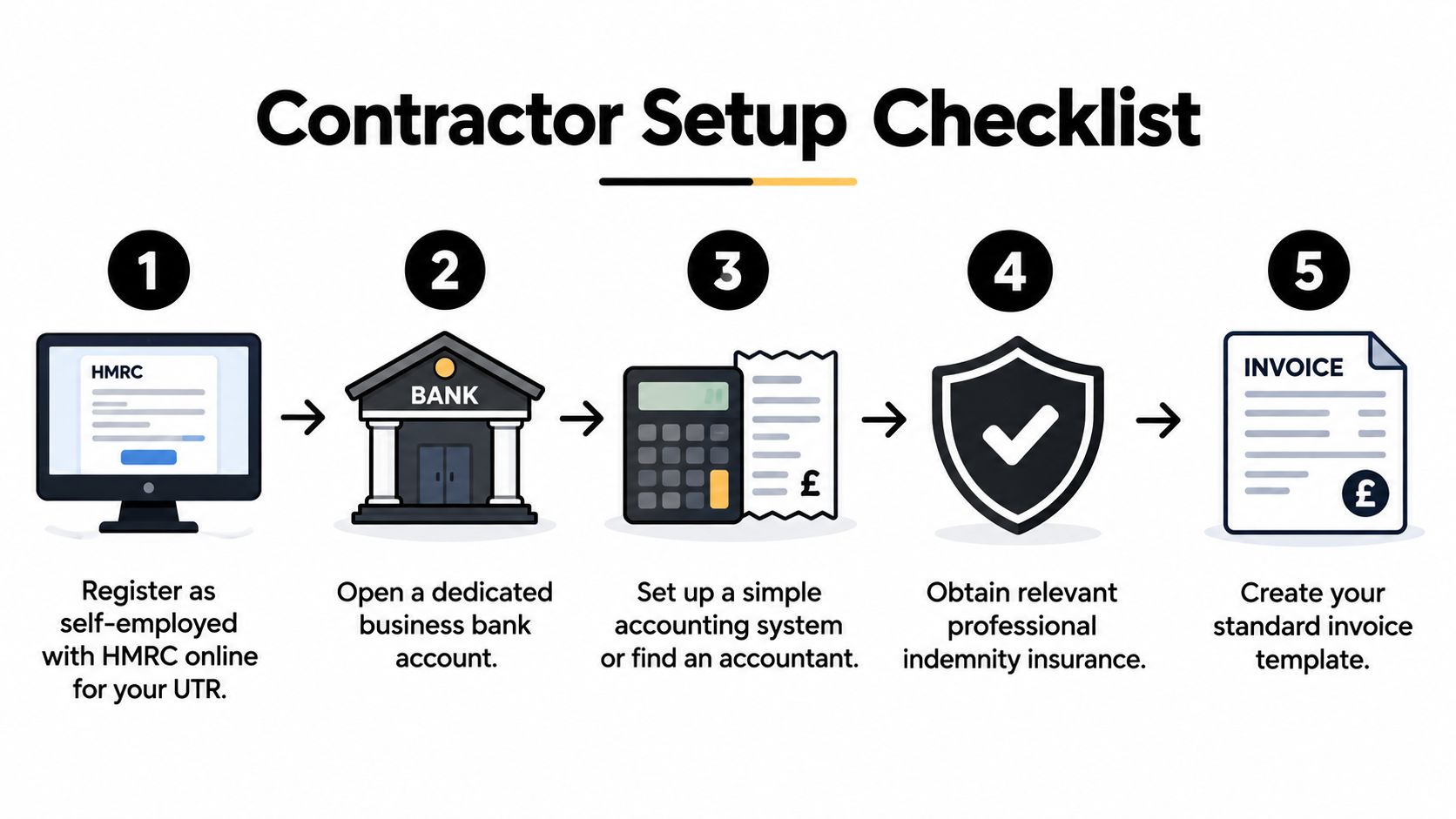
- Register with HMRC: If you're trading as a sole trader, use HMRC's online registration process for Self Assessment and obtain your Unique Taxpayer Reference. Keep the confirmation with your business records.
- Choose the operating model: Decide whether the work belongs through a sole trade, umbrella or limited company. If a company is appropriate, use our guide to opening a limited company before the contract starts.
- Open a dedicated bank account: Keep business receipts and costs separate from personal spending. This makes reconciliations, expense reviews and tax preparation much easier.
- Arrange insurance: Professional indemnity cover protects against claims about your professional service. Public liability cover may also be relevant to your sector, site access and client requirements.
- Select support: Compare a contractor accountant or umbrella provider. Check FCSA or Professional Passport status where relevant, read the fee schedule and ask for a sample payslip.
- Prepare invoicing: Include your name or company name, address, client and agency details, service description, invoice date, payment terms, bank details and VAT where you're registered. International assignments need extra care, so use specialist guidance on how to avoid currency loss on invoices.
- Track records: Keep invoices, receipts, contracts, mileage records and correspondence. Use accounting software or an organised spreadsheet that can support your tax filings and any Making Tax Digital requirements that apply to you.
Protect the first payment
Ask the agency exactly when approved timesheets become payable and whether the client or agency supplies the invoice instructions. Don't assume that submitting a timesheet means the money is on its way.
Before starting, confirm:
- The contracting entity: Your agreement should identify the correct sole trader, limited company or umbrella employer.
- The payment chain: Know who receives the invoice and who pays you.
- The status evidence: Request the IR35 determination where the rules apply.
- The expense rules: Confirm what the client, agency or umbrella will accept before spending.
- The payroll calendar: Understand cut-off dates, pay dates and holiday pay treatment.
If you work through an umbrella, ask for a calculation showing assignment rate, employer costs, gross pay, employee deductions, margin and net pay. A compliant provider won't object to a detailed question about your own payslip.
Advantages and Disadvantages of Self-Employed Contracting
Contracting rewards people who can sell scarce expertise and manage uncertainty. You may choose projects, move between industries and accelerate your experience more quickly than a conventional career path allows. You also control pension arrangements, including whether a SIPP suits your long-term planning, rather than relying solely on an employer's scheme.
The drawbacks are just as real. You fund holidays, training, insurance and pension contributions yourself. You may have no statutory redundancy protection, and a gap between assignments can create pressure even when the previous contract paid well.
Where the market is moving
Construction shows why contractors need to understand sector conditions. Parliament's Commons Library recorded self-employed jobs as 37% of all construction jobs in Q2 2019, compared with 13% across the whole economy, because project-specific work is embedded in the sector (Parliamentary briefing on self-employment).
The same briefing recorded construction self-employment falling to 744,000 in Q1 2021, before reaching 773,000 in Q4 2021. The Q4 figure remained 179,000 below Q1 2019 and 108,000 below Q1 2020, demonstrating how quickly project-based labour can react to economic shocks, skills shortages and changes in hiring conditions (Commons Library construction data briefing).
More recent sector reporting points to a market where construction demand has strengthened while demand in some other contractor sectors has weakened. A 2026 report described a 33% rise in construction demand, alongside stronger regulation and pay transparency reforms affecting umbrella working (construction contractor demand reporting).
| Sector | Demand Level | Typical Day Rate Uplift vs Permanent | Key Risk |
|---|---|---|---|
| IT | Specialist demand can be strong | Often higher for scarce expertise | Rapid skills changes and IR35 scrutiny |
| Engineering | Healthy for specialist project work | Often higher where experience is scarce | Project cycles and site requirements |
| Life sciences | Specialist demand can be strong | Often higher for regulated expertise | Compliance-heavy assignments |
| Construction | Demand has strengthened in recent reporting | Often higher for project capability | Economic shocks and project pauses |
| Post-production media | Margins can be tightening | Uplift varies by project | Irregular work and rate pressure |
| Junior marketing | Competitive contractor market | Uplift may be limited | Role substitution and price competition |
The specific “20% to 40%” day-rate uplift often quoted in contractor guides isn't supported by the verified information available here, so don't use it as a planning assumption. Price your work against total compensation, unpaid time, risk and market evidence.
An honest scorecard
| If you value… | Contracting may suit you | Think carefully if… |
|---|---|---|
| Variety | You want different clients and projects | You need a predictable routine |
| Control | You can manage records and negotiations | You dislike administration |
| Reward | You have scarce, marketable skills | Your rate has little room for downtime |
| Flexibility | You can tolerate changing assignments | You need guaranteed continuity |
| Independence | You can work without employee-style support | You rely heavily on one client |
The emotional cost matters too. Contractors can feel detached from permanent teams, and a contract gap affects both confidence and cash flow. Build a reserve, maintain relationships with recruiters and clients, and start looking for the next assignment before the current one ends.
Key Takeaways and Your Next Steps
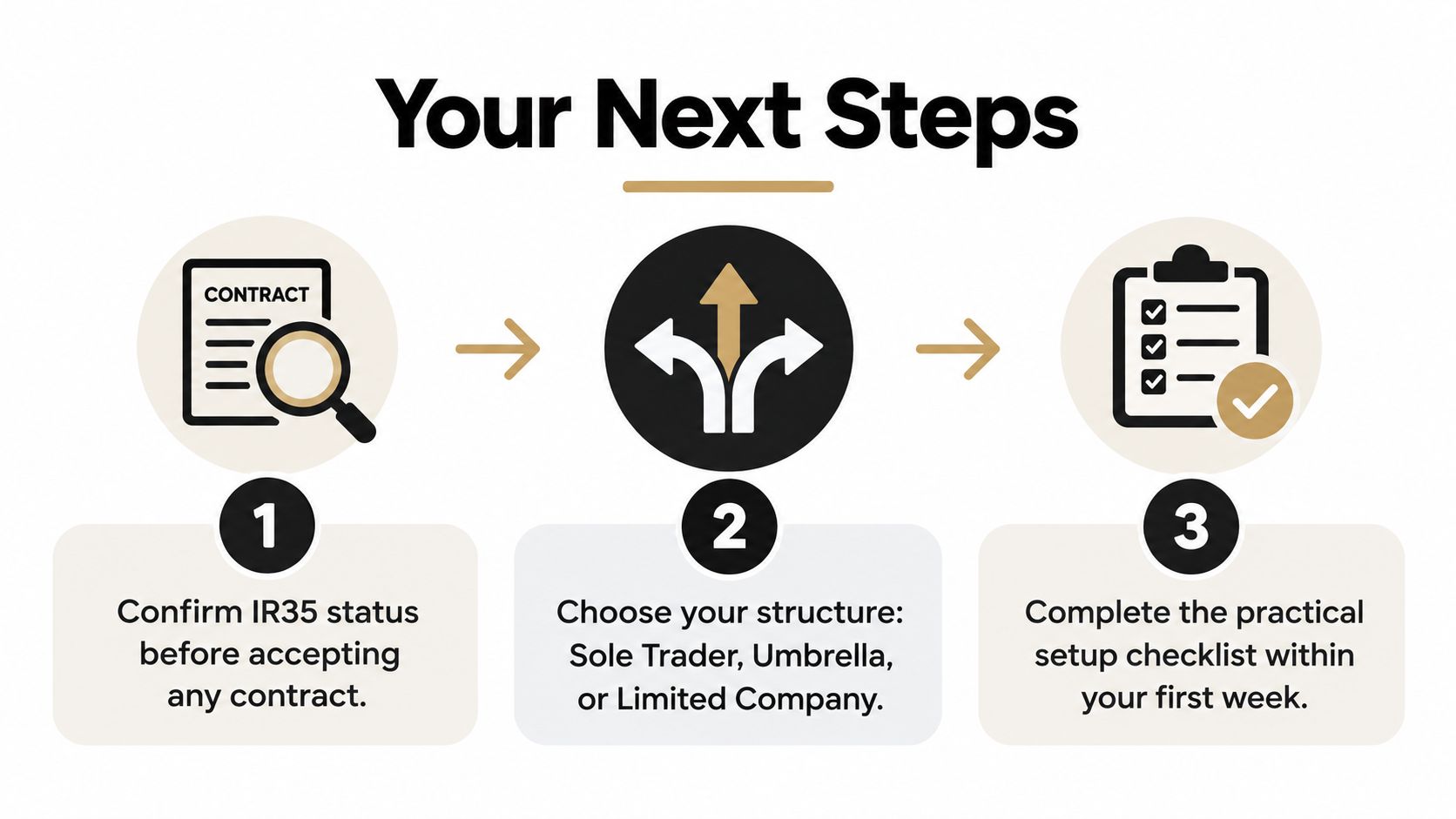
Working as a self-employed contractor is a business decision, not just a job change. Confirm the actual working relationship, establish the IR35 position, then choose the structure that matches the contract's length, risk and administration.
This week, complete the following:
- Check employment status: Use HMRC's employment status resources and compare the guidance with the proposed working practices.
- Request the determination: Ask the client or agency for the IR35 status determination statement where the off-payroll rules apply.
- Compare umbrellas properly: Obtain calculations from two compliant providers and check the margin, employer costs, PAYE deductions and sample payslip.
- Consider a company carefully: If the role is outside IR35 and likely to continue, speak to a specialist contractor accountant before incorporating.
- Finish the basics: Register with HMRC where required, open a dedicated bank account, arrange professional indemnity insurance and prepare your invoice or timesheet process.
The 2026 contractor market also demands more careful umbrella due diligence. Computer Weekly's reported survey found 69% of contractors couldn't establish whether an umbrella was tax compliant, so asking for transparent payroll evidence isn't excessive. It's the minimum sensible check.
Don't choose on gut feel or on a recruiter's optimistic illustration. Compare the actual rate, deductions, accountancy costs, pension plans, unpaid time and likely contract duration. A small difference in fees or tax treatment can materially affect the result across a full assignment, but only a complete calculation tells you which route wins for your circumstances.
Umbrella Company helps contractors compare umbrella providers and understand how PAYE, National Insurance, pensions and payroll deductions affect their assignment. If you're weighing your first contract or need a clearer route through inside-IR35 administration, visit Umbrella Company and compare your options before signing.


