


You've just received a contract offer, and the agency asks whether you'll invoice through a limited company, work as a sole trader, or join an umbrella company. The rate looks attractive, but the payment route affects your tax, administration, employment rights, and the level of compliance risk carried by everyone in the labour supply chain.
This guide explains why use an umbrella company, how PAYE works, what IR35 changes in practice, which deductions appear on your payslip, and how the April 2026 PAYE reforms change the risk for agencies and end clients. We'll also compare umbrella working with a personal service company, outline the trade-offs, and give you a practical way to assess providers.
What This Guide Will Help You Decide
The first decision isn't whether an umbrella company is popular. It's whether the arrangement fits your contract, your approach to administration, and the kind of financial certainty you want.
You'll need to understand four connected points:
- How PAYE works: An umbrella employs you and processes your pay as salary, rather than leaving you to invoice and manage your own tax.
- How IR35 affects the choice: A role assessed as inside IR35 usually offers less scope for tax planning through a personal service company, because the worker is taxed broadly like an employee.
- What the margin really costs: The umbrella's margin is a service charge, not a tax. You'll need to see it separately from employer National Insurance and other employment costs.
- Who benefits most: Short-term contractors, first-time freelancers, people moving between assignments, and contractors who value simplicity may find the model particularly practical.
The guide focuses on UK rules as they stand in 2026, including the PAYE rules for labour supply chains that include umbrella companies from 6 April 2026. Those reforms matter because responsibility doesn't sit only with the contractor or umbrella. Depending on the arrangement, recruitment agencies and end clients can carry significant liability where PAYE hasn't been operated correctly, as explained in the government guidance on umbrella-company reform.
Decision principle: Choose an umbrella because its employment and payroll structure suits your circumstances, not because an agency presents it as the only option.
You won't find a promise that umbrella working is always cheaper or better than running a company. Instead, you'll finish with a framework for judging whether the route gives you enough convenience, clarity, and protection for the contract in front of you.
How Umbrella Companies Actually Work
Suppose an agency offers you a contract and asks you to join an umbrella company. The umbrella becomes your legal employer for that assignment. You sign an employment contract, complete work for the end client, submit approved timesheets, and receive pay through PAYE, meaning Pay As You Earn.
You normally do not invoice the client yourself. The umbrella invoices the recruitment agency or end client, receives the assignment payment, works out employment costs and deductions, then runs payroll. HMRC lists Income Tax, employee National Insurance contributions, workplace pension contributions, student loan repayments where applicable, and other agreed or legally required deductions in its guidance on working through an umbrella company.
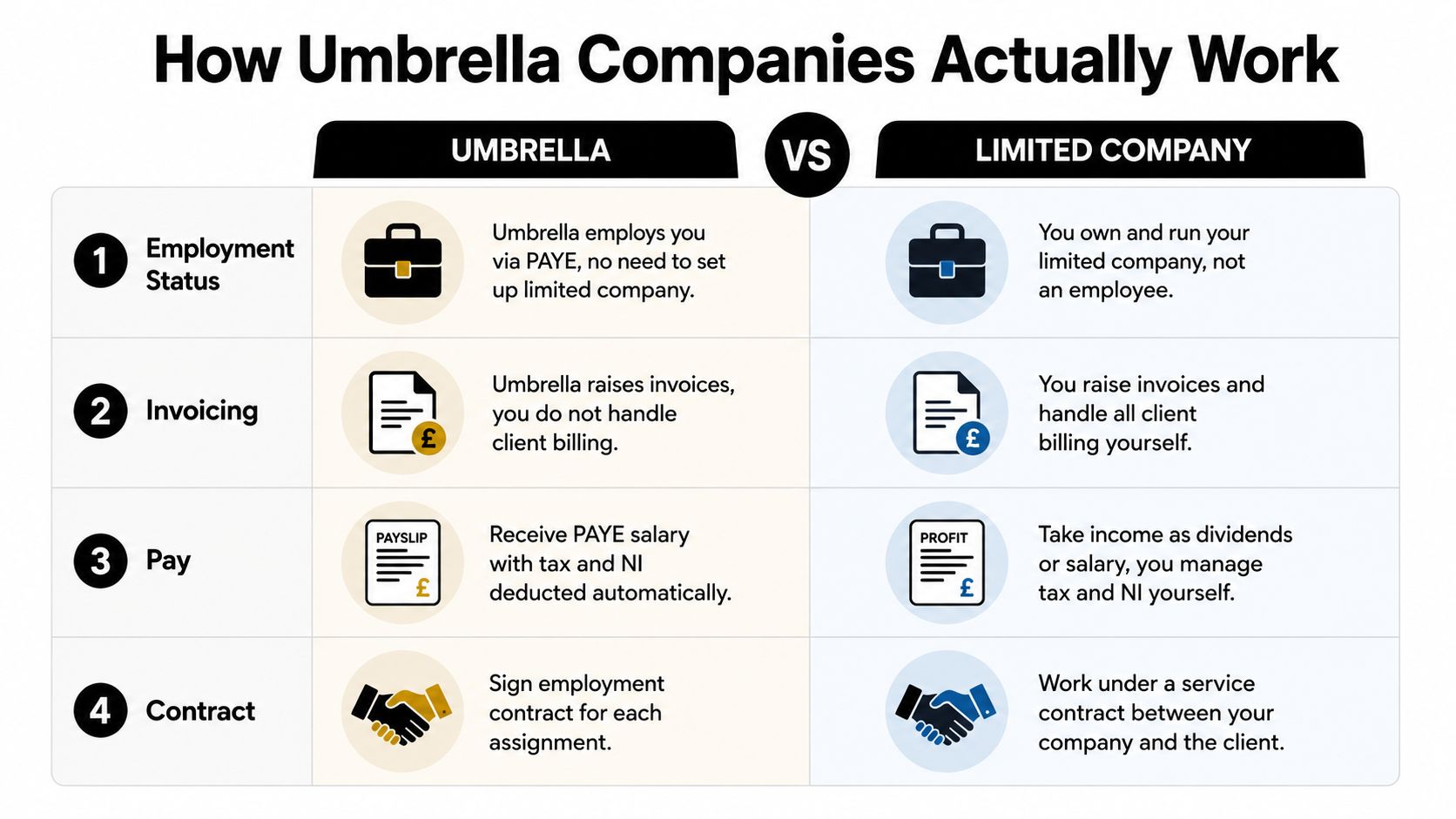
The three routes side by side
The assignment rate paid to the umbrella is not the same as your taxable salary. Before your gross pay is calculated, that rate may need to cover the umbrella's margin, employer National Insurance, employer pension contributions, holiday pay, and the Apprenticeship Levy where applicable. Your payslip then shows the deductions taken from your gross pay. This distinction matters because a quoted assignment rate can look higher than the salary that reaches your bank account.
A personal service company, often called a PSC, is your own limited company. The PSC contracts with the agency or client, raises invoices, arranges payroll, maintains accounting records, submits company filings, and handles its tax obligations. Where the engagement falls inside IR35, the company must account for tax and National Insurance in a way that broadly reflects employment taxation.
A sole trader contracts with the client personally, invoices for the work, and reports business income through Self Assessment. There is no separate limited company, but you remain responsible for business records, tax calculations, National Insurance, and compliance with the engagement terms.
| Feature | Umbrella company | PSC | Sole trader |
|---|---|---|---|
| Legal arrangement | Umbrella employs you | Your company contracts for your services | You contract personally |
| Pay process | PAYE payslip | Company payroll and dividends where appropriate | Client payment and Self Assessment |
| Invoicing | Umbrella handles it | PSC handles it | You handle it |
| Administration | Lower personal administration | Higher company administration | Personal bookkeeping and tax filing |
| IR35 | Employment PAYE route | May apply to the engagement | Separate status considerations apply |
For a visual explanation, read this guide to how umbrella companies work. It shows how the agency, umbrella, contractor, and end client fit together in the payment chain.
The umbrella route does not make you a permanent employee of the end client. You are employed by the umbrella while carrying out temporary or assignment-based work for the client, usually through an agency. From 6 April 2026, PAYE chain rules also affect where responsibility and risk sit. Depending on the arrangement, agencies and end clients may carry liability if PAYE is not operated correctly, so the umbrella's compliance affects more than your payslip.
Why IR35 Made Umbrellas the Default Route
A contractor accepts a role through a PSC, then learns the client has assessed it as inside IR35. The work still goes ahead, but the expected tax advantages of operating through a company largely disappear. An umbrella can then provide the employment and PAYE route the engagement requires.
IR35 is the common name for the off-payroll working rules. They address arrangements where a contractor works through an intermediary, usually a PSC, but the relationship would resemble employment if that intermediary were removed.
The rules began applying to public-sector engagements in 2017 and extended to the private sector in April 2021. An inside-IR35 engagement is taxed broadly like employment. HMRC says the rules aim to ensure workers pay broadly the same Income Tax and National Insurance as an employee would. Its background guidance on the reformed rules explains the purpose and scope. For a fuller walkthrough, see our guide to the off-payroll working rules.
For many contractors, the private-sector reform reduced the practical value of keeping a PSC for inside-IR35 work. A PSC may still suit a genuine outside-IR35 engagement, while an inside-IR35 role removes much of the tax advantage historically associated with incorporation. Some agencies and end clients also prefer an employment-style route because it gives them a clearer PAYE process.
An umbrella handles the situation through employment. You become an employee of the umbrella, and it processes your earnings through PAYE rather than through a PSC intermediary. HMRC's off-payroll working guidance explains that employing the worker through an umbrella takes the engagement outside the off-payroll rules.
IPSE's contractor research shows how umbrella working became established after the private-sector reforms:
| Year | Operating via PSC (%) | Working via umbrella (%) |
|---|---|---|
| 2021 | Not specified in the cited data | 34% |
| 2023 | Not specified in the cited data | 30% |
| 2024 | Not specified in the cited data | 28% |
The figures appear in IPSE's assessment of the impact of IR35 reforms. They do not show that every contractor prefers an umbrella. They show that it became a lasting route for contractors dealing with tax-status uncertainty. IPSE also reported that 69% of umbrella employees said they used an umbrella because of private-sector IR35 changes in its 2025 IR35 spotlight.
An umbrella often became the practical answer to an inside-IR35 role, even when it was not the contractor's preferred business structure.
The decision has a wider consequence from 6 April 2026. PAYE chain rules affect where responsibility and risk sit across the agency, umbrella, and end client. A compliant umbrella therefore protects more than the payslip. Contractors should also consider payment reliability, statutory rights, administration, and supply-chain transparency when choosing a role.
A Look at a Typical Pay Cycle
Consider a contractor working at a £500 daily rate for 20 days, producing an assignment value of £10,000 before deductions. That figure represents the amount shown in the supplied payment example, not a guaranteed salary or take-home amount.
The process starts with an approved timesheet. The client or agency confirms the days worked, and the umbrella invoices the relevant payer. Once the umbrella receives the funds, it builds a calculation showing how the assignment value is allocated.
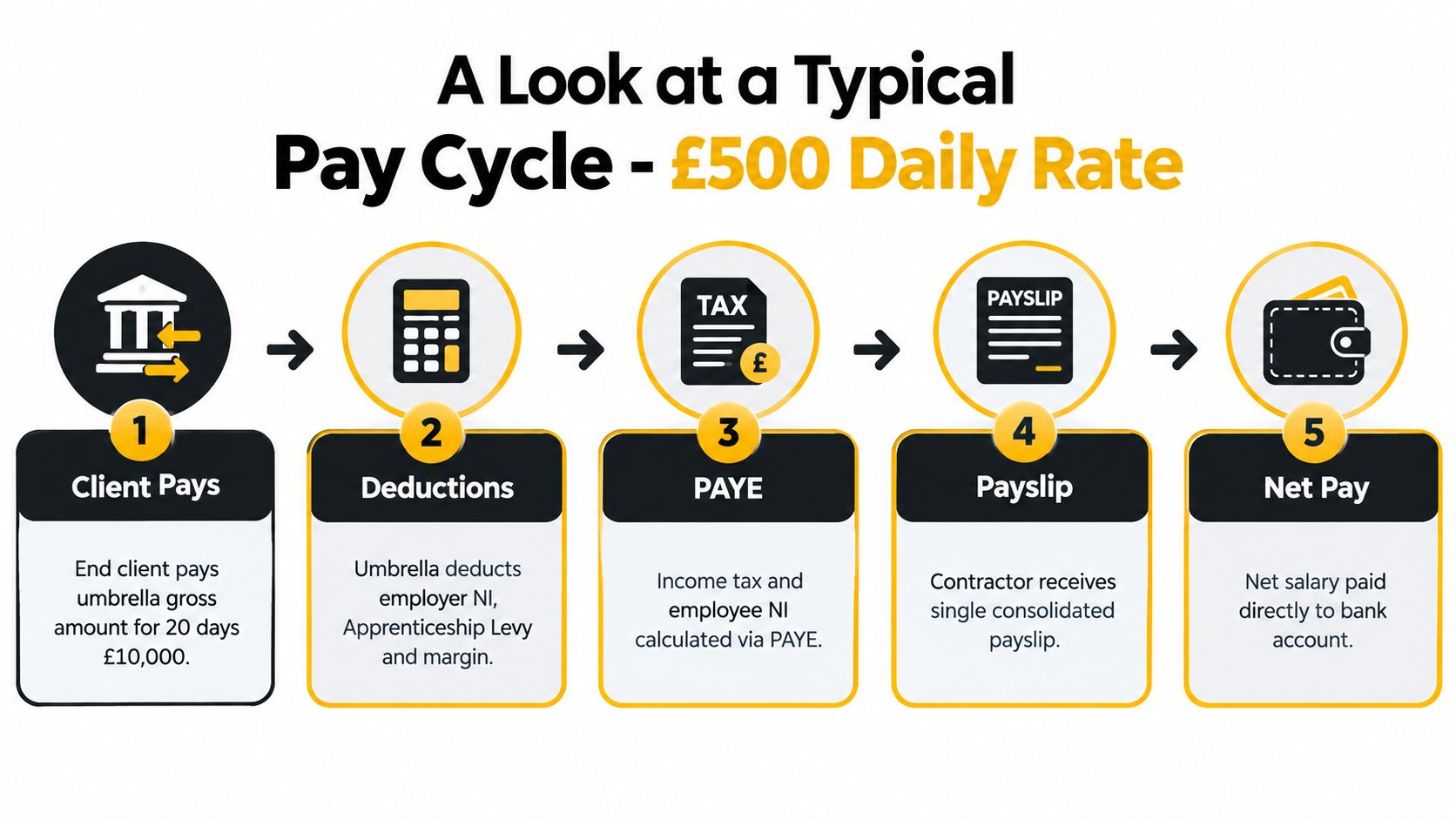
What happens to the £10,000 assignment value
The umbrella first accounts for employment-related costs that can sit within the assignment rate. These may include:
- Employer National Insurance: This is the employer contribution, separate from the employee National Insurance shown as a deduction from your pay.
- Employer pension contribution: This may apply where workplace pension rules require it.
- Apprenticeship Levy: This applies where relevant to the employer's circumstances.
- Umbrella margin: This is the provider's charge for operating the employment and payroll service.
The remaining amount is used to calculate your gross salary. PAYE then deducts Income Tax and employee National Insurance, along with workplace pension contributions, student loan repayments where applicable, and other lawful or agreed deductions. The final amount reaches your bank account as net pay.
Holiday pay needs careful attention. Depending on the arrangement, it may be accrued and paid when you take holiday, or shown as a separate paid element. Ask the umbrella to explain whether holiday pay is retained, rolled up, or paid alongside salary before you sign.
Your payslip should make the calculation traceable. It should distinguish the assignment rate, employment costs, gross pay, deductions, and net payment. Our explanation of an umbrella company payslip can help you check each line.
Weekly and monthly payroll affect when cash reaches you, although they don't remove the underlying deductions. Delays can occur if timesheets aren't approved or the agency hasn't paid the umbrella, so confirm the payment timetable in advance. Contractors working across borders or paying people in different locations may also benefit from guidance on how to manage international contractor payouts, although a UK umbrella remains a specific PAYE employment solution.
Statutory Rights and the 2026 PAYE Shift
An umbrella company doesn't only process tax. It employs you, which gives you employee-style statutory rights subject to the relevant qualifying conditions.
Those rights can include statutory minimum wage protection, holiday pay, statutory sick pay, statutory maternity and paternity pay, and workplace pension rights through automatic enrolment where the conditions are met. HMRC states that umbrella employees have the same employment rights as other employees, subject to qualifying periods.
The rights you should understand
The practical value depends on your contract and eligibility. Don't assume every benefit is paid immediately or without conditions.
- Holiday pay: Check how the provider calculates, displays, and pays accrued holiday.
- Sick pay: Statutory sick pay depends on the relevant eligibility rules and evidence requirements.
- Family leave: Maternity and paternity rights apply within the statutory framework, subject to qualifying conditions.
- Pension rights: Automatic enrolment may apply, with employee and employer contributions handled through payroll.
- Employment protection: Some protections depend on continuous employment and qualifying periods, so read the contract rather than relying on a headline benefit.
What changes from 6 April 2026
From 6 April 2026, new PAYE rules apply to labour supply chains involving umbrella companies. The recruitment agency, or the end client where there's no agency, becomes responsible for ensuring PAYE is correctly operated on payments made through the chain. The rules cover PAYE Income Tax, employee and employer National Insurance, and related payroll deductions, including student loan deductions where applicable. The government explains the structure in its guidance on PAYE rules from 6 April 2026.
This is a shift in risk allocation, not a reason to assume the contractor no longer needs to check the provider. If an umbrella underpays PAYE, responsibility can extend across the chain, including joint and several liability for unpaid PAYE and National Insurance. Agencies and end clients therefore have a stronger reason to audit providers, verify processes, and choose a counterparty that can demonstrate compliant payroll.
Practical consequence: A transparent umbrella protects more than your payslip. It supports the agency's and end client's ability to trace how the payment chain operates.
Contractors who are already inside IR35 may see the clearest structural benefit because PAYE employment matches the tax treatment they would otherwise face. Contractors outside IR35 still need to compare the employment rights and convenience against the flexibility and control of operating through a PSC.
For a closer look at holiday arrangements, review how umbrella-company holiday pay works.
Costs, Tradeoffs and Who Benefits Most
Umbrella working has a price. You're paying for payroll administration, employment, statutory processes, and the provider's role in the labour supply chain. The important question is whether the cost is clear and proportionate, not whether the headline assignment rate looks high.
HMRC confirms that an umbrella's operating costs may include its margin, employer National Insurance, employer pension contributions, holiday pay, and the Apprenticeship Levy where applicable. Those items can reduce the amount available for gross salary before employee deductions are calculated.
The supplied cost assumptions often used for comparisons include an umbrella margin of £20 to £30 per week, or around 3% to 5% of gross, employer National Insurance of roughly 13.8% above the secondary threshold, and an Apprenticeship Levy of 0.5% on qualifying pay bills over £3 million at end-client level. These figures should be treated as comparison assumptions, not universal charges. Check the current calculation and thresholds with the provider and agency.
A side-by-side decision
| Cost item | Umbrella | PSC, inside IR35 |
|---|---|---|
| Provider or company fee | Umbrella margin, commonly illustrated as £20 to £30 per week or around 3% to 5% of gross in the supplied comparison assumptions | Accountancy, payroll, filing, and company administration costs |
| Employer National Insurance | Accounted for within the assignment calculation, with the supplied comparison assumption of roughly 13.8% above the secondary threshold | Employer liability remains within the PSC calculation |
| Apprenticeship Levy | May apply where relevant, including the supplied 0.5% assumption for qualifying pay bills over £3 million | May apply where relevant to the company's circumstances |
| Income Tax | Deducted through PAYE | Deducted through payroll under the deemed employment calculation |
| Employee National Insurance | Deducted through PAYE | Deducted through payroll |
| Company administration | Low personal administration | Accounts, payroll, filings, records, and professional support |
| Employment rights | Statutory employee rights subject to qualifying conditions | Rights differ because the PSC is the intermediary rather than the client employer |
| IR35 risk | PAYE employment route removes the engagement from IR35 | Inside-IR35 rules affect the calculation |
A £60,000 inside-IR35 contract doesn't produce a single universal net-pay result. The outcome depends on the assignment rate structure, working pattern, tax code, pension choices, student loan position, holiday-pay treatment, and the provider's margin. A responsible illustration must show those variables instead of promising a fixed take-home figure.
Who usually gains most
- Short-term contractors: You can start an assignment without incorporating, setting up company banking, or arranging company accounts.
- People moving between agencies: One employment and payroll relationship can simplify repeated assignments.
- Inside-IR35 contractors: PAYE treatment is already aligned with the tax position required for the role.
- First-time freelancers: You receive a payslip and payroll record without learning company administration immediately.
- Rights-focused contractors: Holiday pay, pension access, and statutory protections may matter more than maximising tax flexibility.
A PSC may remain more suitable for a contractor with sustained outside-IR35 work who wants control over business finances and is prepared to manage administration. The right comparison is personal, and it should include time, risk, rights, and cash flow rather than tax alone.
Choosing a Compliant Umbrella and Next Steps
Start with evidence you can check before joining. A professional website or an attractive advertised take-home figure does not prove that a provider runs compliant payroll. Compare providers against the same questions, then keep the answers with your contract records.
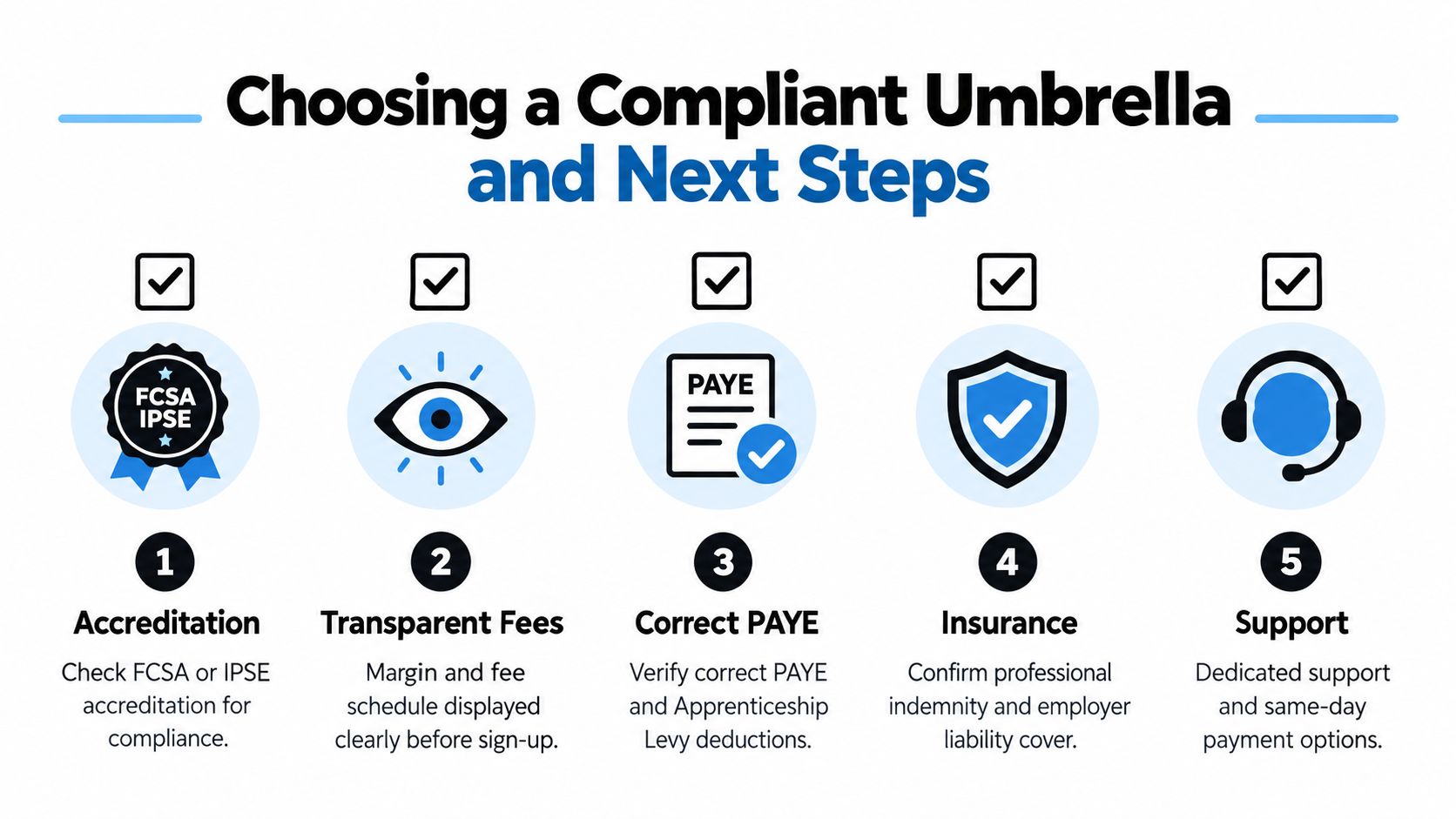
Check these points:
- Accreditation: Look for recognised accreditation, such as FCSA or Professional Passport, and verify the status independently.
- Transparent fees: Request the margin and complete fee schedule in writing before signing.
- PAYE treatment: Ask how Income Tax, employee and employer National Insurance, pension contributions, student loan deductions, and the Apprenticeship Levy are handled.
- Employment contract: Confirm that you will have a genuine employment contract, rather than a hybrid arrangement described as “self-employed umbrella” working.
- Holiday pay: Establish whether holiday pay is accrued, paid when leave is taken, or shown as a separate payment element.
- Insurance and support: Check employer liability and professional indemnity arrangements, and identify who will answer payroll questions.
Ask for a sample calculation using your actual assignment rate. It should show the payment received by the umbrella, employment costs, margin, gross salary, statutory deductions, pension treatment, holiday pay, and expected net pay. This lets you trace the rate from the agency through payroll to your payslip, rather than judging the provider by a headline figure.
Treat unusually high take-home promises as a warning. Disguised remuneration arrangements, retention bonuses, loans, and so-called Section 67 arrangements can create serious tax exposure where ordinary PAYE is not operated. HMRC's guidance on disguised remuneration tax avoidance schemes explains the risks more specifically than a provider's sales material.
The April 2026 rules give agencies and end clients stronger reasons to examine the PAYE supply chain. They do not remove your need to check the arrangement. Keep contracts, payslips, approved timesheets, and payment records. Practical freelancer PDF solutions can help keep supporting documents accessible.
Umbrella Company provides a comparison portal for contractors and freelancers assessing providers by role, pay rate, and IR35 support requirements. Compare two or three accredited umbrellas, request full cost illustrations with sample payslips, and review the choice when your contract renews or working arrangements change.
Umbrella Company helps contractors compare providers and understand the PAYE, employment-rights, and IR35 considerations behind each option. Visit Umbrella Company to compare suitable providers and request clear illustrations before your next assignment begins.


