


So, you’ve decided to go it alone. The big question now is, when do you officially need to tell HMRC you’re self-employed? This guide explains the key rules, deadlines, and responsibilities to help you get it right from the start.
The magic number to remember is £1,000. If you earn more than this from your trading activities in a single tax year, you must register. The critical deadline is the 5th of October following the end of the tax year in which you started your business.
Missing that date can lead to penalties. It’s a date that’s easy to forget but crucial to get right, so let's break down exactly what you need to do.
The Core Rules for Self-Employed Registration
Figuring out the exact moment to register can feel a bit confusing, but the rules are actually quite straightforward once you understand them.
The main trigger is the £1,000 trading allowance. If your gross income from self-employment tips over this amount in any given tax year (which runs from 6th April to 5th April), UK law requires you to let HMRC know.
This isn’t just for full-time ventures. It applies just as much to that side hustle you've started or the freelance work you're doing alongside your main job. It's important to track this extra income from day one. If you're just dipping your toes into the world of contracting, our guide on how to become a contractor has some practical first steps to get you set up.
When Registration Is Mandatory
The £1,000 threshold is the most common reason for registering, but it’s not the only one. There are a few other situations where you'll need to get on HMRC's radar.
You must register if you need to:
- Prove you’re self-employed to claim benefits like Tax-Free Childcare.
- Make voluntary Class 2 National Insurance contributions. This is a smart move to protect your State Pension entitlement and other key state benefits.
The table below breaks down these key scenarios.
Key Self-Employment Registration Triggers
| Registration Trigger | Explanation | Action Required |
|---|---|---|
| Exceeding the £1,000 Trading Allowance | Your gross income from all self-employed work in a tax year is over £1,000. | Register with HMRC by 5th October after the tax year ends. |
| Proving Self-Employment for Benefits | You need to officially prove your work status to apply for certain state benefits. | Register with HMRC to get your Unique Taxpayer Reference (UTR). |
| Making Voluntary NI Contributions | You want to pay Class 2 NICs to build up your State Pension qualifying years. | Register to ensure your contributions are recorded correctly. |
Understanding these triggers helps ensure you stay compliant and avoid any unwelcome letters from the taxman.
HMRC rules state you must register by the 5th of October after the tax year you started trading ends. This means the amount of time you have can vary depending on when you launched your business. If you want to dive deeper, you can learn more about self-employment registration requirements.
A common scenario: a freelance graphic designer starts trading in May and earns over £1,000 by September. Because their business started after 6th April (the start of the tax year), they have until 5th October of the following year to register with HMRC. Getting this right avoids any unwelcome surprises.
Confirming You Are Genuinely Self-Employed
Before starting the registration process, it's crucial to be sure that HMRC would agree you’re genuinely self-employed. The line between a freelancer and an employee can sometimes feel blurry, but it boils down to who has control, who carries the risk, and how much autonomy you have in your day-to-day work.
Essentially, it’s all about how you operate. If you set your own schedule, use your own equipment, and have the freedom to take on work from multiple clients, you're almost certainly self-employed. You are the one responsible for the profit or loss of your business, and you don't get perks like paid holidays or sick pay.
Hallmarks of Self-Employment
Let's think about a freelance graphic designer. They likely juggle several projects for different businesses, send out their own invoices, and manage their own time to meet deadlines. This is a world away from someone on a fixed-term employment contract, who probably has their hours and working location dictated by their employer.
Here are the key signs that point towards self-employment:
- You’re responsible for finding and winning your own work.
- You decide how, when, and where you do the work.
- You have the right to hire someone else to help you or do the work for you.
- You are taking on the financial risk. If a project goes wrong, you bear the cost.
This simple decision tree is a great way to visualise whether you need to register based on your earnings.
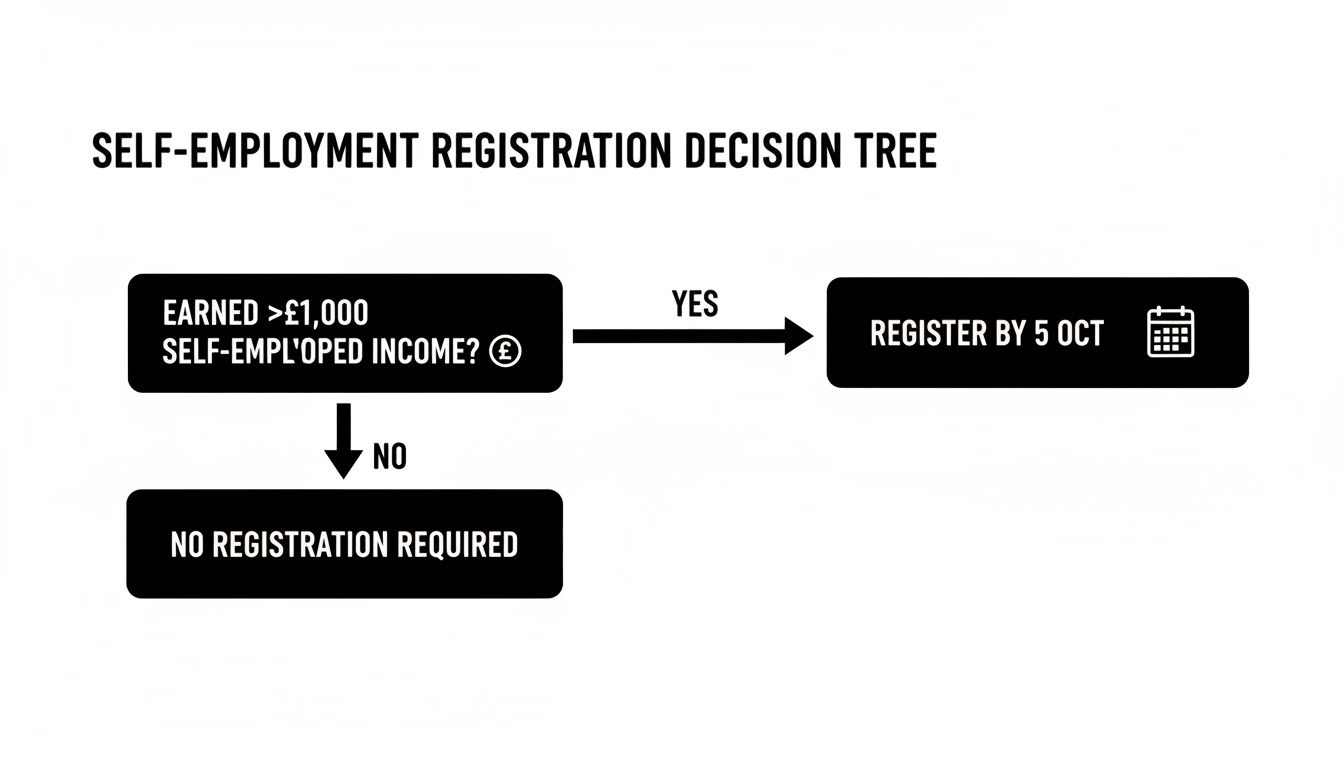
As you can see, the moment you earn more than the £1,000 trading allowance in a tax year, registration becomes a legal requirement. Remember that 5th of October deadline, too.
In certain industries, the rules are even more specific. If you’re a contractor in the construction sector, for example, you’ll likely need to register under a separate framework. We cover this in detail in our guide to the Construction Industry Scheme (CIS).
Ultimately, if you're in business for yourself and you carry the responsibility for its success, you're self-employed. Getting this right from the beginning gives you the confidence to register correctly and handle your taxes without any surprises.
How to Register with HMRC Online
So, you've established you need to register. The next step is actually doing it, and thankfully, it's handled online through the government's website. It can look a bit intimidating with official jargon, but we'll walk you through it.
First, you’ll need to set up a Government Gateway account if you don’t have one already. This is your secure login for most government services, including your Self Assessment. Think of it as your digital key to the tax world.
Getting Your Details Ready
Before you begin, it’s a smart move to have all your details handy. This makes the whole process much quicker and saves you from searching for a document halfway through.
Here’s what you’ll need:
- Your full name and date of birth
- Your UK address
- Your National Insurance number
- The date you officially started trading (your business start date)
- A simple description of what your business does (e.g., "freelance graphic designer" or "plumbing services")
Having this information ready means you can get it all done in one go.
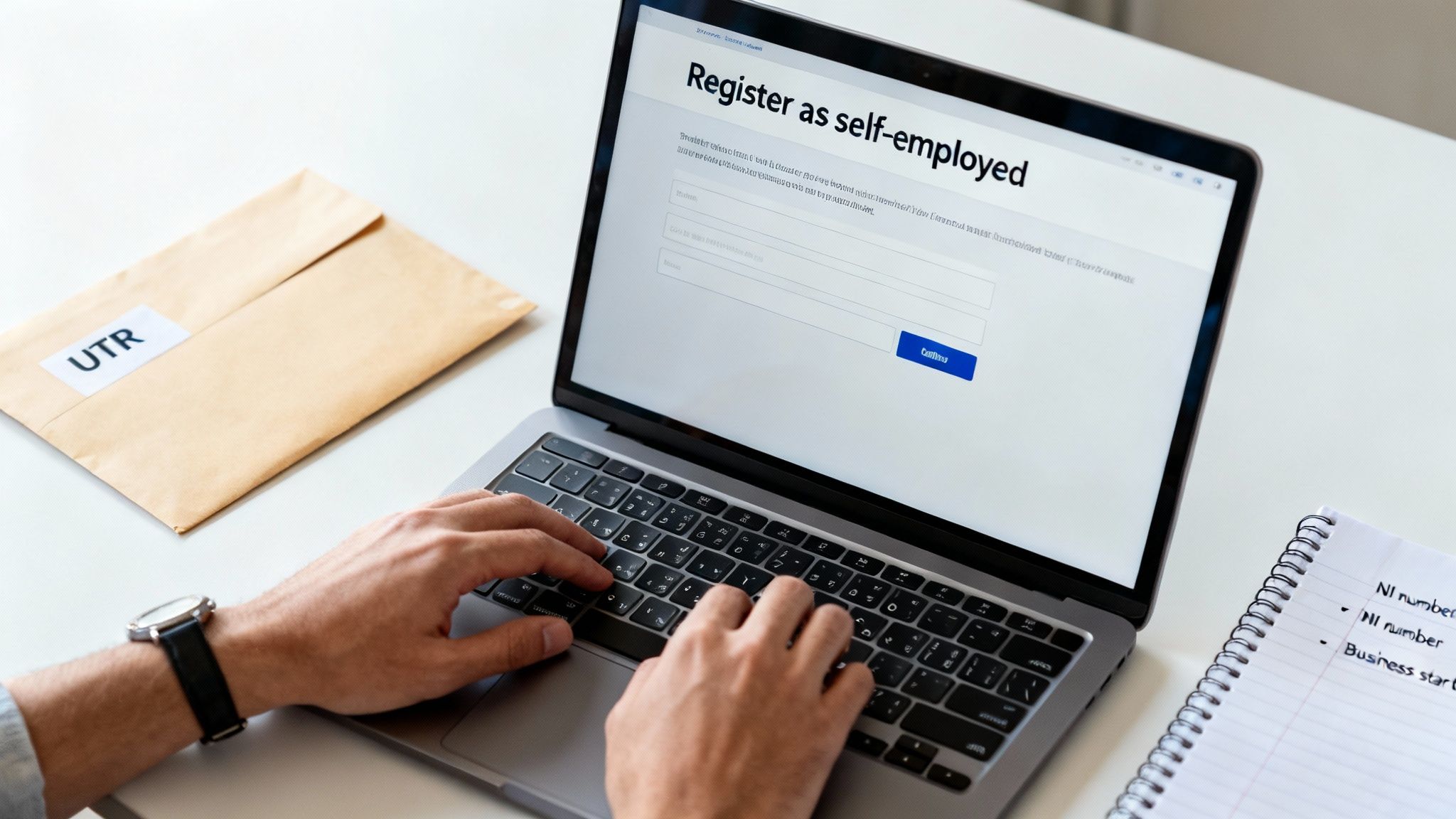
As you can see from the government's own webpage, creating that Government Gateway ID is your first port of call.
Submitting Your Application and What Happens Next
Once you’ve filled in your details on the online portal, you just need to submit the application directly to HMRC. The system guides you through it well, so just follow the prompts.
After you've submitted everything, HMRC gets to work. A common myth is that there is a fee, but it’s completely free to register as a sole trader in the UK.
Now, you play the waiting game. In about 10–15 working days, a letter from HMRC will arrive. This letter is important as it contains your 10-digit Unique Taxpayer Reference (UTR). You'll need this number to file your tax return, so keep it somewhere safe. It's your official ID in the UK tax system.
Your Responsibilities After Registering
So, you've officially registered with HMRC. That’s a massive step, but the journey doesn't stop there. Now, your focus needs to shift to managing your finances properly and staying on the right side of the taxman as a sole trader.
This boils down to keeping organised records, getting to grips with your tax obligations, and planning ahead. Nailing these good habits from day one is the secret to avoiding stress later. Think of it as laying a solid foundation for your business. It doesn’t have to be complicated, but it must be consistent.
Staying on Top of Your Finances
Your biggest responsibility is keeping meticulous records of all your business income and expenses. This isn't just about ticking a box for HMRC; it’s about having a crystal-clear view of your financial health so you don't pay a penny more in tax than you need to.
Here are the absolute essentials:
- Track all income: Keep a copy of every single invoice you send out.
- Log every expense: Record all your business-related spending, from software subscriptions to train tickets for client meetings.
- Keep finances separate: We can't stress this enough. Open a separate business bank account. It keeps everything clean and makes life much easier.
This kind of financial housekeeping is the bedrock of your annual Self Assessment tax return. This is how you declare your income to HMRC and pay any Income Tax and National Insurance you owe. Getting the deadlines wrong can be costly, so it's vital to know them.
To get you started, have a look at our detailed guide on Self Assessment deadlines in the UK.
Understanding National Insurance
As someone who's self-employed, you'll generally pay two types of National Insurance Contributions (NICs). There’s Class 2, a flat weekly rate that goes towards your State Pension entitlement, and Class 4, which is calculated based on your annual profits.
The good news is that both are calculated and paid through your Self Assessment. This is another reason why having those records in good shape makes the whole process much smoother.
It’s worth noting that the number of self-employed people in the UK can shift, which affects how busy HMRC gets. Before the pandemic, the figure was approaching five million. These trends can impact administrative processing times, so it's good to be aware of the bigger picture.
If we could give one piece of advice, it’s this: get organised from the very beginning. Using simple accounting software or even just a well-maintained spreadsheet will make a massive difference when your tax return is due. It turns a task many people dread into something far more straightforward.
When Business Growth Triggers New Obligations
As your business grows, so do your responsibilities. It’s a great problem to have, but it means you need to stay alert to key financial thresholds that trigger new compliance duties, moving you beyond the initial sole trader setup.
Two major milestones to watch for are registering for VAT and taking on your first member of staff. These are fantastic signs of success, but they come with new responsibilities you need to be ready for.
Understanding the VAT Threshold
One of the most significant steps you'll take is registering for Value Added Tax (VAT). This isn't a choice; it becomes mandatory once your VAT-taxable turnover goes over a specific limit within any rolling 12-month period. Crucially, this isn't tied to the tax year, so you have to keep a constant eye on your turnover.
The current VAT registration threshold is £85,000. As soon as your turnover tips over this amount in any 12-month window, the clock starts ticking. You have 30 days to get your VAT registration sorted with HMRC. For a deeper dive, check out our complete guide to the VAT registration threshold in the UK.
Taking on Your First Employee
Hiring staff is another exciting leap forward, but it immediately requires you to register as an employer. This means setting up a Pay As You Earn (PAYE) payroll scheme.
This obligation kicks in the moment you employ someone. Through PAYE, you become responsible for calculating and deducting Income Tax and National Insurance contributions from your employee’s wages and then paying it all to HMRC. It's a big shift from just managing your own finances.
Keeping these thresholds on your radar is essential for staying compliant as you grow. If you can anticipate when you might need to register for VAT or as an employer, you can plan ahead, avoiding last-minute panic and potential penalties. Managing these obligations smoothly is what successful growth is all about.
You can also discover more insights about these official thresholds directly from government sources.
Sidestepping the Common Pitfalls of Self-Employed Registration
Getting started on the right foot is crucial. From our experience, new sole traders often trip up on the same few things. Spotting these common pitfalls early can save you stress and, more importantly, keep you from getting an unnecessary penalty from HMRC.
The biggest mistake we see is missing the 5th of October registration deadline. This rarely happens because people are trying to avoid it. It’s usually because new business owners are so wrapped up in landing their first clients that the admin slips their mind. Before they know it, an unexpected penalty notice arrives. This is a headache that is entirely avoidable.
Getting Your Dates and Records Straight from Day One
Another classic stumble is picking the wrong start date. For example, a freelance consultant registers with the date they landed their first big contract. They forget about the weeks spent before that buying a laptop, setting up a website, and marketing their services. That small oversight means they can't claim those legitimate start-up costs as expenses.
Poor record-keeping is the other major culprit. It’s tempting to put receipts in a box and tell yourself you’ll sort it all out later. "Later" quickly becomes an overwhelming mountain of paperwork. Failing to track your income and outgoings properly doesn't just make Self Assessment a nightmare; it can mean you end up overpaying tax.
For example: a client pays you £500 for a project in March, but you don't officially register your business until the new tax year begins in April. By misaligning your start date, you've created a compliance headache trying to explain that pre-trading income to HMRC.
Here’s how to dodge these common mistakes:
- Set a calendar reminder. As soon as you think about starting to trade, put that 5th of October deadline in your calendar with multiple alerts.
- Your business start date is the very first day you did anything for your business. This could be buying a domain name or business cards, not just the day you sent your first invoice.
- Open a separate business bank account from the get-go. This is probably the single best piece of advice we can give. It keeps everything clean, tidy, and makes bookkeeping a thousand times simpler.
Got Questions About Registering as Self-Employed?
Getting started as a sole trader can bring up many questions. We’ve pulled together some of the most common ones we hear from people just like you.
Can I Be Self-Employed and Employed at the Same Time?
Yes, you absolutely can. It's incredibly common for people to run a 'side hustle' or take on freelance projects while holding down a full-time job.
Just remember, you still have to register as self-employed with HMRC if your income from that side business tops £1,000 in a tax year. You'll need to declare this extra income on a Self Assessment tax return.
What Happens if I Register Late with HMRC?
If you go past the 5th of October deadline, you could be hit with a penalty from HMRC.
The size of the penalty often depends on how late you are and whether HMRC believes you deliberately avoided registering. The best advice is to get it done as soon as you know you need to. It’s a simple way to avoid potential fines and stress.
Do I Really Need a Separate Business Bank Account?
Legally, no. You do not need a separate business bank account to register as a sole trader. However, we at UmbrellaCompany.com can't recommend it enough.
Keeping your business and personal finances separate from day one is one of the smartest things you can do. It makes bookkeeping a breeze and will save you a world of pain when it’s time to fill out your tax return.
Navigating the world of contracting can feel a bit much at times, but you don't have to go it alone. At UmbrellaCompany.com, we help you compare trusted, compliant umbrella companies to find the perfect fit for your needs. Get your tailored comparison today.


