


Finishing one contract and lining up the next should feel straightforward. In reality, this is often the moment contractors start asking, when do i receive my p45, who sends it, and whether a delay will affect the next payslip.
If you work through an umbrella company, the answer is slightly different from a standard permanent job. Your P45 is tied to the employer running your payroll, not the client where you carried out the work. That distinction matters, especially when you move between assignments, switch umbrella providers, or leave mid-pay cycle.
A late P45 is frustrating, but it is usually fixable. What matters most is knowing what should happen, what timeline is reasonable, and what to do if the document does not arrive.
Your P45 An Important Document for Your Contracting Career
You have handed in your notice, wrapped up your assignment, and you are ready for the next role. Then the admin questions start. Final payslip, holiday pay, tax code, and the big one, where is my P45?
Your P45 is not just payroll paperwork. It is the record that shows how much you have earned and how much tax has already been deducted in the current tax year. Your next employer, or your next umbrella company, uses that information to put you on the right tax setup from the start.
Without it, payroll can still proceed, but there is more room for error. That is why contractors often feel nervous if the document does not arrive quickly.
If you have ever had to compare terms between assignments, you will know that leaving arrangements matter just as much as onboarding. Even though it is written for a different market, this guide to understanding employment contracts is a useful reminder to check what your contract says about notice, final pay, and employer responsibilities.
A good starting point is understanding how tax is processed while you are employed. If you want a quick refresher, this guide on PAYE explains the system your P45 sits within.
Tip: If you are close to your leaving date, ask payroll when your final pay will be processed. That usually tells you more about your P45 timing than the date you stopped working.
What Is a P45 and What Information Does It Contain
A P45 is your payroll record for the rest of the tax year. It tells your next employer, or your next umbrella company, what you have already earned and how much tax has already been taken, so they can continue from the right point instead of starting from scratch.
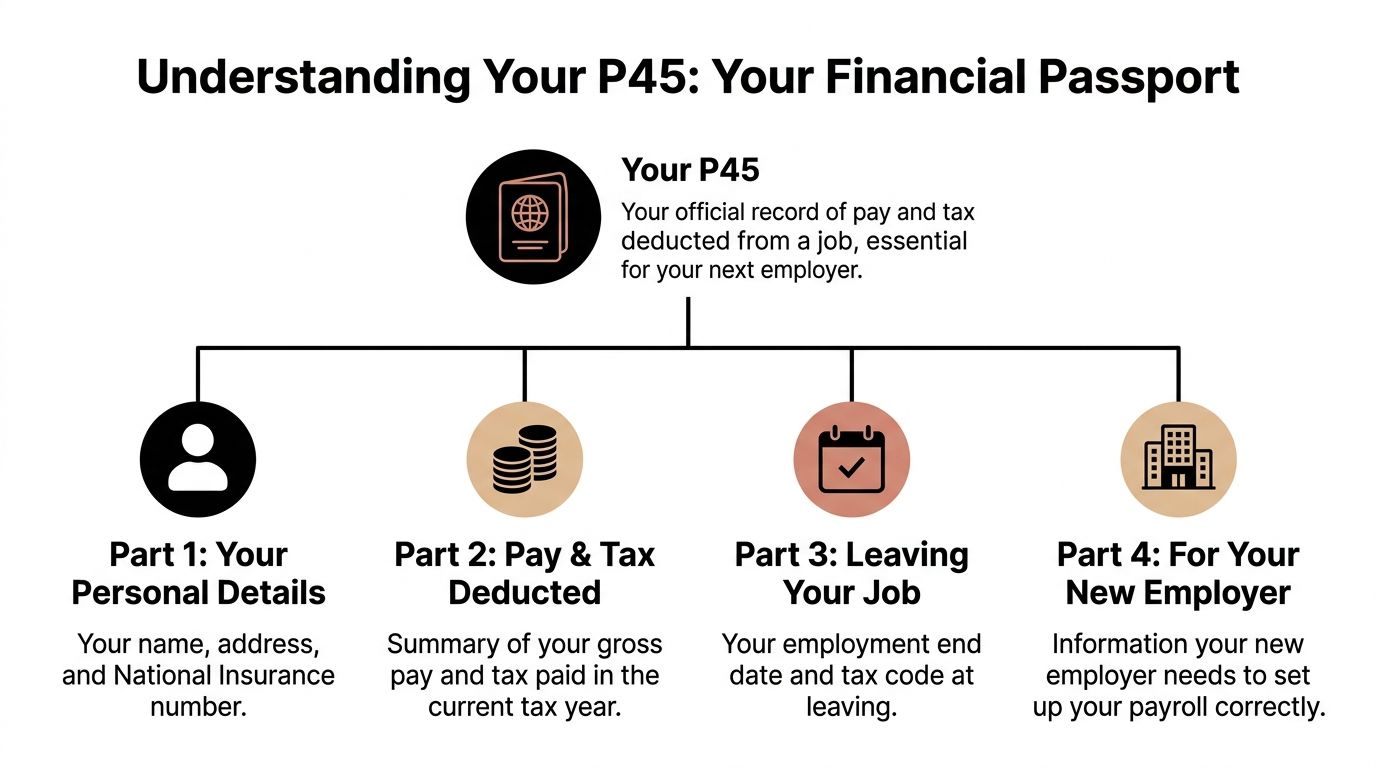
For a permanent employee, that usually means one employer hands over the figures and the next employer picks them up. For contractors, there is often an extra layer. You may be leaving one umbrella company rather than leaving one assignment, and that distinction matters because each umbrella runs its own payroll and issues its own P45 when your employment with them ends.
The four parts in simple terms
The traditional P45 format has four parts, and the labels are still useful even if you receive the document digitally:
- Part 1 goes to HMRC through payroll reporting.
- Part 1A is your copy. Keep it for your records.
- Part 2 goes to your new employer.
- Part 3 also supports your new employer in setting up payroll correctly.
If your umbrella sends a digital P45, the layout may look different, but it performs the same function.
What you will see on the form
A P45 normally shows:
- Your name, address, and National Insurance number
- Your leaving date
- Your tax code at the point you left
- Your total pay so far in the current tax year
- Your total tax paid so far in the current tax year
Those year-to-date figures are the part that matters most. They work like a running total on a meter. Your next payroll team uses them to avoid taxing you as if your earnings for the year have suddenly reset to zero.
For umbrella contractors, this can be where confusion starts. If you finish one assignment on Friday but stay employed by the same umbrella and move to a new client on Monday, you would not usually expect a P45 because your employment with the umbrella has not ended. If you leave that umbrella and join a different one, you should expect a P45 from the old provider because one PAYE employment has ended and another one is about to begin.
Why contractors should check it carefully
A small error can follow you into the next pay run, especially if you move between umbrella companies quickly or switch from a weekly payroll umbrella to a monthly one.
Check the P45 against your final payslip. Focus on your name, National Insurance number, leaving date, tax code, pay to date, and tax to date. If you want help matching those figures line by line, this guide on how to read a payslip in the UK will make the comparison much easier.
Keep Part 1A safe. If your next umbrella questions your tax position, or your first payslip looks wrong, that copy gives you a clear record of what the previous payroll reported.
When You Should Receive Your P45 Timelines Explained
You hand in your notice to one umbrella on Thursday, finish your last timesheet on Friday, and start with a new umbrella the following week. Then the obvious question hits. When should the P45 arrive?
The short answer is: after your final pay has been processed, and without unnecessary delay. HMRC explains the basic rule on its P45 guidance page, but the timing often depends on the payroll cycle your employer uses.

For a permanent employee paid monthly, the pattern is usually simple. They leave, payroll runs, and the P45 is produced around that final pay date or shortly after.
Contractors working through umbrella companies often see a messier version of the same process. The reason is practical, not mysterious. Umbrella payroll has to catch your final taxable pay, any holiday pay due, and the last set of deductions before the record can be closed properly.
The date you stop working is not always the date your P45 is issued
Your last working day matters, but your final payroll date usually matters more.
A good way to picture it is a checkout receipt. The shop cannot print the final receipt until every item has been scanned. In payroll terms, that means your employer usually needs your final pay run completed before issuing the P45.
So if you finish an assignment on Friday but your umbrella processes payroll the following Wednesday, receiving the P45 after Wednesday can still be normal.
It starts to look less normal when your final payslip has already been issued and nobody can tell you when the P45 will follow.
Typical timelines for umbrella contractors
The timing often depends on whether your umbrella pays weekly or monthly.
| Umbrella payroll pattern | What you should usually expect |
|---|---|
| Weekly payroll | Your P45 often follows after the final weekly pay run has been processed |
| Monthly payroll | You may wait until the month-end payroll closes, even if you stopped working earlier in the month |
| Leaving one umbrella and joining another | The old umbrella should issue a P45 after final pay is completed and your employment record is closed |
| Finishing one assignment but staying with the same umbrella | A P45 may not be issued because your employment with that umbrella may still be active |
That last row catches many contractors out. A contract ending and an employment ending are not always the same thing.
Why switching umbrella companies can slow things down
Switching between umbrella providers is different from moving between clients under the same provider.
With a permanent job, there is usually one employer, one leaving date, and one final payroll handover. With umbrella contracting, you may finish one assignment, wait for approved timesheets or accrued holiday to be added, and then have the old umbrella close your record while the new umbrella opens a fresh one. If one side works weekly and the other works monthly, the handover can feel out of sync even when both are following their normal process.
That timing gap is often why contractors end up on a temporary tax code at the new umbrella. If you want to understand that risk, read our guide to emergency tax codes and why they appear between payroll moves.
Signs the delay needs chasing
A short wait is common. Silence is the problem.
Contact payroll directly if:
- your final pay has been made and no P45 arrives soon after
- the umbrella says the agency or client is responsible
- you are moving to a new umbrella and need your year-to-date figures urgently
- different teams keep giving you different leaving dates
The practical rule is simple. Once final pay has been processed, ask for a clear date for the P45, not a vague promise that it is "being sorted."
The P45 Process for Umbrella Company Contractors
You finish on Friday, submit your last timesheet, and expect the usual leaving paperwork to follow. With an umbrella company, the process is a little less direct than it is in a permanent job, because your assignment can end before your employment with the umbrella ends.

The key point is simple. Your umbrella company is usually the employer that issues the P45. The agency finds the contract, and the client receives the work, but the umbrella runs payroll and closes your employment record.
Your assignment end date and leaving date may not match
This catches contractors more than permanent employees.
In a standard job, leaving the role usually means leaving the employer. Under an umbrella, those two dates can split apart. You might finish one client assignment, but stay employed by the same umbrella because another role could start soon, or because final items still need to go through payroll, such as approved timesheets or holiday pay.
A good way to view it is as two separate doors. One door is the client assignment ending. The other is your umbrella employment ending. Your P45 is linked to the second door, not the first.
You will usually receive a P45 only when the umbrella closes your employment, which often happens after:
- your final timesheet has been approved
- any remaining holiday pay has been added or paid out
- the last payroll run has been completed
- you have confirmed you are leaving that umbrella, not just finishing one contract
Weekly and monthly umbrella payrolls can produce different timings
Payroll frequency matters more for umbrella contractors than many people expect.
If your umbrella pays weekly, final pay and the P45 often follow quite quickly once everything is approved. If your umbrella pays monthly, there can be a longer wait because your leaving details may need to sit until the next scheduled payroll run. Two contractors can stop working on the same day and still receive their P45s at different times because one umbrella processes payroll every week and the other only once a month.
That is why contractors often feel the process is inconsistent when it is really tied to payroll cycles. The form normally follows final payroll, not your last day on site.
Switching umbrella companies is different from switching jobs
The contractor experience differs from permanent employment.
If you move from Umbrella A to Umbrella B, you are not just changing assignments. You are ending one employment and starting another. The old umbrella should finalise your pay, report your leaving details through payroll, and then issue your P45. The new umbrella starts a fresh employment record and uses the P45 details, if available, to place you on the right tax setup from the start.
If the old umbrella works weekly and the new one works monthly, or the other way round, the handover can feel uneven. One provider may close your record quickly while the other is still working to a different onboarding or payroll timetable. That does not always mean anyone has made a mistake, but it does mean you need clear dates from both sides.
If you want a clearer picture of why the umbrella, rather than the agency or client, handles PAYE paperwork, this guide on how an umbrella company works explains the employer relationship in plain English.
What a smooth umbrella P45 process looks like
A straightforward handover usually looks like this:
- You confirm you are leaving the umbrella company.
- Your final timesheet and any outstanding pay items are approved.
- The umbrella includes those amounts in your final payroll.
- After that payroll is processed, the umbrella issues your P45.
- You pass the details to your new employer, or keep the document for your records if you are not starting straight away.
One practical tip helps a lot here. Ask payroll for two dates, not one. Ask when your final pay will be processed, and ask when the P45 will be issued after that. For umbrella contractors, those are often different dates, and knowing both makes the move to your next provider much less stressful.
What to Do If You Do Not Receive Your P45
You finish one contract on Friday, expect your paperwork early the next week, and nothing arrives. That is unsettling, especially if your next umbrella company is already asking for your tax details. The good news is that a missing P45 usually points to a payroll timing issue, not a disaster.

For umbrella contractors, the hold-up often happens because your final payroll has not fully closed yet. A weekly umbrella may need the last approved timesheet and any holiday pay adjustment before it can issue the form. A monthly umbrella may wait until its month-end payroll run is complete. If you are switching umbrella providers rather than changing assignment, that timing gap can feel confusing because one employer is closing your record while the new one is trying to open another.
Start with the employer that paid you
The right contact depends on who employed you.
- Umbrella company payroll, if you were paid through an umbrella
- Former employer payroll or HR, if you were employed directly
Your agency or end client usually cannot issue the P45 because they were not running your PAYE record. For contractors, that distinction matters. The company that put you on payroll is the one that can confirm whether your leaving date and final pay have been processed correctly.
Check two dates before you chase
Before sending emails, look at your last payslip and ask yourself two simple questions:
- Has my final payment been processed?
- Was my leaving date recorded after that payroll run, or before it?
That sounds small, but it is often the whole story.
A P45 is usually created after final pay is run. If your umbrella pays weekly, a missing approved timesheet can push that final run back by a week. If it pays monthly, you may be waiting until the normal month-end cycle even if you stopped working earlier. Permanent employees often leave on a cleaner payroll timetable. Contractors switching umbrellas tend to hit more timing mismatches because assignments, timesheets, accrued holiday pay, and provider onboarding do not always line up neatly.
A practical follow-up plan
Use a simple sequence.
Check your final payslip
If you do not yet have it, your P45 may still be pending behind payroll processing.Email payroll directly
Ask whether your final payment has been run, whether your leaving date is on the system, and when the P45 will be issued.Give enough detail to find your record quickly
Include your full name, employee number if you know it, leaving date, and final payment date if available.Ask a clear umbrella-specific question if you are a contractor
Ask whether any unapproved timesheet, holiday pay balance, or deduction is holding up the final payroll.Escalate if you get a vague reply
Ask for the payroll manager or compliance contact and request a firm issue date.
A short message usually works best.
Email template
Subject: Request for P45 following end of employment
Hello,
I finished my employment on [date] and my final pay was processed on [date, if known]. Please confirm whether my P45 has been issued and, if not, when I should expect to receive it.
My details are:
Full name: [name]
Employee number: [if known]
National Insurance number: [if you are comfortable including it securely]Please send the P45 to [email or postal address].
Kind regards,
[Your name]
If you want a quick visual summary of the process, this short video gives a useful overview of how P45 questions are commonly handled:
If you are switching umbrella companies
This is the point many generic guides miss.
If your old umbrella pays weekly and your new umbrella pays monthly, or the other way round, the paperwork can overlap awkwardly. Your old provider may still be waiting for final figures while the new provider wants your starter details straight away. That does not always mean the old umbrella has done anything wrong. It often means the two employers are working to different payroll calendars.
In that situation, ask the old umbrella for written confirmation of:
- your leaving date
- the date of your final payroll
- the expected P45 issue date
That gives your new umbrella something concrete to work with and helps avoid guesswork.
When to involve HMRC
If your former employer stays silent, keeps giving unclear answers, or appears not to have processed your leaving details properly, contact HMRC for guidance. HMRC will not usually issue you a fresh P45 like a replacement certificate, but it can help clarify your tax record and explain what your new employer needs to do if the form is delayed.
Keep copies of:
- Your resignation or leaving confirmation
- Your final payslip
- Any emails chasing the P45
- Any message confirming your final payroll date
- Your starter paperwork for the new role
Treat that paperwork like a handover file. It helps prove where the delay happened and makes it easier to sort out your pay if your next employer has to start without the P45.
Starting a New Role Without a P45
You can still start the new role if your P45 has not arrived.
For a contractor, that matters because gaps between assignments are often short, and a new umbrella company will usually want your starter details straight away so it can place you on payroll for the next run. A permanent employee might change jobs once in a while and wait a little longer for admin to catch up. Contractors often switch faster, and that speed is where confusion starts.
Your new employer can use a Starter Checklist instead of waiting for the P45. That gets you paid, but it is a fallback, not the cleanest handover. A P45 gives payroll your year to date pay and tax figures from the old employment. Without it, the new payroll team has to begin with the information you provide and whatever HMRC updates reach them later.
For umbrella contractors, the timing can feel especially awkward. If you leave a weekly umbrella on Friday and join a monthly umbrella on Monday, your new provider may need to process you before the old one has finished its final payroll. Nothing unusual has happened there. It is just two employers working on different timetables.
What this means for your first payslip
If your new employer does not yet have the P45, payroll may use a temporary tax basis. In plain English, that means your pay is taxed using the details available at that moment, without the full picture from your earlier pay in the tax year.
That can lead to deductions that look higher than expected, especially if:
- you have already earned income elsewhere in the tax year
- your old umbrella has not yet reported the final figures
- your new umbrella has had to rely only on your starter form
This is usually a timing problem, not a permanent loss of money.
How it usually gets corrected
Once the right tax details reach the new employer, payroll can adjust later payslips. Sometimes the correction happens automatically through payroll. In other cases, HMRC updates the record later and the position is sorted out after that.
The practical steps are simple:
- Complete the Starter Checklist carefully
- Tell the new payroll team your P45 is still pending
- Keep your final payslip from the old umbrella or employer
- Check the first payslip from the new role, especially the tax code used
If something looks off, ask payroll one clear question: which tax code and tax basis did you use for my first payment? That usually gets you a faster answer than saying the deductions just seem wrong.
One more point for contractors switching between umbrella providers. A P45 is linked to the end of employment with the old umbrella, not the end of the assignment itself. If the assignment continues but your employer changes from one umbrella to another, the payroll record still has to be closed and restarted. That is why a clean leaving process matters. A simple employee termination checklist can help you keep the handover documents in order while the new payroll setup catches up.
Your P45 Key Takeaways and Next Steps
Handing in your notice as a contractor often feels simple until payroll changes hands. Then the key question starts. Who is ending your employment, and when will that payroll record close?
Your P45 matters because it follows the end of employment with your employer. For many contractors, that means the umbrella company, not the client and not the agency. If you leave one assignment but stay employed by the same umbrella, the process may look different from a permanent job. If you switch from one umbrella provider to another, even for the same assignment, the first umbrella normally needs to close your employment record so the new one can start cleanly.
Keep these points in mind:
- Your P45 is tied to the employer that paid you, which is usually your umbrella company
- Timing depends on the final payroll run, so weekly umbrella payroll can produce it sooner than a monthly cycle
- Switching umbrella companies is different from changing contracts, because one employment record ends and another begins
- You can still start a new role before the P45 arrives, if the new payroll team uses your Starter Checklist first
- Your final payslip and P45 Part 1A are the records to keep, in case tax or pay needs correcting later
- A delay is usually fixable, especially if you spot it early and ask payroll after your final payment has been processed
A clean handover helps more than many contractors expect. It reduces the chance of the new umbrella using temporary tax details for longer than needed, and it gives you a clear paper trail if your first payslip under the new provider does not look right. A simple employee termination checklist can help you keep the practical steps in one place.
The smoother your exit, the smoother your next payroll setup tends to be. This is especially important in contracting, where one umbrella can stop paying you on a Friday and another can start the next week.
If you are comparing providers for your next assignment, Umbrella Company helps contractors review trusted umbrella companies, compare options that fit their role, and choose a compliant provider with confidence.


