


A P45 is the official form your employer gives you when you stop working for them. Think of it as your financial passport for the UK tax year. This guide explains what a P45 is, why it's essential for contractors, and how it helps ensure you are taxed correctly from day one of a new assignment.
Understanding Your P45 and Why It Matters

Whenever you finish a contract or leave any job in the UK, your previous employer is legally required to provide you with a P45. This document is a vital part of the Pay As You Earn (PAYE) system, which HMRC uses to collect Income Tax and National Insurance from employees.
For contractors moving between projects, understanding your P45 is essential for keeping your finances running smoothly.
The form’s main purpose is to pass your tax details seamlessly from one employer to the next. Without it, your new employer will likely place you on an emergency tax code. This nearly always means you will overpay tax until HMRC updates your records, a frustrating and avoidable situation.
What Information Is on a P45?
Your P45 gives your new employer all the information they need to add you to their payroll system correctly. Each detail plays a specific role in ensuring accurate tax deductions.
Here is what you will find on the form:
- Your personal details, including your National Insurance number.
- Your previous employer’s PAYE reference number.
- The final tax code used by your previous employer.
- Your total earnings and the total tax paid with them during that tax year.
The form is split into several parts. The UK tax year runs from 6 April to 5 April, and your P45 summarises your pay and tax information within that period. Part 1 is sent to HMRC, Part 1A is for you to keep, and you give Parts 2 and 3 to your new employer.
At UmbrellaCompany.com, we aim to make this process as simple as possible for you. This guide will walk you through exactly what your P45 does, what each part means, and how to use it properly as a contractor.
Your P45 Form at a Glance
| Aspect | Description for Contractors |
|---|---|
| What It Is | An official HMRC form summarising your pay and tax from a previous job within the current tax year. |
| Who Provides It | Your previous employer (or umbrella company) is legally obliged to give it to you when you leave. |
| Why It's Important | It ensures your new employer uses the correct tax code, preventing overpayment through emergency tax. |
| What To Do With It | Keep Part 1A for your records and give Parts 2 and 3 to your new employer or umbrella company. |
Essentially, your P45 is the key to a smooth and accurate transition between contracts, making sure you pay the right amount of tax from your very first payslip.
Decoding the Different Parts of Your P45
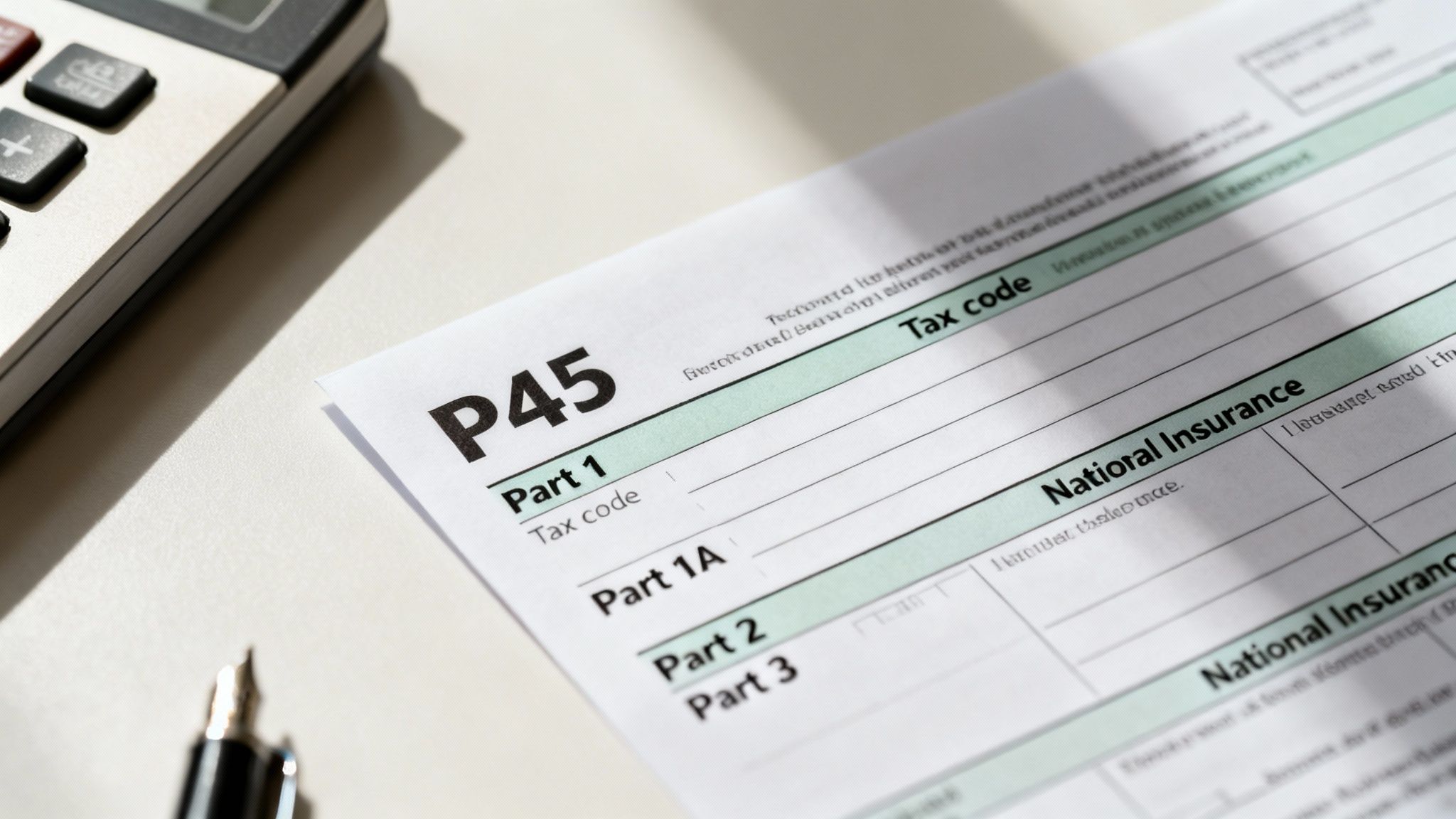
A P45 might look like just another piece of administrative paperwork, but it is a cleverly designed document. Each part has a specific purpose and destination, and understanding its structure is key to seeing how your tax information follows you between jobs.
The form is divided into four sections. This system keeps you, your old employer, your new employer, and HMRC aligned. Think of it as a relay race for your financial data.
Part 1 and Part 1A: The Official Record and Your Copy
The first two parts of the P45 handle the official record-keeping and provide you with a copy for your files. They establish the foundation for the entire information transfer.
- Part 1 is sent directly to HMRC by your old employer. This part officially updates your tax record, confirming your leaving date and final pay and tax figures. Most modern payroll software handles this automatically.
- Part 1A is for you to keep. This is your personal copy and a crucial record of your earnings and the tax you have paid during that employment. It is important not to give this part to a new employer.
Your Part 1A is an important document for your personal financial records. Keep it in a safe place, as you may need it for completing a Self Assessment tax return or to simply verify your income history for the year.
This separation ensures HMRC has the definitive details, while you have an identical copy for your records, which helps prevent any discrepancies.
Parts 2 and 3: The Handover to Your New Role
These last two sections are the ones you will use when you start a new contract. They are the handover documents that ensure your transition to a new payroll is as smooth as possible.
When you start a new role, such as joining us at UmbrellaCompany.com, you will need to provide Parts 2 and 3 of your P45. Your new employer uses the information on these slips to set you up on their payroll system correctly from your first payday.
The details on these parts, like your final tax code and year-to-date earnings, are very similar to what you would see when checking your payslips. If you want to get more familiar with these terms, our guide on how to read a payslip in the UK is a great place to start.
This efficient system creates continuity in your tax affairs. It helps you avoid the common issue of being placed on an emergency tax code, which can lead to you overpaying tax until your details are corrected. By passing these parts on, you give your new payroll team everything they need to get it right from day one.
How Your P4-5 Impacts Your Tax Code and Pay

This is where the details on your P45 truly matter. Your final tax code and cumulative earnings directly influence your new tax code and, ultimately, your take-home pay.
Think of it as a financial handover. Your old employer tells your new one, "Here's everything you need to pick up where we left off." This continuity is what keeps your tax payments smooth and predictable, which is particularly helpful for contractors moving between assignments.
The Problem with No P45
What happens if you start a new contract without a P45? In short, your new employer or umbrella company has no official record of your pay and tax history for the current tax year. To comply with HMRC rules, they must place you on a temporary emergency tax code.
This is a generic code that does not include your personal tax-free allowance. As a result, you are taxed on all your earnings. This almost always leads to you overpaying tax until HMRC issues the correct code, a process that can take several weeks or even months.
If you find yourself in this situation, our guide explains more about dealing with an emergency tax code and the steps to resolve it quickly.
Handing over your P45 is the single best action you can take to ensure your first payslip is correct. It provides your new payroll provider with the cumulative tax information from your last role, meaning you’re taxed correctly from day one.
A Practical Example of the Impact
Let's use a practical example to illustrate the difference a P45 makes.
Scenario 1: Contractor With a P45
- Gross Pay: £1,000 per week.
- Tax Code: 1257L (the standard tax-free allowance for 2024/25).
- Take-home pay: Approximately £730 after tax and National Insurance.
Scenario 2: Contractor Without a P45 (Emergency Tax)
- Gross Pay: £1,000 per week.
- Tax Code: Emergency code (e.g., 1257L W1/M1).
- Take-home pay: Approximately £650 after tax and National Insurance.
In this scenario, not having a P45 costs you around £80 a week in overpaid tax. Although you can claim this money back from HMRC later, it creates an avoidable impact on your cash flow.
Your P45 is your best tool for maintaining financial stability between contracts. By ensuring your tax code travels with you, this simple document helps you manage your income and avoid surprises on payday. At UmbrellaCompany.com, we process P45s immediately to get our contractors paid accurately from the start.
Navigating P45s with an Umbrella Company
Working as a contractor through an umbrella company introduces a different rhythm to your employment paperwork, especially with your P45. Understanding this is key to ensuring you are paid correctly and your tax affairs remain in order between assignments. The process is simpler than it might sound.
When you join an umbrella company, you become their employee for tax purposes. This relationship dictates when you receive a P45. It is not about when your contract with the end client finishes, but about when your employment with the umbrella company itself ends.
When You Get a P45 from an Umbrella Company
You will only receive a P45 from your umbrella company when you formally decide to leave their employment. This typically happens if you secure a permanent role or decide to switch to a different umbrella provider for future contracts.
As your official employer, the umbrella company is legally required to issue you a P45 when your employment with them is terminated. This document summarises all the earnings and tax paid across all the assignments you completed under their employment during that tax year.
The Concept of Continuous Employment
One of the main benefits of staying with a single, reliable umbrella company is the principle of continuous employment. This is a crucial concept for contractors who frequently move between different projects or clients.
If you finish one contract on a Friday and start a new one through the same umbrella company on the following Monday, you have not actually left your job. Your employment is continuous, even if there is a short gap between assignments. In this situation, no P45 is issued.
By maintaining a single employment record, you avoid the administrative hassle of leaving and re-joining payroll systems. This continuity helps ensure you remain on the correct tax code, receive statutory benefits like sick pay seamlessly, and build a consistent employment history.
This is a core advantage of the umbrella model. Your tax code and year-to-date figures simply carry over to your next assignment’s payslip, which prevents any risk of being placed on an emergency tax code. We handle all the background administration so you can focus on your work.
Switching Between Umbrella Companies
If you decide to move to a new provider, the process is straightforward. Once you have formally left our employment, we will issue your P45. You then simply pass Parts 2 and 3 of this document to your new umbrella company when you register with them.
Choosing a compliant and efficient provider is essential. A good umbrella company will process your P45 information promptly, ensuring your first payment is accurate. You can learn more about how different payroll models work in our detailed comparison of PAYE and umbrella companies. This insight helps you make the best choice for your contracting career.
P45 vs P60 vs Starter Checklist: A Contractor's Guide
Navigating HMRC’s paperwork can feel complex, particularly when moving between contracts. However, once you understand the main forms, it is much simpler. Three documents you will encounter are the P45, the P60, and the Starter Checklist. Each has a specific job to do at different points in your working life.
Let’s break it down with a simple analogy:
- A P45 is your 'leaving' document. It is the final summary you receive when a job ends.
- A P60 is your 'annual summary' document. This is your end-of-year report if you are still employed on 5 April.
- A Starter Checklist is your 'starting' document. You complete this for a new employer when you do not have a recent P45.
Understanding which form to use and when is key to a smooth payroll experience. It helps ensure you are taxed correctly from the start, saving you potential problems later.
When Do I Need Each Form?
Timing is crucial with these documents. A P45 is a one-off form you get when employment ends. A P60, on the other hand, is an annual document. The Starter Checklist is only needed when you are starting a new job without a P45.
For umbrella contractors, the situation can feel a bit different. Here is a quick visual guide to help you determine what is needed when changing assignments.
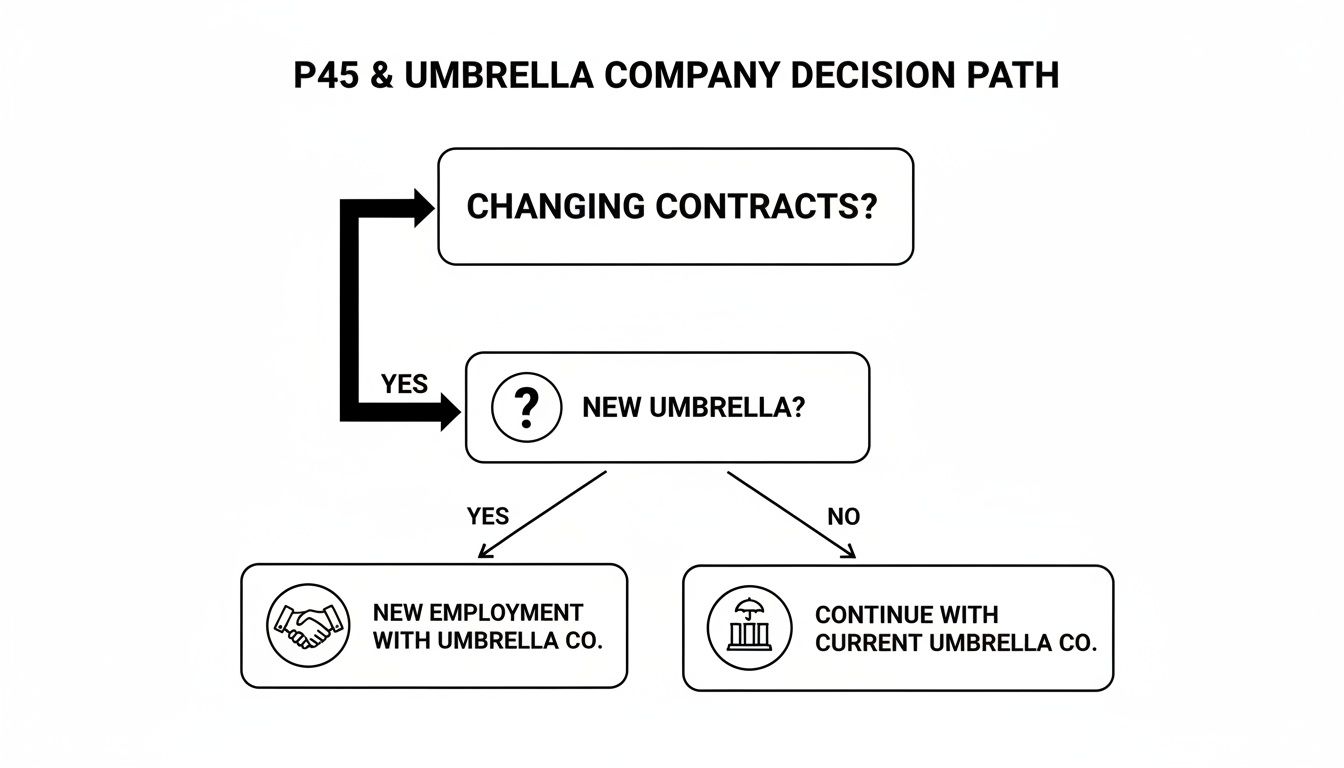
As you can see, if you are just switching contracts but remaining with the same umbrella company, you do not need a P45. This is because you are still their employee and your employment is continuous.
P45, P60, and Starter Checklist: A Contractor's Quick Reference
To clarify the differences, it helps to see everything side-by-side. While these forms all provide crucial information to you, your employer, or HMRC, they are not interchangeable.
Think of it like this: Your P45 and P60 are records of tax you have already paid. The Starter Checklist is a tool to help your new employer determine the tax you should pay from now on when they do not have the full picture.
Getting this right empowers you to manage your compliance with confidence. Here is a simple table for reference.
| Document | What It Is | When You Receive It | What It's Used For |
|---|---|---|---|
| P45 | A summary of your pay and tax from a job you have just left. | On or shortly after your last day of employment. | Given to a new employer to ensure you are put on the correct tax code from day one. |
| P60 | An annual statement detailing total pay and deductions for the tax year. | After the end of the tax year (5 April), but before 31 May. | A personal record for proving income, completing tax returns, or applying for loans. |
| Starter Checklist | A form you complete when starting a new job without a recent P45. | When you start a new role and cannot provide a P45. | Helps your new employer determine the correct temporary tax code to use. |
Understanding these three key documents takes the guesswork out of your payroll and puts you in control of your tax affairs as a contractor.
What to Do If Your P45 Is Missing or Lost
It is a common problem. You are preparing for a new contract, but your P45 from your last role is missing. Perhaps it never arrived, or it was misplaced. The first thing to remember is not to panic. This is a common issue with a straightforward solution.
The key point is that you cannot get a replacement P45. Once your previous employer issues it, that is the only copy. Neither they nor HMRC can print another one. Your P45 is a one-off document for that specific employment, so if it is gone, it is gone for good. However, this is not a dead end, there is a standard process for this situation.
Using a Starter Checklist
Without a P45, your new employer or umbrella company will ask you to complete a Starter Checklist. This is the official HMRC form that helps them determine the correct tax code for you. It is designed to give your new payroll provider a clear picture of your tax situation.
The form asks a few simple questions about your circumstances, such as:
- Is this your first job since 6 April?
- Do you have another job?
- Are you receiving a state, works, or private pension?
Completing a Starter Checklist accurately is the quickest way to resolve a missing P45. It gives your new employer the details they need to get you on the right tax code, which is crucial for avoiding a costly emergency tax code on your first payday.
By filling this in, you help us at UmbrellaCompany.com process your pay correctly from the start. It is a simple step that ensures no unwelcome surprises and allows you to focus on settling into your new role.
Got Questions About P45s? We Have Answers.
To summarise, let’s address some of the most common questions contractors have about P45s. This section provides quick, clear answers to help you feel confident with your tax paperwork.
How Long Is a P45 Valid For?
A P45 has one main purpose: to pass your tax details to a new employer within the same tax year.
If you receive a P45 in August and start a new contract in October, it is valid. However, once the tax year ends on 5 April, that P45 becomes a historical document. If you start a new role after 6 April, your old P45 from the previous tax year is no longer relevant for your new payroll.
Can I Get a P45 From HMRC?
This is a common question, and the answer is a simple no. HMRC cannot issue you a P45, and your old employer cannot print a replacement if you lose it. It is a one-time document.
If you have lost yours, inform your new employer or umbrella company immediately. They will ask you to fill out a Starter Checklist instead, which serves a similar purpose in establishing your correct tax code.
Do Sole Traders Need a P45?
Generally, no. If you are a sole trader managing your tax through Self Assessment, P45s are not relevant to you. They are exclusively for the PAYE (Pay As You Earn) system.
The exception is if you are a director of your own limited company and pay yourself a salary through PAYE. In that scenario, if you were to formally cease that employment and close the payroll, you would issue yourself a P45.


