


A tax code is a series of numbers and letters used by your employer or pension provider to calculate the right amount of Income Tax to take from your pay or pension. In the UK, that simple-looking code sits inside a tax system spread across over 20,000 pages of legislation, which is why it often feels far less simple than it should.
If you're a contractor looking at your first umbrella payslip, it's normal to pause at the tax code line and wonder whether it's right. You might recognise your gross pay, spot tax and National Insurance deductions, then get stuck on a code like 1257L, BR, or something ending in W1 or M1.
That confusion matters because your tax code directly affects your take-home pay. If the code is wrong, the amount of tax taken can be wrong too. For contractors working through an umbrella company, that can happen when you start a contract mid-year, move between roles, or have more than one income source at the same time.
We see this concern all the time in payroll. A tax code isn't random. It is HMRC's instruction to the employer about how to tax you. Once you understand what the code is doing, your payslip becomes much easier to read and much easier to challenge if something looks off.
Decoding Your Payslip's Biggest Mystery
Your first umbrella payslip often raises the same question. Why is there a strange code sitting next to your tax details, and what does it mean for your money?
A common example is a contractor who has just switched from permanent employment into an inside IR35 assignment. They open the payslip, expect to focus on rate, deductions and net pay, and instead get distracted by a line that says 1257L or perhaps something less familiar. The code looks technical, but it has a practical job. It tells payroll how much Income Tax to deduct from your earnings.

For contractors, this matters more than many people realise. The UK's tax law is extensive, and rules that affect contractors, including IR35 under Chapter 10 of the Income Tax (Earnings and Pensions) Act 2003, sit within that wider framework. The legislation itself is available in the Income Tax legislation on legislation.gov.uk, and the same framework allows for penalties of up to 100% of the tax due in cases of non-compliance.
Why payslips can feel harder under an umbrella
An umbrella company employs you for tax purposes and runs your pay through PAYE. That means the tax code on your payslip isn't decorative. It is one of the key instructions used to calculate tax before your net pay is produced.
If you're still getting used to payroll terms, start by checking the core fields on the document itself. Our guide on how to read a UK payslip helps you identify where the tax code appears and how it sits alongside taxable pay, tax deducted and year-to-date figures.
Practical rule: If your net pay looks lower than expected, check the tax code before assuming the contract rate is wrong.
What people usually get confused about
Most confusion comes from three things:
- The numbers: People assume they are random, but they usually relate to your tax-free allowance.
- The letter: It looks minor, but it tells payroll something important about your circumstances.
- Extra markers: Codes ending in W1, M1 or X can change how tax is applied in that pay period.
A tax code is not your tax rate. It is not a judgement about whether you're overpaying. It is HMRC's instruction for how PAYE should treat your income.
Once you know how that instruction is built, the code starts to make sense.
How Your UK Tax Code Is Calculated
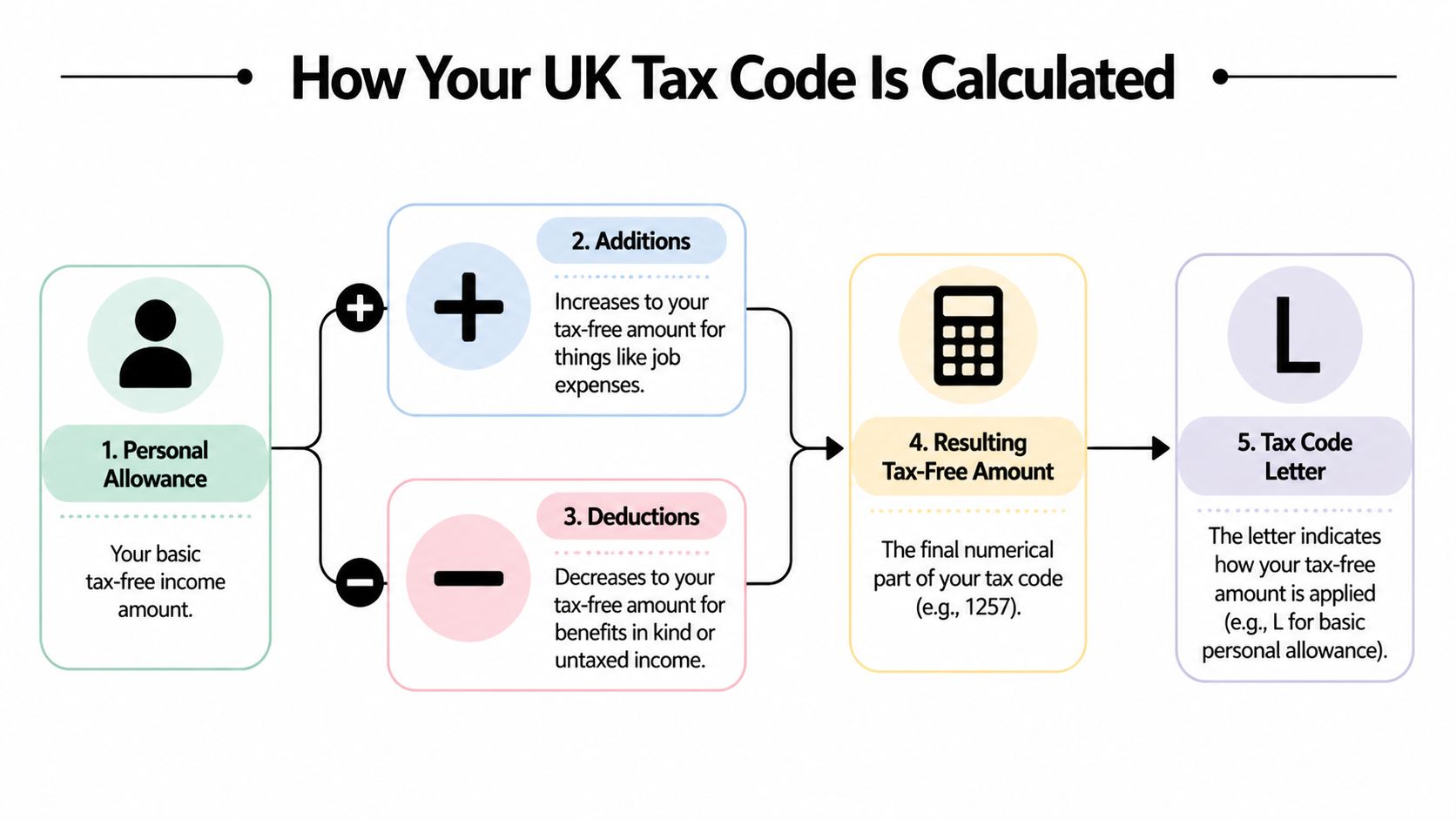
The easiest way to understand what is tax code is to think of it as a tax-free bucket. HMRC decides how much income can go into that bucket before Income Tax starts. Your tax code then tells payroll how to apply that allowance to your pay.
If your bucket is reduced, more of your pay becomes taxable earlier. If your bucket is increased, more income can sit outside Income Tax first. The code is the shorthand version of that decision.
The number part of the code
The number usually represents your tax-free amount, divided by 10.
For example, if HMRC gives you a tax-free amount of 12570, the numeric part often appears as 1257. Payroll uses that instruction within PAYE to spread your allowance across the tax year.
That is why 1257L is such a familiar code. The number points to the allowance figure HMRC wants applied. The letter adds context.
The letter part of the code
The letter tells HMRC and your employer how that allowance should be treated.
A common example is L, which usually means you're entitled to the standard personal allowance in a straightforward way. Other letters can signal a transfer of allowance between spouses or civil partners, or a different tax position that means payroll must treat your pay another way.
A useful way to read a code is this: the number points to the allowance, the letter explains the circumstances.
What changes the code
Your code can change if HMRC adjusts the tax-free bucket. That can happen for several reasons:
- Benefits in kind: If HMRC expects you to receive taxable benefits, your allowance may be reduced.
- Tax owed from an earlier year: HMRC can sometimes collect that through PAYE by adjusting the code.
- Job expenses or reliefs: Some allowable expenses can increase the amount set against tax.
- Multiple incomes: If you have more than one job or a pension as well as employment income, HMRC may split or restrict allowances.
For umbrella workers, that last point catches people out regularly. A second income stream can affect which employer gets the main allowance and which one gets a special code.
Why payroll can't just choose a better code
Your employer, including an umbrella company, does not invent your tax code. Payroll applies the code HMRC sends or the information on your starter details, such as a P45 or starter checklist. That's why the source of the code matters as much as the code itself.
If you'd like a clearer sense of how the deduction process works after the code is applied, our explainer on how PAYE is calculated is a useful next read.
A Breakdown of Common UK Tax Codes
Once you know that the code tells payroll how to tax you, the next question is usually, "What does my specific one mean?" The table below gives you a practical reference point for the codes contractors most often see.
Common UK tax codes and their meanings
| Tax Code | What It Means | Who It Typically Applies To |
|---|---|---|
| 1257L | A standard code often used where the employee receives the normal personal allowance through PAYE | Someone with one main job and no unusual tax adjustments |
| M | A code showing the person has received a transferred allowance through Marriage Allowance | A spouse or civil partner who benefits from the transfer |
| N | A code showing the person has transferred part of their allowance to a spouse or civil partner | A spouse or civil partner who gives part of their allowance away |
| 0T | No personal allowance is being given through this payroll calculation | Someone whose allowance is used elsewhere, or where HMRC needs more information |
| BR | All income from that job is taxed at the basic rate, with no personal allowance set against it in that payroll | Often used for a second job or additional employment |
| D0 | All income from that job is taxed at the higher rate | Common where this income sits on top of another source and HMRC wants no allowance used here |
| NT | No tax is deducted from that income through PAYE | Used only in specific cases when HMRC instructs payroll not to deduct Income Tax |
| 1257L W1 | The code uses the normal allowance, but only for that week, not cumulatively across the year | Often seen when someone starts a job and payroll lacks full year-to-date details |
| 1257L M1 | The code uses the normal allowance, but only for that month, not cumulatively across the year | Common after a mid-year job change or late tax information |
| 1257L X | Similar to W1 or M1, this usually indicates a non-cumulative or emergency-style treatment | People whose new payroll record is still being aligned with HMRC data |
The code most people recognise
1257L is the code many workers see when their position is straightforward. In plain language, it usually means HMRC is giving that employment the main tax-free allowance and payroll will apply it through PAYE in the usual way.
That doesn't mean the code is always correct. It only means it is a common default when nothing unusual is on record.
Special codes that can change your take-home pay fast
Codes like BR, D0 and 0T can produce a bigger shock on payslip day because they often remove or restrict the tax-free allowance in that job. If you've started an umbrella assignment while another job is still open on HMRC's records, payroll may receive one of these codes until HMRC updates the position.
That can feel like you've been "taxed too much" overnight. Sometimes that is exactly what has happened. Sometimes it's a temporary instruction because HMRC is trying to stop your allowance being used twice.
If you see BR, D0 or 0T, don't panic. Check whether HMRC still thinks you have another active income source.
Emergency tax markers
The bits that confuse people most are W1, M1 and X. These markers usually mean your pay is being taxed on a non-cumulative basis. Payroll treats that pay period on its own rather than looking back across the tax year to smooth things out.
That often happens when:
- You start a contract mid-year
- Your P45 hasn't been processed yet
- Payroll is waiting for HMRC's confirmed code
- Your starter details are incomplete
For contractors, this is very common during onboarding. It doesn't always mean something has gone badly wrong. It often means the payroll record is incomplete and needs updating.
A simple way to read the warning signs
Look more closely if your code:
- Ends with W1, M1 or X
- Has no obvious allowance attached
- Suddenly changes after starting a second role
- Doesn't match the code shown on HMRC correspondence
Those are the moments to investigate, not ignore.
How to Check and Correct Your Tax Code
The good news is that checking your code is usually straightforward. The better news is that if it is wrong, there is a clear route to get it corrected.
Where to find it
Your tax code usually appears in several places. Check these first:
- Payslip: Often near your tax deductions or employee details
- P45: Helpful when you've recently left a previous role
- P60: Useful for checking what happened across the tax year
- HMRC Personal Tax Account: Often the quickest way to see the current code HMRC believes should apply
If the code on your payslip doesn't match what HMRC shows, that is your clue to start asking questions.
A practical checking process
Use this sequence rather than trying to fix everything at once:
- Compare documents: Match the code on your payslip against your P45, P60 or HMRC account.
- Check your job history: Make sure HMRC knows which employments have ended.
- Review your income sources: A second job, pension or recent employer can affect the code.
- Look for emergency markers: W1, M1 or X usually point to a temporary setup issue.
- Contact HMRC if needed: HMRC issues the code. Payroll applies it.
Common reasons the code is wrong
A tax code often goes wrong because the information chain is incomplete rather than because anyone has made a dramatic error.
Typical causes include:
- You started a new assignment without a P45
- HMRC still shows an old employer as active
- You have more than one PAYE income
- A benefit or earlier tax adjustment has been added
- Your starter checklist was completed with incomplete information
For umbrella workers, the first pay period is the most common flashpoint. If you'd like a closer look at one of the main problem areas, our guide to the emergency tax code explains why it happens and what usually resolves it.
Good habit: Keep your P45, starter details and payslips together. Most tax code problems are easier to fix when you can show the timeline clearly.
Who to contact
This part matters. If the code itself is wrong, HMRC must correct it. Your employer or umbrella company cannot replace it because you think another code looks more reasonable.
Once HMRC issues an updated code, payroll can apply it in the next available run. If you've overpaid tax, the PAYE process may correct some of it automatically once the new code lands. If not, HMRC can tell you how the refund will be handled.
Tax Codes for Contractors and Umbrella Company Workers
Contractors don't deal with tax codes in the same way as someone in one steady permanent job. Work starts and stops. Assignments change mid-year. Income can come from different places. That makes tax code errors more likely, especially when a new umbrella payroll record is created.

The wider legal backdrop is one reason this feels complicated. The Finance Act 2021 extended off-payroll working rules to the private sector, impacting over 200,000 businesses, and the UK tax system's compliance burden has been estimated at £12 billion annually. At the same time, compliant umbrella companies manage PAYE for over 1.3 million contractors, as outlined in the government's off-payroll working rules from April 2021 guidance.
Why the tax code matters more inside IR35
If you're inside IR35 and working through an umbrella company, your pay is taxed through PAYE like employment income. That means your tax code has an immediate effect on your take-home pay each time payroll runs.
A wrong code can lead to too much tax coming off, too little tax coming off, or confusion over whether your allowance is being used in the right place. Because umbrella workers often join during an active tax year, temporary codes appear more often than they do in long-term permanent employment.
What the umbrella company actually does
The umbrella company acts as your employer for payroll purposes. In practical terms, that means it:
- Processes PAYE: It applies the tax code in force to your taxable pay.
- Uses HMRC instructions: It cannot choose a different tax code just because your first payslip looks harsh.
- Updates payroll when HMRC updates the record: Once the official code changes, the new instruction can be used.
This is one reason a compliant provider matters. Good payroll teams won't promise to override HMRC, but they should explain what has happened, what documents they need and what you should ask HMRC to check.
If you're comparing options, this guide to an umbrella company for freelancers gives a useful overview of how the model works in practice.
The most common contractor problem
A contractor leaves one assignment, starts another quickly, and doesn't yet have a processed P45. Payroll then has to rely on starter information. If HMRC hasn't lined up the records yet, the first payment may use an emergency or restricted code.
That is frustrating, but it is common. The fix is usually administrative rather than dramatic. HMRC updates the employment record, issues the correct code, and payroll applies it in a later run.
Contractors should treat the first payslip from a new umbrella assignment as a check point, not just a payment confirmation.
A related point is that tax code confusion often gets mixed up with the separate question of what expenses or deductions are allowable in different working arrangements. If you also want a plain-English comparison of deduction thinking outside umbrella employment, Grow My Acorn's tax deductions guide is a helpful companion read.
Inside IR35 compared with outside IR35
The tax code issue is much sharper inside IR35 because PAYE sits at the centre of the arrangement. For an outside IR35 contract run through your own limited company, the immediate role of a personal tax code is different because you're not receiving umbrella salary in the same way.
That doesn't mean tax planning disappears. It means the point of attention changes. Inside IR35, your tax code is a front-line payroll issue. Outside IR35, your focus is more likely to move toward how income is drawn and reported through your wider business setup.
To help with the visual side of this, here is a short video that gives broader context on tax and umbrella working.
What a sensible contractor should do each time they move
When you start or switch assignments, keep this checklist in mind:
- Carry your P45 forward: This gives the next payroll team a clearer starting point.
- Review the first payslip quickly: Don't wait months to spot a wrong code.
- Check HMRC's record of active jobs: Old employments left open can trigger the wrong code.
- Separate tax code issues from contract rate questions: They affect net pay differently.
That small routine saves a lot of confusion later.
Your Next Steps and Essential Resources
A tax code looks small on the page, but it has a big job. It tells payroll how your Income Tax should be calculated, and for contractors that can change quickly when work arrangements change.
The main thing to remember is simple. Your tax code affects your take-home pay, and checking it is part of looking after your own finances. Payroll can apply the code, but only HMRC can decide and issue it.
A sensible routine to follow
You don't need to become a tax specialist. You just need a repeatable habit.
- Check the first payslip from every new role: This is when most code issues show up.
- Keep your paperwork in one place: P45s, P60s and payslips make errors easier to trace.
- Use your HMRC Personal Tax Account regularly: It helps you spot old jobs or mismatched records.
- Query unusual codes early: Especially those with no clear allowance or emergency markers.
- Tell HMRC about changed circumstances: Multiple jobs, benefits or ended employments all matter.
Resources worth using
Start with official HMRC tools and correspondence whenever you're trying to confirm the code itself. Those records sit closest to the decision that payroll is following.
It can also help to read around the edges of the topic, especially if you move between different ways of working. If you're comparing umbrella work with self-employed arrangements, this guide on how to reduce self-employed tax is a useful broad primer on deductions and tax awareness from that angle.
The contractors who handle tax codes best usually aren't tax experts. They are simply quick to check, quick to keep records and quick to ask HMRC to fix mistakes.
The key takeaway
If you've been asking what is tax code, the plain answer is this: it is HMRC's instruction for how your employer should tax your pay. For a contractor, especially one paid through an umbrella company inside IR35, that instruction deserves attention every time your working arrangement changes.
Small code. Real impact on your net pay.
If you're comparing compliant payroll options for your next contract, Umbrella Company helps you review UK umbrella companies based on your role and working setup, so you can choose with more confidence.


