


In simple terms, pensionable pay is the part of your earnings that your pension contributions are calculated on. It is a crucial detail for UK contractors because not every pound you earn necessarily counts towards your pension. Getting your head around this is the first step to understanding exactly how your retirement savings stack up.
Defining Pensionable Pay For UK Contractors

When you are a contractor working through an umbrella company, you are, for all intents and purposes, an employee for tax and pensions. This status makes you eligible for a workplace pension under a government scheme you have probably heard of: auto-enrolment.
Your pensionable pay is the specific figure we use to work out both your contributions and our employer contributions to that pension scheme. Think of it this way: your contract rate represents the total value of your assignment, but your pensionable pay is the portion of that income earmarked for building your retirement nest egg. It is a number that directly shapes your financial future.
Why Pensionable Pay Matters
So, why should you care about the nitty-gritty of what is pensionable pay? It is vital for a couple of big reasons. First, it dictates the size of your pension pot. The more of your earnings that are pensionable, the more money goes into your savings from both you and your employer. Over a long career, that difference can be huge.
Second, it is tied to your National Insurance contributions, which is what builds your entitlement to the State Pension. Making sure your pay is processed correctly means you are shoring up both your private and your state retirement income for the years ahead.
The idea of pensionable pay is not new; it has always been a cornerstone of UK pensions. Before the New State Pension was introduced in 2016, for instance, certain earnings were used to calculate additional state pension benefits through schemes like SERPS. You can explore the history of the UK state pension to see just how these principles have changed over time.
Key Pension Terms At A Glance
To really get to grips with this, it helps to understand a few of the core terms you will see on your payslip or in pension documents. Getting these straight will make managing your finances a lot less confusing.
Here is a quick rundown of the main concepts we will be covering.
| Concept | What It Means For You |
|---|---|
| Qualifying Earnings | This is the specific band of your earnings (£6,240 to £50,270 per year for 2024/25) that pension contributions are based on for auto-enrolment. |
| Auto-Enrolment | A government programme that requires employers (including us) to automatically sign up eligible workers into a workplace pension. |
| Employer Contributions | The money your employer (the umbrella company) must legally pay into your pension. It is calculated as a percentage of your pensionable pay. |
| Employee Contributions | The portion of your pensionable pay that you contribute to your own pension, which is taken directly from your salary before you get it. |
Getting these basics right is key to feeling in control of your financial future. We are committed to making this process crystal clear. Every payslip you receive from us will show you exactly how your pension contributions have been calculated, so you can have complete confidence that your retirement savings are being handled correctly and compliantly.
What Earnings Count Towards Your Pension
When we talk about pensionable pay, it is crucial to understand which parts of your income actually get used for pension calculations. Not every pound you earn as a contractor automatically counts, and getting your head around this breakdown is the key to seeing exactly how your retirement savings are built.
Your basic salary is the bedrock of your pensionable pay. It is the core figure from which your contributions are calculated. But other parts of your pay, like bonuses or overtime, might also be included depending on the pension scheme's specific rules.
On the flip side, some payments are almost always left out. Expense reimbursements, for instance, are not considered earnings, so they are not pensionable. Think of it this way: that money is just you getting paid back for business costs, not income that can be put towards your retirement pot.
Understanding Qualifying Earnings
For auto-enrolment, the government has created a specific definition called 'qualifying earnings'. This is not your total income but a set band of it, and it is the standard used to work out the minimum pension contributions for everyone.
For the 2024/25 tax year, this qualifying earnings band sits between £6,240 and £50,270 a year. Any of your earnings that fall within this range are used to calculate the minimum contributions for both you and us, your employer.
This system ensures everyone contributes based on a standardised measure, making the whole process fair and consistent. It is the legal framework that props up the entire auto-enrolment programme here in the UK.
Pensionable Vs Non-Pensionable Earnings
To make this crystal clear, let's break down which common earnings types usually count towards your pension under these qualifying earnings rules.
| Type Of Earning | Typically Pensionable? | Important Note |
|---|---|---|
| Basic Salary | Yes | This is the main component of your qualifying earnings. |
| Bonuses & Commission | Yes | These are included as part of your qualifying earnings. |
| Overtime Pay | Yes | Any overtime payments are also pensionable under these rules. |
| Statutory Pay | Yes | This includes Sick Pay, Maternity, Paternity, and Adoption Pay. |
| Expense Reimbursements | No | Reimbursed expenses are not earnings and therefore not pensionable. |
This distinction is vital for contractors. Your pensionable pay directly impacts how much of your income is funnelled into your retirement savings. The stronger your pensionable earnings are over your career, the better your retirement income will likely be. If you need more help getting to grips with your earnings, check out our guide on how to read a payslip in the UK.
A Practical Payslip Example
Let's say your monthly gross pay is £4,500. The pension calculation is not based on this full amount. Instead, we only look at the portion that falls within the monthly qualifying earnings band.
The lower monthly threshold is £520 (£6,240 / 12), and the upper one is £4,189 (£50,270 / 12). This means your pensionable pay for that month would be £4,189 – £520 = £3,669.
Both your pension contributions and ours (as your employer) are then calculated based on this £3,669 figure, not your total £4,500 gross pay. As a contractor paid through an umbrella company, this calculation is fundamental to how your pension pot grows. Building consistent pensionable earnings throughout your career really pays off. In fact, UK pensioner median incomes rose by 12% between 2011–12 and 2022–23, showing the real-world impact of strong state and private pension contributions.
How Auto-Enrolment Works For Contractors
When you work through a compliant umbrella company like us, you are legally considered an employee for tax and pension purposes. This is a crucial detail, because it means the government’s auto-enrolment rules apply to you, just like they do for permanent staff across the UK.
Think of auto-enrolment as the default setting for workplace pensions. It is designed to get more people saving for retirement without having to lift a finger. At UmbrellaCompany.com, we manage the whole process for you. Once you meet the criteria, we will enrol you in our pension scheme and start making contributions from your pay. All the admin is on us.
This is where the idea of pensionable pay really comes to life. All the calculations and contributions are based on that specific part of your earnings, making retirement saving a seamless part of how you get paid.
Triggers For Automatic Enrolment
You will not necessarily be enrolled from day one. The government has set specific triggers to enrol people when they are most likely to benefit.
We are legally required to automatically put you into our pension scheme if you tick all of these boxes:
- You are aged between 22 and the State Pension age.
- You ordinarily work in the UK.
- You earn over £10,000 a year (which works out at £833 per month or £192 per week for the 2024/25 tax year).
As soon as you meet these conditions, the process kicks in. We will send you a notification to let you know you are being enrolled and give you all the details about the scheme, including how much is being paid in and where it is invested.
Minimum Contribution Percentages
Auto-enrolment is a joint effort. Both you and we (as your employer) have to chip in a minimum amount. These percentages are calculated on your ‘qualifying earnings’, which is the band of your pay between £6,240 and £50,270 for this tax year.
Here are the current minimum rates:
- Your contribution: 5% of your qualifying earnings.
- Our employer contribution: 3% of your qualifying earnings.
This adds up to a total of 8% of your pensionable pay going into your retirement fund each time you are paid. These are the legal minimums, and as a compliant umbrella, we make sure these contributions are handled correctly and on time, every time. You can get a better sense of how we manage your pay by reading our guide on the differences between PAYE and umbrella company employment.
For UK contractors, understanding pensionable pay within an umbrella company is essential. It's the portion of your earnings subject to National Insurance contributions that also helps you build up qualifying years for your State Pension. This is especially critical for contracts inside IR35, where compliant umbrella companies ensure your pay is processed correctly.
Your Right To Opt Out
While enrolment is automatic, saving is not compulsory. You have the right to opt out of the pension scheme if you decide it is not for you. You can only do this after you have been enrolled, and there is a specific one-month ‘opt-out window’ to make your move.
If you opt out during this window, we will refund any contributions you have made. If you leave the scheme later on, that is fine too, but your money will stay invested in the pension pot until you retire.
It is worth thinking carefully before opting out. Yes, it boosts your immediate take-home pay, but you will be walking away from our employer contributions and the tax relief that makes pension saving so powerful. Just think about the debate around the UK's state pension 'triple lock'. It is a constant reminder of how important consistent saving is, but its rising cost also shows why having your own private pension pot is so vital. We are here to give you the facts so you can make a properly informed choice.
Calculating Your Pensionable Pay With An Umbrella Company
Figuring out how an umbrella company calculates your pay is key. It is all about understanding the journey your money takes from the client’s payment to the final pensionable figure on your payslip. Let’s walk through exactly how it works.
The whole process starts with your assignment rate, which is the total amount your client pays for your services. But hold on, that is not your gross pay just yet. Because the umbrella company is your legal employer, we have to deduct certain employment costs first. These deductions are what turn the assignment rate into your gross pay, which is then used to work out your pensionable pay.
From Assignment Rate to Gross Pay
It all kicks off when we invoice your client for the agreed assignment rate. Once that payment lands, we deduct the necessary employment costs. This is not just something we choose to do; it is a crucial step that every single compliant umbrella company in the UK has to follow.
These costs typically include:
- Our Margin: This is the small, fixed fee we charge for running payroll and handling all the admin.
- Employer’s National Insurance: As your official employer, we are legally required to pay this on your earnings. For the 2024/25 tax year, the rate is 13.8% on earnings above the secondary threshold.
- The Apprenticeship Levy: A UK tax on employers that helps fund apprenticeship schemes. It is calculated at 0.5% of the annual pay bill.
- Employer Pension Contributions: The minimum 3% we must contribute to your pension under auto-enrolment rules.
Once these employment costs are taken off the assignment rate, the amount left over becomes your gross pay. This is the figure that your personal tax (PAYE) and your own employee pension contributions are calculated from. For a more detailed look at this, check out our guide on how an umbrella company works.
A Worked Example Step-By-Step
Let's put some real numbers to this. Say you are a contractor with an assignment rate of £400 per day, working five days a week. That gives you a weekly assignment value of £2,000.
Here is a breakdown of how we get from that figure to your pensionable pay.
Start with the Assignment Rate: The initial amount we receive from your client is £2,000.
Deduct Employment Costs: Next, we subtract the employer costs from this amount.
- Our Margin: Let's assume a weekly margin of £25.
- Employer’s NI, Apprenticeship Levy & Pension: These are calculated from what is left. To keep it simple, let’s say these come to about £250.
Determine Gross Pay: After deducting the employment costs (£25 + £250 = £275), we arrive at your gross pay for the week.
- £2,000 (Assignment Rate) – £275 (Total Employment Costs) = £1,725 (Gross Pay)
Calculate Pensionable Pay (Qualifying Earnings): Finally, we work out your pensionable pay using the government's qualifying earnings bands for 2024/25.
- Weekly Lower Threshold: £120
- Weekly Upper Threshold: £967
Your gross pay of £1,725 is well above the upper limit, so your weekly pensionable pay is based on the maximum amount within that band.
Calculation: £967 (Upper Limit) – £120 (Lower Limit) = £847
This £847 is your final pensionable pay for the week. Both your 5% employee contribution and our 3% employer contribution will be calculated based on this figure. This structured approach means there is no guesswork, and you can see exactly how the value of your contract directly funds your pension pot.
The simple three-step journey from earning to contributing under auto-enrolment is shown below.
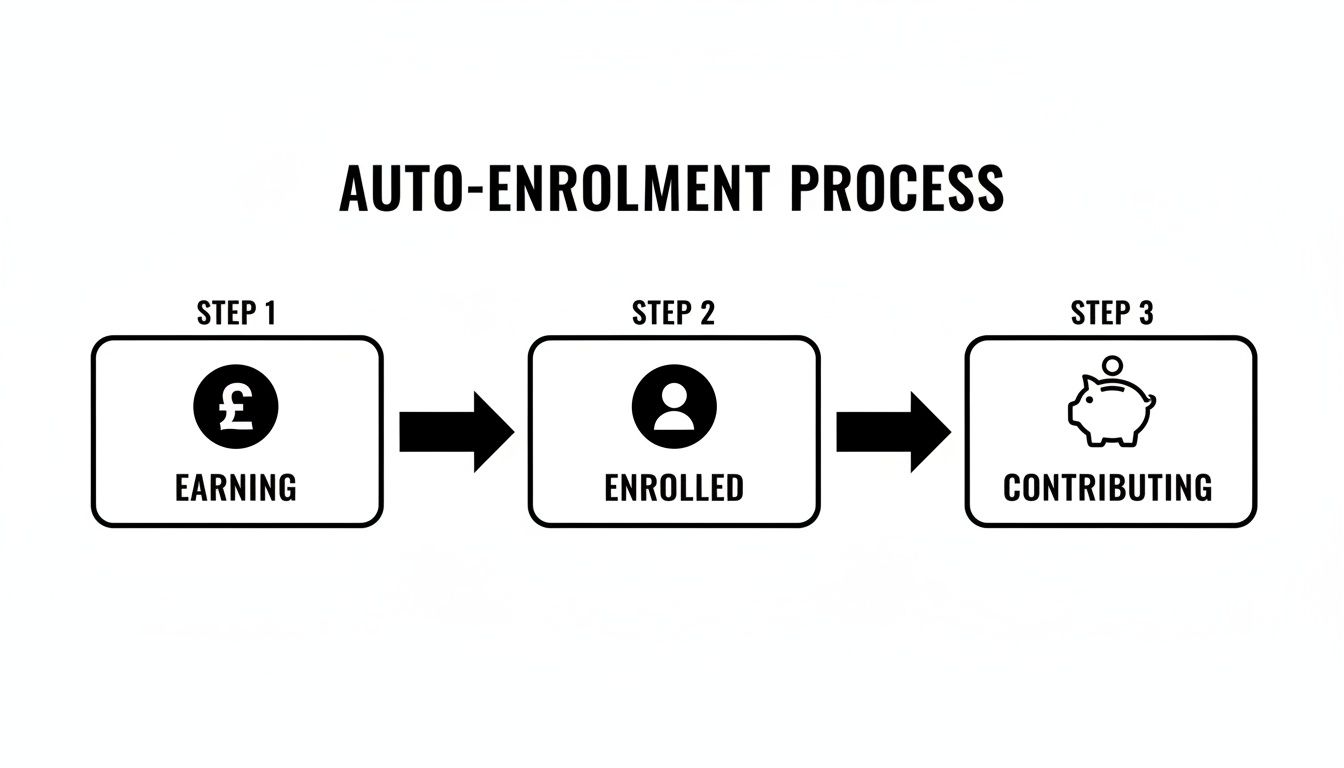
This just goes to show how, once your earnings hit the right level, you are enrolled into a scheme and contributions start flowing automatically into your pension.
Using Salary Sacrifice To Boost Your Pension

As a contractor, you want to make every pound you earn work harder. Salary sacrifice is a brilliant, tax-efficient way to do exactly that by giving your pension savings a serious boost. It is a key benefit that any compliant umbrella company, including us, should be able to set up for you.
The idea is simple. You agree to officially reduce your gross salary by a set amount, and in exchange, we (as your employer) pay that same amount straight into your pension pot. It is a simple swap on paper, but it has a surprisingly big impact on your finances.
The Main Advantage: National Insurance Savings
The biggest win with a salary sacrifice arrangement comes from savings on National Insurance contributions (NICs). Because your official gross salary is lower, both you and your employer pay less in NICs.
Straight away, you will see your own employee NICs go down, which means more money in your pocket each month. At the same time, we save on our Employer’s NICs. As a completely transparent umbrella, we pass that saving directly on to you, usually by adding it to your pension contribution to give your retirement fund an extra lift.
It is a genuine win-win. You are building a healthier pension for the future while making your take-home pay more efficient today.
Salary Sacrifice: A Practical Example
Let’s put some numbers to it. Say you have a gross salary of £50,000 and you want to put £3,000 into your pension over the year.
Here is a quick comparison of how that looks with and without salary sacrifice.
| Calculation Element | Without Salary Sacrifice | With Salary Sacrifice |
|---|---|---|
| Initial Gross Salary | £50,000 | £50,000 |
| Sacrificed Amount | N/A | £3,000 |
| New Contractual Salary | £50,000 | £47,000 |
| Employee Pension Contribution | £3,000 (from net pay) | £0 |
| Employer Pension Contribution | £0 (in this example) | £3,000 |
| Total Pension Contribution | £3,000 | £3,000 |
The real magic is in the tax treatment. Without salary sacrifice, your National Insurance is calculated on the full £50,000. With it, it is based on the lower £47,000, saving you money right away. To learn about other ways to make your pay more efficient, check out our guide on how to reduce PAYE tax as a contractor.
Potential Downsides To Consider
While salary sacrifice is a fantastic tool for most, it is not a one-size-fits-all solution. Lowering your contractual salary can have some knock-on effects, so it is important to go in with your eyes open.
Salary sacrifice can be a fantastic tool, but it's not a one-size-fits-all solution. It’s vital to weigh the significant tax advantages against any potential impacts on your wider financial life, ensuring it aligns perfectly with your personal circumstances and future plans.
Here are a few things to bear in mind:
- Mortgage Applications: Some lenders use your contractual salary for their affordability checks. A lower figure on paper could, in theory, affect how much they are willing to lend you.
- Life Insurance: If you have life insurance or death-in-service benefits, they are often calculated as a multiple of your salary. A reduced salary might mean a lower payout.
- Statutory Payments: Your entitlement to payments like Statutory Maternity or Sick Pay could be impacted if your new, lower earnings fall below the Lower Earnings Limit.
We are all about being upfront, so it is crucial you think about these points. For the vast majority of contractors, the pension and tax benefits will easily outweigh any potential downsides, but it is always smart to make a choice that is right for your own situation.
Choosing The Right Umbrella Company For Your Pension
Your choice of umbrella company is more than just a payroll decision; it directly impacts how your pension is managed and grown. Getting this right is fundamental to building a secure financial future, so it pays to know what to look for and what questions to ask before you sign up.
A good umbrella company will not just process your pay compliantly. They will also offer pension options that actively help you maximise your savings. They should be completely transparent about their processes, support your retirement goals, and make the whole experience as straightforward as possible.
Key Factors To Evaluate
When you are comparing providers, try to look beyond the weekly margin. A truly supportive umbrella partner offers a comprehensive pension service, and you often need to dig a little deeper to make sure they have your best interests at heart.
Here is a practical checklist to help you size up your options:
- Salary Sacrifice Schemes: Do they offer a salary sacrifice arrangement? As we have covered, this is one of the most tax-efficient ways to boost your pension pot. Any top-tier provider should have this in place.
- Pension Provider Reputation: Who is their chosen pension partner? Look for well-known, reputable names like NEST, The People’s Pension, or Aviva. A strong partner is a good sign of their commitment to quality.
- Scheme Fees and Charges: Ask about any management fees or charges linked to the pension scheme. While all schemes have costs, they should be competitive and clearly explained to you upfront. No nasty surprises.
- Flexibility and Support: How easy is it to manage your contributions? Do they provide clear, itemised payslips that show exactly how your pensionable pay is calculated? Good communication and support are non-negotiable.
The Importance Of Accreditation
In the world of contracting, compliance is everything. Choosing an umbrella company that holds accreditation from a recognised professional body is the single most important step you can take to protect yourself and your pension.
Choosing an accredited umbrella company is your best defence against non-compliant schemes. Accreditations from bodies like the FCSA or Professional Passport aren't just badges; they are proof that a provider has undergone rigorous, independent audits of their business practices, ensuring they meet the highest standards of compliance and transparency.
Accredited members are audited every single year to confirm they handle tax, employment rights, and pension obligations correctly. By partnering with an FCSA or Professional Passport accredited company like us, you get genuine peace of mind. You can be confident that your pension contributions are calculated correctly from your pensionable pay, paid on time, and managed in full compliance with HMRC regulations.
This assurance allows you to focus on your contract work, knowing your financial future is in safe hands.
Frequently Asked Questions
Pensions and pay can feel like a maze of jargon. To help you get your bearings, we have tackled some of the most common questions contractors ask us about their pensionable pay.
Is My Holiday Pay Pensionable?
Yes, for the most part. Under the government's auto-enrolment rules, holiday pay is counted as part of your 'qualifying earnings'. This is the band of income used to calculate both your and our pension contributions.
It is worth remembering, though, that some workplace pension schemes have their own specific rules and might define pensionable pay differently, sometimes only including basic salary. We can always confirm the exact terms for the pension scheme you are enrolled in.
Can I Pay Into My SIPP Through An Umbrella Company?
Absolutely. Many compliant umbrella companies can make payments into an existing Self-Invested Personal Pension (SIPP) for you. It is a handy way to keep all your retirement savings in one place.
However, we are still legally required to auto-enrol you into our own workplace pension scheme if you meet the criteria. From there, it is your call. You can contribute to both, or simply opt out of our workplace scheme. It is always a good idea to chat through the options with us before you sign up.
What Happens To My Pension If I Change Umbrella Companies?
The pension pot you have built up is yours and yours alone. When you move to a new umbrella, you have a few options for the money in your old scheme:
- Leave it where it is: You can simply leave your pension pot with the old provider.
- Transfer it: You can move the funds into the pension scheme your new umbrella company offers.
- Consolidate it: You could also transfer the money into a personal pension you manage, like a SIPP.
Each path has different admin steps and potential fees involved, so it pays to investigate which route works best for your personal circumstances.
How Does IR35 Affect My Pensionable Pay?
While there is not a direct link, IR35 definitely has a big impact. If your contract is determined to be ‘inside IR35’, you have to be taxed just like an employee. Using an umbrella company is the most straightforward way to manage this.
We handle this by processing your entire contract income through PAYE, making sure all the right tax and National Insurance contributions are paid. This process not only ensures your earnings are correctly treated for pension purposes, but it also helps you build your entitlement to the State Pension, preventing any gaps from appearing in your NI record.
At UmbrellaCompany.com, we cut through the confusion around contractor pay and pensions. Our platform lets you compare trusted, accredited umbrella companies to find the perfect fit for you, ensuring your retirement savings are always handled with compliance and care. Find your ideal umbrella company today.


