


You're reviewing a contract from an agency or end client. Most of it looks familiar until you hit a phrase that changes the feel of the whole document, joint and several liability.
If you're a contractor, that term can sound like legal padding. It isn't. It can affect who pays when something goes wrong on a project, especially when several businesses or individuals sit in the same supply chain. That might include the client, a recruitment agency, an umbrella company, a consultancy, and you.
For many contractors, the confusion starts here. If several parties are involved, surely each one only pays their own share. Sometimes that happens. Sometimes it doesn't. Under joint and several liability, one party can end up paying far more than they expected, then trying to recover money from others afterwards.
That matters whether you contract directly, work through an agency, or are weighing up which business structure fits your contracting work. The legal and financial exposure can look very different depending on the setup.
Introduction
Contractors rarely have the luxury of treating legal clauses as background noise. If a project fails, a loss lands somewhere. If several parties contributed to the same problem, the question becomes simple and uncomfortable: who will the claimant chase first, and who is able to pay?
Joint and several liability is one of those rules that sounds technical but works in a very practical way. It affects recovery, not just blame. In plain terms, a claimant may be able to recover the whole loss from one liable defendant, even when more than one party was involved.
That's why this issue shows up in real commercial settings, not just in textbooks. Think about complex IT rollouts, construction programmes, outsourced compliance work, professional advice, or any engagement where one failure can trigger a wider, indivisible loss.
Practical rule: If several organisations touch the same outcome, don't assume your legal risk stops at your own slice of the work.
For contractors, the danger is often hidden in the supply chain. You might be a small part of a larger engagement, but if another party is insolvent, underinsured, or impossible to recover from, the solvent party in the frame can face the immediate claim.
That doesn't mean every contractor is automatically exposed in every job. It does mean you need to understand the mechanism, spot where it appears in contracts, and manage the risk before a dispute starts.
What Is Joint and Several Liability in Plain English
A simple way to understand what joint and several liability is is to forget legal language for a moment.
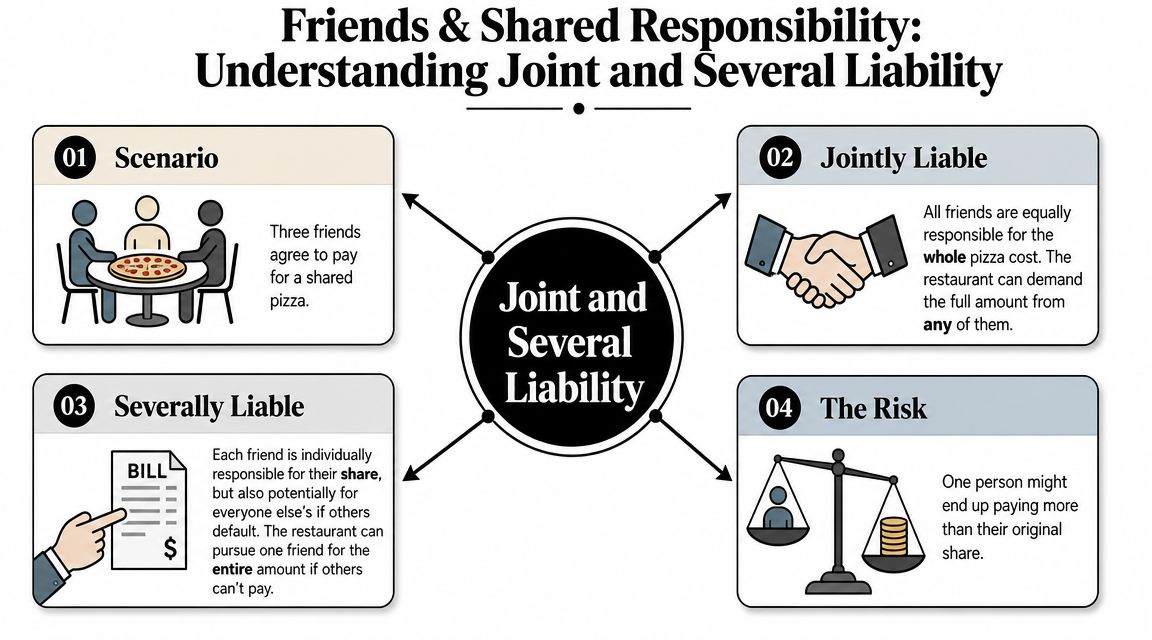
Three friends order one pizza and agree to split the bill. If the restaurant treats them as jointly and severally liable, it doesn't need to collect one share from each person. It can ask any one of them to pay the full amount. That friend can then chase the other two for reimbursement.
That's the core idea.
The plain-English version
Under several liability alone, each person pays only their own share.
Under joint and several liability, each liable person may be pursued for the whole amount. The claimant doesn't have to absorb the shortfall if someone else can't pay.
That's why people often get caught out by the phrase. They hear “shared liability” and assume “shared bill”. Legally, those aren't always the same thing.
Why UK law treats it seriously
In the UK, joint and several liability is a long-standing common-law doctrine. A key milestone was the Civil Liability (Contribution) Act 1978, which modernised how liability is shared between wrongdoers while preserving the claimant's ability to recover the full loss from any one liable party, as outlined in Cornell Law School's explanation of joint and several liability.
The practical effect is important. The insolvency risk shifts away from the injured person and onto the defendants.
So if several parties helped cause one indivisible loss, the claimant can focus on recovery first. Sorting out who should ultimately bear what share can happen later, between the defendants.
The claimant's question is often, “Who can pay?” not “Who was easiest to blame in neat percentages?”
Where contractors often misunderstand it
Contractors often assume this rule only matters in headline-grabbing injury claims. It can matter in commercial disputes too, particularly where multiple parties contribute to the same outcome and the loss can't be neatly split into separate boxes.
The key phrase there is indivisible loss. If the damage is one combined loss, the law may let the claimant recover in one place, then leave the defendants to argue over contribution afterwards.
That's why a short contract clause can create a much larger commercial risk than it first appears to.
The Key Differences Joint vs Several Liability
People often bundle these terms together, but they don't mean the same thing. For a contractor, the distinction affects how wide your financial exposure could be if a claim lands across multiple parties.
Three related but different models
Joint liability usually means parties are responsible together for the same obligation. The claimant can look to the liable group as a whole.
Several liability means each party is responsible only for their own share. If one party can't pay, the claimant may be left with a shortfall.
Joint and several liability combines both ideas. Each liable party may be pursued individually for the full loss, even though more than one party is involved.
Liability types compared
| Liability Type | Who is Responsible? | Example (Based on a £100,000 claim against two parties) |
|---|---|---|
| Joint liability | Both parties are responsible together for the same obligation | The claimant pursues both parties together for the full £100,000 |
| Several liability | Each party is responsible only for their own allocated share | If Party A is responsible for £60,000 and Party B for £40,000, each pays only that amount |
| Joint and several liability | Each party may be pursued for the entire claim | The claimant could recover the full £100,000 from Party A, then Party A would try to recover Party B's share later |
Why the distinction matters in a contract chain
If you're a contractor on a programme involving an agency, consultancy, software supplier, and end client, these models produce very different results.
Under several liability, your exposure is more contained. Under joint and several liability, your own role in the fault picture might be only part of the story, but your balance sheet and insurance position can make you the easiest target for recovery.
That's why contract review matters. A clause that looks like standard wording can alter who carries the collection risk when a co-defendant disappears, dissolves, or has no meaningful cover.
Contractors should separate two questions. First, who caused what. Second, who may be forced to pay first.
Shared fault is not handled the same way everywhere
If you want a useful contrast, Mattiacci Law's guide to key facts about shared fault in Pennsylvania shows how fault allocation rules can interact differently in another legal system. That comparison helps make one UK point clearer: liability rules are not just about fairness in theory, they shape who bears the practical risk when money must be recovered.
For contractors, that practical risk is the primary issue. You don't need to become a litigator. You do need to know whether the document in front of you points towards proportionate exposure or a wider recovery risk.
How Joint and Several Liability Affects Contractors in Practice
The doctrine makes more sense when you put it into situations contractors recognise.

An IT project that fails as one whole loss
A client hires a delivery team for a major system launch. One contractor handles integration, another handles testing, and a third manages implementation. The system goes live and fails hard. Orders are missed, customer access breaks, and the client says the whole rollout was defective.
In that sort of dispute, the client may argue the loss is indivisible. It wasn't one neat error with one neat price tag. It was one failed outcome. If several parties contributed, the claimant may pursue the defendant most likely to satisfy the judgment.
That's where contractors get uneasy, rightly. Even if your own contribution was limited, you could still be pulled into a wider claim because the loss is framed as one combined result.
A supply chain data breach
Now take a modern contractor chain. The end client appoints an agency. The agency places a worker through an umbrella arrangement. A separate service provider controls part of the data environment. A breach happens and personal data is exposed.
The client may not care much about the internal relationships on day one of the dispute. It will first look at who had responsibility, who had insurance, and who can meet the claim. Liability can move through the chain quickly when several organisations touched the same process.
That's one reason contractors need to understand their cover, including contractor insurance options in the UK, before a project starts. Insurance doesn't remove the doctrine, but it can change how survivable the problem is.
Construction shows the issue clearly
Construction and refurbishment projects make this risk easy to visualise because so many parties overlap. If you want a homeowner-friendly explanation of how layered project responsibility works in practice, South Eastern General Contractors has a useful piece on construction coaching for your legacy home. The setting is different, but the takeaway is familiar: once several parties contribute to one outcome, accountability can become messy very quickly.
For contractors in commercial projects, that mess becomes expensive if the legal position lets a claimant collect in one place.
A statutory example from UK law
This isn't only a contract drafting issue. UK law also contains specific examples of the policy behind claimant protection.
A major UK-specific statutory milestone is the Compensation Act 2006, which introduced a special joint and several liability rule for mesothelioma claims. It allows claimants to recover full damages from any single responsible defendant, responding to the reality that other involved employers or insurers might now be insolvent, as explained in this discussion of joint and several liability and the Compensation Act 2006.
That example matters because it shows the underlying policy choice plainly. Where the law sees a serious injustice in leaving the claimant short, it may place the recovery burden on solvent defendants instead.
Understanding the Financial and Legal Implications
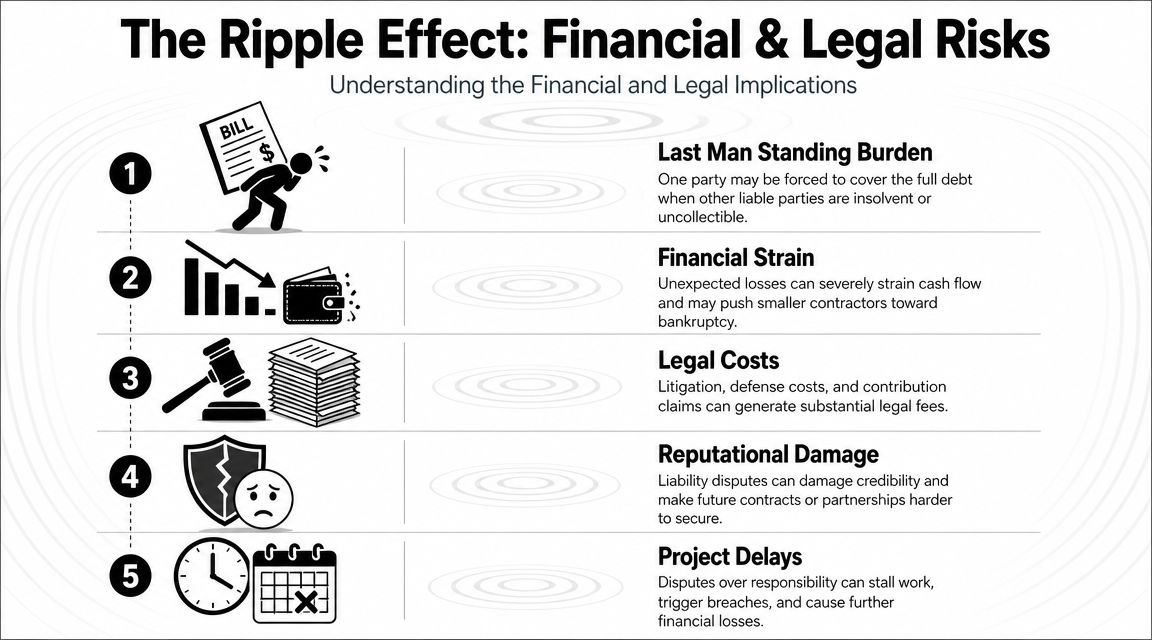
For contractors, the sharp edge of this doctrine is the last one standing problem.
If several parties are involved in the same loss and one of them has folded, lacks insurance, or can't be found, the claimant may pursue the defendant with money, cover, or both. In real life, that can be the party who kept better records, carried stronger insurance, or remained in business long enough to be sued.
Why claimants focus on recovery
In UK civil procedure, joint and several liability is essential when a claimant faces multiple defendants for an indivisible loss. It shifts insolvency risk from the injured party onto the defendants. If one defendant is insolvent or underinsured, the claimant can still recover 100% from a solvent defendant, a material risk in multi-party construction and professional-negligence disputes.
That's why lawyers often describe it as a collection rule. The doctrine doesn't just ask who was at fault. It helps decide who may be made to pay first.
What that can mean for your business
The damage isn't limited to the claim amount itself. A contractor can also face:
- Cash flow pressure, because legal disputes absorb management time and working capital
- Insurance complications, including notification duties and coverage disputes
- Recovery risk, because seeking contribution from others can mean fresh proceedings
- Commercial strain, where a dispute harms future agency or client relationships
- Operational drag, if directors or key staff are pulled into evidence, disclosure, and defence work
One solvent defendant can become the funding point for a much wider argument.
Here, contract wording, insurance schedules, and counterparty quality stop being admin and start becoming risk control.
Read the agreement like a risk document
If you work in projects where several parties overlap, it helps to look at the contract with the same care a client would use. Templeton Built's guide on understanding your construction agreement is written for a different market, but the discipline is the same: identify the clauses that move responsibility, cap exposure, or leave you carrying a problem you didn't price for.
Contractors also need to think carefully about structure. The legal and commercial consequences can differ depending on whether you trade personally, through an umbrella arrangement, or through a company. If you're weighing that decision, our guide to the advantages of a limited liability company is a practical place to start.
How to Mitigate Your Risks and Take Action
You can't wish this risk away, but you can manage it. The goal is to reduce the chance of being the easy target and improve your position if a dispute starts.
Start with the contract
Before you sign, slow down around liability language.
- Check liability clauses carefully. Look for joint and several wording, broad indemnities, uncapped loss provisions, and vague promises to accept responsibility for third-party acts.
- Look for caps and carve-outs. A sensible cap can matter. So can the exceptions, because some clauses remove the cap for specific losses.
- Test the wording against the actual project. If your role is narrow, the contract should reflect that. Broad responsibility for the entire deliverable can create avoidable exposure.
Match insurance to the work
Insurance only helps if it fits the engagement.
- Review your cover before the work starts. Professional indemnity and public liability insurance are often central, but the right mix depends on the service you provide.
- Check exclusions and conditions. A policy that exists on paper may still disappoint if the claim falls outside scope or notification rules weren't followed.
- Use a specialist where needed. If you're unsure what protection your role calls for, our guide to contractor indemnity insurance gives a useful starting point.
Carry out due diligence on the other parties
This is the part many contractors skip because it feels awkward.
Ask basic commercial questions. Who are you contracting with? Are they established, insured, and clear about responsibility? If the project depends on several businesses, weak counterparties increase the chance that a solvent party gets left carrying the claim.
Get legal advice when the risk is real
Not every contract needs a solicitor's markup. Some do.
Take advice when the project is high value, the wording is broad, the client pushes back on caps, or several parties share the same outcome. A short legal review before signature often costs less than one argument after delivery.
If you're comparing engagement models and want a practical tool rather than guesswork, Umbrella Company lets contractors compare umbrella companies based on their needs and working setup. It's one option among the checks you can use when reviewing how you'll operate in a client and agency chain.
The key takeaway is simple. Joint and several liability can turn a shared problem into one party's immediate bill. Contractors who understand that early can price better, negotiate better, and protect themselves more effectively.
If you want help comparing compliant umbrella options for your working arrangement, Umbrella Company offers a practical way to review providers and choose a setup that fits your contracting needs.


