


IR35, or the off-payroll working rules as it is officially known, is a piece of UK tax legislation that gets to the heart of how contractors work. Its purpose is to determine if a contractor is, for all intents and purposes, acting like an employee for tax reasons.
In this guide, you will learn what IR35 is, how it has changed, and how to determine your own status. If your contract is found to be 'inside IR35', you are treated as an employee for tax, meaning it is deducted at source. An 'outside IR35' determination means you are recognised as a genuine, independent business.
Understanding IR35 And Why It Matters For Contractors
At its core, IR35 exists to tackle what HMRC calls ‘disguised employment’. This is where a contractor supplies their services through a limited company, but their day-to-day working relationship with the client is practically identical to that of an employee.
For example, you hire a plumber to fix a one-off leak. That is a clear business-to-business transaction. But if you asked that same plumber to work in your office from 9-to-5 every week, using your equipment and reporting to your line manager, the relationship looks much more like traditional employment. IR35 is the framework HMRC uses to tell these two scenarios apart.
The rules first came into effect in April 2000 through the Finance Act. The goal was to ensure individuals in these 'disguised employment' situations pay broadly the same Income Tax and National Insurance Contributions (NICs) as regular employees. Getting this right is crucial, as a wrong determination can come with hefty financial penalties.
The Financial Impact Of An Incorrect Status
An incorrect IR35 status can lead to a significant tax bill. If HMRC investigates and finds a contract you treated as 'outside IR35' should have been 'inside', they can demand all the unpaid tax and NICs. On top of that, they will add interest and potentially steep penalties.
This financial risk is why both contractors and the clients who hire them must take IR35 compliance seriously. A clear, correct understanding from day one protects everyone involved from an unexpected tax bill.
To help you get a clear picture of the key differences between the two statuses, here is a quick comparison.
Inside IR35 Vs Outside IR35 At A Glance
Aspect | Inside IR35 (Deemed Employee) | Outside IR35 (Genuine Business) |
|---|---|---|
Tax & NICs | Paid via PAYE, deducted at source by the fee-payer. | Paid via Corporation Tax and dividends; contractor is responsible. |
Control | Client has significant control over how, when, and where the work is done. | Contractor has high degree of autonomy and control over their work. |
Substitution | No genuine right to send a substitute to do the work. | Contractor has a genuine right to send a qualified substitute. |
Financial Risk | Contractor bears little to no financial risk. | Contractor bears genuine financial risk (e.g., correcting errors at own cost). |
Equipment | Typically uses client-provided equipment. | Typically uses their own equipment. |
This table provides a snapshot, but every contract is unique. To build a fuller picture of your responsibilities, it is also worth understanding your wider obligations, such as the general remote work tax implications.
How IR35 Rules Have Changed Over Time
The IR35 rules we work with today have evolved significantly. Understanding this evolution is crucial for grasping why clients are so focused on compliance and how your responsibilities as a contractor have shifted.
When IR35 was first introduced, the burden of determining the status fell entirely on you. As a contractor running your own limited company, you had to assess each contract and ensure you paid the correct tax.
This created a challenge for HMRC. They believed that many contractors were incorrectly classifying themselves as ‘outside IR35’ to lower their tax liability, leading to a significant tax shortfall for the UK Exchequer.
The Public Sector Reforms in 2017
The first major change happened in April 2017, when the Off-Payroll working rules were introduced across the public sector. This was a fundamental shift in responsibility.
For the first time, the task of determining a contractor's IR35 status was moved from the contractor to the public sector organisation hiring them. If an engagement was classed as ‘inside IR35’, the body paying the contractor's company (the 'fee-payer') became responsible for deducting tax and National Insurance at source.
This was a massive turning point. It set a precedent that would soon be rolled out across the private sector and forced public sector bodies to build solid assessment processes, changing the dynamic almost overnight.
Extending the Rules to the Private Sector
After the public sector changes took effect, the government confirmed it would do the same for the private sector. After a brief delay due to the COVID-19 pandemic, these reforms went live in April 2021.
The responsibility for determining IR35 status has shifted significantly. Initially, the onus was on the contractor. However, reforms in the public sector in April 2017, and later in the private sector in April 2021 for medium and large businesses, shifted this responsibility to the end-client organisations.
Under the current rules, the end client is responsible for issuing a Status Determination Statement (SDS). This official document states whether your contract is inside or outside IR35 and provides the reasons for that decision.
This SDS must be passed down the supply chain to you and any recruitment agency involved. For any role deemed ‘inside IR35’, the responsibility for deducting tax and NICs now sits with the fee-payer, which is usually the client or recruitment agency. You can read more about how the IR35 reforms and off-payroll rules affect you.
Understanding the Small Company Exemption
There is a crucial part of the 2021 private sector reform to understand: the ‘small company exemption’. Your end client is only required to determine your IR35 status if they are a medium or large-sized business. If your client is a ‘small company’ under the Companies Act 2006, the old rules still apply.
This means that if you are contracting for a small business, the responsibility for determining your IR35 status remains with you. A business is typically considered small if it meets at least two of these criteria:
An annual turnover of no more than £10.2 million.
A balance sheet total of no more than £5.1 million.
No more than 50 employees.
This exemption is vital to understand. Your obligations can change completely depending on the size of the client you work with, so it is something you must always be aware of.
The Three Key Pillars of IR35 Status
When HMRC assesses a contract to decide if it's inside or outside IR35, they look at the actual day-to-day working relationship. Their decision is based on three core principles shaped by decades of employment law.
Understanding these pillars, often called the ‘tests of employment’, is the most important step you can take to figure out your own IR35 status. Think of them as the lens a tax inspector would use to examine your contracts and working practices.
This infographic gives a great overview of the criteria that underpin these all-important status tests.
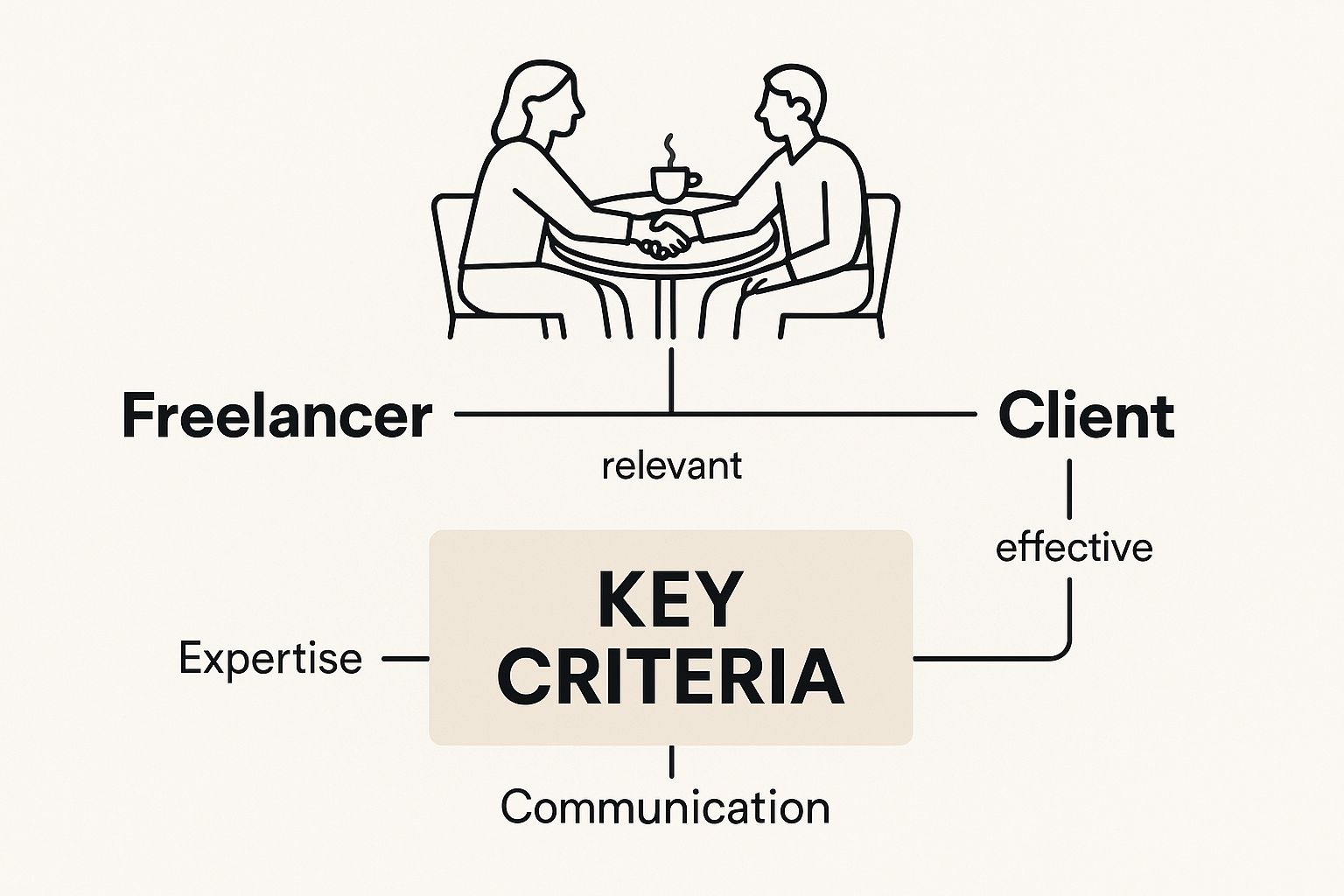
As you can see, the assessment is about the nature of the working relationship, not just what is written in a document. Let’s break down each of these key pillars.
Control: What You Do and How You Do It
The first and arguably most important pillar is Control. This test is about how much say the client has over how, when, and where you complete the work. If your client dictates your every move and manages your schedule, it looks like an employee relationship.
A genuine business-to-business engagement, which would be outside IR35, is different. A contractor is hired for their expertise and is trusted to deliver the work how they see fit.
Ask yourself these questions:
How you work: Is the client giving you a step-by-step manual, or are they relying on your professional judgement?
When you work: Do you have to follow the client’s 9-to-5 schedule, or can you manage your own time as long as you meet deadlines?
Where you work: Are you expected to be in the client’s office, or do you have the freedom to work from wherever you are most productive?
If you have a high degree of freedom over these factors, you demonstrate the independence expected of a separate business.
The Right of Substitution
Next is the Right of Substitution. This asks a simple question: can you send a suitably qualified replacement to do the work instead of you? An employee cannot send someone else to cover their shift, but a business can subcontract work.
This right must be genuine. A clause in your contract that everyone knows will never be used is not sufficient. The client’s ability to refuse your substitute should be limited, for example, they could only refuse if the person was not qualified.
A genuine right of substitution is a strong indicator of an outside IR35 status. It shows the client is paying for a service to be completed, not for the personal skills of one individual.
If you are responsible for finding and paying that substitute, your case becomes even stronger. It proves you are taking on a financial risk, which is a classic hallmark of being self-employed.
Mutuality of Obligation
The final pillar is Mutuality of Obligation (often called MOO). This test looks at expectations. Is the client obliged to offer you more work once the current project is finished, and are you obliged to accept it?
In a standard job, there is an ongoing expectation of work. For a true contractor, that 'mutuality' should not exist beyond the specific project you were hired for.
Outside IR35: Once the project is delivered, there is no obligation on either side for future work. The relationship ends with the project.
Inside IR35: If there is an understanding that the client will keep providing new tasks and you are expected to do them, it feels more like continuous employment.
MOO can be a tricky concept, but its absence is a powerful sign that you are running a proper business, moving from one distinct project to the next.
Applying the Key IR35 Status Tests
To make this clear, let's look at how different working practices stack up against these three tests. The table below shows real-world examples that point towards either an 'inside' or 'outside' IR35 determination.
Status Test | Indicates Outside IR35 (Business) | Indicates Inside IR35 (Employee) |
|---|---|---|
Control | You decide how to complete the work, set your own hours, and can work from your own premises. | The client directs how, when, and where the work is done, much like a line manager. |
Substitution | You have an unfettered right to send a qualified substitute and are responsible for paying them. | You must perform the service personally and cannot send a replacement. |
Mutuality of Obligation | Once the project is complete, there is no expectation of further work from the client. | There is an ongoing obligation for the client to provide work and for you to accept it. |
Ultimately, these tests are not a simple checklist. HMRC looks at the whole picture, weighing up all the factors to build a complete view of your working relationship with a client.
Reviewing Your Contracts and Working Practices

Understanding the theory behind IR35 is one thing, but applying it to your own situation is what truly matters. This requires a practical approach, looking closely at both your contracts and your day-to-day working practices to build a solid case for your status.
You must remember that HMRC looks beyond the written contract. They care about what actually happens in practice. A contract might state that you are ‘outside IR35’, but if your working relationship looks and feels like employment, the contract alone will not protect you.
Given how tricky IR35 can be, learning effective contract review for non-lawyers is no longer a 'nice-to-have', it is an essential skill for any serious contractor.
Creating a Clear Picture of Your Engagement
To argue convincingly that you are ‘outside IR35’, you need to see your arrangements through HMRC's perspective. This means examining the details that separate a genuine, independent business from a ‘disguised employee’. A good way to start is by asking yourself direct questions about every contract you take on.
Use this as a starting checklist:
Financial Risk: Are you taking on any real financial risk? This could include paying for your own professional indemnity insurance, fixing mistakes at your own cost, or not being paid if you do not deliver.
Equipment: Are you using your own equipment? Providing your own laptop, software licences, or specialist tools is a strong indicator of self-employment.
Business Presence: Do you look and act like a proper business? This means having a website, business cards, and potentially working with multiple clients at once.
Integration: How embedded are you in the client’s organisation? If you are on their organisation chart, have a company email address, or manage their permanent staff, you start to look like an employee.
The Role of HMRC’s CEST Tool
To help people with status determination, HMRC created an online tool called Check Employment Status for Tax, or CEST. You answer a series of questions about a contract, and it provides an opinion on your status.
It can be a useful starting point, but you must be aware of its limitations. The CEST tool has been widely criticised for being simplistic and not always reflecting the subtleties of employment law established in UK courts over the years.
One of its biggest weaknesses is that it largely ignores one of the three key tests: Mutuality of Obligation (MOO). Because of this, it can sometimes produce a determination that would not stand up in a tax tribunal.
For that reason, you should never rely on the CEST tool alone for your IR35 assessment. Treat it as one piece of evidence, not the final answer.
What to Do with Your Findings
After reviewing your contract and working practices, you should have a better sense of where you stand with IR35. If you spot any weak points or grey areas, it is time to take action.
This might mean having a conversation with your client to clarify your working relationship, or suggesting changes to your contract so it accurately reflects a business-to-business engagement. The goal is to get your contract and your day-to-day reality perfectly aligned.
And document everything. Keep records of your assessment, the reasons you believe you are outside IR35, and any related communications with your client. If HMRC ever investigates, that file will be your best friend. At UmbrellaCompany.com, we are here to help contractors with these challenges, giving you the support you need to work with confidence.
Navigating Inside IR35 with an Umbrella Company
https://www.youtube.com/embed/1_NiISfDywY
If your client has determined your contract is 'inside IR35', it can feel like a challenge. However, for most UK contractors, the path forward is straightforward: working through a reputable umbrella company. This has become the standard, compliant solution for handling inside-IR35 work.
An umbrella company acts as your professional employer. Instead of invoicing from your own limited company, the umbrella company manages the contract with the agency or client. They handle all invoicing, and when they are paid, they process your earnings through PAYE. They sort out all the necessary Income Tax and National Insurance contributions before paying you a salary.
The benefit of this arrangement is that it removes the IR35 compliance burden from you. It guarantees you are taxed correctly as an employee for that specific engagement, keeping you fully compliant with HMRC's off-payroll working rules.
How the Umbrella Process Works
The setup is straightforward. The umbrella company holds the contract with your agency or end client, and you sign a contract of employment with the umbrella. This structure makes you an employee of the umbrella company for the duration of that project.
A major benefit is that you gain access to statutory employment rights you would not have as a limited company director. This includes:
Statutory Sick Pay: A safety net if you are too ill to work.
Holiday Pay: You will accrue paid time off as you work, just like a permanent employee.
A Workplace Pension: Both you and the umbrella (as your employer) will contribute to your pension.
Continuity of Employment: Working with one umbrella company across multiple contracts creates a continuous employment record, which can help with things like getting a mortgage.
In short, the umbrella company takes care of all the administrative and tax paperwork. This frees you up to focus on delivering great work for your client. The system is designed to be as seamless as possible.
Choosing a Compliant and Trustworthy Provider
This is the most critical step. A good, compliant umbrella company offers peace of mind. Unfortunately, the industry has some non-compliant operators running tax avoidance schemes.
These schemes are often easy to spot as they promise take-home pay that sounds too good to be true. They might try to pay you through complex "loan" arrangements or other forms of disguised remuneration. These are illegal, and getting involved could leave you facing a large, unexpected tax bill from HMRC.
The best way to protect yourself is to choose an umbrella company that holds an accreditation from a respected professional body like the FCSA (The Freelancer & Contractor Services Association) or Professional Passport. These organisations put members through tough annual audits to ensure they operate compliantly and ethically.
Checking for one of these accreditations is a quick and reliable way to vet a provider. At UmbrellaCompany.com, we only recommend accredited and fully-vetted providers, so you know you are in safe hands.
Common Questions about IR35 Answered
Even when you feel you have a grasp of the basics, IR35 can present specific questions. To help you feel more confident, we have answered some of the most common queries we hear from contractors.
What Happens if HMRC Investigates My Contract?
If HMRC investigates a contract you have treated as 'outside IR35' and disagrees, the consequences can be significant. Depending on whether it is an old or new contract, either your limited company or your end client could be liable for the underpaid Income Tax and National Insurance.
On top of that bill, HMRC will add interest for late payment. They can also apply penalties, which can be severe. The size of the penalty often depends on why they believe the mistake was made, for example, whether it was due to a lack of reasonable care or a deliberate error.
This is why keeping a detailed record of your IR35 assessments, contract reviews, and working practices is so important. That documentation is your first and best line of defence if HMRC ever investigates.
Can I Have Inside and Outside IR35 Contracts at Once?
Yes, this is a very common situation for UK contractors. You must remember that every single contract must be assessed for IR35 on its own merits. It is completely possible, and acceptable, to work on one project deemed 'inside IR35' while also managing another that is clearly 'outside'.
The key is effective financial management.
For the inside IR35 contract, your income is taxed at source through PAYE, usually handled by an umbrella company or the agency paying you.
For the outside IR35 contract, your limited company is paid the gross amount, and you are responsible for managing your own tax through a mix of salary and dividends.
Solid bookkeeping is essential here to keep the two income streams separate and ensure you are fully compliant on both fronts.
What Is a Statement of Work and Does It Help?
A Statement of Work (SOW) is a document that outlines the specific scope, deliverables, milestones, and payment schedule for a project. When written correctly, a good SOW can be powerful evidence to support an 'outside IR35' status.
This is because it helps prove you have been hired to deliver a specific outcome, not just to provide your labour for a set time. This frames the relationship as a true business-to-business transaction. A well-written SOW is fantastic for demonstrating a lack of client control over how you do the work. The crucial point, however, is that your day-to-day working reality must match what is written in the SOW.
Does IR35 Apply If I Am a Sole Trader?
No, the specific IR35 legislation, the off-payroll working rules, does not apply to sole traders. These rules were created to tackle situations where someone works through their own intermediary, which is almost always a limited company (often called a Personal Service Company or PSC).
As a sole trader, you are engaged directly by the client with no intermediary company. While IR35 itself is not a concern, your employment status can still be reviewed by HMRC under general employment status rules. These rules are based on similar principles, like control and substitution, but they exist outside the specific off-payroll framework.
At UmbrellaCompany.com, we specialise in helping contractors navigate the complexities of IR35. We provide expert guidance and a trusted comparison service to connect you with compliant, accredited umbrella companies that suit your needs. Find the right support for your contracting career at https://umbrellacompany.com.


