


Indemnity insurance is a form of protection. It is there to shield professionals and businesses from taking a major financial hit if a client claims your work was not up to scratch. Think of it as a safety net, ready to catch the legal costs and any compensation you might have to pay.
This guide explains what indemnity insurance is, the main types you will encounter, and why it is essential for UK contractors.
What Is Indemnity Insurance in Simple Terms?
In essence, indemnity insurance is designed to put you back in the exact financial position you were in before a claim was ever made. For contractors, freelancers, and consultants, where your expertise is the product, this kind of protection is absolutely vital.
Without it, one simple mistake, a bit of bad advice, or an allegation of negligence could spiral into crippling legal fees and payouts. This could easily put both your business and your personal finances at risk. Having the right cover gives you the peace of mind to get on with doing what you do best.
The Main Types of Cover
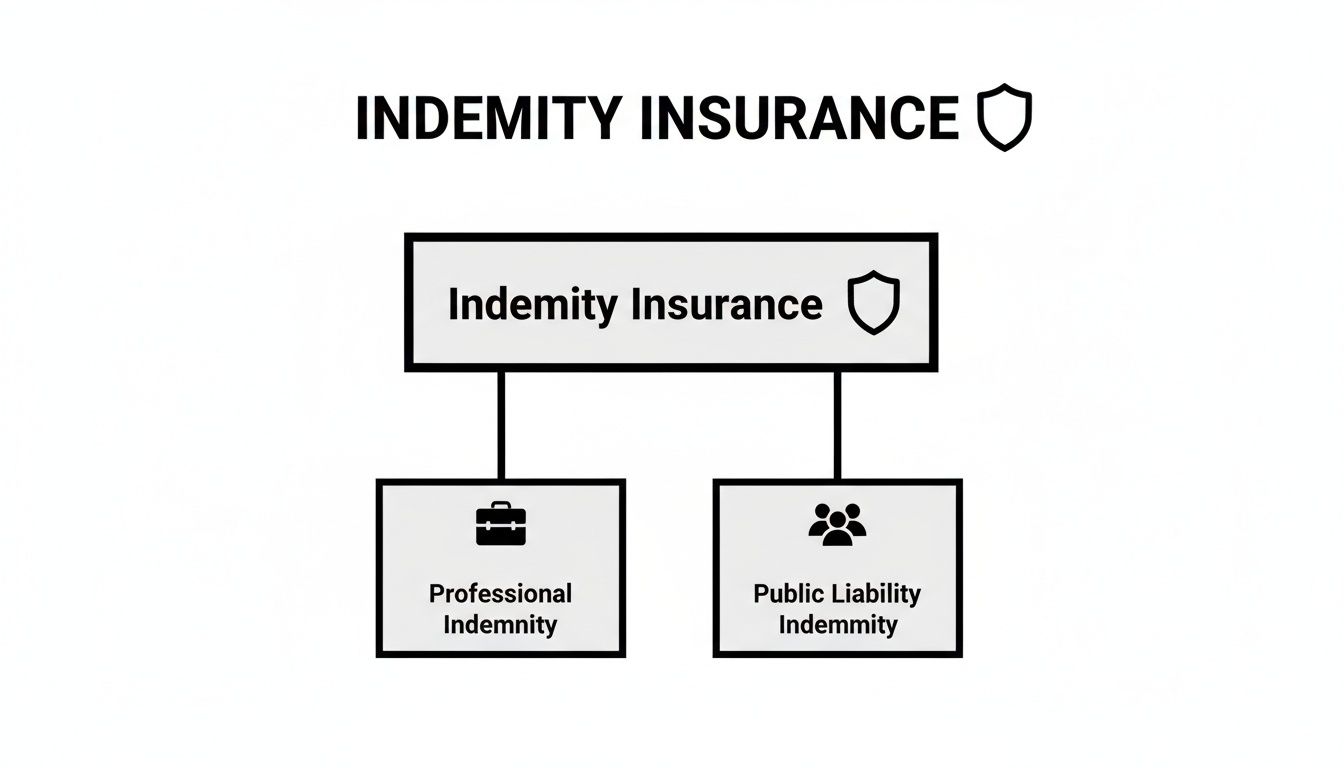
"Indemnity insurance" is a broad term that covers a few different policies. For most UK contractors, the two you will come across time and time again are Professional Indemnity (PI) and Public Liability (PL) insurance.
- Professional Indemnity Insurance: This is your defence against claims of negligence, errors, or omissions in your professional services. If a client loses money because of advice you gave or work you did, this is the policy that kicks in.
- Public Liability Insurance: This one covers you for accidents. If your business activities lead to someone being injured or their property getting damaged, public liability insurance is there to handle the claim.
This diagram shows how these key policies fit under the wider indemnity insurance umbrella.
While they both protect you, they cover very different risks. One is about the quality of your professional service; the other is about physical accidents. For a closer look, you can learn more about professional indemnity insurance for freelancers in our detailed guide.
When you hear the term 'indemnity insurance', think of it as a family of related policies, all designed to protect professionals like you. They all provide a financial shield, but they each guard against very different kinds of risks.
Getting to grips with the differences is the first, and most important, step to making sure your business is properly protected. Let's break down the three core types you're most likely to come across.

Professional Indemnity Insurance (PI)
Professional Indemnity (PI) insurance is the absolute cornerstone of cover for any contractor delivering a professional service, advice, or design. It is there to protect you if a client claims they have lost money because of a mistake you made, negligence on your part, or an error in your work.
Imagine you're an IT contractor rolling out a new software system. A tiny bug in your code ends up taking the client's e-commerce site offline for a full day, costing them a fortune in lost sales. They could easily make a claim against you for that loss. PI insurance is what would cover your legal defence costs and any compensation you're ordered to pay.
Even the most meticulous contractor can have an off day, and the financial fallout from a simple mistake can be eye-watering. That is why PI is non-negotiable. In fact, professional indemnity claims are the most common type of business insurance claim in the UK. Recent research shows that over a quarter (26%) of all annual business insurance claims are PI-related, covering everything from professional negligence to copyright breaches.
Public Liability Insurance (PL)
While PI insurance is all about the quality of your professional work, Public Liability (PL) insurance covers physical accidents. It protects you against claims from a member of the public for injury or property damage caused by your business activities.
This cover is vital for any contractor who works on client sites or has clients visit their own workspace. A classic example would be a client tripping over your laptop bag in their office and breaking their wrist. If they decide to sue, your Public Liability policy would cover the legal fees and any compensation.
Public Liability insurance deals with the real-world, physical impact of your business. It is less about the advice you give and more about making sure an accidental slip or spill does not turn into a financially devastating claim.
It's a huge mistake to think this only applies to contractors in manual trades. An office-based consultant can just as easily spill a coffee on a client's expensive server equipment, leading to a massive claim for damages.
Employers' Liability Insurance (EL)
The third key policy in the trio is Employers' Liability (EL) insurance. This one is simple. If you employ anyone, even on a temporary basis, it is a legal requirement in the UK to have it. This insurance protects your business financially if an employee gets ill or is injured as a direct result of the work they do for you.
For most contractors operating as a one-person limited company, this will not be necessary. But the moment you hire a substitute to cover for you, or even an assistant to help with admin, you must have EL insurance in place. Failing to do so can lead to hefty fines from the Health and Safety Executive (HSE).
- Who it protects: Your employees.
- What it covers: Claims for any work-related illness or injury they suffer.
- When you need it: The day you hire your first member of staff.
At UmbrellaCompany.com, we handle all of this for you. Our service comes with a comprehensive insurance package built-in, so you have all the necessary cover from day one. To see how these policies fit together, take a look at our complete guide to contractor insurance in the UK. It's all about letting you focus on your work, knowing you're fully protected.
Why Indemnity Insurance Is Non-Negotiable for Contractors
If you're a professional contractor, thinking of insurance as an optional extra is a massive miscalculation. It is not just a safety net; it is a core part of running a credible, secure business here in the UK.

The simple truth is that many end clients and recruitment agencies will not even talk to a contractor who does not have the right cover. It has become a standard, non-negotiable clause in almost every professional service contract.
Meeting Client and Contractual Demands
Before you even think about stepping onto a client’s site or touching a line of code, you will almost certainly be asked for your insurance certificates. Most contracts will explicitly state the levels of Professional Indemnity and Public Liability cover you must have.
This is not just about ticking boxes. For your client, it is fundamental risk management. They need to know that if your work accidentally causes a financial loss, or if an accident happens on their premises, there is a proper financial backstop in place.
Without proof of insurance, a contract offer can be withdrawn or your start date pushed back indefinitely. For most professional gigs, it is a complete non-starter.
Holding the right policies is also a sign of your professionalism. It tells clients you take your work and responsibilities seriously and that you are prepared for the unexpected. That builds a huge amount of trust right from the get-go.
The IR35 Connection
Beyond just keeping clients happy, having business insurance is a key pointer in determining your employment status for tax, otherwise known as your IR35 status.
HMRC sees business insurance as a strong indicator of genuine self-employment. Think about it: a regular employee is covered by their employer’s policies and would never need their own. By investing in your own cover, you are making a clear statement that you operate a real business, shoulder your own financial risks, and are separate from your client.
This helps paint a picture of a proper business-to-business relationship, which is vital for any contractor wanting to operate outside IR35. It is one of several crucial factors, alongside things like control and substitution, that proves you are not a 'disguised employee'.
Your Ultimate Financial Protection
At the end of the day, indemnity insurance is about your own peace of mind. As a contractor, the buck stops with you. Without it, you are personally liable for legal fees and any compensation awarded.
A claim of professional negligence could easily land you with legal bills running into tens of thousands of pounds, even if you are eventually proven innocent. If a court rules against you, compensation claims can be financially catastrophic, putting both your business and your personal assets on the line.
Just picture a few all-too-common scenarios:
- An IT contractor's botched data migration wipes out a client’s critical information.
- A marketing consultant gives advice that leads to a failed campaign and a huge financial loss for the client.
- A project manager’s oversight causes costly delays that put the entire project in breach of contract.
In every one of these cases, indemnity insurance is the only thing standing between the contractor and a potentially ruinous financial outcome. It is not an expense; it is a strategic investment in your livelihood, your reputation, and your future as a successful independent professional.
Understanding the Cost of Indemnity Insurance
When you're budgeting for your contracting business, one of the first questions that comes to mind is, "how much is this indemnity insurance actually going to set me back?" While there is no one-size-fits-all price tag, the cost is far from random. It is carefully calculated based on a few key factors that reflect the specific risks of the work you do.
The final premium you pay hinges on several variables. Insurers will want to know about your profession, your annual turnover, and the level of indemnity your client contractually requires. All these pieces help them build a picture of your risk profile.
Key Factors Influencing Your Premium
The biggest driver of cost is, without a doubt, the nature of your work. An IT project manager overseeing a multi-million-pound system migration simply faces a different set of potential liabilities than a freelance marketing consultant advising on a social media campaign.
Several core elements will shape your final quote:
- Your Profession: High-risk roles, like those in finance, engineering, or IT architecture, naturally attract higher premiums. This is because the potential for huge financial losses from a single error is much greater.
- Level of Cover: A client contract demanding £5 million in professional indemnity cover will, of course, cost more to insure than one that only asks for £1 million.
- Annual Turnover: Higher earnings can signal to an insurer that you're handling larger, more complex projects. They often view this as carrying a greater risk of a significant claim.
- Claims History: Just like with any other insurance, a history of previous claims can unfortunately lead to an increase in the cost of your future cover.
Current Market Trends and Realistic Costs
The good news for UK contractors is that the insurance market is fiercely competitive, which has made getting comprehensive cover more affordable than ever. Recent market shifts have been especially kind to freelancers and contractors looking for professional indemnity insurance (PII).
In fact, the market has seen some dramatic changes. In the final quarter of last year, PII premiums dropped by a staggering 25-30% compared to the previous year. This has created one of the most accessible markets in nearly a decade. For a contractor earning £50,000 annually, a drop like that could mean saving hundreds of pounds each year on essential cover. You can read more about these PII market trends to get a better sense of the shifts.
As a general benchmark, a contractor needing a standard £1 million of professional indemnity and £2 million of public liability cover might expect to pay anywhere from a few hundred to over a thousand pounds annually, depending on their role.
This affordability makes securing robust protection a straightforward and manageable business expense. At UmbrellaCompany.com, we simplify this even further by including a comprehensive insurance package as part of our service, ensuring you get the necessary cover without the hassle of shopping around.
How to Choose and Secure Your Insurance Policy
Getting the right indemnity insurance sorted is one of the most important things you will do to protect your contracting business. It can feel like a bit of a minefield, but it is actually pretty straightforward once you break it down. It all starts with figuring out what you need, comparing your options, and then giving the policy details a final, careful once-over.
Your first port of call should always be the contract from your client. Nine times out of ten, it will spell out the exact minimum levels of Professional Indemnity (PI) and Public Liability (PL) cover you need to have in place. Ticking this box is non-negotiable; you will not be able to start work without it.
Sourcing Your Insurance Cover
Once you know the required cover levels, you have got two main options. You can go directly to an insurer or a specialist broker, or you can work through a compliant umbrella company that bundles insurance into its service. For a lot of contractors, the umbrella route is simply easier and often works out cheaper.
Here at UmbrellaCompany.com, we include a comprehensive insurance package that meets industry standards as part of our margin. This means you are covered from the very first day of your assignment, without the headache of sourcing and comparing policies yourself. It's a neat, integrated approach that gives you peace of mind that your cover is fit for purpose.
Reading the Small Print
Whether you buy your own policy or get it through an umbrella, it is absolutely vital you understand what you are signing up for. Do not just glance at the big headline indemnity figure, the devil is always in the detail.
Always check the policy documents carefully. Key terms like the excess amount, retroactive date, and specific exclusions will determine how well your insurance actually protects you in a real-world claim scenario.
Keep a sharp eye out for these three critical elements:
- The Policy Excess: This is your contribution, the amount you have to pay towards a claim before the insurer steps in. A lower excess is usually better, but it might mean a slightly higher premium.
- Retroactive Cover: This one is crucial. It protects you for work you did in the past, before your current policy started. Without it, you are left completely exposed to claims that might pop up from old projects.
- Notable Exclusions: Every policy has a list of things it will not cover. You need to read these and look for anything that is particularly relevant to your line of work, as it could leave a dangerous gap in your protection. For example, some standard PI policies might exclude certain cybersecurity-related claims.
The good news is that the UK professional indemnity market is very competitive for contractors right now. Increased capacity has led to better rates, with recent reports showing London PII rates fell by 5-10%, correcting some of the big hikes we saw previously. This trend, as noted in the 2025 professional services insurance market update, makes getting robust cover more affordable. Taking the time to understand all your options, including things like dedicated IR35 insurance, will ensure you make a smart decision that properly safeguards your business.
Common Questions About Contractor Insurance Answered
Getting to grips with indemnity insurance can throw up a few practical questions. To make sure you feel completely confident, we have put together some straightforward answers to the queries we hear most often from UK contractors.

Think of these as the quick-fire round to clear up any final bits of confusion and lock in the key takeaways from this guide.
Do I Need My Own Insurance if My Client Has It?
Yes, you absolutely do. This is a common and dangerous misunderstanding. Your client’s policy is designed to protect their business, not yours.
If a claim is made about your professional services, their insurer could legally come after you or your company to get back any money they have to pay out. Your own policy is your personal and business shield. It is the only thing that guarantees your interests are protected, which is why it's a standard clause in nearly every professional contract.
What Happens if I Cancel My Policy After a Contract Ends?
Be very careful here. Cancelling your cover the moment a project wraps up can leave you seriously exposed. Most professional indemnity policies work on a ‘claims-made’ basis. This means for a claim to be paid, your insurance has to be active when the claim is filed, not just when the work was done.
Claims can pop up months, or even years, after a project is finished. To protect yourself from old projects coming back to haunt you, you should look into buying ‘run-off’ cover whenever you stop trading or take a long break from contracting.
Is Contractor Insurance a Tax-Deductible Expense?
Good news, yes, it is. In the UK, the premiums you pay for business insurance, including Professional Indemnity and Public Liability, are almost always considered an allowable business expense.
This means you can subtract the cost from your company’s profits, which in turn helps lower your corporation tax bill. If you're working through a compliant umbrella company, like the ones we partner with, they handle all of this for you. The insurance costs are simply part of their overall service.
How Does an Umbrella Company Provide My Insurance?
One of the big perks of using a reputable umbrella company is the all-inclusive insurance package. The providers we feature on UmbrellaCompany.com include comprehensive cover for Professional Indemnity, Public Liability, and Employers’ Liability as a standard part of their service.
They hold a single master policy that covers every contractor they employ, making sure you meet client demands right from day one. It takes away the hassle of shopping for quotes yourself and gives you immediate peace of mind. Getting your contracts in order is crucial, and our guide on using a freelance contract template in the UK can offer more helpful tips.
Ready to find a compliant umbrella company that includes all the insurance you need? Our comparison tool at UmbrellaCompany.com makes it easy to find the perfect match for your contracting career. We are here to help you get started with confidence. https://umbrellacompany.com


