


If you're a contractor in the UK, you have probably seen 'Employer NI' on a payslip and wondered what it is and why it affects your money. This guide will explain exactly what Employer National Insurance is, how it's calculated, and what it means for you.
Let's clear it up. Employer National Insurance is a tax paid by employers on their employees' earnings once they go over a certain threshold. It's a non-negotiable legal requirement that helps fund essential public services like the NHS and state pensions.
Understanding Employer National Insurance

When you see Employer National Insurance (NI) on a document, it is easy to think it is just another deduction from your wages. But it’s not. It is a completely separate cost that the employer is responsible for paying directly to HMRC.
This contribution is calculated on top of your salary and is a major part of the total cost of employing someone. For contractors, understanding this is vital, especially if you are working through an umbrella company or dealing with the complexities of IR35.
The Purpose of Employer NI
So, where does all this money actually go? Employer NI, combined with the contributions we all make as employees, is the lifeblood of the UK's social security system. The money collected is pooled to pay for the state-provided services and benefits we all rely on.
These contributions help finance things like:
- The National Health Service (NHS), providing healthcare for everyone in the UK.
- State Pensions, making sure there is financial support for people when they retire.
- Welfare benefits, including Jobseeker's Allowance and Universal Credit.
Think of it as the employer's share of the bill for keeping the country's welfare infrastructure running. It helps guarantee that the safety nets we all count on are properly funded.
How It Differs from Employee NI
You will often hear Employer National Insurance called secondary Class 1 contributions. This is the slice of NI that UK employers have to pay on their staff's earnings once they pass a specific threshold.
Crucially, it is a business cost and is entirely separate from Employee NI, which is what gets deducted from your own wages. This distinction is important for contractors using umbrella companies, as it directly impacts how their assignment rates are structured. To get a feel for how these rates fit into the bigger tax picture, you can explore UK National Insurance tax rate data on Statista.com.
Decoding Employer NI Rates and Thresholds
To understand Employer National Insurance, you first need to understand the numbers that make it work. HMRC sets out specific earnings thresholds, and these are what determine when an employer has to start paying. For businesses, the key figure is the Secondary Threshold (ST).
Think of the Secondary Threshold as a starting line. Once an employee's earnings cross that line, the employer is legally required to start paying National Insurance contributions on every pound earned above it. These figures are not set in stone, either. The government reviews them annually and can adjust them during major fiscal events like the Spring Budget or Autumn Statement.
We saw a good example of this with the 2022 Autumn Statement, which froze the Secondary Threshold at 2023-24 levels until April 2028. However, policies can change. A more recent budget announced the threshold will actually be lowered to £5,000 annually from April 2025. This is a significant change, as it means a larger portion of earnings will be subject to the main NI rate, directly impacting employers, including umbrella companies processing payroll for contractors inside IR35.
Current Rates and Thresholds
Keeping on top of the latest figures is absolutely critical for running an accurate payroll. The main rate for Employer NI is currently 13.8%.
Here is a quick overview of the key thresholds for the 2024/25 tax year. This applies to most employees who are on a standard NI category code (Category A).
Getting these figures straight is the first step. If you want to see how this fits into the bigger picture of payroll, you might find our guide to discover how PAYE is calculated helpful.
Key Takeaway: The Secondary Threshold is the trigger point. An employer pays 0% NI on earnings up to this limit and the standard rate on all earnings above it.
Employer NI Thresholds and Rates at a Glance
This table breaks down the essential numbers you need to know for the current 2024/25 tax year.
| Threshold Name | Weekly Earnings | Annual Earnings | Employer NI Rate |
|---|---|---|---|
| Secondary Threshold (ST) | £175 | £9,100 | 0% on earnings up to this point. |
| Earnings Above ST | Above £175 | Above £9,100 | 13.8% on earnings above the ST. |
It is a simple system once you know the trigger point: nothing is due below the ST, and 13.8% is due on everything above it.
Looking Ahead to 2025/26
It is crucial to be aware of what is coming, as it will have a real impact on payroll costs. From 6 April 2025, the landscape for Employer NI will shift quite significantly:
- The Employer NI rate will increase from 13.8% to a new rate of 15%.
- The Secondary Threshold will be reduced from £9,100 down to £5,000 per year.
Taken together, these changes mean employers will start paying NI on more of an employee's earnings, and at a higher rate. For contractors, this really drives home the importance of agreeing to an assignment rate that properly accounts for all of these statutory employment costs from the outset.
Putting the Numbers into Practice
Theory is one thing, but seeing how Employer NI is calculated in the real world is where it all makes sense. The percentages and thresholds can feel a bit abstract on their own, but a simple, practical example makes it much clearer. Let's walk through it.
The calculation itself is actually quite straightforward. It all comes down to identifying the portion of an employee's earnings that sits above the Secondary Threshold (ST). Any earnings below this point are ignored for the purposes of Employer NI.
Once you have that figure, you just apply the correct NI rate. The result is what the employer owes for that pay period.
The Core Calculation Formula
At its heart, the whole process follows one simple rule. This is the key formula that any compliant payroll provider, including umbrella companies, uses every single time they process your pay.
(Total Earnings Above the Secondary Threshold) x (Employer NI Rate) = Employer NI Due
By understanding this, you can confidently check your own payslip and see exactly how this employment cost has been handled.
Example 1: A Contractor Earning £50,000
Let’s picture a contractor on an assignment with an annual salary of £50,000. We will use the 2024/25 tax year figures, where the Secondary Threshold is £9,100 and the Employer NI rate is 13.8%.
- Isolate the Taxable Earnings: First, we subtract the threshold from the total salary.
- £50,000 – £9,100 = £40,900
- Apply the NI Rate: Next, we just apply the 13.8% rate to that amount.
- £40,900 x 0.138 = £5,644.20
So, for a contractor on a £50,000 assignment rate, the total annual Employer NI contribution comes to £5,644.20.
Example 2: A Contractor Earning £75,000
Now, let's take a contractor on a higher rate, earning £75,000 a year. The threshold and the rate are exactly the same.
- Isolate the Taxable Earnings: Again, we find the amount above the ST.
- £75,000 – £9,100 = £65,900
- Apply the NI Rate: And then we calculate 13.8% of this figure.
- £65,900 x 0.138 = £9,094.20
In this case, the annual Employer NI liability is £9,094.20. As you can see, the contribution scales directly with earnings once you are over the threshold.
If you want to see how these costs affect your net pay, you can use our comprehensive payroll calculator to estimate your take-home pay.
The Role of Employer NI in Umbrella Company Payroll
For contractors, understanding Employer NI is absolutely crucial when you are working through an umbrella company. Once you join one, they effectively become your employer for tax purposes. This means they are responsible for managing all the statutory costs of employment, and Employer National Insurance is a big part of that.
A common mistake for new contractors is seeing Employer NI on a payslip and thinking it’s a deduction from their personal income. It’s not. Instead, it’s an unavoidable cost that has to be covered by the assignment rate you agree with your client or recruitment agency. This rate is the total pot of money set aside for the work you do.
How the Assignment Rate Works
Think of the assignment rate as one big pot of money. Before your own salary can even be calculated, the umbrella company uses this pot to cover all the necessary employment costs. This whole process ensures they are fully compliant with HMRC regulations, which protects everyone in the supply chain.
So, from this initial assignment rate, the umbrella company covers:
- Employer National Insurance
- The Apprenticeship Levy
- Employer pension contributions
- Your accrued holiday pay
- The umbrella company's margin for their services
Whatever is left after these costs are sorted becomes your gross pay. It is from this gross pay figure that your personal deductions, like Employee NI and PAYE income tax, are then calculated and sent to HMRC.
This structure guarantees that all the legal and financial duties of being an employer are met properly. This flowchart gives you a simplified look at how the NI calculation works in practice.
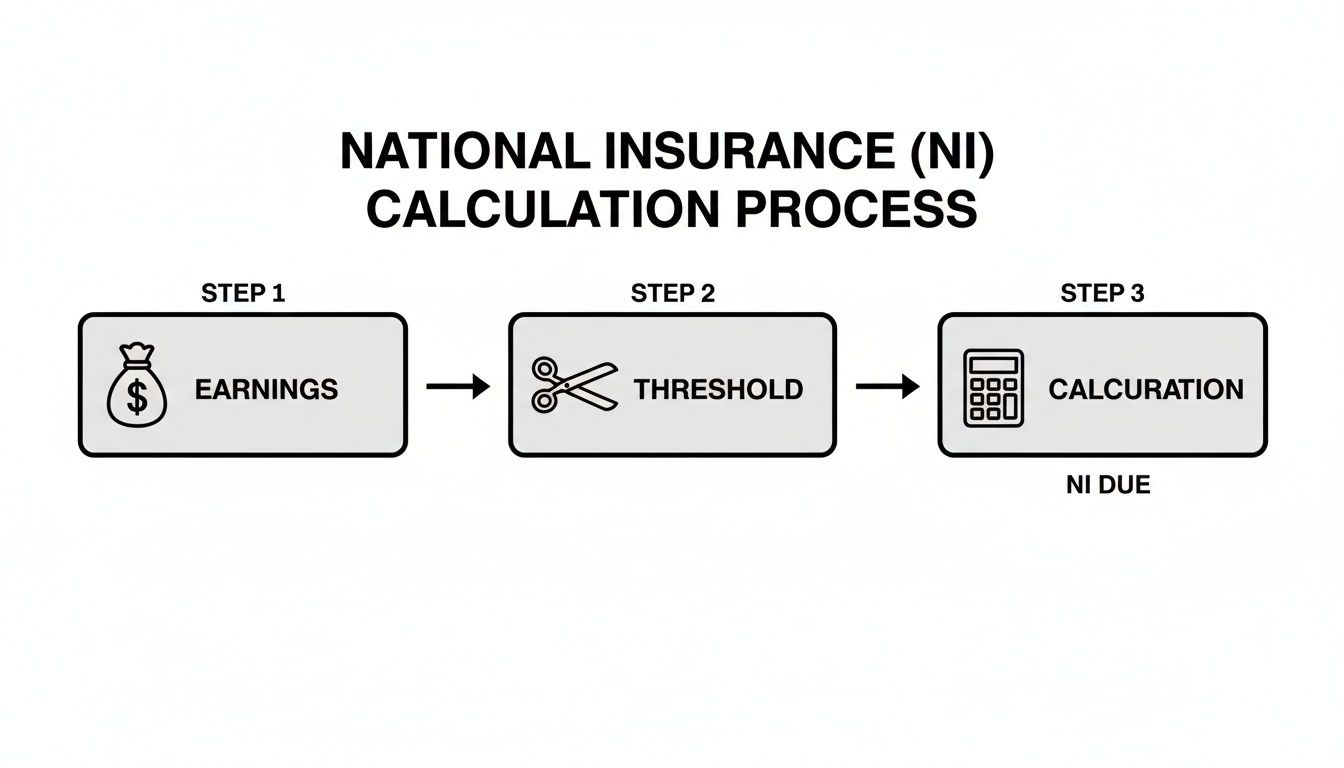
As you can see, the process is broken down into three clear stages: identifying the total earnings, applying the threshold, and then calculating the NI due on the income above it.
Why This Structure Matters
This is not a quirky model; it is standard practice for any compliant umbrella company. It ensures the money from the end client is enough to cover every single employment cost, leaving no financial loose ends or surprises. It is also a key reason why the assignment rate for an umbrella contractor is higher than the equivalent PAYE salary for a permanent employee.
By covering Employer NI from the assignment rate, the umbrella company acts as a compliant and responsible employer, managing the complex administrative tasks so you do not have to.
Understanding this is essential for accurately working out your take-home pay and comparing different contract offers. To get a more detailed look at the entire payroll journey, you can learn more about how an umbrella company works in our dedicated guide. It is all about transparency and making sure there are no shocks when your payslip arrives.
While Employer NI is a standard cost of doing business, it is not always a fixed calculation. The government has several relief schemes and exemptions in place, mostly designed to encourage the hiring of certain groups of people or to give smaller businesses some support.
Understanding these reliefs is key to understanding the full UK payroll picture. It also highlights why working with a compliant umbrella company is so important, we make sure every rule is applied correctly, which means a fair and transparent payroll process for every contractor.
The Employment Allowance
One of the biggest reliefs available is the Employment Allowance. This is a real helping hand for smaller businesses, allowing them to reduce their annual Employer NI bill by up to £5,000 for the 2024/25 tax year.
It is not for everyone, though. To qualify, a business must have had a total Class 1 National Insurance bill of less than £100,000 in the previous tax year. This provides direct financial support where it's needed most: for the UK's many small and medium-sized enterprises.
It's worth noting that most umbrella companies cannot claim the Employment Allowance. This is because our total NI liability is far higher than the £100,000 threshold. This rule is specifically in place to stop larger organisations from benefiting.
Key NI Exemptions for Employers
Beyond the Employment Allowance, there are also specific exemptions that can reduce or even completely remove the Employer NI cost for certain employees. These are targeted incentives that can really shift the numbers on an employer's balance sheet.
Even with these breaks for specific groups, these contributions generate significant revenue for the government. You can get a detailed breakdown by reviewing UK National Insurance rates on RossMartin.co.uk.
Here are the main exemptions in play:
- Employees under 21: Employers pay 0% Employer NI on their earnings up to the Upper Secondary Threshold, which is £50,270 a year.
- Apprentices under 25: They get the same deal, a 0% NI rate on earnings up to that same £50,270 threshold.
- Military Veterans: For the first year of a veteran's civilian employment, their employer pays 0% NI on earnings up to the threshold.
- Freeport Employees: Special reliefs are also available for new staff working within designated Freeport tax sites.
These measures play a crucial role in shaping the UK labour market and ensuring everyone stays compliant. Here at UmbrellaCompany.com, we navigate all these complexities for you, making sure your payroll is always accurate and in line with HMRC’s latest rules.
Understanding Your Payroll Responsibilities
Every compliant employer in the UK, including us at UmbrellaCompany.com, has a non-negotiable set of payroll and reporting duties. The whole system is managed through HMRC’s Pay As You Earn (PAYE) framework, which is designed to make sure tax and National Insurance are collected correctly and on schedule.
When you work with us, we take care of all these administrative hurdles for you. This means you get complete peace of mind that all the legal boxes are ticked, leaving you free to concentrate on your actual contract work.

Real Time Information (RTI) Submissions
A central part of modern UK payroll is the Real Time Information (RTI) system. This is not just good practice; it is a mandatory electronic reporting process that keeps HMRC in the loop with payment details as they happen.
Under RTI, we have to send a Full Payment Submission (FPS) to HMRC every single time we process your pay. This report breaks down your gross pay and all the deductions, including Employer NI, for that specific payment. It has to be filed on or before your payday.
RTI reporting creates total transparency with HMRC. It confirms that the right amounts of tax and National Insurance are being calculated and recorded for every payment you get, forming a key part of our commitment to compliance.
This system has truly changed the game for payroll, making everything far more accurate and reducing the risk of year-end errors that used to be common.
Deadlines and Penalties
Just reporting the figures is only half the job. The other critical task is actually paying the tax and National Insurance we've collected over to HMRC. The deadline for this is strict and does not move.
- Payment Deadline: All PAYE tax, Employee NI, and Employer NI must be paid to HMRC by the 22nd of the month that follows the tax month it was deducted in. So, for a May payroll, the payment is due by 22nd June.
HMRC is very serious about these deadlines. Late payments or incorrect RTI submissions can lead to penalties and interest charges that can mount up surprisingly fast. This is exactly why partnering with a professional, accredited umbrella company is so vital. If you are curious about the mechanics, our guide on setting up a PAYE scheme breaks it down further.
We manage all of this meticulously, making sure every deadline is met and every report is accurate. This protects you from any potential compliance headaches and lets you enjoy the freedom of contracting without the administrative burden.
Still Have Questions About Employer NI?
We have covered the technical details, but it's natural if a few questions still remain. Let's tackle some of the most common ones we hear from contractors trying to understand employer NI.
Is Employer NI Taken From My Salary?
No, this is a common point of confusion. Employer NI is never deducted from your salary. It is an entirely separate tax that your employer pays on top of your wages.
When you are working through an umbrella company, this cost is built into the assignment rate agreed with your client from the outset. It is not a surprise deduction from your gross pay.
So, Who Actually Pays the Employer NI Bill?
The legal responsibility to pay Employer NI contributions to HMRC always sits with the employer.
When you join an umbrella company like one of our partners, they become your employer for tax purposes. This means they take on the legal duty of calculating and paying all the necessary taxes, including employer NI, so you do not have to worry about it.
Why Is My Umbrella Assignment Rate Higher Than a Standard Salary?
This is a great question. The assignment rate for a contractor has to cover the total cost of employment, not just your take-home pay.
Think of it like an all-inclusive price. It covers your gross pay, but it also has to account for Employer NI, the Apprenticeship Levy, your accrued holiday pay, and the umbrella company’s margin. A permanent employee's salary figure does not show these extra employer costs, but they are still being paid behind the scenes.
Can I Use the Employment Allowance to Reduce the NI?
Unfortunately, as an individual contractor, you cannot claim the Employment Allowance yourself. This relief is strictly for the employer.
Most umbrella companies are not eligible either. Their total annual NI bill is usually far greater than the £100,000 threshold set by HMRC, which means the allowance simply does not apply to them.
At UmbrellaCompany.com, our goal is to cut through the jargon and make contracting simple. We connect you with compliant, accredited umbrella companies that handle all this complexity with total transparency, so you can focus on your work.


