


If you have spent any time on a building site in the UK, you have probably heard people talking about ‘CIS’. But what is it, exactly?
In short, the Construction Industry Scheme (CIS) is a set of special tax rules created by HMRC specifically for the construction industry. It is a system that ensures tax is collected from subcontractors throughout the year, rather than waiting until the end of the tax year. The main purpose is to reduce tax evasion and ensure everyone pays their fair share.
This guide explains what the Construction Industry Scheme is, who it affects, and how it works in practice. You will learn about your responsibilities as a contractor or subcontractor and how to stay compliant with HMRC's rules.
The Core Principles of the Construction Industry Scheme
At its heart, CIS manages the flow of payments between main contractors and the subcontractors they hire. Think of it as a 'pay-as-you-go' tax system tailored for builders, plumbers, electricians, and other construction trades.
Instead of a subcontractor receiving full payment and sorting out their tax bill later, the contractor deducts a portion for tax at the source. That money is then sent directly to HMRC on the subcontractor's behalf.
This system was introduced to handle the unique nature of the construction sector, where much of the labour is self-employed and moves between projects. By collecting tax incrementally, HMRC receives a steady stream of revenue and there is less risk of large, unpaid tax bills accumulating. For firms navigating these rules, using companies that offer specialized services in Payroll and CIS can be a significant time-saver.
Why Was CIS Created?
The construction industry has a historical reputation for 'cash-in-hand' jobs and payments that might not always be declared on a tax return. CIS was designed to tackle this issue directly.
By making the main contractor responsible for the initial tax deduction, the scheme creates a clear paper trail that is much harder to ignore.
This has several key benefits:
- Reduced Tax Evasion: It makes it more difficult for income to go undeclared.
- Improved Cash Flow for HMRC: Tax is collected consistently, not just in one large sum after the tax year ends.
- A Fairer System: It helps to level the playing field, ensuring everyone contributes appropriately.
To give you a quick overview, here are the key moving parts of the scheme.
| CIS at a Glance: Key Components |
| :— | :— |
| Component | Brief Explanation |
| Contractor | The business that hires other self-employed individuals (subcontractors) for construction work. |
| Subcontractor | The self-employed individual or business hired by a contractor to carry out construction work. |
| Verification | The process where a contractor checks a subcontractor's CIS status with HMRC. |
| Deduction | The percentage of a subcontractor's payment (excluding materials and VAT) that the contractor pays to HMRC. |
| Payment Statement | A document the contractor must give the subcontractor showing the gross payment and any CIS deductions made. |
This table neatly summarises the main roles and actions, but the day-to-day reality involves the flow of money and information between these parties.
How It Works in Simple Terms
So, what does this look like in practice?
Imagine a large building firm (the contractor) hires a self-employed electrician (the subcontractor) to wire a new housing development. When the electrician finishes the job and submits their invoice, the contractor does not simply pay the full amount.
First, the contractor must verify the electrician's CIS registration with HMRC. Depending on the electrician's status, the contractor will then deduct either 20% (the standard rate for registered subcontractors) or 30% (the higher rate for those not registered) from the payment. It is crucial to remember this deduction only applies to the labour part of the invoice, not materials or VAT.
This deducted amount is paid directly to HMRC by the contractor. It acts as an advance payment towards the electrician's annual tax and National Insurance bill. The electrician receives the remaining payment, along with a statement showing exactly how much was deducted.
Who Needs to Register for CIS?
Determining if you need to register for the Construction Industry Scheme (CIS) is the first and most crucial step. The scheme divides everyone involved into two distinct roles: contractors and subcontractors. Understanding where you fit is fundamental to staying compliant.
A contractor is any business that pays others for construction work. A subcontractor is the party being paid by a contractor to do that work. It is not always clear-cut, as it is common for a business to act as both, receiving payment from a main contractor while also paying smaller specialist firms.
The Contractor's Role
If you are a contractor, registration is not optional, it is mandatory. You must be signed up for CIS before you engage your first subcontractor.
The definition of a 'contractor' is wider than many people realise. It is not limited to building firms. Your business must also register as a contractor if it is not a mainstream construction company but has significant spending on construction. The trigger point is an average annual spend on construction work exceeding £1 million a year over any three-year period.
This rule often applies to organisations such as:
- Property developers
- Housing associations
- Local authorities
- Large retailers that regularly refurbish their stores
Many businesses in these sectors overlook this, but if their construction spending reaches that £1 million threshold, they fall under CIS rules just like a typical builder.
Once you are registered, your main duties are to verify every subcontractor with HMRC, deduct the correct amount of tax from their payments, and file your monthly returns on time.
The Subcontractor's Role
For subcontractors, registering for CIS is not compulsory, but it is highly advisable. If you are self-employed or run a business doing construction work for a contractor, this applies to you.
The main incentive relates to the tax deduction rate. There are two key figures:
- Registered subcontractors have tax deducted at a standard rate of 20%.
- Unregistered subcontractors face a much steeper deduction of 30%.
That 10% difference can significantly impact your cash flow. Registering means more of the money you have earned stays in your pocket from the start. If you are just beginning your journey, our guide on how to become a contractor in the UK is packed with useful advice for getting set up correctly.
What Actually Counts as Construction Work?
HMRC is very specific about what it defines as 'construction operations'. If the work you are doing (or paying for) is on their list, then CIS applies.
Most activities you would expect to see on a building site are covered, including:
- Site preparation, laying foundations, and general groundwork.
- The actual building, plus any alterations, repairs, and demolition.
- Installing systems like heating, lighting, power, water, and ventilation.
- Finishing jobs like painting and decorating.
However, some services are specifically excluded. Professional work like architecture and surveying is exempt. The same applies to carpet fitting and simply delivering materials to a site (as long as you are not involved in fixing them).
HMRC is increasing its focus on CIS compliance. They are looking closely for common mistakes like misclassifying subcontractors and filing late returns. With digital tax tools providing more visibility than ever, getting it right from the start has never been more important.
This heightened scrutiny means a simple registration mistake can easily lead to penalties. People often make errors by failing to properly verify a subcontractor's status, which leads to incorrect tax deductions and a formal notice from HMRC. Getting your status right is not just a box-ticking exercise; it is the foundation of your entire CIS compliance.
How CIS Tax Deductions Work in Practice
Understanding the theory of the Construction Industry Scheme (CIS) is one thing, but seeing how it works day-to-day is what really matters. For contractors, deducting tax from a subcontractor's payment is not a choice, it is a strict sequence of steps set by HMRC. It all starts with one crucial task: verifying your subcontractor.
This verification process is the absolute foundation of your CIS duties. Before you pay a subcontractor for the first time, you must check their registration status with HMRC. This single check determines the rate of tax you are legally required to deduct, ensuring you get it right from the very beginning.
The Three CIS Deduction Rates
Once you have verified a subcontractor, HMRC will inform you which of three tax statuses they fall under. Each one has a specific deduction rate you must apply to the labour element of their invoices. Getting this right is a core compliance requirement.
The three possible statuses are:
- Gross Payment Status (0% Deduction): Subcontractors who have met HMRC’s strict criteria for this status are paid in full, with no tax taken off. This is a major benefit for their cash flow, as they settle their own tax bill at the end of the year.
- Standard Rate (20% Deduction): This is the most common status. It applies to subcontractors who are properly registered for CIS but do not have gross payment status. A 20% deduction is taken from their labour payments and sent directly to HMRC.
- Higher Rate (30% Deduction): This much steeper rate applies when a subcontractor is not registered for CIS, or if you cannot verify them with HMRC. It acts as a powerful incentive for subcontractors to register and comply with the rules.
To make this crystal clear, here’s a quick overview of how the subcontractor's status directly impacts the deduction rate you must apply.
CIS Subcontractor Status and Deduction Rates
| Subcontractor Status | HMRC Verification Result | Tax Deduction Rate |
|---|---|---|
| Gross Payment Status | Subcontractor is registered for gross payment. | 0% |
| Standard Net Status | Subcontractor is registered for net payment. | 20% |
| Unverified / Unregistered | Subcontractor is not registered or cannot be verified. | 30% |
As you can see, the verification step is non-negotiable. It is the only way to know for sure which rate to use and remain compliant.
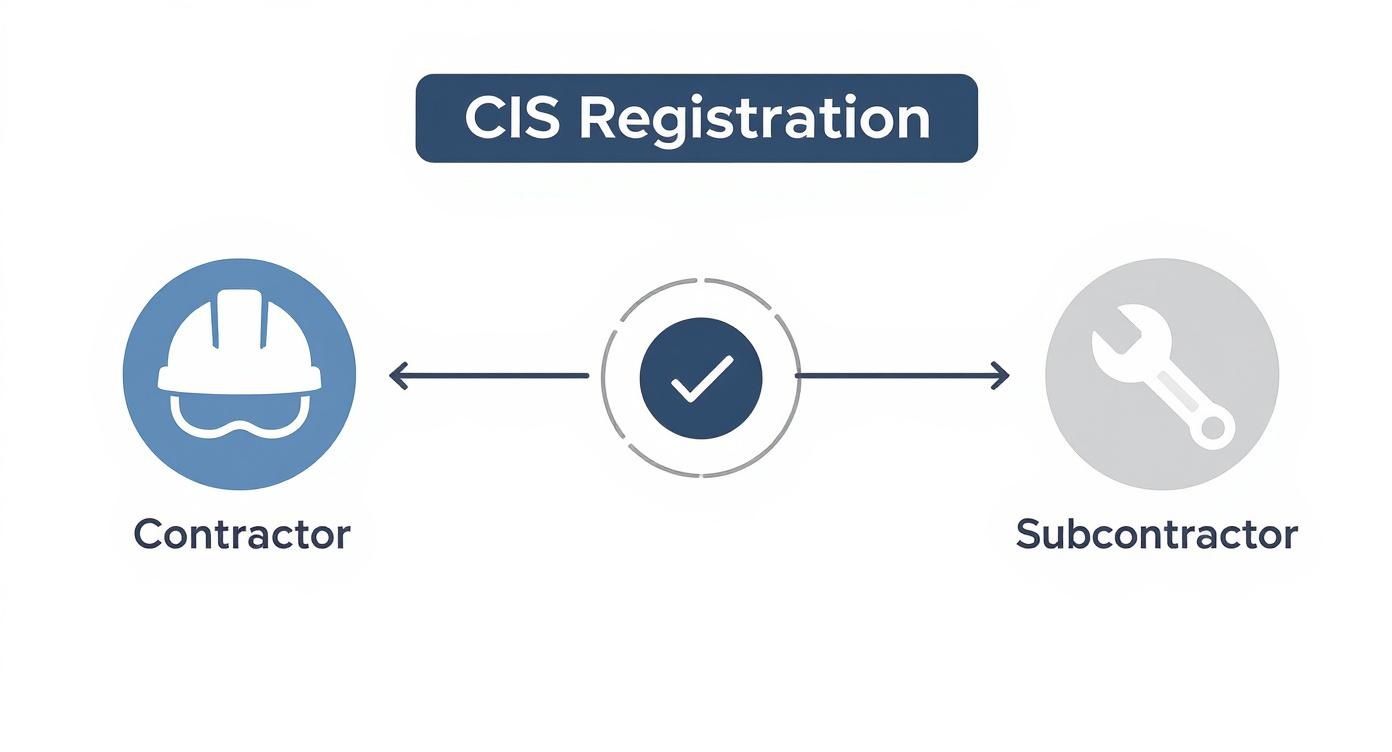
This simple flow shows that the contractor’s first job is always to verify the subcontractor. That single action sets the correct payment and deduction pathway in motion.
Calculating the Deduction: A Practical Example
Let's walk through a real-world scenario. Say you have hired a CIS-registered plasterer (who is on the standard 20% rate) for a project. They send you an invoice for £1,500.
The invoice breaks down like this:
- Labour: £1,000
- Materials: £300
- VAT: £200
The key thing to remember is that the CIS deduction is only applied to the cost of labour. You must ignore the cost of materials and any VAT when doing the calculation.
Here is the simple calculation:
- Identify the labour cost: £1,000
- Apply the correct deduction rate: 20% of £1,000 = £200
- Calculate the final payment: £1,500 (total invoice) – £200 (CIS deduction) = £1,300
- Pay HMRC: That £200 deduction is set aside and paid to HMRC with your monthly return.
This is very different from how typical payroll works, where tax is handled through the Pay As You Earn (PAYE) system. Under CIS, the subcontractor is still self-employed and is responsible for settling their final tax bill with HMRC through their Self Assessment tax return.
Your Monthly Duties as a Contractor
The job is not done once you have paid the subcontractor. As a contractor, you have two final, non-negotiable tasks every month to stay compliant. If you miss these deadlines, you can expect instant penalties from HMRC.
Your monthly duties are:
- File a Monthly Return: You must submit a CIS return to HMRC by the 19th of every month. This report lists every single payment you made to all your subcontractors in the previous tax month (which runs from the 6th of one month to the 5th of the next).
- Provide Payment and Deduction Statements: For every payment, you are legally required to give each subcontractor a written statement. This document needs to show the gross payment amount and clearly state how much CIS tax you have deducted. It is their proof of tax paid.
Managing CIS correctly is the mark of a professional and trustworthy contractor. It builds confidence with your subcontractors, who rely on you to handle their deductions accurately so they can manage their own tax affairs without any unexpected issues. Consistent, on-time compliance is the bedrock of strong, lasting business relationships in the construction industry.
Qualifying for Gross Payment Status
For most subcontractors, achieving gross payment status is the ultimate goal. It means you are paid your full invoice value, with no CIS tax withheld by the contractor. This makes a huge difference to your cash flow, freeing up vital working capital to run the business smoothly and fund its growth.
Instead of having tax deducted upfront, you become responsible for settling your own tax and National Insurance bill at the end of the year. It is a sign of a well-run business, but HMRC does not grant this status easily. You must prove you are trustworthy by passing three strict tests.
The Three HMRC Hurdles for Gross Status
To get your application for gross payment status approved, you need to satisfy HMRC on three fronts: the business test, the turnover test, and the compliance test. There is no flexibility here; you must pass all three. HMRC will also conduct periodic reviews to ensure you continue to meet the standards.
Let’s look at what each test involves.
1. The Business Test
This test is usually the most straightforward. You just need to show HMRC that you are running a genuine construction business in the UK. The main evidence they look for is a business bank account. They want to see a clear separation between your business finances and personal spending.
2. The Turnover Test
This test focuses on your business's income. HMRC needs to see that your construction turnover (excluding VAT and the cost of materials) has reached a certain level.
Here are the minimum thresholds you need to meet:
- For sole traders: Your annual construction turnover must be at least £30,000.
- For partnerships and limited companies: The requirement is £30,000 for each partner or director, or a minimum of £100,000 for the entire business.
You will need to have financial records to back this up, showing a consistent stream of work.
3. The Compliance Test
This is often the most challenging part. HMRC will scrutinise your tax history to check if you have a solid track record of following the rules.
To pass the compliance test, your tax record must be impeccable. This means you have filed all your tax returns and paid all tax and National Insurance on time for the past 12 months. Any significant failures could lead to your application being rejected.
HMRC is essentially asking: "Can we trust you to pay your tax later if we do not take it now?" A history of late payments, missed deadlines, or outstanding tax debts suggests that the answer is no. Securing, and keeping, gross payment status is a testament to your financial discipline and reliability.
Navigating CIS Compliance and Common Pitfalls

Staying on the right side of the Construction Industry Scheme (CIS) is not just good practice, it is absolutely essential. If you get it wrong, you could face significant penalties from HMRC and damage to your professional reputation.
Most problems begin with simple administrative mistakes that can quickly escalate. This could be anything from forgetting to verify a new subcontractor to making a slight error in a deduction calculation. These small oversights can have major financial consequences.
Let's walk through the most common traps and provide clear, practical advice on how to avoid them.
Common Mistakes Contractors Make
For contractors, the compliance burden is significant. The responsibility to verify, deduct, and report falls squarely on your shoulders. Knowing where others have made mistakes is one of the best ways to protect your business.
Here are the most common errors we see:
- Forgetting to Verify: You must verify every single subcontractor with HMRC before their first payment is made. If you skip this, you risk applying the wrong deduction rate and receiving a penalty.
- Incorrect Deduction Calculations: This is a classic mistake. Many people wrongly apply the deduction to the entire invoice. Remember, CIS deductions are only for the labour element, not materials, VAT, or plant hire.
- Missing Monthly Return Deadlines: CIS returns are due by the 19th of every month. A late submission triggers an immediate £100 penalty, which continues to grow the longer it is left. Consistency is vital.
- Failing to Provide Payment Statements: You are legally required to give each subcontractor a payment and deduction statement every month. This is their proof of tax paid and is essential for their own tax returns.
Pitfalls for Subcontractors
While contractors handle the administration, subcontractors also have responsibilities. You need to proactively manage your CIS status to protect your cash flow and avoid tax complications later.
Subcontractors often encounter problems by:
- Not Registering for CIS: This is a costly mistake. If you are not registered, you will automatically face the higher 30% deduction rate, which takes a huge portion of your earnings.
- Poor Record-Keeping: Not keeping all your payment and deduction statements makes completing your Self Assessment tax return extremely difficult. It is the only way to accurately reclaim any overpaid tax.
- Misunderstanding Employment Status: It is crucial to know your employment status for tax purposes. This not only affects CIS but also links to your obligations under the off-payroll working rules. You can learn more in our simple guide on what IR35 is.
Meticulous record-keeping is the cornerstone of CIS compliance for both contractors and subcontractors. Keeping invoices, payment statements, and verification records for at least three years is not just a recommendation; it is a requirement that can save you from major issues during an HMRC audit.
The Importance of Strong Processes
Ultimately, staying compliant and avoiding penalties comes down to having solid, repeatable processes. Using accounting software with built-in CIS features can automate much of the work, reducing the risk of human error.
Beyond tax, contractors also need to consider other key protections. It is worth exploring the essential business insurance for contractors to ensure your business is fully covered. Here at UmbrellaCompany.com, we believe in clear, simple systems that make compliance straightforward, so you can focus on what you do best.
How CIS Interacts with Umbrella Companies and IR35
In the construction sector, understanding the Construction Industry Scheme (CIS) is only part of the puzzle. You also need to consider IR35 (the off-payroll working rules) and the role of umbrella companies. Knowing how these three elements fit together is essential if you want to remain compliant with HMRC.
For the most part, the distinction is clear. A genuine subcontractor who controls their own work and meets the criteria for self-employment will usually fall under CIS and be classed as outside IR35. The contractor makes the standard CIS deductions, and the subcontractor is responsible for settling their own tax bill at the end of the year.
However, the situation becomes more complex when a role is deemed 'inside IR35'. This is HMRC's determination that, for tax purposes, the worker is effectively an employee of the end client. When this occurs, PAYE employment taxes must be paid, and processing payments through CIS is no longer a compliant option.
The Umbrella Company Solution for IR35 Roles
When an assignment is inside IR35, a compliant umbrella company offers a clean, straightforward solution. Instead of being paid as a self-employed subcontractor, the worker becomes a full employee of the umbrella company.
This simple change completely alters the payment structure, removing CIS from the process entirely.
Think of an umbrella company as your official employer for the duration of the contract. They handle all your tax and National Insurance contributions through the standard Pay As You Earn (PAYE) system. This ensures you are fully compliant on inside IR35 roles, removing the complexity of CIS for both you and the hiring company.
The benefits are twofold. As the worker, you receive full employment rights, such as statutory sick pay and holiday pay, which provides greater stability. For the hiring contractor, it completely removes the risk and administrative burden of managing CIS deductions and complex employment status decisions. You can learn more about how umbrella companies work in our detailed guide.
Why Compliance is Key in a Growing Industry
The UK construction sector is expanding. Projections suggest it could grow by 18% over the next five years, driven by government investment and major infrastructure projects. This growth, however, is built on a foundation of strict regulations.
HMRC is increasing its focus on compliance to ensure everyone adheres to the CIS rules. This is a vital part of maintaining the health of an industry that employs around 1.4 million people and is a cornerstone of the UK economy.
Choosing the right payment route is not just about ticking boxes; it is about future-proofing your career in a booming but increasingly regulated industry. Working through an accredited umbrella company for your inside IR35 roles provides peace of mind. It means your tax is handled correctly and professionally, leaving you free to focus on what you do best.
Your Questions Answered on the CIS Scheme
Getting to grips with the Construction Industry Scheme (CIS) often raises specific questions, especially when dealing with different job types or managing your tax affairs. We have answered some of the most common queries to help you handle these situations with more confidence.
What Types of Construction Work Are Exempt from CIS?
Not every job on a construction project is covered by CIS. HMRC has established clear guidelines to avoid confusion, setting out a specific list of excluded activities.
Generally, the following services are exempt:
- Professional and advisory roles, such as the work of architects or surveyors.
- Scaffolding hire, but only if you are supplying the equipment and not the labour to erect it.
- Simple delivery of materials to a site, for example, a courier dropping off a pallet of bricks.
- Carpet fitting, which HMRC considers a separate trade that falls outside the scheme.
- Work on sites not classified as construction sites, such as creating artistic works or signwriting.
It is crucial to remember that if you have a single contract that includes both CIS-covered work and exempt work, the entire payment for that contract usually falls under the scheme.
How Do Subcontractors Reclaim CIS Deductions?
If you are a subcontractor, the deductions taken from your pay are not lost money. They are advance payments towards your annual tax and National Insurance bill. When the tax year ends, you can claim back any overpayment.
The process for reclaiming your money depends on your business structure:
- Sole traders and partners claim back any overpaid tax through their annual Self Assessment tax return. The total amount of CIS deducted is calculated and offset against what you owe in Income Tax and National Insurance. If you have paid too much, HMRC will issue a refund.
- Limited companies reclaim their CIS deductions through their regular PAYE and National Insurance payments to HMRC. The CIS suffered can be used to reduce the company's monthly or quarterly PAYE bill.
Regardless of your business structure, keeping meticulous records of every payment and deduction statement is essential for making an accurate claim.
Can I Be a Contractor and a Subcontractor at the Same Time?
Yes, absolutely. In fact, it is a very common scenario in the construction industry. Many businesses act in both capacities, often on the same project.
For example, imagine a general building firm hired by a major developer. In that relationship, they are the subcontractor. However, that same firm then needs to engage specialist electricians and plumbers. In this context, they become the contractor for those trades.
If this describes your business, you must register with HMRC as both a contractor and a subcontractor. This means you will have CIS deductions taken from your income from the developer, and you will also be responsible for making CIS deductions from the payments you make to your own subcontractors.
Juggling the rules of CIS, IR35, and contractor payments can feel complex. At UmbrellaCompany.com, we cut through the complexity by helping you find and compare compliant umbrella companies that fit your specific needs. Find the right umbrella company for you in just a minute.


