


If you’re employed in the UK, you have almost certainly seen National Insurance deductions on your payslip. Think of it as your contribution to the country's social safety net; it’s what funds essential services like the State Pension, NHS, and employment benefits.
For most people, this is Class 1 National Insurance, and your employer automatically handles it through the PAYE system. This article will explain what it is, how it's calculated, and what it means for you. This applies whether you're a permanent employee or a contractor working through an umbrella company.
Understanding Class 1 National Insurance

At its core, Class 1 National Insurance contributions (NICs) are the foundation of the UK's welfare system. But it’s not just a single payment. When you work for an employer, these contributions are actually split into two separate parts, and understanding both is vital, especially if you're a contractor.
The Two Parts of Class 1 NI
The system is built on a dual-contribution model, meaning both you and your employer pay into the pot.
To make it clearer, here’s a quick breakdown of the two components that make up Class 1 National Insurance.
Quick Overview of Class 1 National Insurance Components
| Contribution Type | Who Pays It | What It Is |
|---|---|---|
| Primary Contributions | The Employee | A deduction from your gross salary. This is your personal contribution. |
| Secondary Contributions | The Employer | An additional payment made by your employer on top of your salary. |
This table shows how the responsibility is shared, which is a key concept for understanding your pay.
This split is especially important for contractors to grasp. When an agency quotes an 'assignment rate' for an umbrella company contract, that rate has to cover more than just your pay. It also includes all the associated employment costs, such as holiday pay and the employer’s secondary NI contributions. For a deeper dive, check out our guide on what employer National Insurance contributions are.
The amount you and your employer pay is based on thresholds set by HMRC. For the 2024/25 tax year, the Primary Threshold (PT) for employees is £1,048 per month. In contrast, the Secondary Threshold (ST) for employers is much lower at £758 per month. This means you don’t pay any employee NI until your earnings cross the PT, but your employer starts paying their contribution much sooner. You can always review the full government guidelines for the latest rates and allowances.
How Your National Insurance Contributions Are Calculated

Figuring out how HMRC calculates your National Insurance can feel like trying to solve a puzzle. But it all boils down to a few key numbers known as thresholds.
Your employer, or your umbrella company, uses these thresholds to work out exactly how much Class 1 NI to deduct from your pay. This whole process is a core part of the Pay As You Earn (PAYE) system. Understanding these thresholds is the first step to making sense of your payslip.
If you want to see how this fits into the bigger picture, our guide on how PAYE is calculated is a great place to start.
Key National Insurance Thresholds Explained
HMRC uses specific earnings bands to figure out how much NI you owe. The easiest way to think of them is as different tiers. What you earn within each tier determines the rate of NI you pay on that slice of your income.
For the 2024/25 tax year, these are the three main thresholds you need to know:
- Lower Earnings Limit (LEL): This is the baseline. As long as you earn above this amount, you build up your qualifying years for things like your State Pension, even though you do not actually pay any NI at this level.
- Primary Threshold (PT): This is the trigger point. Once your earnings cross this line, you officially start paying employee (primary) NI contributions, and you'll see the deductions on your payslip.
- Upper Earnings Limit (UEL): When your pay packet goes above this limit, the rate of NI you pay on any earnings over this amount drops significantly.
The system is progressive. You pay 0% on anything you earn up to the Primary Threshold, the main rate on earnings between the PT and UEL, and then a much lower rate on anything above the UEL. This ensures your contributions are proportionate to what you earn.
What Are National Insurance Category Letters?
There's one more piece to this puzzle: your NI category letter. This single letter tells your employer or umbrella company exactly which rates to use when calculating your contributions.
For the vast majority of people in the UK, this will simply be Category A.
You'll only have a different letter in specific situations, like if you're working past the State Pension age (Category C) or are an apprentice under 25 (Category H). It’s an easy way to make sure the right calculation is applied every time you’re paid.
It’s worth noting that the government made some significant changes recently. On 6th April 2024, the main rate of employee Class 1 NI was cut from 10% to 8% for earnings between the PT and UEL. This came after another cut in January 2024 from 12% to 10%. For the average worker, the government said this adds up to a saving of around £450 a year.
Breaking Down Employee and Employer NI Rates for 2024/25
So, we have covered the thresholds. Now let's get into the actual percentages you and your employer pay for Class 1 National Insurance. For the 2024/25 tax year, these rates are distinct for employees and employers.
Knowing these numbers is vital, especially if you’re a contractor using an umbrella company. It helps demystify your payslip and explains how the total assignment rate from your agency is structured to cover all the legal employment costs.
Employee (Primary) NI Contribution Rates
As an employee, your National Insurance isn't a flat tax. The rate changes as your income crosses the different thresholds, creating a tiered system designed to be fair.
For the 2024/25 tax year, the main rates for most people (under NI Category A) break down like this:
- 0% on earnings up to the Primary Threshold (£1,048 per month).
- 8% on earnings between the Primary Threshold (£1,048) and the Upper Earnings Limit (£4,189 per month).
- 2% on all earnings above the Upper Earnings Limit.
This means the bulk of your contribution is calculated at the main 8% rate. The drop to 2% on higher earnings stops contributions from becoming disproportionately large once you earn over the UEL.
Employer (Secondary) NI Contribution Rates
This is a point that often confuses contractors, but it’s crucial to grasp. On top of your gross salary, your employer is legally required to pay a separate employer’s National Insurance contribution to HMRC. It's a direct cost of employment for them.
For the 2024/25 tax year, the main employer NI rate is a flat 13.8% on all of your earnings above the Secondary Threshold (£758 per month). Unlike employee NI, there is no upper limit; this 13.8% applies to all eligible earnings, no matter how high they go.
When you work through an umbrella company, we become your legal employer. The assignment rate you agree with your agency must therefore include enough funds to cover this 13.8% employer’s NI. It is not an extra deduction from your pay; it is a mandatory cost that is already factored into the total project rate.
Here's a simple table to pull all those figures together for the 2024/25 tax year.
Class 1 National Insurance Rates and Thresholds for 2024/25
This table shows exactly which rate applies at each monthly earnings level for both employees and employers.
| Earnings Band (Per Month) | Employee NI Rate (Primary) | Employer NI Rate (Secondary) |
|---|---|---|
| £0 – £758 | 0% | 0% |
| £759 – £1,048 | 0% | 13.8% |
| £1,049 – £4,189 | 8% | 13.8% |
| Over £4,189 | 2% | 13.8% |
This shows that between £759 and £1,048 per month, only the employer pays NI, a key detail in payroll calculations.
Class 1 NI has been a cornerstone of the UK’s welfare state since its modern form was established back in 1948. By the 2019-20 tax year, total NI receipts hit an incredible £145 billion, with Class 1 being the single biggest contributor. The system constantly evolves, with additions like employer Class 1A contributions on benefits in kind. You can read more about the history and application of National Insurance on cipp.org.uk.
Getting your head around this dual-contribution model means you can read your payslip with confidence, knowing exactly how your earnings are processed to keep you fully compliant with HMRC.
How Class 1 NI Works for Contractors and Umbrella Users
When you start working as a contractor, getting to grips with how Class 1 National Insurance applies is crucial. If you decide to work with a compliant umbrella company, you effectively become our employee for tax purposes.
This change in legal status enables us to handle all your tax and NI deductions through PAYE. We process your employee's (primary) contribution from your earnings, and we also pay the required employer's (secondary) contribution straight to HMRC. It’s a straightforward structure that gives you full employment rights while taking the tax administration off your plate.
The Role of an Umbrella Company in IR35
The 'off-payroll working' rules, widely known as IR35, are often what brings contractors to an umbrella company in the first place. If your contract is deemed 'inside IR35', HMRC sees you as an employee for that specific engagement.
When that happens, running the contract through your own limited company isn't a tax-efficient option. The standard, compliant path is to work through an umbrella company. We make sure the right income tax and Class 1 National Insurance are paid on your earnings, just as they are for any permanent employee.
Using a compliant umbrella company is the standard, hassle-free way to operate for inside-IR35 contracts. It removes the compliance burden from you and the end client, ensuring all tax and NI obligations are met correctly.
Assignment Rate vs Gross Pay Explained
One of the most common points of confusion for new umbrella contractors is the difference between the assignment rate and your gross pay. Making sense of this is key to understanding your payslip.
Here’s how they differ:
- Assignment Rate: This is the full amount your agency or client pays to the umbrella company for your services. It is not your personal take-home pay; it is the total pot of money that must cover all associated employment costs.
- Gross Pay (or PAYE Rate): This is what’s left after we deduct the costs of employment from the assignment rate. These costs include employer's NI, the Apprenticeship Levy, and our umbrella margin. Your gross pay is the figure on which your personal tax and NI contributions are then calculated.
Think of the assignment rate as the total budget for your contract. The employment costs are settled from this budget first. The remaining amount is your gross pay, which is then subject to your employee's NI and income tax. This is a vital concept for any contractor wanting to understand their pay, and you can explore this further in our guide to choosing an umbrella company for freelancers.
At UmbrellaCompany.com, we are committed to complete transparency. Our payslips provide a clear, detailed reconciliation from the assignment rate to your final take-home pay. This ensures you always know exactly how your earnings are processed and can contract with total confidence. We believe that by demystifying this process, we empower you to make informed decisions about your contracting career.
Worked Examples of Class 1 NI on a Contractor Payslip
Theory is one thing, but seeing the numbers in black and white is the best way to understand how Class 1 National Insurance really affects your contractor earnings. Let's walk through a couple of real-world examples to show you exactly how the calculations work on your monthly payslip.
First, it’s vital to grasp how money flows from your client, through your agency, and finally to your payslip. The process starts with the assignment rate, the total amount the agency pays to us, your umbrella company. We then process this to calculate your gross pay.
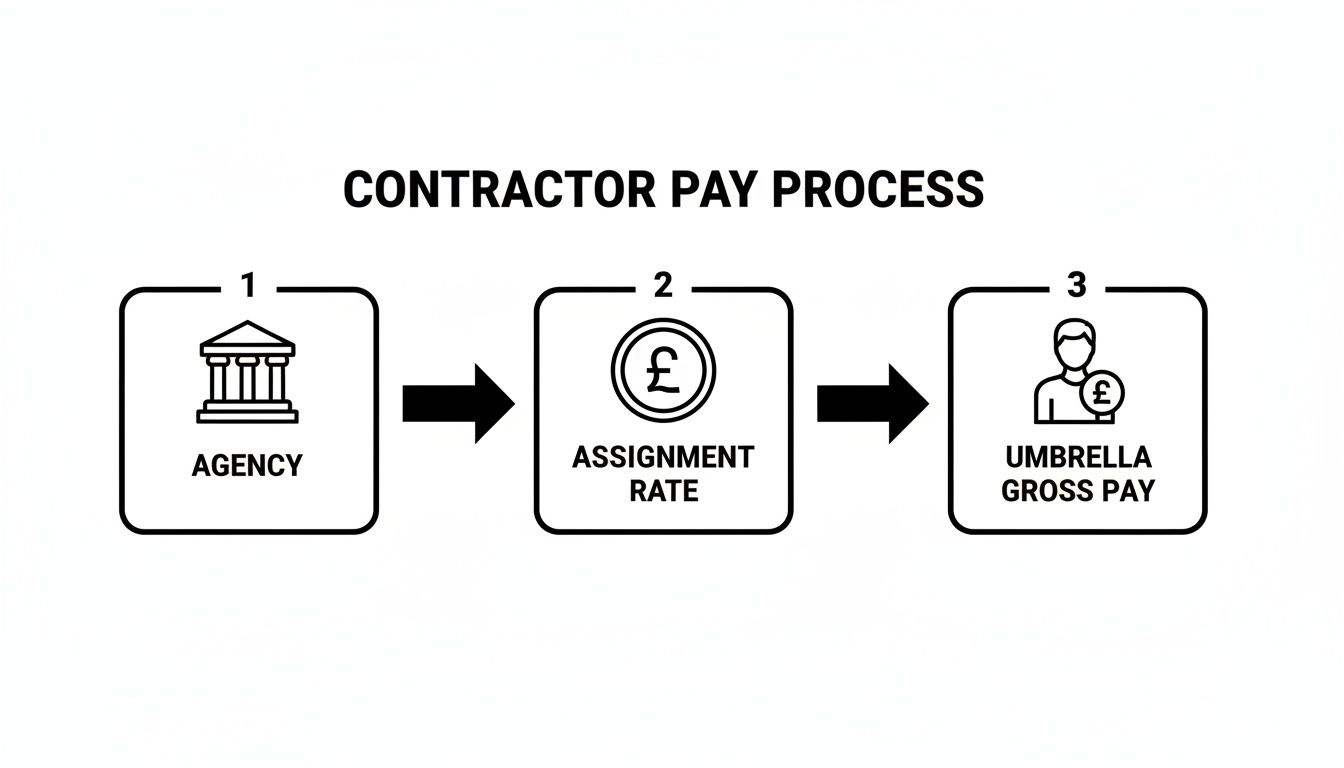
As you can see, the initial assignment rate is the total pot from which all employment costs, especially employer’s NI, are paid. Only after these costs are covered do we arrive at your gross pay, which is the figure used to calculate your personal deductions like employee's NI.
Example 1: Contractor on a £350 Day Rate
Let's imagine you're on a £350 day rate and work 21 days in a month. This gives a total assignment value of £7,350, which is the full amount your agency pays to us. From here, we first deduct the employment costs.
Here’s the breakdown to get to your gross pay:
- Assignment Value: £7,350.00
- Less Employer's NI (13.8%): -£884.22
- Less Our Margin: -£100.00 (example figure)
- Your Gross Pay: £6,365.78
Now, we calculate your employee's Class 1 NI on that gross pay figure of £6,365.78, using the 2024/25 thresholds:
- Earnings up to £1,048: £0 NI (0%)
- Earnings from £1,048.01 to £4,189: £3,141 taxed at 8% = £251.28
- Earnings over £4,189: £2,176.78 taxed at 2% = £43.54
- Total Employee NI: £294.82
For a more detailed look at this, feel free to read our guide on how to read a payslip in the UK.
Example 2: Contractor on a £600 Day Rate
Now for a higher day rate. Working 21 days at £600 per day gives a total assignment value of £12,600.
First, we work out your gross pay:
- Assignment Value: £12,600.00
- Less Employer's NI (13.8%): -£1,566.21
- Less Our Margin: -£100.00 (example figure)
- Your Gross Pay: £10,933.79
Next, we calculate your personal Class 1 NI contribution on this higher gross pay of £10,933.79:
Remember, your employee NI is calculated on your gross pay, not the initial assignment rate. The employer's NI is a cost of employment that we must pay on your behalf, so it’s always deducted from the assignment funds first.
- Earnings up to £1,048: £0 NI (0%)
- Earnings from £1,048.01 to £4,189: £3,141 taxed at 8% = £251.28
- Earnings over £4,189: £6,744.79 taxed at 2% = £134.90
- Total Employee NI: £386.18
These examples show that while your income grows, the NI calculation follows the same consistent, tiered process. By breaking it down this way, we make sure you always have a clear and transparent view of where your money is going.
Common Questions About Class 1 National Insurance
Even when you have a handle on the rules, a few practical questions always seem to pop up. We get it. Here are some of the most common queries we see from contractors about Class 1 National Insurance, with straightforward answers to give you complete confidence in your finances.
Why Do I Pay Employer's NI When Using an Umbrella Company?
This is probably the most frequent question we hear, and it’s a crucial one. When you work through an umbrella company, the 'assignment rate' you agree with your agency or client covers all employment costs. Legally, this must include employer's National Insurance.
Because the umbrella is your legal employer, we are the ones responsible for paying this to HMRC on your behalf. Think of it not as an extra deduction from your pocket, but as a mandatory cost of the project that we handle for you to ensure everything is above board.
What State Benefits Does Class 1 NI Actually Pay For?
Your Class 1 contributions are the lifeblood of the UK’s social security system. Every penny deducted helps to fund:
- The National Health Service (NHS), providing healthcare for everyone.
- The State Pension, with each qualifying year of contributions building your entitlement for the future.
- Contribution-based benefits like Jobseeker's Allowance and Employment and Support Allowance if you need them.
- Statutory payments, such as Maternity, Paternity, and Adoption Pay.
In short, your contributions form the bedrock of the UK’s welfare system. It's the collective fund that provides a crucial safety net for all employed workers.
Can I Reduce My Class 1 NI as a Contractor?
When you’re an employee of an umbrella company, your Class 1 NI payments are fixed by rates and thresholds set by HMRC. There is no legitimate way to lower these contributions.
Be extremely wary of any provider or scheme that claims it can reduce your National Insurance bill. These are almost always non-compliant tax avoidance schemes that will land you in serious trouble with HMRC down the line. The safest and most reliable approach is to partner with a fully compliant, accredited umbrella company.
Do I Pay Class 1 NI if My Contract Is Outside IR35?
Your IR35 status is what dictates how National Insurance is handled. If you work outside IR35 through your own limited company, you won’t pay Class 1 NI on dividends you take from the business. You would, however, pay it on any salary you draw.
For contracts inside IR35, it is a different story. Working through an umbrella company and paying the correct Class 1 NI and income tax via PAYE is the standard, compliant method. This structure ensures all your tax obligations are met correctly for any engagement HMRC considers to be employment.
Navigating contractor pay and tax can feel complex, but you do not have to do it alone. By understanding these key principles, you are better equipped to manage your career. UmbrellaCompany.com makes it simple to find and compare compliant umbrella companies suited to your needs.
Get started and compare trusted umbrella companies in minutes.


