


If you are new to contracting in the UK, you have probably heard the term “umbrella company”. So, what exactly is one?
Think of an umbrella company as your personal HR and payroll department, all rolled into one. It is a company that employs temporary workers, like you, who are working on fixed-term contracts. It gives you the freedom of contracting with the stability and simplicity of being an employee.
Instead of setting up your own limited company, with all the associated paperwork and administration, you simply become an employee of the umbrella company. This straightforward setup lets you focus on what you do best: your job.
Understanding What an Umbrella Company Is
Let's break down how this works in practice. It is a simple, streamlined process that creates a clear, compliant chain between you, your recruitment agency, and the end client you work for.
How does this relationship work?
The structure is surprisingly straightforward. First, you find a contract role, usually through a recruitment agency. The agency then forms a contract with us, your chosen umbrella company. In turn, we provide you with a contract of employment, making you our official employee.
You carry out your work for the end client, submit your timesheets to the agency for approval, and we take care of everything else. It is that simple.
The core functions of an umbrella company
At its heart, an umbrella company exists to manage your employment administration, ensuring you get paid correctly and on time, every time.
To give you a clearer picture, here is a quick look at the core responsibilities an umbrella company handles for you.
The umbrella company model at a glance
| Entity | Role and Responsibility |
|---|---|
| The Contractor (You) | Find and complete the contract work for the end client. Submit timesheets for work done. |
| Recruitment Agency | Sources the contract role. Manages the relationship with the end client. Pays the umbrella company. |
| Umbrella Company | Acts as your legal employer. Invoices the agency and processes your pay via PAYE. |
| End Client | The business where you physically carry out your contracted work. |
This table shows how each party fits into the puzzle, creating a seamless and compliant working arrangement. It is a system designed to take the administrative burden off your shoulders.
So, what does this look like day-to-day? Here are the key tasks we manage:
- Processing Your Pay: We receive the payment from your recruitment agency for the hours you have worked.
- Managing Deductions: Just like any regular employer, we calculate and deduct the correct amount of Income Tax and National Insurance Contributions (NICs) through the PAYE system.
- Providing Employee Rights: Because you are legally our employee, you get access to all the important statutory rights. This includes things like holiday pay, sick pay, and a workplace pension scheme.
- Ensuring Compliance: We make sure every single payment is fully compliant with HMRC regulations, giving you total peace of mind.
While the umbrella model is the go-to solution for UK contractors, it is worth knowing it shares similarities with the global Employer of Record (EOR) model. An EOR also handles payroll and compliance but typically on an international scale for businesses hiring abroad. For most UK-based contractors, however, the umbrella route is the most practical and common choice.
How Does the Umbrella Company Process Actually Work?
It might sound a bit complicated at first, a three-way relationship between you, your agency, and an umbrella company. But in reality, it is a very straightforward process designed to make your life simpler and keep everything above board.
Let’s walk through the entire journey, from the moment you submit your timesheet to the day the money lands in your bank account. The whole system is built on a clear chain of payment and communication. You do the work, we handle the administration, and you get paid like a regular employee, with all the legal protections that come with it.
This infographic gives you a quick visual summary of how the money flows from your client, through the supply chain, and finally to you.
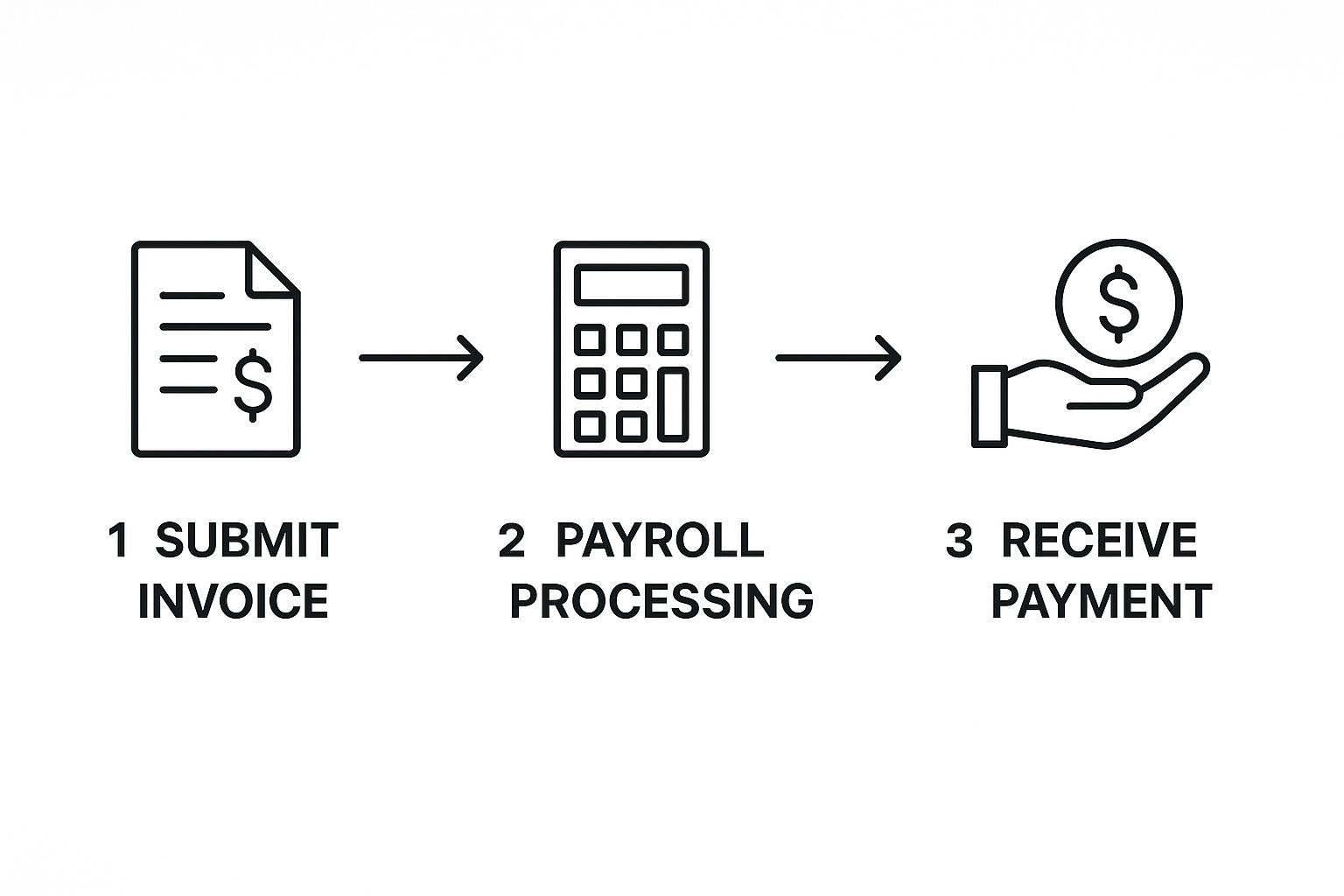
As you can see, it is a logical sequence that ensures everyone gets paid efficiently and on time.
The step-by-step payment journey
Feeling confident about using an umbrella company starts with knowing exactly how your earnings get from the client to your bank account. The good news is that it follows the same consistent pattern every single pay cycle.
Here's a breakdown of the typical journey:
- You Complete Your Work: First things first, you carry out your assignment for the end client as laid out in your contract.
- Submit Your Timesheet: At the end of the week or month, you send your approved timesheet, detailing the hours you have worked, over to your recruitment agency.
- The Agency Pays Us: Once the agency has your timesheet, they invoice the end client. A key part of this is understanding invoicing processes, but that is our job; we handle it all for you. The agency then transfers the funds for your work directly to us.
- We Process Your Payroll: This is where we step in. We receive the gross payment from the agency and run it through our fully compliant PAYE payroll system.
- You Get Paid: We pay your salary directly into your bank account, just like any other employer would. You will also get a detailed payslip showing the full breakdown of your earnings and all the deductions.
Decoding your umbrella company payslip
Your payslip is a transparent record of everything you have earned and what has been deducted. While it will look familiar if you have been a permanent employee before, it has a few extra details specific to the umbrella setup. Our goal is to make sure you can see exactly where every penny goes.
Here are the key items you will see on your payslip:
- Gross Pay: This is the full contract value we receive from the agency for the work you’ve done.
- The Umbrella Margin: This is our fee for managing your employment and payroll administration. It is a fixed amount that is deducted before any tax is calculated, so there are no surprises.
- Employer’s National Insurance: As your legal employer, we are required to pay this contribution to HMRC. This is deducted from the gross funds we receive from the agency.
- Apprenticeship Levy: This is another required deduction, a government tax on employers that is used to fund apprenticeship schemes across the UK.
- Your Net Pay: And finally, this is the amount that hits your bank account after all taxes, National Insurance, and any pension contributions have been made.
We believe in total transparency. Our payslips are designed to be as clear and easy to follow as possible, giving you complete confidence that you are being paid correctly and compliantly every time. To dig into the details a bit more, feel free to explore our guide on how do umbrella companies work.
Why Umbrella Companies Are Central to UK Contracting

If you are a contractor in the UK, you have almost certainly heard of umbrella companies. They have become a cornerstone of the flexible workforce, acting as a crucial intermediary for contractors and the clients who hire them. Their rise in popularity is not accidental; it is directly tied to the twists and turns of UK employment law, especially the off-payroll working rules, better known as IR35.
At its core, IR35 was introduced to ensure contractors who work in a similar way to permanent employees pay a similar amount of tax and National Insurance. But for businesses, figuring out a contractor's IR35 status can be a minefield. Getting it wrong could lead to hefty penalties from HMRC.
This is exactly where the umbrella company model steps in to offer a clean, compliant way forward.
Providing a safe harbour from IR35 complexity
By employing a contractor directly, an umbrella company takes the entire IR35 headache away from the end client. It is a simple, elegant solution. Because the contractor is a bona fide employee of the umbrella, their pay is processed through PAYE, with tax and National Insurance deducted at source.
This immediately means the contract falls outside the scope of the IR35 rules.
For businesses, this offers huge peace of mind. They can bring in the flexible talent they need without getting bogged down in administrative red tape or worrying about a compliance investigation. As a result, many large organisations and recruitment agencies now make it a standard requirement for contractors to work through a compliant umbrella company.
The numbers really tell the story here. According to HMRC's own statistics for 2022-2023, around 700,000 workers in the UK were paid via an umbrella company. This figure jumped significantly after the IR35 reforms were rolled out to the private sector in 2021, as clients looked for a straightforward way to stay on the right side of the law. You can get more detail on how new umbrella company legislation is shaping the industry.
The Government's focus on regulation
The sector's explosive growth has not gone unnoticed by the government. There is a continuous push to regulate the industry more tightly, primarily to shield workers from non-compliant schemes and clamp down on tax avoidance.
This official scrutiny makes choosing the right partner more critical than ever. A reputable, trustworthy umbrella company will always be transparent about its margins and follow HMRC guidelines to the letter. It is about protecting you, your finances, and the clients you work for.
Key Takeaway: Partnering with a compliant umbrella company is not just a box-ticking exercise to get paid. It is a professional decision that safeguards your tax affairs and shows clients and recruiters you are serious about compliance.
Ultimately, the model provides a solid framework that supports the dynamic, fast-paced needs of the modern UK workforce. It successfully balances the freedom contractors want with the security and compliance that businesses absolutely need, making it an indispensable part of the contracting ecosystem.
The Real Benefits of Working with an Umbrella Company
Beyond just being a way to get paid, a good, compliant umbrella company offers real, practical advantages for your contracting career. It is about blending the freedom you love with the kind of stability and protection you would normally only get in a permanent job.
Think of it this way: you gain a whole host of statutory employment rights that a sole trader simply does not have access to. It is not just about the payslip; it is about building a more secure foundation for your professional life, all without giving up your independence.
Gaining essential employment rights
One of the most significant perks is that, on paper, you are legally an employee of the umbrella company. This single fact unlocks the same core benefits and protections that any other employee in the UK enjoys.
That safety net can be incredibly valuable, giving you proper peace of mind as you move from one contract to the next.
Here are the key benefits you become entitled to:
- Statutory Sick Pay: If you are too ill to work, you are entitled to sick pay. It provides a financial cushion when you need it most.
- Holiday Pay: For every hour you work, you will accrue paid time off. This means you can take those well-earned breaks without your income grinding to a complete halt.
- Workplace Pension: We will automatically enrol you into a workplace pension scheme. This helps you save for the future, with contributions coming from both you and us as your employer.
- Maternity and Paternity Pay: If your family is growing, you will have access to statutory parental leave and pay, supporting you through those big life moments.
The power of continuous employment
A huge, and often overlooked, benefit is maintaining a continuous record of employment. Even if you are working for half a dozen different clients on various projects, your employment history with us remains unbroken.
This continuity is a game-changer when it comes to major financial applications.
When you apply for a mortgage or a significant loan, lenders want to see a stable, consistent employment history. An umbrella company gives you exactly that, which can make getting approved for the credit you need to move your life forward much, much simpler.
This consistent record smooths out the natural ups and downs of contracting, presenting you to the outside world as a reliable and steadily employed professional.
Streamlined administration and guaranteed compliance
Perhaps the most immediate relief you will feel is the convenience. We handle all the administrative headaches, from raising invoices with the agency to calculating all your tax and National Insurance contributions. All that is taken off your plate, freeing you up to focus on what you are actually paid to do.
You can stop worrying about chasing payments, keeping complex books, or trying to navigate HMRC's ever-changing rules. We deal with the paperwork so you do not have to. For more on how providers stack up, take a look at our analysis of the best umbrella companies for high take-home pay.
Ultimately, the whole model is designed to give you the best of both worlds. You get to keep your independence as a contractor, while we provide the supportive, compliant employment structure that makes life easier and more secure.
Potential Downsides and Red Flags to Avoid

While a good, compliant umbrella company is a contractor's best friend, it pays to be aware of the potential downsides and, more importantly, the red flags that signal a non-compliant scheme. Any transparent provider will be completely upfront about its costs, but the responsibility to choose a legitimate partner ultimately rests with you. Getting it wrong can seriously damage your finances and reputation.
One of the first things to consider is the cost. A legitimate umbrella company charges a fixed weekly or monthly margin for its services. Think of this as their administration fee for handling all your payroll, tax, and employment paperwork. It is a standard cost of doing business this way, but you absolutely need to factor it into your financial planning.
Beyond that, every single deduction on your payslip should be crystal clear and justifiable under UK tax law. This means PAYE Income Tax, employee’s National Insurance, and any pension contributions. If you get a payslip that is confusing or has deductions you do not recognise, start asking questions immediately.
Identifying non-compliant schemes
Unfortunately, the contracting market has its fair share of rogue operators pushing tax avoidance schemes. These schemes might look tempting at first, but they can land you with a massive, unexpected tax bill from HMRC years down the line. Knowing what to look for is your best defence.
The most common warning sign? A promise of unrealistically high take-home pay, often quoted at 80-90% of your contract value. This is a huge red flag. A compliant umbrella company works under the exact same PAYE system as any other UK employer, so your net pay should be broadly similar.
Remember, if an offer sounds too good to be true, it almost certainly is. HMRC is clear that the responsibility for unpaid tax ultimately falls on you, the individual contractor, even if you were unknowingly pulled into a scheme.
Here are a few common red flags that should set alarm bells ringing:
- Complex Payment Structures: Be extremely wary of any arrangement that pays you via loans, grants, annuities, or anything other than a straight salary. Your income should be treated as employment income, period.
- Offshore Payments: If a provider mentions routing your money through offshore accounts in places like the Isle of Man or Guernsey, run a mile. This is a classic tax avoidance tactic.
- Lack of Accreditation: Reputable providers are usually accredited by professional bodies like the FCSA (The Freelancer & Contractor Services Association) or Professional Passport. While it is not a legal requirement, accreditation shows they have passed independent audits for compliance.
- Vague or Evasive Answers: A compliant provider will have no problem answering your questions about their fees, how they calculate your pay, and their processes. If they get defensive or cannot give you a straight answer, it is a bad sign.
Staying vigilant is the name of the game. By understanding what an umbrella company in the UK should, and more importantly, should not do, you can choose a partner that operates by the book and keeps you fully compliant.
Choosing the right umbrella company is one of the biggest calls you will make as a contractor. Get it right, and you have got a partner that protects your finances and your reputation. Get it wrong, and you could be facing serious trouble with HMRC.
The trick is knowing what to look for and, just as importantly, what questions to ask.
Check for accreditations
Your first port of call should always be to check for proper professional accreditations. You are looking for providers that have been audited and given the seal of approval by reputable UK bodies like The Freelancer & Contractor Services Association (FCSA) or Professional Passport.
These are not just fancy logos for a website. They are a sign that the company has passed tough, independent checks against UK tax law and industry codes of conduct. It is your best initial filter for weeding out the cowboys.
The essential questions to ask
Before you even think about signing up, you need to do your own homework. Any provider worth their salt will welcome your questions and give you clear, straightforward answers.
Here is a quick checklist of things you absolutely must clarify:
- What is your margin? A compliant firm will charge a fixed, flat fee for their service, either weekly or monthly. They should never take a percentage of your earnings.
- What insurance is included? Make sure they provide adequate Professional Indemnity and Public Liability insurance as a standard part of their service.
- Can I see a sample payslip? This is crucial. It lets you see exactly how your pay is calculated and helps you spot any hidden fees or confusing deductions before they become your problem.
- What employee benefits do you offer? Ask them about access to a workplace pension, statutory pay (like sick and maternity pay), and how they handle your holiday pay.
Separating the good from the bad
To help you tell a legitimate umbrella company from a tax avoidance scheme, here is a quick checklist of what to look for versus what to run from.
Compliant vs. non-compliant scheme checklist
| Feature | Compliant Umbrella Company | Warning Sign (Non-Compliant Scheme) |
|---|---|---|
| Payment Method | All earnings are processed through standard UK PAYE. | Payments are split, often involving loans, annuities, or offshore trusts. |
| Take-Home Pay | Realistic take-home pay, typically 60-70% of your contract value. | Promises of 85-95% take-home pay, which is simply not achievable legally. |
| Fees | A fixed, transparent weekly or monthly margin. | Fees are a percentage of your earnings or are hidden in complex calculations. |
| Payslip | Clear, easy-to-understand payslip showing all tax and NI deductions. | Vague or confusing payslips that do not clearly show where your money is going. |
| Accreditation | Accredited by a recognised body like FCSA or Professional Passport. | No recognised accreditations or claims of being "HMRC Approved" (which is not a real thing). |
In short, if an offer seems too good to be true, it almost certainly is. Stick with transparent, accredited providers to stay safe.
Making a safe choice in a crowded market
The UK umbrella market is packed with providers, so choosing carefully is vital. You will find established, FCSA-accredited companies that serve tens of thousands of contractors with completely transparent fee structures and solid benefits. These are the kinds of firms you want to be dealing with.
A compliant provider will never promise you unbelievable take-home pay or talk about paying you via loans. Your money should always, without exception, be processed through PAYE. This ensures you are paying the correct tax and National Insurance.
By putting transparency and proper accreditation at the top of your list, you can find a partner that genuinely supports your contracting career. For a deeper look at this, check out our complete guide on finding a tax-efficient umbrella company in the UK.
Got Questions? We've Got Answers
To help you get your head around the finer details, here are the answers to a few common questions contractors ask when they are first looking into umbrella companies.
Is using an umbrella company the same as being inside IR35?
They are very closely related, but they are not the same thing. Think of it this way: if your contract is judged to be ‘inside IR35’, it means that for tax purposes, you are essentially seen as an employee. You can get a full breakdown of what IR35 is in our detailed guide.
Working through an umbrella company is simply one of the most common and straightforward ways to handle an inside-IR35 contract correctly. The umbrella firm puts you on their payroll, sorts out your PAYE tax and National Insurance, and keeps everything above board with HMRC.
Can I still claim expenses through an umbrella company?
This is a big one, and the rules have tightened up significantly. Since legislative changes in 2016, claiming general travel and food expenses against tax is off the table for most contractors.
The reason? You are usually considered to be working under ‘Supervision, Direction, or Control’ (SDC), which puts you in the same boat as a regular employee who cannot claim their daily commute. You can only claim expenses in very specific situations where SDC is not a factor, so it is something you absolutely must clarify with your chosen umbrella provider before signing up.
How much does an umbrella company actually cost?
A legitimate, compliant umbrella company will charge a fixed weekly or monthly fee, known as their margin. This is taken from your gross earnings before any tax is calculated. Typically, you can expect this to be somewhere between £15 to £30 per week.
One of the clearest signs of a trustworthy provider is this transparent, flat-fee structure. If you ever come across a company that wants to charge you a percentage of your earnings, treat it as a major red flag and steer clear.
Ready to find a compliant and trustworthy payroll partner? At UmbrellaCompany.com, we make it easy to compare accredited UK umbrella companies to find the perfect fit for your contracting career.


