


Retirement planning often slips to the bottom of the list when you're contracting. One month is busy with deadlines, invoice chasing, and timesheets. The next month you're between projects, checking cash flow and deciding what can wait.
That’s why so many contractors ask a very practical question, what is a stakeholder pension, and is it useful when income isn’t predictable? It can be.
A stakeholder pension was built to be simple, flexible, and easier to keep going when your earnings change. For freelancers, consultants, and umbrella workers, that matters far more than glossy pension jargon.
Planning Your Future as a Contractor
If you're working contract to contract, your finances probably don’t move in a straight line. A strong month can make saving feel easy. Then a gap between roles, a late client payment, or a switch to a lower day rate can make long-term planning feel less urgent.
That’s common, especially when you're still figuring out the practical side of contracting, from tax to payroll to becoming a contractor in the first place. Retirement saving usually gets treated as something to sort out later.

A stakeholder pension suits this kind of working life because it was designed to remove some of the barriers that put people off saving. You don’t need a perfect salary pattern. You don’t need to commit to large fixed payments. You don’t need to worry that pausing contributions will trigger a penalty.
Where contractors often get stuck
A lot of pension advice still assumes a standard employee setup. It assumes steady monthly pay, automatic deductions, and an employer scheme doing most of the heavy lifting.
Contractors and freelancers don’t always fit that model. You might be:
- Working through an umbrella company, with PAYE deductions already affecting take-home pay
- Inside or outside IR35 at different points in your career
- Moving between contracts, with income that rises and falls
- Holding older pension pots, but not knowing whether to keep them, transfer them, or ignore them
Contractors usually don’t need a pension that looks impressive on paper. They need one they can keep using when real life gets messy.
That’s where stakeholder pensions are worth understanding properly.
What Is a Stakeholder Pension
A stakeholder pension is a type of personal pension built to be straightforward and affordable. It’s a defined contribution pension, which means the money paid in is invested, and what you have at retirement depends on contributions, investment growth, and charges.
The big idea behind it was access. Stakeholder pensions were introduced in the UK on 6 April 2001, and from 8 October 2001 most employers had to designate a scheme for eligible employees unless exempt. That employer duty ended on 1 October 2012 when automatic enrolment took over, as outlined in Royal London’s stakeholder pensions technical summary.
Why they were created
Before stakeholder pensions, many personal pensions were harder to access or more expensive than many workers could comfortably manage. The stakeholder model tried to solve that by setting rules around cost, flexibility, and ease of joining.
That made them especially relevant for people who didn’t fit neatly into a traditional company pension setup, including:
- Self-employed workers
- People on lower earnings
- Contractors with changing income
- Workers without access to an occupational pension
What the name really means
The term can sound technical, but the concept is simple. A stakeholder pension is just a personal pension with extra consumer protections built in.
Those protections shape the product in practical ways. The charges are controlled. Contributions are flexible. Transfers are easier than in many older-style pensions. For someone asking what is a stakeholder pension in plain English, the simplest answer is this:
It’s a pension designed to make saving easier for people who need lower costs and more flexibility.
That doesn’t automatically make it the best option for everyone. Some people want a much wider investment range and are happy to manage more complexity. But for many contractors, the appeal is that a stakeholder pension is easier to understand and easier to keep running consistently.
Key Features of a Stakeholder Pension Explained
The rules around stakeholder pensions matter because they shape how the pension behaves in real life. For contractors, that means looking beyond the label and understanding what you can do with it.
Charges are capped
One of the strongest protections is the charge cap. According to Unbiased’s guide to what a stakeholder pension is, charges are capped at 1.5% of the fund each year for the first 10 years, then 1% after that. For plans started before April 2005, the cap is a flat 1%.
That matters because charges can reduce long-term growth. A capped structure gives you a clearer ceiling on what the provider can take.
Contributions are flexible
This is usually the feature contractors care about first. The same Unbiased guide notes that the minimum contribution is typically £20, and you can stop and start payments at any time without penalty.
In practice, that means you can adapt contributions around your workload and cash flow.
- Busy contract month. You may choose to pay in more.
- Quiet period. You can reduce or pause contributions.
- Unexpected bill. You’re not locked into a fixed schedule with a penalty hanging over you.
If you're also looking at the wider tax picture, our guide to reducing tax as a contractor can help you think about pension saving alongside other legitimate planning steps.
Transfers are usually straightforward
Stakeholder pensions are also known for portability. If you already have an older pension pot, a stakeholder plan can be easier to move in or out of than some legacy products.
That doesn’t mean every transfer is automatically a good idea. You still need to check what you’d be giving up, especially if an older pension includes guarantees or special features.
Practical rule: Low charges and easy transfers are useful, but they’re not a substitute for checking the investment options inside the pension.
A quick explainer can help if you want a visual overview before comparing products.
Tax relief can confuse people
Pensions often sound more complicated than they are because of tax relief. In simple terms, money paid into a personal pension usually receives tax relief under pension rules, so your contribution can be topped up in a tax-efficient way depending on your circumstances.
The exact benefit depends on how you pay in and your own tax position. For contractors, especially those moving between umbrella work and other setups, it’s worth checking how contributions are handled rather than assuming every arrangement works the same way.
Why Stakeholder Pensions Suit Contractors and Freelancers
Stakeholder pensions make sense for contractors because they were built with uneven income in mind. That’s not a marketing line. It’s part of how the product works.
Accotax explains in its guide to pensions for contractors and freelancers that stakeholder pensions allow contributions to be started, stopped, or varied at any time without penalty, with a low minimum of around £20. For anyone whose income changes between projects, that’s a practical advantage.
A better fit for variable income
A salaried employee might prefer a pension that runs quietly in the background every month. Contractors often need something more adaptable.
Take a simple example. You finish a contract, wait for onboarding into the next role, and cash flow tightens for a while. With a stakeholder pension, you can pause contributions without feeling that the plan itself is punishing you for a temporary gap.
Then when work picks up again, you restart.
That sounds basic, but it removes one of the biggest psychological barriers to pension saving. Many freelancers don’t avoid pensions because they dislike saving. They avoid products that feel too rigid.
How it works with umbrella company arrangements
If you work through an umbrella company, you may already have pension choices linked to that employment arrangement. A stakeholder pension sits slightly differently because it’s a personal pension.
That means it can still be relevant if you want your own pension arrangement rather than relying only on whatever workplace setup happens to come with a specific assignment. For contractors, that independence can be useful.
Common questions we hear include:
- Can I have a stakeholder pension if I work via an umbrella company? Yes, it’s a personal pension type, so your umbrella status doesn’t stop you having one.
- What if I’m inside IR35? IR35 affects how your income is taxed. It doesn’t remove the need to plan for retirement.
- Can I keep the same pension when I change contracts? In many cases, yes. That continuity is one reason personal pensions appeal to freelancers.
If your income changes often, consistency matters more than perfection. A pension you can keep contributing to unevenly is often more realistic than one you abandon after a few difficult months.
Why simplicity matters
Some contractors enjoy managing investments in detail. Others don’t want another financial admin task after dealing with invoices, compliance, and contract changes.
A stakeholder pension can work well when your priority is a pension that is:
- Easy to understand
- Simple to maintain
- Flexible during project gaps
- Less likely to punish inconsistent contributions
That won’t make it the ideal choice for every contractor. But if the main reason you haven’t started is that pensions feel too complicated or too fixed, a stakeholder pension is often one of the most approachable places to begin.
Stakeholder vs SIPP vs Workplace Pensions
Not every pension solves the same problem. A stakeholder pension is built around simplicity and flexibility. A SIPP gives you more control. A workplace pension is tied more closely to employment and payroll.
For contractors, the right choice usually depends on how hands-on you want to be, how often your income changes, and whether you want your pension linked to your current work arrangement. If you need a refresher on employment setups, our guide to PAYE vs umbrella working is a useful companion read.
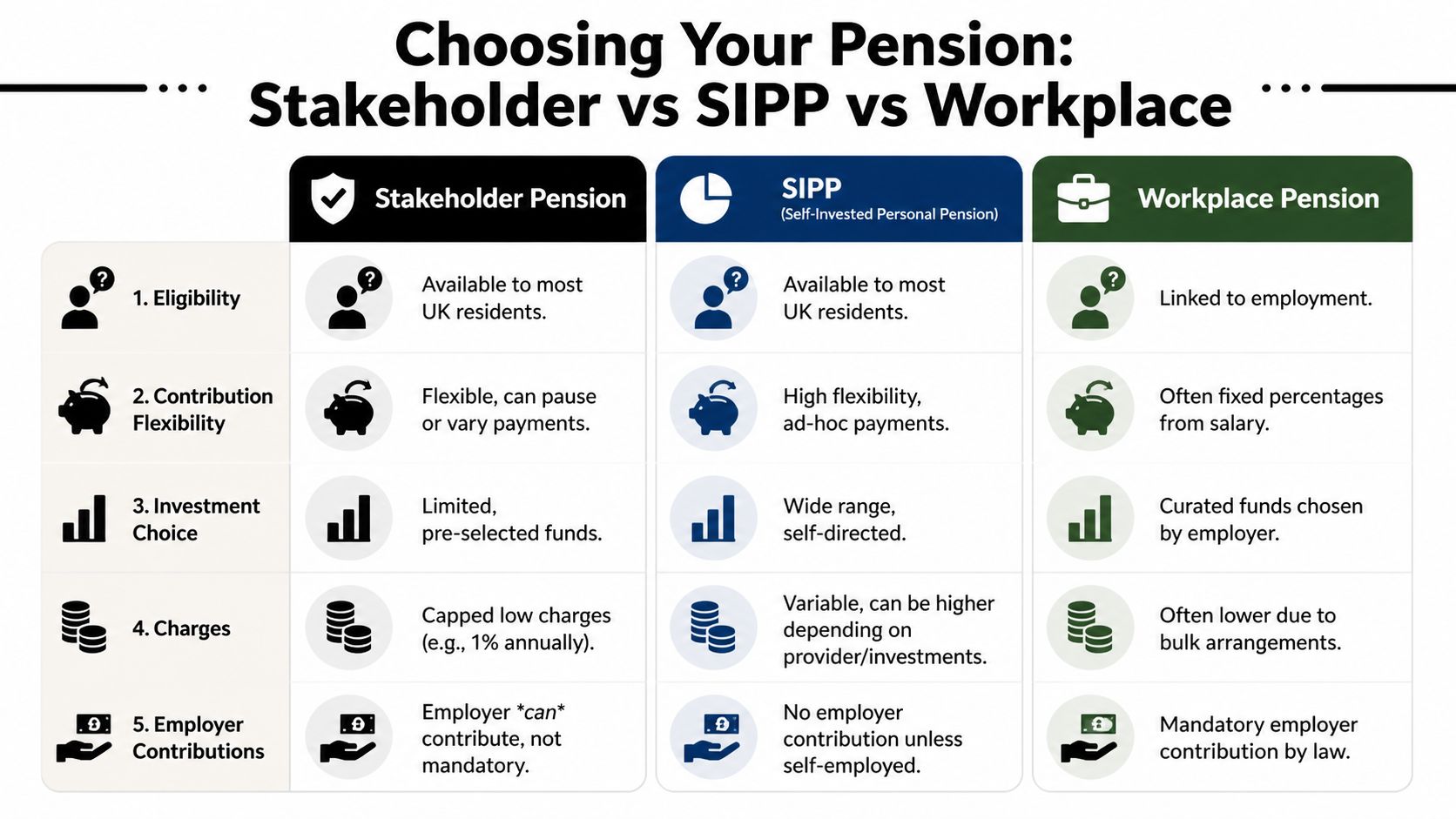
Wikipedia’s overview of the stakeholder pension scheme notes that over 1.5 million contractors in the UK often deal with irregular income, which helps explain why the low minimum contribution and stop-start flexibility can suit umbrella workers and others with variable earnings.
Pension comparison for contractors
| Feature | Stakeholder Pension | SIPP (Self-Invested Personal Pension) | Workplace Pension (Auto-Enrolment) |
|---|---|---|---|
| Who it suits | Contractors who want simplicity and flexible payments | Contractors who want broad investment control | Workers using an employer-linked pension |
| Contribution pattern | Flexible, easy to pause or vary | Flexible, often suited to ad hoc funding | Usually tied to payroll deductions |
| Investment choice | More limited, provider-led options | Much wider range, more self-directed | Curated fund range set by scheme |
| Charges | Capped under stakeholder rules | Vary by provider and investments | Often competitive in employer schemes |
| Admin style | Straightforward | More involved | Usually handled through payroll |
| Best for | People who want a simple personal pension | People comfortable making investment decisions | Employees relying on employer pension arrangements |
The trade-offs to understand
A stakeholder pension is often the easiest to live with. It tends to suit people who want a low-friction pension they can keep going around changing contracts.
A SIPP can be more appealing if you want to choose from a broader investment range. The trade-off is that you usually take on more decisions, more complexity, and potentially higher costs depending on the provider and assets chosen.
A workplace pension can be valuable when it includes employer contributions and simple payroll deductions. But it may feel less portable from your point of view if your work arrangements change regularly.
For readers comparing workplace arrangements and pension responsibilities more broadly, Stewart Accounting pension services offers a useful overview of workplace pension obligations from an accountancy perspective.
A good pension choice isn’t the one with the most features. It’s the one you’ll actually keep funded and review properly.
Is a Stakeholder Pension Right for You in 2026
A stakeholder pension still has a place in 2026, especially if you value low-cost simplicity over broad investment choice. It remains a viable option for people who want a personal pension that can cope with changing income and doesn’t punish them for stopping and starting contributions.
The main drawback is investment range and, in some cases, performance compared with more flexible alternatives. PensionBee notes that average annual returns for stakeholder pensions have recently lagged behind SIPPs by 1 to 2%, and also highlights that there are 2.1 million dormant stakeholder pots holding around £15 billion as of 2025 in its guide to stakeholder pensions. That makes regular reviews important, especially if you opened a plan years ago and haven’t looked at it since.
A simple way to decide
A stakeholder pension may suit you if you want:
- Flexible contributions that can change with your contracts
- Clear charge limits
- A personal pension you can keep even when work arrangements change
- Straightforward administration rather than lots of investment decisions
You may want to compare it against a SIPP if you care more about investment choice and are comfortable managing that extra complexity.
If you already have an older plan, this is also a good time to review whether it still fits your current goals. Some contractors also compare pension planning alongside broader income decisions, especially when weighing salary versus dividends across different ways of working.
The right answer isn’t always to switch. Sometimes the best move is to keep a simple pension and start using it properly. Sometimes it’s to consolidate. Sometimes it’s to move on from an older plan that no longer suits you.
If you're building your contracting career and want help finding a compliant setup that fits how you work, Umbrella Company helps contractors and freelancers compare umbrella companies with confidence.


