


So, what exactly is a Personal Service Company, or PSC? In simple terms, it is your very own limited company, created specifically to provide your professional services to clients.
Think of it as putting a formal business wrapper around yourself. This creates a clear legal separation between your professional and personal life, which is a big deal when it comes to managing your finances and liability.
What Is a Personal Service Company?

For a huge number of contractors and freelancers across the UK, setting up a PSC is the go-to way of working. It establishes a professional boundary: instead of you signing a contract as an individual, your company enters into the agreement and sends the invoices.
This structure really came into the spotlight with the introduction of the IR35 legislation back in 2000. HMRC brought this in to tackle what it called ‘disguised employment’, where someone works like an employee but uses a PSC for a better tax position. Before IR35, this was thought to be costing the Treasury an estimated £300–£400 million every year.
The Two Hats You'll Wear: Director and Shareholder
When you form a PSC, you instantly give yourself two distinct roles, and it is vital to understand what each one means.
- You're the Director: This is the 'doing' role. You are legally responsible for running the company properly. That means filing accounts with Companies House, dealing with HMRC, and making sure all the paperwork is in order.
- You're the Shareholder: This is the 'owning' role. As the owner, you are entitled to the company's profits. These are typically paid out as dividends, which have different tax rules compared to a salary.
This Director-Shareholder setup is precisely where the flexibility of a PSC comes from. It gives you control over how you draw your income, but it also places the full weight of the company's legal and financial health squarely on your shoulders.
At its heart, a Personal Service Company formalises your contracting work. It creates a legal shield between your business and personal affairs, giving you control but also bringing the official duties and tax responsibilities of a company director.
Let's quickly recap the key characteristics of a PSC.
Personal Service Company at a Glance
| Feature | Description |
|---|---|
| Legal Status | A separate legal entity from you, the owner. |
| Your Role | You are both the Director (managing it) and the Shareholder (owning it). |
| Liability | Your personal assets are generally protected from business debts. |
| Taxation | The company pays Corporation Tax on profits. You are taxed on the salary and dividends you draw. |
| Administration | You are responsible for all company administration, including accounts and tax returns. |
| Control | You have full control over the business and its finances. |
This table gives you a bird's-eye view, but the reality is in the details.
What Running a PSC Actually Involves
Operating through a PSC is not just a different way to invoice; it means you are genuinely running a business. You will need to handle all the day-to-day administration that comes with it. This includes opening a dedicated business bank account, maintaining meticulous financial records, and managing all your company's tax obligations, from Corporation Tax to VAT if you are registered.
Getting your head around these fundamentals is the first real step in deciding if a PSC is the right move for you. It offers a great deal of autonomy, but it is a significant commitment. Before you jump in, it is smart to weigh it against the other ways of working available to contractors. You can dive deeper into how they stack up by exploring the different types of business structures available in the UK.
How Your PSC Manages Contracts and Payments
So, you’ve set up your Personal Service Company. What happens now? Let's break down the day-to-day reality of managing your contracts and getting paid. The key thing to remember is that your company sits at the heart of every financial transaction, not you personally.
The first step for any new gig is the contract. As a PSC director, your company formally agrees to the work with your client or an agency, establishing a clear business-to-business relationship. This is a world away from being an employee.
Securing the Work and Getting Paid
When you land a new project, your PSC is the legal entity that signs the contract. This document is non-negotiable; it needs to spell out exactly what services your company will provide, the project timelines, and your agreed-upon rates. Always get a solid contract signed before a single minute of work begins.
Once you hit a milestone or finish the job, your PSC raises an invoice and sends it to the client. This invoice must look professional and contain all the right details: your company information, the client’s details, a clear breakdown of services, and the total amount owed.
The client then pays this invoice, with the money landing directly in your dedicated business bank account. It is absolutely critical to keep this money separate from your personal cash. This is company money, not your own.
Paying Yourself: A Mix of Salary and Dividends
Now the money is in your company account, how do you actually get it into your own pocket for personal bills? This is where the PSC structure really shines, offering some serious flexibility. The most common and tax-efficient method is to pay yourself a combination of a small salary and regular dividends.
Here’s the breakdown:
- A Low Director's Salary: You will run a small salary for yourself through the company’s payroll (PAYE). This is typically set just high enough to count towards your state pension credits, but low enough to keep Income Tax and National Insurance contributions to a minimum.
- Tax-Efficient Dividends: The rest of your income comes from dividends. Dividends are simply a way for the company to distribute its post-tax profits to its shareholders (which, of course, is you).
This salary-plus-dividend strategy is one of the main attractions of the PSC route. But it is not a free-for-all. Dividends can only be paid from profits. That means you first have to account for all your business running costs and, crucially, set aside money for Corporation Tax.
A Personal Service Company works by creating a distinct financial boundary. It contracts with clients, receives money into a business account, and then you, as the director, pay yourself a tax-efficient blend of salary and dividends drawn from the company's profits.
Understanding Your Company's Tax Duties
As a company director, you are legally responsible for making sure your PSC pays all its taxes to HMRC. Getting this wrong can lead to some painful penalties.
The main tax your company pays is Corporation Tax, which is levied on your annual profits. Before you can work out your profit and declare a dividend, you absolutely must put aside enough cash to cover this tax bill.
On top of that, if your company's turnover goes above the VAT threshold (currently £90,000 a year), you will have to register for VAT. This brings another layer of administration, as you will need to charge VAT on your invoices and file regular VAT returns with HMRC.
The tax side of running a PSC can feel complex, and staying compliant is everything. Recent HMRC statistics from 2023 showed that while PSCs contributed £14.2 billion in corporation tax, around 15% of them faced compliance checks that led to big financial adjustments. This just goes to show how important it is to get things right from day one. You can dig into the economic role of personal service workers and compliance data through detailed occupational data. And to make sure your contracts are watertight, take a look at our guide on creating a freelance contract template for the UK.
Understanding the Impact of IR35 on Your PSC
If you’re a contractor with a Personal Service Company, there's one piece of tax law you absolutely cannot ignore: IR35. It is also known as the off-payroll working rules.
Think of it as HMRC's way of looking at your contract and deciding if you are genuinely a self-employed business owner or, for all intents and purposes, a 'disguised employee'. Getting this wrong can lead to a massive, unexpected tax bill, so it is something you need to get right from the start.
Inside vs. Outside IR35: What Does It Mean for You?
Every single contract your PSC takes on has to be assessed, and the result will place it either 'inside' or 'outside' IR35. This one decision completely changes how your company gets paid and how much tax you will owe.
Outside IR35: This is what every PSC owner hopes for. It means HMRC sees your relationship with the client as a genuine business-to-business service. Your PSC gets paid the full gross amount, and you can draw your income as a tax-efficient mix of a small salary and dividends. You keep control, and your take-home pay is higher.
Inside IR35: This is the opposite. HMRC views you as an employee for tax purposes on that particular contract. The company paying you (your client or recruitment agency) has to deduct PAYE tax and National Insurance right off the top, just like they would for a regular employee. Only the net amount ever hits your company's bank account.
The financial hit from an 'inside' determination is significant. It essentially cancels out the main tax benefit of using a PSC for that contract, bringing your net pay much closer to what a standard employee would earn.
Who Decides Your IR35 Status?
The rules changed back in April 2021. For most contracts with medium and large companies in the private sector, the responsibility for deciding your IR35 status now rests with the end client.
They are required to provide a Status Determination Statement (SDS), which is a formal document that states their decision and the logic behind it. They have to give a copy to you and any agency involved. If they do not show 'reasonable care' when making this call, the tax liability could fall on them.
However, if you are working for a 'small' private sector client, the responsibility is still yours. This means you have to be confident you understand HMRC's tests, which look at things like control, substitution, and mutuality of obligation.
This diagram shows how money typically flows for a contractor.
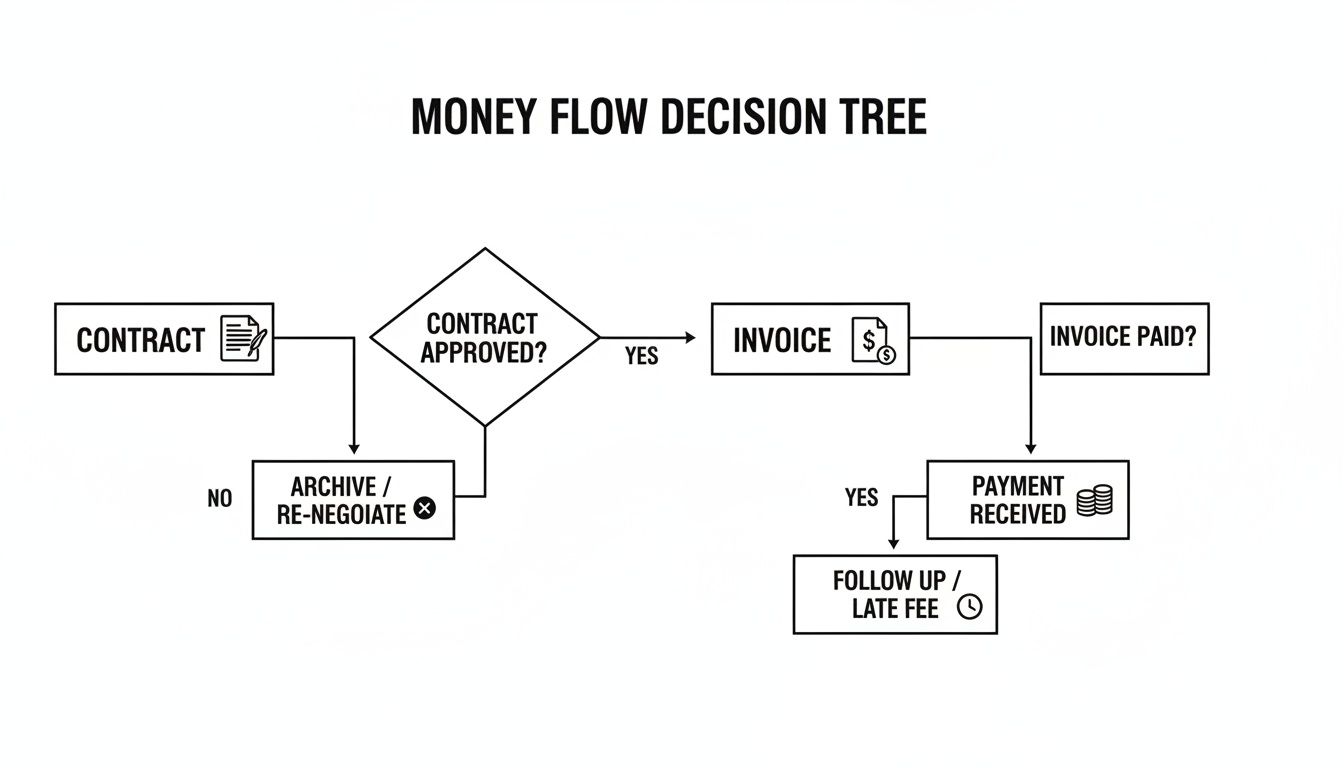
As you can see, the process is straightforward, until an 'inside IR35' determination steps in. That is when HMRC takes its cut before the money even reaches you.
The Financial Risks of an Incorrect Determination
The stakes here are incredibly high. If you work a contract as 'outside IR35' but HMRC investigates later and disagrees, your PSC will be responsible for all the unpaid tax and National Insurance. They will also add interest and can hit you with some hefty penalties.
An incorrect IR35 status can unravel the financial benefits of your PSC overnight. The potential for back-dated tax liabilities, interest, and penalties makes compliance an absolute priority for every contractor.
Let's say you complete a £100,000 project you thought was 'outside IR35'. If HMRC later decides it was 'inside', your company could suddenly be facing a tax bill for tens of thousands of pounds. This is exactly why many contractors will only take 'inside IR35' work through an umbrella company, as it completely removes this risk.
For a complete breakdown of the legislation, have a look at our full IR35 for contractors guide.
Given the complexity and the risks involved, getting expert advice is non-negotiable. Professional Tax Accountants can review your contracts and working practices to ensure you’re compliant, protecting you from very costly problems down the line.
Choosing Between a PSC and an Umbrella Company
For most UK contractors, the biggest decision you will make is not about which project to take on, but how you will get paid for it. The choice boils down to operating through your own Personal Service Company (PSC) or using an umbrella company. It is a fundamental decision that will shape your finances, legal duties, and even your work-life balance.
Ultimately, this comes down to what you value most. Are you after complete control and the highest possible earnings, or do you prefer simplicity and guaranteed compliance? There is no single right answer here; the best path is entirely down to your personal circumstances, your appetite for risk, and how much administration you are willing to take on.
The Case for a Personal Service Company
Running your own PSC puts you firmly in the driver’s seat. It is your business, and you have total control over its finances and direction. For any contractor whose work is determined to be outside IR35, this is where a PSC can really shine.
Here is why many contractors go down this route:
- Higher Potential Take-Home Pay: By paying yourself a small salary and taking the rest of your income as dividends, you can often achieve significant tax efficiency on outside-IR35 contracts. For many, this is the single biggest draw.
- Total Business Control: You call all the shots. From which contracts you accept and the business insurance you buy, to managing the company bank account and your pension, you have complete autonomy.
- Access to a Wider Range of Expenses: As a company director, you can claim a much broader array of legitimate business costs against your company's tax bill, which helps reduce your final Corporation Tax liability.
However, this freedom comes with a hefty dose of responsibility. The administrative load is not to be underestimated; you are talking bookkeeping, filing annual accounts, managing VAT, and running payroll. You are also a company director with legal duties, and the financial risk of getting an IR35 determination wrong falls squarely on your shoulders.
The Case for an Umbrella Company
If the thought of director's duties and complex tax returns gives you a headache, an umbrella company offers a much simpler path. When you join one, you effectively become their employee for the duration of your contract. They handle all the tax and National Insurance deductions through PAYE, giving you total peace of mind.
The main benefits of using an umbrella company are clear:
- Simplicity and Ease of Use: There is almost no administration for you to worry about. You submit your timesheets, and the umbrella company handles invoicing the client and processing your pay. It is that simple.
- Guaranteed Compliance: For any contract that falls inside IR35, an umbrella company is the safest way to work. It ensures all the right tax and NI is paid, completely removing the risk of an HMRC investigation for you.
- Full Employment Rights: As an employee of the umbrella company, you get statutory benefits like sick pay, holiday pay, and access to a workplace pension. It provides a valuable safety net that solo contractors often miss out on.
The trade-offs are less control and a different pay structure. Your take-home pay is what is left after all employment costs (including Employer's NI) and taxes are deducted, which is very different from the PSC's dividend model. For a more detailed breakdown, our complete guide offers a thorough umbrella company vs limited company comparison.
A Direct Comparison
To make the choice clearer, let's put the two side-by-side. This table breaks down the key differences to help you see which structure aligns better with your goals and working style.
PSC vs Umbrella Company a Direct Comparison
| Feature | Personal Service Company (PSC) | Umbrella Company |
|---|---|---|
| Best For | Outside IR35 contracts | Inside IR35 contracts |
| Take-Home Pay | Potentially higher via salary & dividends | PAYE salary after all deductions |
| Admin Burden | High (bookkeeping, accounts, tax returns) | Very low (submit timesheets only) |
| Control | Full control over business and finances | No control; you are an employee |
| Legal Status | Company Director with legal duties | Employee with statutory rights |
| IR35 Risk | Falls on you and your company | None; umbrella handles compliance |
| Expenses | Can claim a wide range of business costs | Limited to allowable employment expenses |
| Setup | Requires company formation and bank account | Simple sign-up process, often same-day |
Choosing the right structure is a critical step. A PSC gives you the freedom and financial upside of being a business owner, but with all the associated risks and paperwork. An umbrella company offers a straightforward, compliant, and hassle-free way to contract, especially for inside-IR35 roles.
Making an Informed Decision
Recent IR35 reforms have definitely shaken things up, and we are seeing a clear shift in how contractors choose to operate. PSC usage has declined as regulations have tightened. HMRC's 2022-23 data shows around 1.5 million limited companies classified as PSCs, which is down from 1.8 million back in 2019.
This trend is directly linked to the rise of umbrella companies. They processed over £10 billion in contractor payroll in 2023, employing over 500,000 freelancers. That is a 25% increase since 2020. A 2024 IPSE report also noted that 58% of contractors who faced IR35 status disputes found they were resolved much faster when working via an umbrella.
If you go the umbrella route, using a comparison tool is a smart move. It allows you to filter providers based on what matters to you, like your daily rate and industry, to make sure you find a compliant and suitable partner. The results clearly display margins and accreditations, simplifying what can be a confusing choice.
The core choice boils down to this: A PSC offers maximum control and reward for outside-IR35 work but demands significant administrative effort and carries risk. An umbrella company provides simplicity, compliance, and employment rights, making it the ideal choice for inside-IR35 work or for contractors who want to avoid running a business.
How to Set Up and Run Your PSC Correctly

So, you’ve decided a PSC is the right move for your contracting career. What’s next?
The process of setting up and running your own limited company can seem daunting, but it breaks down into a few manageable stages. Think of this as your initial to-do list for becoming a company director and getting everything right from the start.
First, Let's Form Your Company
Before you can do anything else, you need to create the legal entity for your business. This is the official process of becoming a limited company, and while it is more straightforward than you might think, getting the details spot-on is vital.
Here’s what you will need to do to get incorporated:
- Choose a Unique Company Name: Your company name cannot be the same as, or too similar to, another one on the register. A quick search on the Companies House website will tell you if your chosen name is available.
- Appoint Directors and Shareholders: As a contractor, this will almost always just be you. You will be the sole director (responsible for running the company) and the sole shareholder (the owner).
- Register with Companies House: This is the final step that makes your company real. You can do it online by providing your company's name, its registered office address, and the director's details.
Once that is done, you will get a Certificate of Incorporation. Congratulations, your company officially exists.
Get Your Finances and Tax in Order
With the company formed, the next job is to sort out its financial plumbing. This is not optional; it is about creating a clear separation between your business and personal finances, which is the cornerstone of operating a PSC.
Here are the immediate next steps:
- Open a Business Bank Account: This is a legal must-have. All your company’s income and expenses must go through this account. It is essential for clean bookkeeping and proves to HMRC that your company is a separate entity.
- Register for Corporation Tax: You have to tell HMRC about your new company so you can pay Corporation Tax. You must do this within three months of starting to trade; they will not do it for you.
- Consider VAT Registration: If you expect your turnover to top the VAT threshold of £90,000 in a year, you are legally required to register for VAT. You can also register voluntarily below this threshold, which can sometimes work in your favour.
Working with a specialist contractor accountant from day one is one of the best investments you can make. They will handle the setup correctly, manage tax registrations, and offer advice that genuinely saves you time, stress, and money down the line.
Managing Your Day-to-Day Responsibilities
Running a PSC is not a "set-and-forget" task. As a company director, you have legal and financial duties that need attention throughout the year. Keeping on top of these from the start is the key to staying compliant and avoiding penalties.
Your main ongoing duties will include:
- Keeping Meticulous Books: You need to keep a clear record of all sales invoices, business expenses, and every transaction. Modern cloud accounting software like FreeAgent or Xero makes this far less of a chore.
- Managing Business Expenses: Knowing what you can and cannot claim as a legitimate business expense is crucial. Claiming everything you are entitled to directly reduces your Corporation Tax bill, so keep every receipt and invoice organised.
- Getting Business Insurance: Most clients will insist you have professional indemnity and public liability insurance before you can start work. This protects your business if a client makes a claim against you for negligence or accidental damage.
These tasks are the bread and butter of running a compliant company. While a good accountant will handle the heavy lifting like filing annual accounts and tax returns, the day-to-day record-keeping falls to you. Build good habits early, and you’ll find your PSC runs smoothly, letting you focus on what you are paid to do: delivering great work for your clients.
Your Next Steps as a UK Contractor
So, where do you go from here? We have walked through what a personal service company is, how it really works, and the huge part IR35 plays in a contractor's life. You should now have a much clearer picture of the landscape.
The choice really boils down to two distinct paths, and the one you take will shape how you handle your money and your legal duties. A PSC can feel like the ultimate goal, offering more control, better tax planning, and higher potential earnings on those prized 'outside IR35' contracts. But it comes with real responsibilities. You are not just a contractor; you are a company director.
On the other side, you have the umbrella company. Think of it as the plug-and-play option. It is a straightforward, compliant route that strips away the admin headaches and gives you the rights and security of being an employee. For inside-IR35 work, or if you just want to keep things simple, it is often the most sensible choice.
Making Your Decision
There is no single right answer here. It is about what fits you. You need to weigh the freedom and tax efficiency of running your own company against the simplicity and security of an umbrella.
As you map out your future as a UK contractor, getting your head around contract specifics is non-negotiable. If you go down the PSC route, a solid grasp of understanding independent contractor agreements is absolutely vital before you sign anything.
If the simplicity and guaranteed compliance of an umbrella company sound like a good fit, we can point you in the right direction. Helping contractors make these decisions with confidence is what we do at UmbrellaCompany.com.
Your contracting journey is yours alone. The trick is to pick a structure that not only helps you earn what you are worth, but also fits your professional aims and lets you sleep at night.
If you decide that an umbrella company is the right move for you, our free, independent comparison tool is the perfect next step. It lets you find a trusted, accredited provider that matches your exact needs. Start comparing today and move forward with clarity.
Frequently Asked Questions About PSCs
We have explored what a personal service company is and how it works. To tie everything together, here are our answers to the questions we hear most often from contractors weighing up their options.
Can I Have a PSC and Use an Umbrella Company?
Yes, you can. In fact, it’s a smart and flexible strategy many seasoned contractors use.
The common approach is to run all your 'outside IR35' projects through your PSC, letting you benefit from the tax efficiencies. Then, for any contracts that are 'inside IR35', you simply work through a compliant umbrella company. This gives you the best of both worlds, maximising your income on eligible work while staying protected and compliant on the rest.
What Are the Risks of Using a PSC for an Inside-IR35 Contract?
The main risk is a significant, back-dated tax bill. If you use your PSC for an inside-IR35 role and HMRC investigates and finds that tax was not handled correctly, the financial hit can be severe.
You could be held liable for all the PAYE tax and National Insurance that should have been deducted from your earnings. HMRC will also add interest and can impose hefty penalties. It is for this exact reason that almost all contractor accountants advise using an umbrella company for any inside-IR35 work. It takes this risk completely off the table.
Running an inside-IR35 contract through your PSC exposes you to a large, unexpected bill from HMRC. An umbrella company offers a compliant, risk-free path for these contracts, safeguarding both you and your business.
How Much Does It Realistically Cost to Run a PSC?
Running a PSC does come with ongoing costs. The good news is these are all legitimate business expenses, which means you can claim them to lower your Corporation Tax bill.
Your primary recurring expense will be your specialist contractor accountant, with monthly fees typically between £80 and £150+. Other key costs include:
- Bookkeeping Software: A subscription to a platform like FreeAgent or Xero is essential for keeping your records straight.
- Business Insurance: Professional indemnity and public liability cover are non-negotiable for most contracts.
- Company Formation: This is a small, one-off fee to get your company registered with Companies House.
While you need to budget for these, a good accountant often saves you more in tax than their fees cost, not to mention the peace of mind they provide.
If you've decided the simplicity and security of an umbrella company are right for you, UmbrellaCompany.com can help. Use our free comparison tool to find a trusted, accredited provider that fits your needs perfectly. Compare top UK umbrella companies and get started in minutes.


