


A Personal Service Company (PSC) is your own limited company, which you set up to provide your professional services to clients. Think of it as a business ‘wrapper’ that creates a clear legal separation between your personal finances and your contracting work.
This structure gives you far greater control and often opens the door to higher take-home pay by blending a small salary with tax-efficient dividends. This guide will explain what a PSC is, how it operates, and whether it is the right choice for you.
Understanding the Personal Service Company

When you step into the world of contracting, deciding how to structure your business is one of the biggest calls you will make. Using a PSC is a popular choice for many independent professionals in the UK, but it is a path that comes with its own set of responsibilities.
At its heart, a PSC is a private limited company that you, the contractor, own and run. You are the director and usually the sole shareholder. This company is the entity that signs contracts with clients or agencies to supply your expertise. It formalises the relationship, making it a clear business-to-business transaction, which is quite different from being an employee or a sole trader.
Key Features of a PSC
For contractors who need a quick summary, here are the core features of a PSC.
PSC at a Glance Key Features
| Feature | Description |
|---|---|
| Legal Status | A separate legal entity from you, the individual. |
| Liability | Limited liability, protecting your personal assets from business debts. |
| Tax Structure | Pay Corporation Tax on profits. You can draw income via a low salary and dividends. |
| Control | You have full control over the company's finances, contracts, and business decisions. |
| Administration | You are responsible for all company accounting, tax returns, and Companies House filings. |
| IR35 | You are responsible for determining your employment status for tax purposes on each contract (unless the client is a medium or large organisation). |
These features are what make the PSC model both powerful and demanding.
The boom in flexible working has made PSCs a cornerstone of the UK's business scene. According to the government's Business Population Estimates for 2026, the UK is home to 5.7 million private sector businesses. Of these, a massive 5.64 million are small businesses (with 0-49 employees), and a significant portion of these are PSCs run by contractors like you.
This structure provides a few distinct advantages:
- Legal Separation: As a separate legal entity, the company’s money is not your money. This firewall, known as limited liability, is a huge benefit, protecting your personal assets if things go wrong.
- Financial Control: You are in the driver's seat. As the director, you manage everything from invoicing clients and claiming expenses to deciding how profits are taken out of the business.
- Tax Efficiency: This is the real draw for many. You can pay yourself a small, tax-efficient salary combined with dividends paid out from company profits. This strategy can often lead to a higher net income than traditional employment.
By setting up a PSC, you are not just a contractor anymore; you are a business owner. This is a crucial mental shift. You are now responsible for everything from balancing the books to staying on the right side of UK law.
The Trade-Off of Independence
While the autonomy and financial perks are compelling, they do not come for free. This independence brings a significant administrative load. You are now responsible for all the company paperwork, from filing annual accounts with Companies House to submitting Corporation Tax returns to HMRC.
Then there is the big one: IR35. Getting to grips with the off-payroll working rules is non-negotiable. These complex rules determine your tax status for each contract and can have a massive impact on your finances. Understanding the different types of UK business structures is essential before you commit to one.
Ultimately, weighing the independence of a PSC against the simplicity of an umbrella company is the first major crossroad in a successful and compliant contracting career.
How a Personal Service Company Operates Day to Day

Let’s pull back the curtain on what running your own Personal Service Company (PSC) really involves. When you operate through a PSC, you essentially wear two hats: you are the director of your own limited company, and you are also its primary employee.
It is your PSC, as a distinct legal entity, that engages with your clients. The company sends invoices for the work you do, and your clients pay these into your dedicated business bank account. This money belongs to the company, not to you personally, which is a critical distinction to make.
From this company revenue, you then decide how to pay yourself. The most common and tax-efficient method is to take a combination of a small salary plus dividends drawn from the company’s post-tax profits. This structure is the core of what makes a PSC financially attractive for many UK contractors.
Understanding Your Dual Roles
Being both the director and the main employee means you have two distinct sets of responsibilities. Getting this right is key to running your PSC successfully and, most importantly, compliantly.
As the director, you are legally responsible for the company’s governance. Your duties include:
- Financial Management: Ensuring the company can pay its bills, including taxes like Corporation Tax and VAT.
- Legal Compliance: Filing annual accounts and confirmation statements with Companies House on time.
- Strategic Decisions: Appointing an accountant, securing business insurance, and setting the company's financial strategy.
As the employee, you are the one delivering the work. Your PSC ‘employs’ you to provide your professional skills to the end client. This is the operational side of your business, where you earn the revenue that flows into your company.
The Flow of Money in a PSC
The financial pipeline of a PSC is straightforward, but it must be managed correctly. It is a clear, multi-step process that ensures everything is handled by the book.
- Invoicing the Client: Your PSC issues an invoice to your client or recruitment agency for the services you have provided.
- Receiving Payment: The client pays the gross amount into your company’s business bank account.
- Paying Business Costs: Your company pays for any legitimate business expenses, like accountant fees, software, or travel costs. These are deducted from your revenue before tax is calculated, reducing your Corporation Tax bill.
- Paying Taxes: Your company pays Corporation Tax on its annual profits to HMRC.
- Distributing Your Income: You pay yourself from the remaining post-tax profits through a combination of salary and dividends.
A common strategy is to pay yourself a small salary that falls below the National Insurance threshold, making it highly tax-efficient. You take the remainder of your income as dividends, which are not subject to National Insurance contributions.
This approach often results in a higher take-home pay compared to being a traditional employee or working through some other contracting models. To see how this works in practice, you can learn more about the best way to split your income between salary and dividends in our detailed guide. Correctly balancing these two income streams is fundamental to maximising the financial benefits of your personal service company in the UK.
Navigating the Critical IR35 Rules with Your PSC
If you run a Personal Service Company (PSC), getting to grips with the off-payroll working rules, what everyone calls IR35, is absolutely essential. These are HMRC's rules for determining whether you are a genuine business or, for tax purposes, a 'disguised employee'.
Making the wrong call can hit your finances hard.
The core question IR35 tries to answer is this: are you a specialist brought in to deliver a specific project, or are you filling a role that a permanent employee would normally cover? If your contract and day-to-day work look like the latter, you will likely be deemed ‘inside IR35’.
What an Inside IR35 Determination Means
When a contract is classed as inside IR35, it means you must be taxed like an employee for that job. This removes most of the tax efficiency you gain from using a PSC for that particular contract.
In practice, the organisation paying your invoice (usually your end-client or a recruitment agency) must deduct PAYE tax and National Insurance directly. They pay the net amount into your company bank account, which can significantly reduce what you actually take home.
The Client's Role in Determining IR35 Status
For most contracts these days, the decision is not up to you. Since the off-payroll rules were rolled out to the private sector in 2021, the end-client must be the one to assess IR35 status, provided they are a medium or large organisation.
They must give you a Status Determination Statement (SDS), which is a formal document explaining their decision. While this was intended to make things clearer, it also means you have lost a lot of direct control over your tax status on a per-contract basis.
It is crucial to review the Status Determination Statement carefully. If you disagree with the client's assessment, you have the right to challenge it through a formal dispute process.
Staying compliant is paramount. It is not just about what the SDS says, but also about making sure your contracts and working practices always reflect a true business-to-business relationship. For a deeper dive into this topic, our comprehensive guide on IR35 for contractors provides valuable insights.
Operating Compliantly and Proving You Are Outside IR35
To operate confidently outside IR35, you need to show that you are in business on your own account. HMRC looks at several key indicators to work this out:
- Substitution: Can you send someone else to do the work? A genuine right to send a qualified substitute is a powerful sign you are outside IR35.
- Control: How much say does the client have over how, when, and where you work? If they micromanage your daily schedule, it looks more like employment.
- Mutuality of Obligation (MOO): Is there an expectation of more work from the client once the project is done, and are you expected to take it? A proper contract ends when the work is finished, with no strings attached.
At UmbrellaCompany.com, we help contractors navigate these tricky regulations every day. Whether you need advice on challenging an SDS or a straightforward, compliant way to handle an inside IR35 role, we are here to help you make smart decisions that protect your finances while running your personal service company in the UK.
Choosing Your Path: PSC vs. Umbrella Company
Deciding on the right structure for your contracting career is one of the most important calls you will make. For most, it comes down to two main routes: operating through your own Personal Service Company (PSC) or joining an umbrella company.
These paths offer very different experiences, and the best choice for you depends entirely on your personal circumstances, attitude to risk, and long-term career plans.
Think of it this way. Running a PSC is like owning your own car. You have total control, you choose the model, the colour, and where you drive. But you are also responsible for the MOT, insurance, tax, and all the running costs. It is your asset, but it is also your full responsibility.
Joining an umbrella company is more like using a car subscription service. You get a reliable vehicle whenever you need one, and all the tricky paperwork like insurance and tax is handled for you. It is simple and gives you peace of mind, but you get less say over the car itself.
Key Factors in Your Decision
To make a smart choice, you need to weigh up these two options against your own priorities. As we look at the key differences, the right path for you should become much clearer.
- Take-Home Pay and Tax: A PSC often leads to higher take-home pay through a tax-efficient mix of a small salary and larger dividend payments. This, however, is only possible if your contracts are confirmed as 'outside IR35'. An umbrella company pays you via PAYE, just like a regular employee, which is less tax-efficient but very straightforward.
- Administrative Burden: When you run a PSC, you are the company director. That means you are legally responsible for invoicing, bookkeeping, filing annual accounts, and managing corporation tax. An umbrella company does all this for you; they handle the client invoicing and process your pay for a small margin.
- Employment Rights: As an employee of an umbrella company, you get statutory employment rights, including holiday pay, sick pay, and access to a workplace pension. If you run a PSC, you get none of these. You are responsible for building your own financial safety net.
PSC vs Umbrella Company: A Head-to-Head Comparison
This table breaks down the core differences at a glance, helping you compare the two structures side-by-side.
| Feature | Personal Service Company (PSC) | Umbrella Company |
|---|---|---|
| Setup & Admin | You must incorporate a limited company, set up a business bank account, and manage ongoing statutory filings. High admin burden. | No setup required. You simply sign a contract of employment. All admin is handled for you. Low admin burden. |
| Take-Home Pay | Potentially higher due to tax planning (salary + dividends), but only for contracts outside IR35. | Generally lower as all income is taxed via PAYE (Income Tax and National Insurance). |
| IR35 Risk | You (the contractor) are responsible for determining IR35 status for small clients. The risk and liability sit with you. | Zero IR35 risk for you. The umbrella company structure is fully compliant for inside IR35 roles. |
| Control & Flexibility | Full control over your company's finances, branding, and business decisions. | You are an employee of the umbrella company. You have no control over its operations. |
| Costs | Accountant fees (typically £80-£150+ per month), insurance, software, and other business running costs. | A weekly or monthly margin is deducted from your invoice value (typically £20-£30 per week). |
| Employment Rights | None. You are a company director, not an employee. No sick pay, holiday pay, or pension unless you arrange it yourself. | Full employment rights, including statutory sick pay, holiday pay, and pension auto-enrolment. |
| Best For | Experienced contractors with long-term, high-value contracts that are consistently outside IR35. | Contractors on short-term roles, those new to contracting, or anyone working on a contract deemed inside IR35. |
Ultimately, the choice comes down to a trade-off. A PSC offers greater financial reward and autonomy for those outside IR35, while an umbrella company provides simplicity and security for those inside IR35 or who prefer a hands-off approach.
The central question is what you value more: the potential for higher earnings and total control that a PSC can offer, or the simplicity, security, and low administrative burden of an umbrella company.
This decision tree shows how your IR35 status directly impacts whether a PSC is a viable option for a given contract.
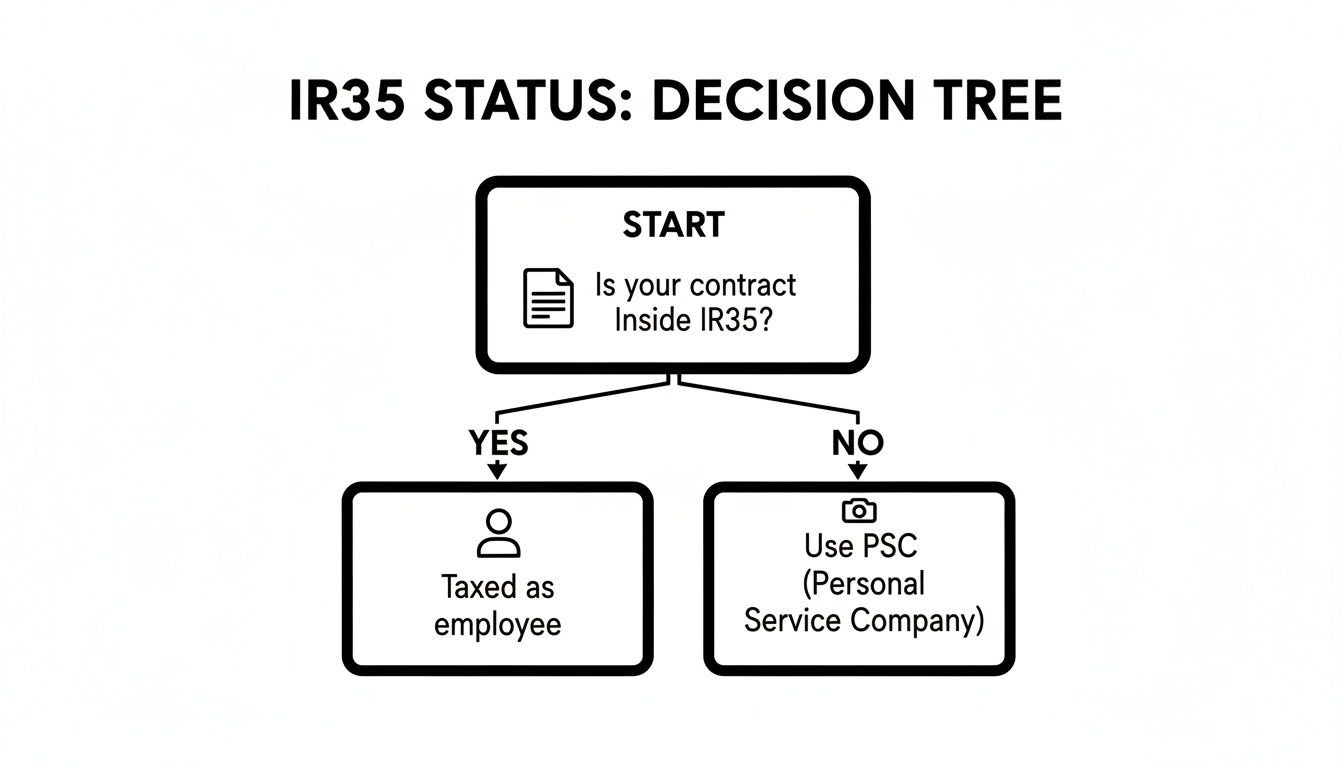
As the graphic makes clear, if a contract is determined to be 'inside IR35', the tax advantages of a PSC are eliminated. This makes an umbrella company a much more practical and compliant choice for that particular project.
Making the Right Choice for You
There is no single "best" answer that fits every contractor. The right decision is driven by the nature of your work and your personal preferences.
A seasoned contractor with a string of high-value projects consistently falling outside IR35 might find the admin of running a PSC is a small price to pay for the significant financial upside.
On the other hand, someone new to contracting, working on shorter assignments, or taking a role that is 'inside IR35' will almost certainly find an umbrella company's simplicity far more appealing. It is a compliant, no-fuss way to get paid so you can focus on the job at hand.
For a more granular comparison, our detailed guide on umbrella company vs a limited company explores the financial and legal nuances in greater depth. It will give you the clarity you need to move forward with confidence.
A Practical Guide to Setting Up and Running Your PSC

So, you have weighed the options and decided a Personal Service Company (PSC) is the right move for your contracting career. It can feel like a big step, but do not be daunted. This is your practical guide to getting it right from day one.
Setting up and running your own limited company is a series of clear, manageable steps. If you are methodical, you will find the process is far more straightforward than it first seems.
Your Initial Setup Checklist
Before you can raise that first invoice, you need to turn your idea into a proper legal entity. Think of this as laying the foundations of your business; get these early steps right, and everything that follows becomes much easier.
Here is a simple checklist to get you started:
- Choose a unique company name: Your name cannot be the same as another on the Companies House register. It also cannot contain sensitive words without official permission.
- Appoint a director and shareholder: As a contractor, this will almost certainly be you. You will be the director running the company and the main shareholder owning it.
- Register with Companies House: This is the moment your company officially exists. You will need to provide details about the business, its directors, and its registered office address.
- Open a business bank account: This is non-negotiable. You are legally required to keep your company’s finances completely separate from your personal money.
Managing Your Ongoing Director Duties
Once you are incorporated, your focus shifts to the day-to-day and year-to-year running of the company. As a director, you have legal responsibilities to keep your company compliant, and failing to meet them can have serious consequences.
These ongoing tasks are every bit as important as the initial setup. They prove you are running a genuine business, which is vital for protecting your limited liability status and keeping HMRC happy.
One of the best investments you will ever make is partnering with a specialist contractor accountant. They will navigate the complex tax rules, ensure you never miss a deadline, and help you run your company in the most tax-efficient way possible. It provides the ultimate peace of mind.
Your key ongoing responsibilities will include:
- Arranging professional insurance: Most clients will insist you have professional indemnity, public liability, and employers' liability insurance before they will even consider working with you.
- Meeting filing deadlines: You have to file annual accounts and a confirmation statement with Companies House each year. Miss these deadlines, and you will face automatic penalties.
- Managing tax obligations: This involves registering for Corporation Tax (and maybe VAT), filing your annual Corporation Tax return, and handling your own personal Self Assessment tax return.
Choosing the right accounting software will make your life significantly easier. Many UK contractors use specialised tools, and it is worth seeing how FreeAgent compares to other options. The right software, often recommended by your accountant, will simplify your bookkeeping and expense tracking massively.
By following these steps and getting the right professional support, you can confidently handle the administrative side of your PSC. That leaves you free to focus on what you do best: delivering outstanding work for your clients.
Understanding the Risks and Director Responsibilities
While the rewards of running your own Personal Service Company (PSC) are clear, it is crucial to go in with your eyes open. Stepping up as a company director means you are not just a contractor delivering a service anymore; you are legally responsible for your company's financial health and its compliance with the law.
First, you must draw a thick, clear line between your business and personal finances. This is not just tidy bookkeeping; it is what underpins your limited liability. This is the legal "firewall" that protects your personal assets, like your house or savings, if the business accrues debts. If those finances mingle, you risk that firewall crumbling, putting everything you own in jeopardy.
Your Duties as a Director
As a director, you have legal duties laid out in the Companies Act 2006. These are not just suggestions. Failing to meet them can land you in serious trouble, with penalties ranging from fines to being disqualified from running a company altogether.
In a nutshell, you are required to:
- Follow the company’s rules: You must act within the powers granted by your company's articles of association.
- Promote the company's success: Every decision you make must be for the benefit of the company and its members (which is usually just you).
- Exercise independent judgement: You have to make your own calls. You cannot just be a puppet for your client or anyone else.
- Avoid conflicts of interest: You must be transparent about any personal stake you might have in a transaction the company makes.
A critical part of this role is meeting every single statutory deadline. If you miss a filing date with Companies House or HMRC, you will face automatic financial penalties. It is also a surefire way to attract unwanted attention from the authorities.
Staying on the Right Side of the Law
Beyond the basic filings, you need to be aware of specific anti-avoidance rules. The Managed Service Company (MSC) legislation, for instance, is designed to stop schemes where contractors operate through a PSC that is, in reality, controlled by a third party. To steer clear, you must be able to prove you are genuinely in control of your own company and making your own business decisions.
Protecting the business from liability is another key responsibility. This almost always means getting the right insurance in place. Taking out comprehensive Business Insurance for Contractors is a standard step to shield your company from claims of negligence or other professional mishaps.
The PSC model is a huge part of the UK economy. Recent government figures show that of the 5.7 million private businesses in the UK, roughly 74% (around 4.1 million) have no employees. That number is a near-perfect fit for the solo contractor working through a PSC.
Ultimately, these responsibilities are the trade-off for the control and tax efficiency a PSC offers. If the idea of managing all this administration feels like a burden, remember that a good umbrella company provides a simpler path. They handle all the legal and financial heavy lifting, letting you focus purely on your work with total peace of mind.
Frequently Asked Questions About Personal Service Companies
Still have a few questions? Let's clear up some of the common queries contractors have about running a Personal Service Company.
How Much Does It Cost to Run a Personal Service Company?
Your main ongoing cost will be your accountant. Expect to pay a specialist contractor accountant somewhere between £80 and £150+ per month. Do not see this as just a cost; it is an investment in keeping your tax affairs straight and avoiding trouble with HMRC.
On top of that, you will have a small one-off fee to form the company, plus annual premiums for business insurance and possibly a subscription for accounting software.
Can I Use a PSC and an Umbrella Company at the Same Time?
Yes, you can, and many contractors do exactly this to stay flexible. It is a smart hybrid approach.
You can run any contracts deemed ‘outside IR35’ through your PSC, which allows you to maximise your earnings using tax-efficient dividends. If you then take on a role that falls ‘inside IR35’, you can simply work through a compliant umbrella company for that specific contract. This ensures all the correct taxes are paid.
This strategy gives you the best of both worlds, letting you choose the right setup for each individual job.
What Should I Do with My PSC if I Stop Contracting?
If you are taking a break or stopping for good, you have a couple of choices for your company.
- Make it dormant: If you think you might contract again in the future, you can declare the company dormant with both Companies House and HMRC. This effectively puts it on pause, minimising your reporting duties until you need it again.
- Close it down: If you are leaving contracting for good, the cleanest option is to formally dissolve the company. This means settling any final tax bills and filing the right paperwork to have it officially struck off the register.
Is a Business Bank Account Really Necessary for a PSC?
Yes, it is absolutely non-negotiable. A separate business bank account is a legal requirement.
Your company is a distinct legal entity, and mixing its money with your personal funds breaks down that separation. This is sometimes called "piercing the corporate veil," and it can completely undo your limited liability protection.
If that happens, your personal assets, such as your house or savings, could be on the line if the company runs into debt. Think of it as one of your most fundamental duties as a director.
At UmbrellaCompany.com, we provide the tools and guidance to help you make informed decisions about your contracting career. Whether you need to find a compliant umbrella solution for an inside IR35 role or want to compare your options, we are here to support you. Visit us at https://umbrellacompany.com to get started.


