


So, what does professional indemnity insurance cover, really? Think of it as your professional safety net. It is designed to protect you if a client claims your specialist advice or work has caused them a financial loss.
For contractors and freelancers, it is essentially 'mistake insurance'.
Your Guide to Professional Indemnity Insurance
As a professional, clients pay for your expertise. But we are all human, and mistakes can happen. An unintentional error in your work could hit your client with a serious financial loss, and they may look to you for compensation. This is where professional indemnity (PI) insurance comes in.
PI insurance is built to cover the costs of defending yourself against that kind of claim. It can pay for legal fees, the cost of hiring experts, and any compensation awarded to the client if you are found to have been negligent. It is there to protect both your finances and your professional reputation.
This diagram breaks down the main pillars of what a typical PI policy covers.
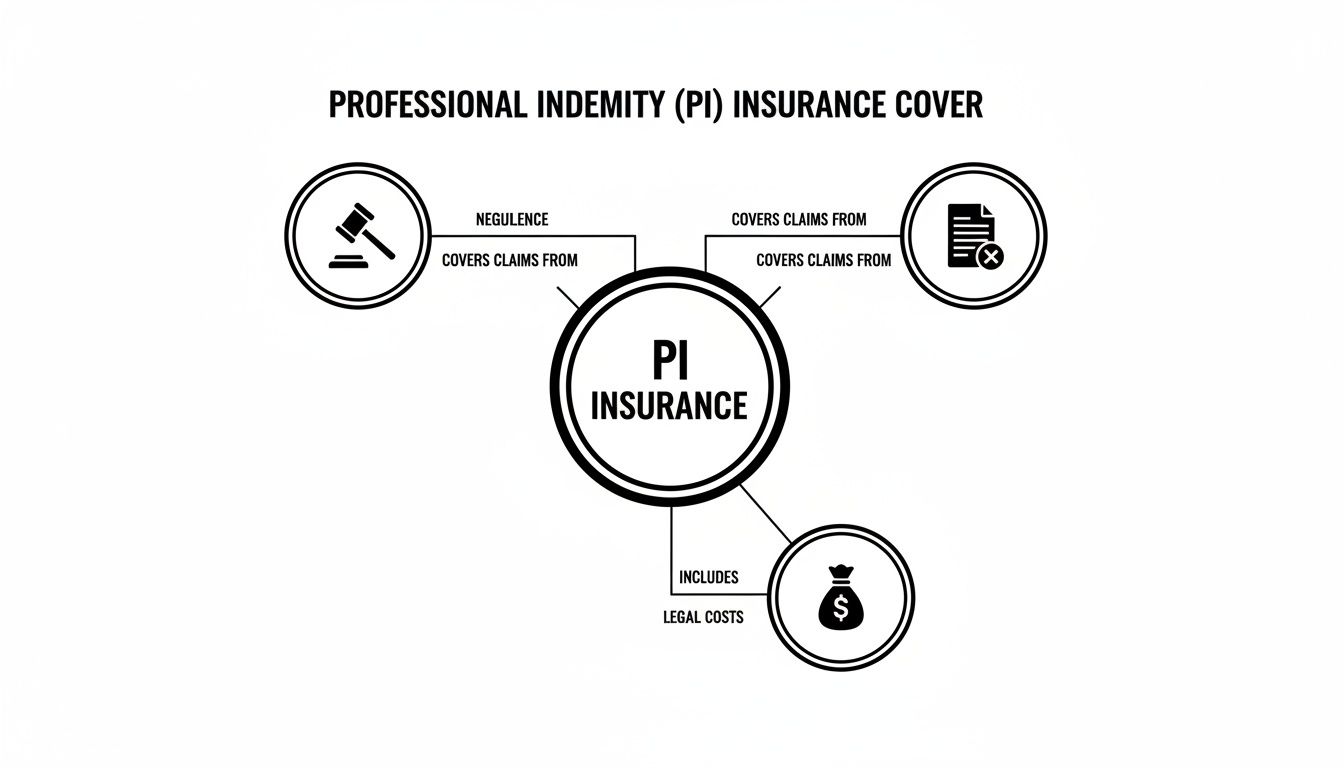
As you can see, the cover centres on three key areas: claims of negligence, fixing errors, and, crucially, paying for the often-substantial legal costs involved.
Why Is This Cover So Important for Contractors?
For many UK contractors, having PI insurance is not just a good idea; it is a contractual requirement. Many clients and recruitment agencies simply will not work with a contractor who does not have a certain level of cover in place. It is a vital layer of security for everyone involved.
To give you a clearer picture, here is a quick summary of what a standard PI policy usually includes and excludes.
Professional Indemnity Cover at a Glance
| Typically Covered | Typically Excluded |
|---|---|
| Professional negligence (making a mistake) | Deliberate or dishonest acts |
| Breach of professional duty or confidentiality | Bodily injury or property damage (this is for Public Liability) |
| Errors and omissions in your work | Fines, penalties, or punitive damages |
| Loss of client documents or data | Claims arising from work outside your stated business activities |
| Defamation (libel and slander) | Contractual liability (assuming liability you would not otherwise have) |
| Intellectual property infringement (unintentional) | Claims known about before the policy started |
| Legal defence costs and compensation payouts | Work done in or for clients in the USA/Canada (unless specified) |
This table shows how PI insurance is specifically designed to handle claims related to the quality of your professional services, not other business risks.
Professional indemnity insurance covers the gap between a client’s expectations and the reality of a project outcome when an error occurs. It ensures a single mistake does not jeopardise your financial stability or your ability to continue trading.
In this guide, we will dive into exactly what is covered, what common exclusions to look out for, and how to figure out how much protection you actually need. We will also explore:
- Real-world claim scenarios that are relevant to today's contractors.
- Why this cover is so vital, especially if you work through an umbrella company.
- The key differences between PI and other business insurances you might need.
Understanding your cover is the first step to securing your contracting career. For a wider view of the different protections available, you might find our complete guide to contractor insurance in the UK helpful. With this knowledge, you can take on new projects confidently, knowing you have a solid safety net in place if things do not go to plan.
What Professional Indemnity Insurance Actually Covers
So, what does professional indemnity (PI) insurance cover in practice? Your policy is designed to respond when a client claims your professional services caused them a financial loss. It is a safety net for a range of professional risks, not just one big blunder.
Understanding these protections is crucial for any contractor. Let's break down the main areas of cover.
Professional Negligence
This is the most common reason for a PI claim. Professional negligence is when you fail to meet the standard of care expected in your profession, and that failure directly causes a client to lose money.
It is not about just any mistake, but one that a competent professional in your field should not have made.
For example, an IT contractor might deploy faulty code that crashes a client's e-commerce site during Black Friday. The client could then claim for lost revenue. Your PI insurance would handle the legal defence and any compensation owed.
Another scenario is a business consultant providing advice based on flawed market data. If the client acts on that advice and suffers major financial setbacks, they could argue the consultant was negligent.
Errors and Omissions
Closely related to negligence, errors and omissions cover accidental mistakes or oversights. This is not about a lack of skill, but about human error (forgetting something, or a minor miscalculation with big consequences).
Imagine you are a project manager and you accidentally leave a critical task dependency out of the project plan. This small oversight causes a month-long delay and triggers penalty clauses in the client’s contracts. A claim for these costs falls under errors and omissions.
A PI policy is built to protect you from the financial consequences of human error. It accepts that even the best professionals can make mistakes, and provides a way to make things right without facing financial ruin.
Intellectual Property Infringement
Accidentally infringing on someone else's intellectual property (IP) is a real risk for contractors. This part of your cover protects you if your work allegedly breaches copyright, trademark, or patent laws.
- For a Graphic Designer: You might use a font in a logo that, unknown to you, requires a commercial licence. If the font's creator pursues your client for damages, the client will look to you.
- For a Software Developer: You could accidentally use a piece of open-source code with a restrictive licence in a client's commercial software, sparking a legal challenge.
Your PI insurance helps cover the legal costs and any damages awarded in these complex cases.
Loss of Data or Documents
As a contractor, you are often trusted with sensitive client information, from project files to personal data. Your policy can cover you if you lose this data, whether it is on a misplaced laptop or in an accidentally deleted database.
This cover typically helps with the cost of trying to replace or restore the lost information. If the data is gone for good, it can also cover the financial losses the client suffers as a direct result.
Crucially, your PI policy will almost always cover your legal defence costs. Even if a claim against you has no merit, defending yourself is expensive and time-consuming. Your insurance gives you the funds and expert legal support to handle the process, so you can focus on your work.
To see how these protections apply specifically to independent professionals, our guide on freelancer professional indemnity insurance offers more tailored insights.
When Things Go Wrong: Real-World Contractor Scenarios

Talking about what a policy covers is one thing. Seeing how it works in the real world is another. Let’s move past the jargon and look at a few scenarios that show just how fast a simple mistake can snowball into a financial and reputational nightmare.
These are the moments when your PI insurance steps in, acting as a crucial buffer between a human error and a claim that could threaten your entire business.
Scenario 1: The IR35 Consultant
Let’s say you are an experienced IR35 consultant. A marketing agency has relied on your advice for years to classify their freelance designers. After reviewing their working practices, you confidently advise them that their contractors fall outside IR35. So far, so good.
Six months later, HMRC opens an enquiry. To everyone's shock, they rule the contracts were inside IR35. The agency is now staring down a huge bill for unpaid PAYE and National Insurance, plus hefty penalties.
Convinced your advice was negligent, the agency files a claim against you to recover their losses. This is where your PI insurance kicks in.
- Your insurer immediately appoints legal experts who live and breathe tax liability cases.
- The policy covers the mounting legal fees needed to defend your position.
- If you are found liable, your insurance pays the compensation owed to your client, right up to your policy’s limit.
Without that policy, you would be facing the full force of a legal defence and a potential six-figure payout all on your own.
Scenario 2: The Marketing Contractor
Now, imagine you are a freelance marketer hired to launch a social media campaign for a new health supplement. You create some great posts that drive a lot of traffic. The problem? One post makes a claim about the product’s benefits that is not backed by scientific proof, accidentally breaching Advertising Standards Authority (ASA) codes.
A competitor spots it and files a complaint. The ASA agrees, forcing your client to pull the entire campaign and issue a public clarification. The brand’s reputation is damaged and sales plummet. They hold you responsible for the mistake.
Professional indemnity insurance is built for exactly this kind of situation. It covers losses that do not come from a physical action, but from the professional service and advice you delivered. It recognises that a misplaced sentence in a social media post can be just as financially damaging as a major engineering blunder.
Your PI policy would step in to cover the legal costs of managing the claim and potentially the client’s expenses for remedial advertising and proven financial losses. You can find more detail on how this applies to various roles in our guide to contractor indemnity insurance.
Scenario 3: The Construction Project Manager
PI insurance is all about covering your legal liability for professional negligence, errors, or omissions. This is absolutely vital for UK contractors, especially in light of a landmark UK Supreme Court ruling in the URS Corporation Ltd v BDW Trading Ltd case. It clarified that professionals like architects and engineers can be held liable for their work long past the standard 12-year limitation period, stretching their risk out indefinitely. As this professional indemnity market update explains, the implications are huge.
Let's put that into practice. You were the contractor managing the design and build of an office block. Years go by. You have long since moved on to other projects when significant cracks appear in the building’s foundations. An investigation reveals the slab was under-designed for the load it was carrying.
The building owner sues you for the rectification costs, which run into the hundreds of thousands. Because of those extended liability periods, the claim is still valid. Your PI policy, which you have thankfully kept active, becomes your lifeline. It covers the defence costs and, ultimately, the settlement. It is a stark reminder of why continuous cover is so important, even years after a project is finished.
Decoding Your Policy Limits and Excess

When you get your policy documents, it is easy for your eyes to glaze over. But there are two numbers you absolutely need to understand: the limit of indemnity and the policy excess. These figures determine how much protection you actually have, and getting them right is crucial for balancing cost and real-world cover.
Think of the limit of indemnity as your insurer's maximum payout for a claim. This is the total pot of money they will use to cover everything from solicitors' fees and legal defence to the final compensation cheque for your client. It is your safety net, so you need to be sure it is big enough.
Understanding Your Limit of Indemnity
As a contractor in the UK, the limit of indemnity you need is often decided for you. It is a common clause in client contracts, especially with larger companies or public sector bodies. They will often specify a minimum cover level, typically £1 million or £2 million, before you can even set foot on site.
This is not just a number plucked out of thin air. It is based on their assessment of the potential financial fallout if your work were to cause a major problem. If your contract is silent on the matter, the ball is in your court. You will have to judge the risk yourself, you should consider the size of your projects, the value of the contracts, and the worst-case financial hit your mistake could cause.
The limit of indemnity is your financial backstop. It’s the total value of the safety net your professional indemnity insurance provides. Always check your client contracts carefully to ensure your cover meets their minimum requirements.
Any One Claim vs In the Aggregate
You also need to check whether your policy is offered on an 'any one claim' or 'in the aggregate' basis. This detail might seem small, but it has a massive impact on your total protection if you are unlucky enough to face multiple claims in one year.
Any One Claim: This is what you want to see. It is the most common and far more generous option, giving you the full limit of indemnity for each separate claim during the policy year. So, with a £1 million limit, if you face two unrelated claims, you have up to £1 million of cover available for each one.
In the Aggregate: This means your indemnity limit is the total pot for all claims combined in the policy year. If you have a £1 million aggregate limit and an early claim costs £700,000 to settle, you are left with only £300,000 to handle any other issues that might crop up that year. It can leave you dangerously exposed.
What Is the Policy Excess?
The policy excess is simply your contribution towards a claim. It works exactly like the excess on your car or home insurance. Before your insurer steps in, you have to pay this first part of the claim yourself.
For instance, if your policy excess is £500 and a claim ends up costing £10,000 to resolve, you pay the first £500. Your insurer then picks up the tab for the remaining £9,500. Opting for a higher excess can bring your premium down, but do not get carried away. Make sure it is an amount you could genuinely afford to pay out of pocket if a client suddenly made a claim against you.
What Professional Indemnity Insurance Does Not Cover

Knowing what your professional indemnity (PI) policy covers is half the battle. The other half is getting crystal clear on what it does not. Understanding the policy exclusions is crucial for avoiding nasty surprises down the line and making sure you do not have any hidden gaps in your cover.
PI insurance is a specialist policy. Its job is to protect you if your professional advice or service causes a client a financial loss. It is not a general business policy designed to cover every eventuality; many risks are intentionally left out because they belong under a different type of insurance.
Common Exclusions in a PI Policy
While every policy has its own unique wording, most PI insurance includes a standard set of exclusions. Think of these as the clear boundaries of your cover.
Here are the key things your policy will almost certainly not cover:
Deliberate or Malicious Acts: If you intentionally defraud a client, lie, or set out to cause them harm, your insurance will not protect you. PI is there for genuine mistakes and negligence, not for dishonest behaviour.
Claims Outside Your Stated Activities: Your policy only covers you for the specific business activities you declared when you bought it. If you are an IT consultant who offers unofficial financial advice on the side, a claim arising from that advice will not be covered.
Known Circumstances: You cannot insure a house that is already on fire. Likewise, you cannot take out a policy to cover a dispute you already know about or a mistake you have already made. You must disclose any circumstances that could lead to a claim when you apply.
Bodily Injury and Property Damage
This is where contractors often get confused. A core distinction to remember is that PI insurance is for financial loss, not physical damage or injury.
Say you are at a client’s office and you knock a cup of tea over their main server, causing thousands of pounds of damage. Your PI policy will not help you here. This is a job for Public Liability insurance, which is designed to cover claims of accidental injury to a person or damage to their property.
Similarly, if one of your own employees gets hurt while working for you, that would fall under Employers’ Liability insurance.
Professional Indemnity insurance is laser-focused on the financial fallout from your professional services and advice. It isn't built to handle physical accidents, injuries, or property damage – those are what other policies are for.
Building Your Complete Insurance Picture
This is why most contractors need a combination of policies to be properly protected. Each one has a distinct and important role to play:
- Professional Indemnity (PI) Insurance: Covers claims for financial loss arising from your negligent advice or professional services.
- Public Liability (PL) Insurance: Covers claims for injuring a third party (like a client) or damaging their property.
- Employers’ Liability (EL) Insurance: A legal must-have if you employ anyone, covering claims if an employee is injured or falls ill as a result of working for you.
At UmbrellaCompany.com, we help you connect with compliant umbrella providers who frequently include a comprehensive insurance package as part of their standard service. Understanding how these policies fit together means you can operate without any gaps in your cover, giving you the peace of mind to focus on what you do best.
Finding the Right PI Policy for Your Business
So, you understand what professional indemnity insurance is for. But how do you actually pick the right policy? It is about more than just finding the cheapest quote; it is about getting cover that genuinely has your back.
First things first: steer clear of generic, off-the-shelf policies. The risks you face as an IT project manager are worlds apart from those of a marketing consultant. You need a policy built for your specific trade, with wording that covers the real work you do. Anything less is a false economy.
Choose a Specialist Broker
This is where a specialist broker proves their worth. Someone who lives and breathes the contractor market will know the common contractual headaches you face and can translate your client’s demands into the right policy features.
They will ensure your indemnity limit is high enough for the projects you are taking on and can help you navigate the application, which brings us to a critical point.
The Importance of Accurate Disclosure
When you apply for PI insurance, you have a duty of disclosure. That means you must give a full and honest account of your business activities and any past claims or disputes.
It might be tempting to hide a previous issue to get a lower premium, but it is a huge risk. If you are not upfront, the insurer could later refuse to pay a claim or even void your policy entirely, leaving you to foot the bill. It is far better to be honest and pay a fair price for cover you can actually rely on.
Understanding Current Market Trends
The insurance market moves in cycles. After a tough period between 2019 and 2022 where premiums rocketed, the market has softened considerably, creating a much better environment for contractors.
For instance, after London rates eased by 5-10% in 2024, the market continued to soften into 2025. Some rates dropped by as much as 25-30% from the previous year. As this 2025 professional indemnity market update shows, insurers are now more willing to offer broader cover, including for things like threatened claim costs. If you can show you manage your risks well, you are in a great position to get a competitive premium.
A softer market is a real opportunity for contractors. If you work with a specialist and can demonstrate good risk management, you can lock in better terms and broader cover than were available just a few years ago.
How We Can Help at UmbrellaCompany.com
Getting the right insurance sorted is a vital step in your contracting career, whether you are working through your own limited company or using an umbrella. Many compliant umbrella companies include a solid insurance package (PI, Public Liability, and Employers' Liability) as part of their standard service. This is often the most straightforward and cost-effective way to get protected.
At UmbrellaCompany.com, we help you compare FCSA-accredited umbrella providers, letting you check the insurance cover they offer alongside their margin and other services. It ensures you find a partner that not only handles your payroll but also gives you the safety net your business needs. And for those risks that a standard PI policy will not cover, like a tax investigation, it is wise to look into specific IR35 insurance to make sure all your bases are covered.
Your Professional Indemnity Insurance Questions Answered
To finish up, let's run through some of the most common questions contractors and freelancers have about professional indemnity (PI) insurance. Getting these answers straight will help you feel more confident about the cover you have in place.
Is PI Insurance a Legal Requirement for UK Contractors?
For most UK contractors, professional indemnity insurance is not a legal requirement. It is not like Employers’ Liability insurance, which is mandatory if you have staff.
That said, it is almost always a contractual requirement. Most clients, especially larger organisations and public sector bodies, simply will not take you on without proof of adequate PI cover. It has become an essential part of doing business professionally.
How Much Cover Do I Actually Need?
The level of cover you need really comes down to your client contracts. Many will state a minimum limit of indemnity you must hold, which often starts at £1 million.
If your contract does not specify an amount, it is up to you to assess the risk. You need to think about:
- What is the total value of the contracts you are working on?
- What is the worst-case financial fallout for your client if your advice or work causes a major issue?
- What is the standard level of cover for other professionals in your specific field?
When in doubt, it is always better to have a little more cover than you think you might need.
What Is Retroactive Cover and Do I Need It?
Retroactive cover is a crucial part of any PI policy. It protects you against claims that arise from work you did before your current policy started. When you first buy PI insurance, you can set a 'retroactive date', which is usually the date you started trading.
This feature is designed to make sure there are no gaps in your professional history. Without it, you would be completely exposed for any mistakes on past projects.
If you ever switch insurers, it is absolutely vital to ensure your new policy carries over the same retroactive date. This guarantees continuous cover, protecting you from claims that can pop up years after a project has finished.
If My Client Has Cover Am I Protected?
No, you are almost certainly not. A client's insurance policy is there to protect their business, not yours.
If a mistake you make causes them a financial loss, their insurer might pay their claim and then come after you to get their money back. This is a common process known as subrogation.
Relying on your client’s policy is a huge gamble. Your own professional indemnity insurance is the only real way to make sure your interests are defended and your personal finances are safe.
At UmbrellaCompany.com, we make it easy to compare compliant and accredited umbrella companies, many of which provide comprehensive insurance packages as standard. Find a partner that secures your finances so you can focus on your work. Visit UmbrellaCompany.com to get started.


