


If you've ever glanced at your payslip and wondered what ‘PAYE’ means, you're not alone. In simple terms, PAYE stands for Pay As You Earn. It’s the system HMRC uses to collect Income Tax and National Insurance Contributions (NICs) straight from your wages before the money ever hits your bank account.
What PAYE on Your Payslip Really Means
Think of it as a 'pay-as-you-go' plan for your taxes. Rather than getting hit with a huge tax bill at the end of the financial year, PAYE smooths things out by taking a small slice from each payday. It’s a system that’s been around since 1944, designed to make paying tax much more manageable for everyone. You can learn more about the Pay As You Earn system and how it works in practice.
Here at UmbrellaCompany.com, we know that deciphering a payslip can feel like trying to crack a code. This guide will walk you through it, piece by piece. We will break down everything from your gross pay to your final take-home salary, explaining how each deduction is calculated so you can read your payslip with total confidence.

Decoding Your Payslip: The Key Components
Think of your payslip as the story of your month's work and pay. To get the full picture, you need to know who the main characters are.
It all starts with your Gross Pay. This is the headline figure, your total earnings before anyone takes a penny. Then, at the very bottom, you will see the Net Pay. This is the number you really care about, as it’s what actually lands in your bank account. Everything that happens between those two numbers is the story of your deductions.
You will also spot your National Insurance Number and, crucially, a Tax Code. This little string of numbers and letters is a direct instruction from HMRC to your employer, telling them exactly how much of your pay is tax-free. We will dig into that a bit more later, but for now, just know it’s a vital piece of the puzzle. Getting familiar with these terms is the first step to making your payslip feel a lot less like a foreign language.
How Your PAYE Income Tax Is Calculated
Ever wonder how the tax figure on your payslip is actually worked out? It's not just a number plucked from thin air. The whole process is a systematic calculation that starts with your Personal Allowance. Think of this as the amount you're allowed to earn each year completely tax-free.
For the 2025-26 tax year, that magic number is £12,570. Anything you earn above this threshold is then subject to Income Tax.
This is where the tax bands come into play. Your earnings are sliced into different portions, with each portion taxed at a specific rate. It's a progressive system: the more you earn, the higher the rate on the top slice of your income.
Here's a quick rundown of the current UK income tax bands.
UK Income Tax Rates and Bands
| Tax Band | Taxable Income | Tax Rate |
|---|---|---|
| Personal Allowance | Up to £12,570 | 0% |
| Basic Rate | £12,571 to £50,270 | 20% |
| Higher Rate | £50,271 to £125,140 | 40% |
| Additional Rate | Over £125,140 | 45% |
So, you pay 20% on the portion of your income that falls into the basic rate band, 40% on the next slice, and so on. It's a common misconception that getting a pay rise that pushes you into a higher band means you pay the higher rate on all your earnings. That is simply not true. You only pay the higher rate on the amount above the threshold.
This simple flowchart breaks down how your gross pay (your total earnings before any deductions) becomes your net pay (what you actually take home).
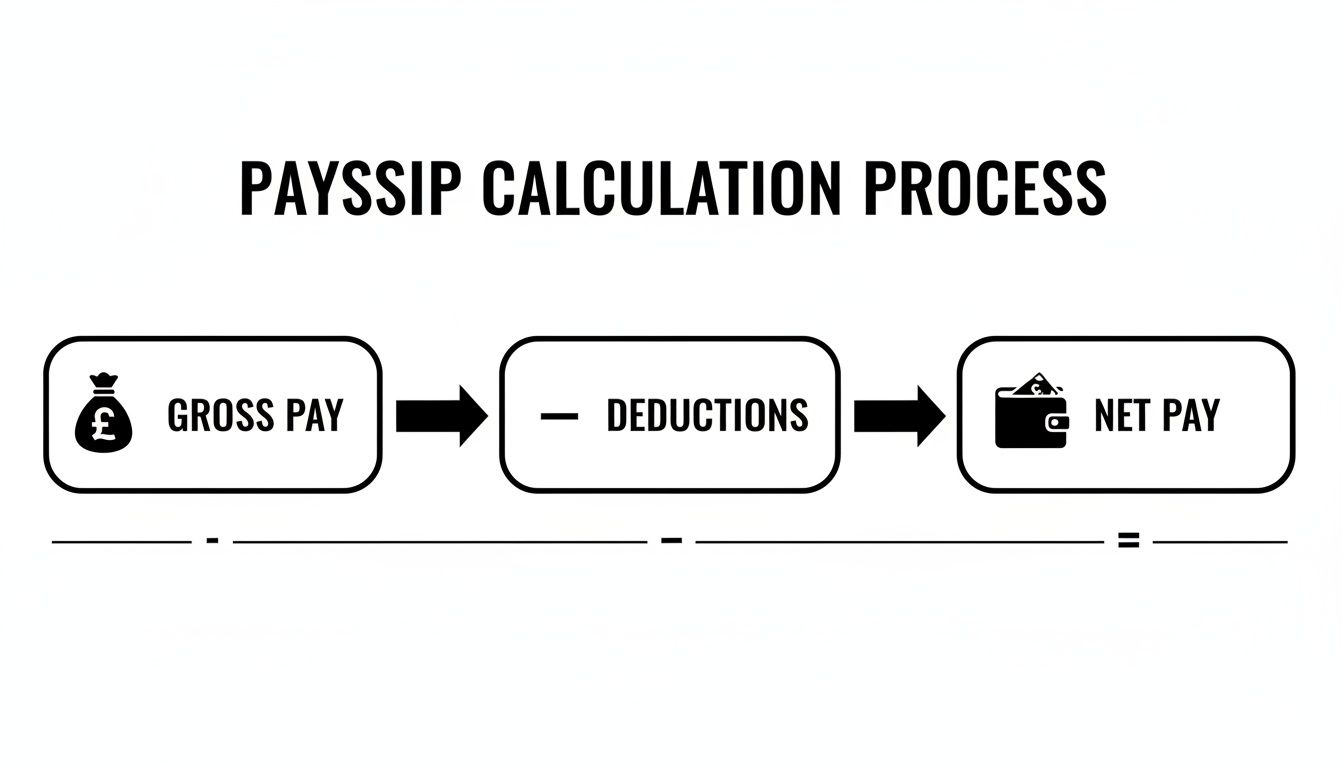
As you can see, your final take-home pay is what is left after HMRC has taken its slice for PAYE tax, along with your National Insurance, pension contributions, and any other deductions.
If you want to see how this works with your own numbers, give our handy UK payroll calculator a try. It can give you a much clearer picture of your personal tax situation.
What About National Insurance Contributions?

Right next to your Income Tax, you'll spot a deduction for National Insurance (NI). It’s easy to lump the two together, but NI plays a completely different role. It is not just another tax; it's more like a compulsory savings plan for the nation's welfare system.
Think of it as your contribution to a massive safety net. The money you pay into the system funds crucial state benefits like the State Pension, Maternity Allowance, and Employment and Support Allowance. For most employees, this is known as Class 1 NI.
It's important to know that NI is calculated separately from your PAYE Income Tax. It has its own thresholds and rates based on how much you earn. Both you and your employer contribute, and ultimately, this deduction is what builds your entitlement to state support when you need it most.
Making Sense of Other Common Payslip Deductions
While PAYE tax and National Insurance are the big two, they're not the only things you might see coming off your gross pay. We believe in total transparency at UmbrellaCompany.com, so let's break down a few other common deductions to give you the full picture.
One you'll frequently spot is a student loan repayment. If you've been to university, these are automatically deducted once your earnings cross a certain government-set threshold. It is all handled for you, so you do not have to worry about making manual payments.
Another regular feature for most people is a workplace pension contribution. Thanks to the auto-enrolment scheme, both you and your employer are contributing to build a pension pot for your future. It’s a slow and steady way to save for retirement, directly from your salary.
Beyond that, you might also have voluntary deductions for things like company share schemes, charity donations, or even a 'cycle to work' initiative. Each of these reduces your pay for a specific reason you've agreed to, ensuring every pound is accounted for clearly on your payslip.
How PAYE Works for Umbrella Company Contractors

This is where things get particularly relevant for contractors. When you work with an umbrella company like us, we effectively become your employer for tax purposes. It sounds complicated, but it actually simplifies your life enormously.
We handle all the administration that comes with traditional employment. We process your earnings from the client, calculate the exact Income Tax and National Insurance contributions due, and send them straight to HMRC for you.
The upshot is you stay fully compliant with tax law and also gain access to statutory employment rights, like sick pay and holiday pay. It’s a clean, straightforward way to work, especially if your contracts are deemed ‘inside IR35’.
We believe in complete transparency, so our payslips always show our margin clearly, which is our fee for providing this service. If this way of working is new to you, have a read of our guide on the difference between umbrella and PAYE for a deeper dive.
Got a Question About PAYE?
Even when you think you have got the hang of it, payslips can throw up a few curveballs. Here are some of the most common questions we get asked about PAYE, with straightforward answers.
Why Has My Tax Code Changed?
It’s quite common for your tax code to change, and it usually happens when your personal circumstances do. Starting a second job is a classic example, but it could also be triggered by a change in company benefits.
HMRC might also tweak your code based on your earnings from the previous tax year to make sure you're paying the right amount this year. Don't worry, they should always send you a letter explaining why it has changed.
What Does YTD Mean On My Payslip?
This is a simple one. ‘YTD’ stands for ‘Year to Date’.
It’s just a running total of everything you have earned and paid in deductions since the start of the tax year (6th April) up to the date of that specific payslip.
What Should I Do If I Think My PAYE Tax Is Wrong?
If you suspect your PAYE calculation is off, the very first thing to do is check your tax code. Is it the right one for your situation?
You can check your code on the HMRC website or give them a call. If it turns out the code is wrong, HMRC will issue a new one to your employer, and your future deductions will be adjusted to get you back on track.


