


Let's get straight to it. Employer National Insurance contributions (NICs) are a type of tax that UK businesses pay on top of their employees' salaries.
Think of it as your company's contribution to the UK's social safety net. The money helps fund massive public services like the NHS, the State Pension, and other social security benefits. It is a legal requirement, handled through your payroll, and it is completely separate from the National Insurance your employees pay from their own wages.
This guide explains what employer NICs mean for your business, how we calculate them, and how the system works for contractors using an umbrella company.
What Employer National Insurance Really Means for Your Business
When you hire someone, you take on more than just their salary. Employer National Insurance is a core part of your employment costs, representing your company's role in supporting the country's social fabric.
This isn't an optional extra; it's a legal requirement enforced by HMRC. The key difference is that while an employee's contribution is deducted from their gross pay, your contribution is an additional cost to the business. Understanding this is vital for accurate budgeting, especially when you are thinking about growing your team.
The Purpose of Employer NICs
So, where does all this money actually go? At its heart, Employer National Insurance has a clear and crucial purpose. The cash collected goes into the National Insurance Fund, which is then used to pay for key state provisions.
- The National Health Service (NHS): A huge slice of NICs goes towards keeping our healthcare system up and running.
- The State Pension: Your contributions directly help to fund the pensions of people who are retired right now.
- Welfare Benefits: It also supports people through benefits like Jobseeker's Allowance and bereavement support.
Understanding this helps to see it less as just another tax and more as an investment in the country's infrastructure and well-being. The system is designed so that both employers and their staff chip in to a collective safety net. For a deeper dive into managing these kinds of business finances, our guide to accounting for contractors offers some great insights.
Employer NICs are a major part of both employment costs and government income. It is a direct, legally required payment you make to HMRC, calculated on employee earnings once they go over a set threshold.
Upcoming Changes You Should Know
The goalposts for NICs do move. The government often announces changes to rates and thresholds in the Budget.
For the 2025-26 tax year, the plan is for employers to pay NICs at a rate of 15% on any earnings above the Secondary Threshold. This is a noticeable jump from the 13.8% rate in 2024-25. That threshold (the point at which you start paying) was £12,570 a year for the 2024-25 tax year.
You can always find the latest, official figures by checking the rates and allowances on GOV.UK.
How We Calculate Employer NICs
Working out how much Employer National Insurance you owe does not have to be a headache. The system is built on a few core ideas that make the whole process pretty straightforward once you understand them. It all kicks off with something called the Secondary Threshold.
Think of this threshold as the starting line. You do not pay a penny of employer NICs on any of your employee's earnings that fall below this amount. This is great for simplifying payroll for lower-earning or part-time staff. It is only the portion of their salary that goes above this line that you need to worry about.
This visual helps to show how your contributions travel from your business, through HMRC, and end up funding vital public services for us all.
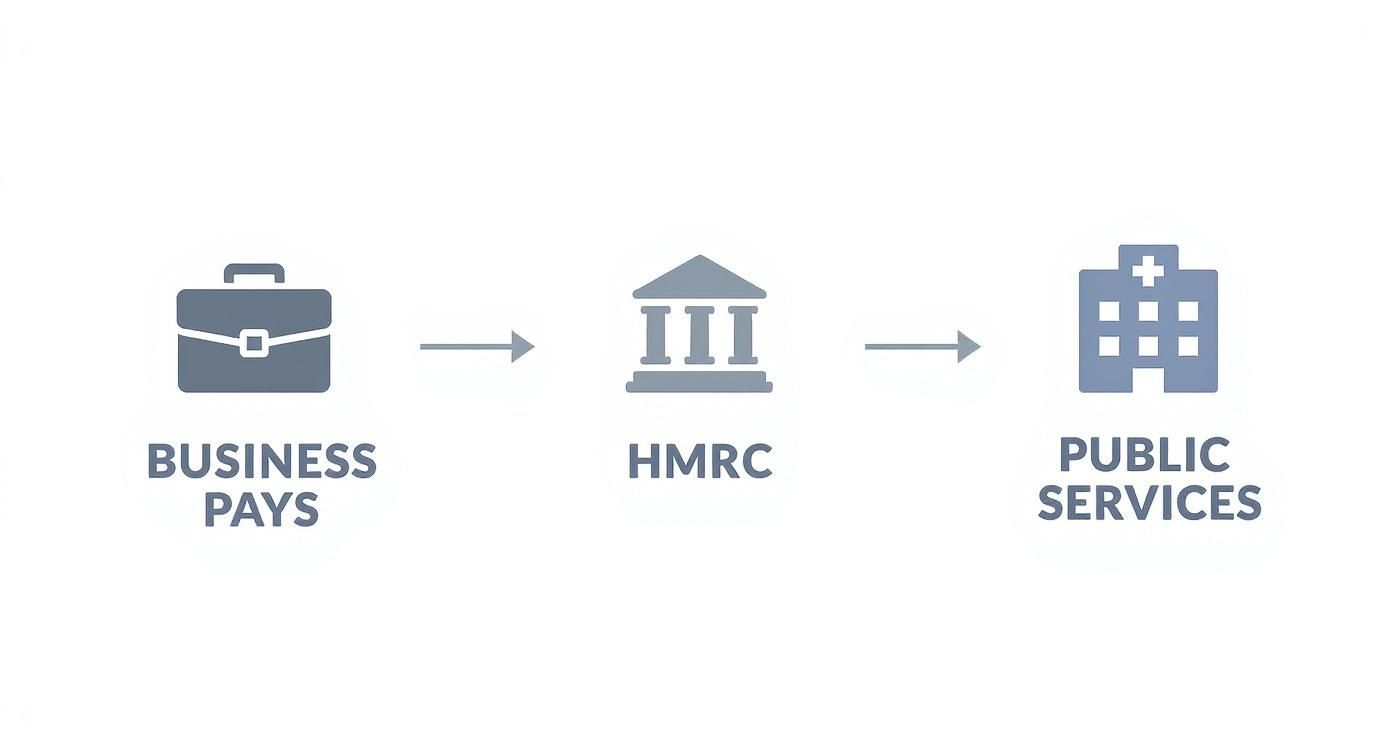
As you can see, employer NICs are a direct pipeline from UK businesses into the nation's welfare system, all managed by HMRC.
Understanding National Insurance Category Letters
The next piece of the puzzle is the National Insurance category letter. HMRC assigns every employee a letter based on their individual circumstances, and this little letter dictates which rates and thresholds apply to them.
Most of your team will likely fall under Category A, which is the standard, catch-all category for anyone who does not fit into a special group. But it's worth knowing about the others, as they can seriously change the calculation.
- Category H: This is for apprentices under 25.
- Category M: Use this for employees under 21.
- Category V: This one is for military veterans in their first year of civilian work.
These special categories often come with a much higher earnings threshold. That means you will not start paying employer NICs for these employees until their salary hits a much higher level, which is a clear incentive for businesses to hire young people, apprentices, and veterans.
The Class 1 Secondary Rate and Calculation Steps
For the vast majority of your employees (those in Category A), you will use the Class 1 Secondary contribution rate. This is the standard percentage you, as the employer, have to pay on any earnings above that Secondary Threshold we talked about.
The calculation itself is a simple, three-step process:
- Find the gross pay: Start with the employee's total gross pay for the pay period (whether it's a week or a month).
- Deduct the threshold: Take away the Secondary Threshold amount for that same pay period.
- Apply the rate: Multiply what's left over by the current Class 1 Secondary NICs rate. That is your contribution.
Let’s run a quick example. If an employee earns £3,000 in a month and the monthly Secondary Threshold is £758, you only calculate NICs on the difference: £2,242. This is the number you apply the percentage rate to.
Of course, many businesses use modern payroll software solutions to automate all of this, ensuring everything is spot on. But if you want to run the numbers yourself for a quick estimate, our own UK payroll calculator is a handy tool.
Current Rates and Thresholds Reference
Keeping up with the latest figures from HMRC is absolutely crucial for accurate payroll. Rates and thresholds can, and often do, change each tax year, so always double-check you are using the correct numbers.
To make things easier, here's a simple table showing the most common rates for the 2024/25 tax year.
Employer National Insurance Rates and Thresholds
| Contribution Type | Rate | Weekly Threshold | Annual Threshold |
|---|---|---|---|
| Class 1 Secondary (Cat. A) | 13.8% | £175 | £9,100 |
| Class 1 Secondary (Cat. H, M, V) | 13.8% | £967 | £50,270 |
As you can see, while the standard employer NIC rate of 13.8% is the same across the board, the point at which it kicks in is dramatically different depending on the employee’s category letter.
Calculating Employer NICs with Real-World Examples
Theory is one thing, but seeing the numbers in action is where it all clicks. Let's walk through a couple of real-world scenarios to show you exactly how employer National Insurance contributions are calculated. This is the best way to get a feel for the real impact on a business's payroll.

This hands-on approach should turn abstract thresholds and percentages into something concrete, giving you a much clearer picture of how to manage your employment costs.
Example 1: Full-Time Employee on a Fixed Salary
Let's start with a classic setup: a full-time employee on NI Category A, earning a steady annual salary of £35,000. We will use the 2024/25 tax year rates.
First, we need their monthly pay.
- Gross Annual Salary: £35,000
- Gross Monthly Pay: £35,000 / 12 = £2,916.67
Next, we look at the monthly Secondary Threshold for Category A, which is £758. Remember, the employer only pays NICs on earnings above this line.
- Earnings Subject to NICs: £2,916.67 – £758 = £2,158.67
Now we apply the Class 1 Secondary NICs rate of 13.8% to that figure.
- Monthly Employer NICs: £2,158.67 x 13.8% = £297.90
So, for this one employee, the business has to find an extra £297.90 to send to HMRC every month. Over a year, that is an additional £3,574.80 on top of their salary.
Example 2: Part-Time Employee with Variable Pay
Things get a bit different for part-time staff whose hours change. Imagine a worker, also on NI Category A, who earns £1,000 in a busy month.
- Gross Monthly Pay: £1,000
The Secondary Threshold is still £758.
- Earnings Subject to NICs: £1,000 – £758 = £242
Applying the 13.8% rate gives us the contribution for that specific month.
- Monthly Employer NICs: £242 x 13.8% = £33.39
But what if the next month is quiet and they only earn £700? Since that is below the £758 threshold, the employer’s NICs bill for that person, for that month, is £0. This is how the system protects businesses from extra costs on lower-earning staff.
Understanding these calculations is vital for budgeting. Employer NICs are a significant and direct cost of having staff, completely separate from the salary you agree to pay them.
The collective impact on UK businesses is huge, especially for those employing people on average wages. Forecasts suggest that upcoming changes from April 2025 could add around £900 per year to an employer's bill for an employee on the median wage. The government offers the Employment Allowance for smaller businesses to soften the blow. To get the full picture, you can learn more about these NIC findings and their economic impact.
How Different NI Categories Change the Calculation
The sums can change dramatically for employees in special NI categories, like apprentices or young people.
Let’s take an apprentice under 25 (Category H) earning £25,000 a year.
- Gross Monthly Pay: £25,000 / 12 = £2,083.33
The monthly earnings threshold for Category H is way up at £4,189. Because their monthly pay is well below this line, the employer's NICs bill for this apprentice is £0.
This is a powerful incentive from the government to encourage businesses to hire apprentices and younger workers, as it can make a serious dent in an organisation’s payroll costs.
How Employer NICs Work for Umbrella Company Contractors
If you are a contractor working through an umbrella company, your payslip can sometimes feel like a puzzle. One of the most common questions we get is about deductions for employer National Insurance. It is a perfectly fair question: if it is the employer’s tax, why is it showing up on your pay breakdown?
Let’s clear this up.
The answer lies in how umbrella employment is structured. When you join an umbrella company, we legally become your employer. This is the setup that allows us to manage your tax and National Insurance correctly under PAYE, especially for contracts that fall inside IR35.
Because we are your employer in HMRC's eyes, we are legally required to pay employer NICs on your earnings. This is not optional; it is a statutory duty for every single employer in the UK.
The Assignment Rate Explained
This brings us to a crucial concept: the assignment rate. The rate your agency agrees with the end client is not your personal salary. It is a higher, all-inclusive rate designed to cover every cost associated with your contract.
Think of the assignment rate as one big pot of money from the client. Before we can even calculate your personal gross pay, all the necessary employment costs have to be settled from this pot. These are mandatory costs that are part of the total price of hiring a contractor.
These costs always include:
- Employer National Insurance contributions: The tax we must pay to HMRC on your earnings.
- The Apprenticeship Levy: Another statutory employment tax.
- The Umbrella Company Margin: Our fee for running payroll and providing employment support.
- Employer’s pension contributions: Where applicable under auto-enrolment.
Only after these legitimate, legally required costs are covered do we get to your gross pay. This is the figure that your personal tax (PAYE) and employee NICs are then calculated on.
A compliant umbrella company will always make this crystal clear. Your payslip should show the assignment rate we received and then detail exactly how these employment costs were deducted to arrive at your gross pay.
Why This Model Is Used
This whole process is designed to make sure all legal tax obligations are met properly and efficiently. The assignment rate is deliberately set at a level that accounts for these extra employment costs. In short, the client pays a rate that allows the umbrella company to meet its duties while still providing you with a competitive gross wage.
This structure also protects you. It removes the administrative headache and legal risk of you having to manage these complex payments yourself. It keeps you fully compliant with HMRC while letting you access employment benefits like statutory pay. For a deeper dive into the mechanics, take a look at our guide on how an umbrella company works.
It's vital to know the difference between this compliant model and a dodgy scheme. Any outfit claiming you can bypass employer NICs is almost certainly a disguised remuneration scheme, which could land you with a massive tax bill from HMRC down the line.
To make it easier to visualise, here is a simple table showing how we allocate an assignment rate.
Breakdown of an Umbrella Contractor Assignment Rate
| Component | Description | Example Allocation |
|---|---|---|
| Assignment Rate | The total funds paid by the end-client/agency for the contractor's services. | £400 per day |
| Employment Costs | Deductions for Employer NICs, Apprenticeship Levy, and the umbrella margin. | (£75) |
| Contractor Gross Pay | The remaining amount after employment costs are deducted. This is the figure used for tax calculations. | £325 |
| PAYE & Employee NICs | The contractor's personal income tax and National Insurance deductions. | (£95) |
| Contractor Net Pay | The final take-home pay after all taxes and deductions. | £230 |
Understanding this flow is the key to demystifying your payslip. It confirms that employer NICs are not being unfairly snatched from your salary. They are a legitimate cost of employment, correctly funded from the overall assignment rate before your own pay is calculated.
Finding Savings with Employer NIC Reliefs and Allowances
Paying employer National Insurance is a fundamental part of having staff on the books in the UK, but it does not have to be a fixed, unavoidable cost. The government offers a few valuable reliefs and allowances specifically designed to help businesses, which can seriously reduce or even get rid of your NICs bill for the year.

Getting to grips with these schemes is just smart financial management. When you use them properly, you can cut your employment costs, free up cash, and plough those savings right back into growing your business. Let's walk through the main opportunities available.
The Employment Allowance
For most small to medium-sized businesses, the Employment Allowance is the big one. It lets eligible employers knock up to £5,000 off their annual employer Class 1 National Insurance bill.
And it is not some complicated rebate you have to chase. You simply claim it through your payroll software when you report to HMRC. The allowance chips away at your bill each time you run payroll until the £5,000 is used up or the tax year ends.
The main condition is that your total employer Class 1 NICs bill in the previous tax year must have been less than £100,000. For a lot of smaller companies, this allowance can wipe out their entire employer NICs cost for the year.
Specific Exemptions for Hiring Certain Individuals
Beyond the Employment Allowance, there are some powerful incentives to hire people from specific groups. These schemes work by effectively lifting the earnings threshold where you start paying employer NICs, often so high that you end up paying nothing at all.
Here are the key exemptions:
- Employees under 21: You do not pay any employer NICs on earnings up to the Upper Earnings Limit for employees who are under 21.
- Apprentices under 25: A similar rule applies to apprentices under 25, making it far more affordable to bring in and train up new talent.
- Military Veterans: To help veterans move into civilian jobs, employers pay zero NICs for the first full year of a qualifying veteran's employment.
- Freeport Employees: If your business is in a designated UK Freeport tax site, you can get a zero rate of employer NICs for new staff working there.
Understanding these reliefs is a core part of managing payroll costs efficiently. The government actively uses the NICs system to encourage specific hiring decisions that benefit both businesses and the wider economy.
How to Claim These Reliefs
Claiming these allowances is usually straightforward and baked right into modern payroll software. For the Employment Allowance, you just need to tick a box in your software when you send your first Employer Payment Summary (EPS) of the tax year.
For the specific exemptions, like hiring a younger employee or a veteran, it is all about using the right National Insurance category letter when you run payroll. This tells HMRC that a different, higher earnings threshold applies, automatically making sure you do not overpay.
National Insurance contributions have long been a cornerstone of UK government revenue. In the 2019-20 tax year alone, NICs raised a massive £145 billion, making up around 17.5% of all tax receipts. While this includes employee payments, employer contributions form a huge part of this total, showing their importance in funding the NHS and state pensions. To further enhance financial efficiency, businesses might explore broader strategies for international and national tax planning, similar to managing NICs.
Got Questions About Employer NICs? We Have Got Answers.
When you are dealing with payroll and employment taxes, it's easy to get tangled up in the details. To make sure you feel confident, we have put together answers to the most common questions we hear about employer National Insurance.
We will cut through the confusion and reinforce what you have learned so far. Whether you are a business owner running payroll for the first time or a contractor trying to make sense of your payslip, think of this as a final check-in to clear up any lingering doubts.
Are Employer National Insurance and Employee NI the Same Thing?
No, they are completely separate, even though both contribute to the UK’s social security system. It is a really common mix-up, so let's get it crystal clear.
Employee National Insurance, officially called Class 1 Primary contributions, is what gets deducted from an employee's gross pay. It is the worker's personal contribution.
Employer National Insurance, or Class 1 Secondary contributions, is an extra cost the business pays on top of an employee's salary. It should never be taken from their agreed wage.
A simple way to see it is as two parallel payments from both sides of the employment contract. While the money goes to the same pot at HMRC to fund state benefits, the rates and, in some cases, the thresholds, are different.
Why Are Employer NICs Taken From My Umbrella Assignment Rate?
This is easily the question we get asked the most by contractors. When you work through an umbrella company like us, the rate you agree with your agency or client is the ‘assignment rate’. This single figure is an all-inclusive amount designed to cover every single cost of your employment.
Because the umbrella company is your legal employer, we are required by law to pay employer NICs on your earnings. It is not optional; it is a non-negotiable legal duty for every single employer in the UK.
So, this cost is calculated and deducted from the total assignment rate before we work out your personal gross pay. Any compliant, transparent umbrella company will show this deduction clearly on your payslip, proving all the legal employment costs have been sorted correctly.
Can My Business Reduce Its Employer NICs Bill?
Yes, you absolutely can. The government has several official schemes that can shave a significant amount off your employer NICs liability, freeing up cash you can put back into your business.
The most popular one is the Employment Allowance. This lets eligible small businesses claim a reduction of up to £5,000 a year against their employer NICs bill.
On top of that, there are specific exemptions that can wipe out employer NICs on earnings for certain people entirely. This includes:
- Employees who are under 21.
- Apprentices under the age of 25.
- Armed forces veterans in their first year of civilian work.
Taking advantage of these government reliefs is a smart part of managing your payroll and can lead to some serious savings.
Do I Pay Employer NICs on Benefits in Kind?
Yes, for most of them, you do. Employers generally have to pay a special type of National Insurance, known as Class 1A, on the majority of benefits in kind they give to employees. We are talking about the non-cash perks like a company car, private health insurance, or a gym membership.
The rate for Class 1A contributions is usually the same as the main employer NICs rate. But unlike the regular contributions handled through your monthly payroll, Class 1A NICs are calculated, reported, and paid separately at the end of the tax year on a P11D(b) form.
It is a crucial cost for businesses to remember when they are putting together their employee benefits packages. Forgetting about Class 1A NICs can result in an unexpected tax bill from HMRC after the tax year has closed.
Who Really Pays for Employer NICs?
Now that is a more complicated economic question. Legally, the responsibility to pay employer NICs falls squarely on the business. However, many economists argue that the cost ultimately finds its way back to the workers.
The theory goes that when the cost of hiring someone rises due to higher employer NICs, businesses might react by offering slower wage growth over time. The Office for Budget Responsibility (OBR), for instance, often works on the assumption that a big chunk of any employer NICs hike will be passed on to employees through suppressed wages in the long run.
In the short term, though, businesses usually just soak up the cost directly. This can hit their profits, affect their investment plans, and even influence how many people they hire. It is a delicate balance that shows how employer NICs ripple through the entire job market, not just a company's accounts.
At UmbrellaCompany.com, we specialise in helping contractors find compliant, transparent, and reliable umbrella solutions. If you need expert guidance on managing your contracts and ensuring your payroll is handled perfectly, compare your options with us today.
Find the right umbrella company for your needs at https://umbrellacompany.com.


