


You have probably heard about the VAT registration threshold, but what is it? In simple terms, the current VAT registration threshold in the UK is £90,000. If your business's taxable turnover reaches that figure within any rolling 12-month period, you are legally required to register for VAT with HMRC. This guide will explain how to monitor your turnover, know when to register, and understand what it means for your business.
Understanding the UK VAT Registration Threshold
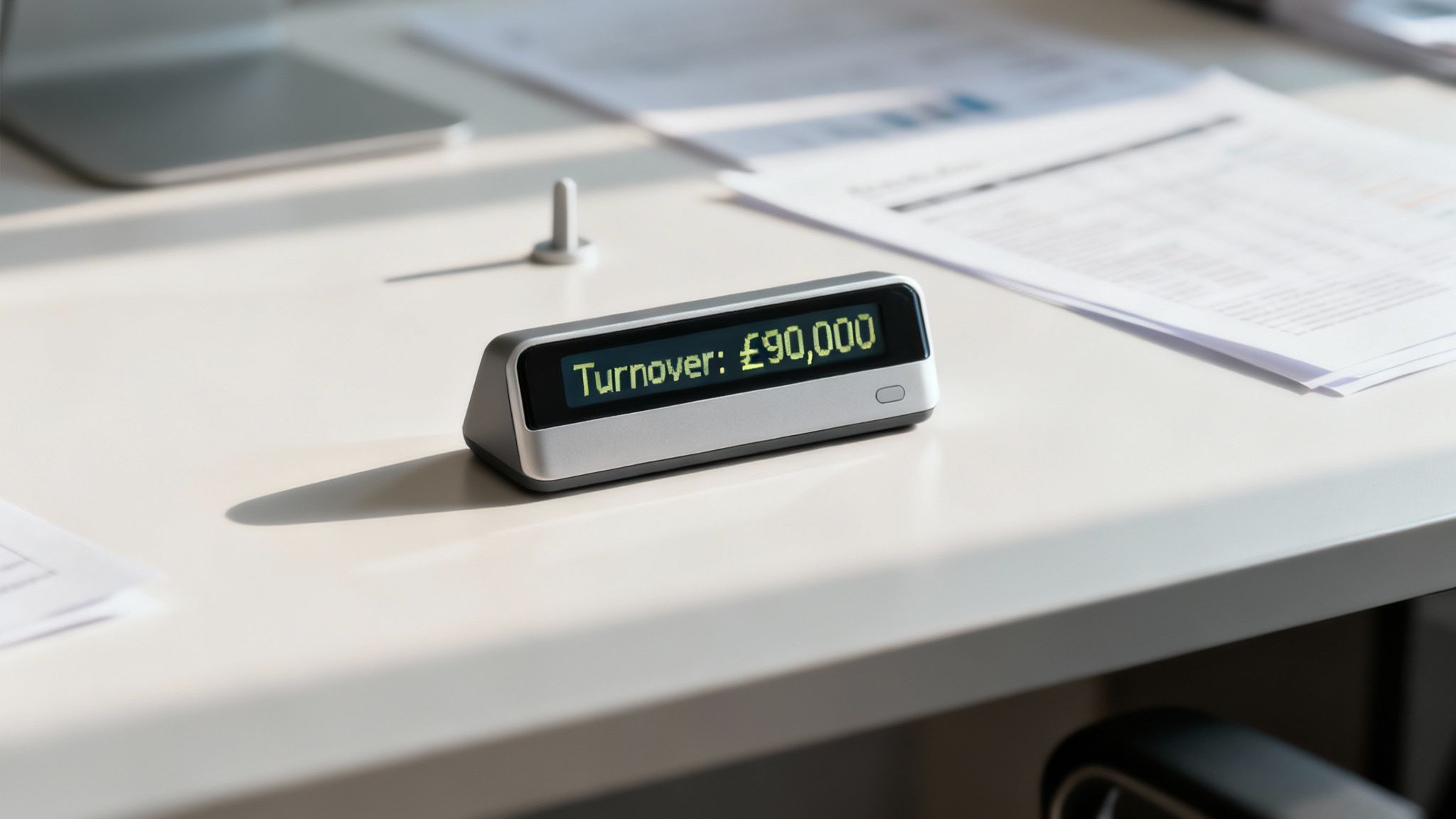
Think of the VAT threshold as a financial tripwire for your business. It is not linked to your financial year or the calendar year. Instead, it is a constant, rolling calculation based on your last 12 months of trading.
Crossing that line changes things. It means you must start charging VAT on your sales, but you can also start reclaiming the VAT you pay on your business purchases and expenses.
Key Aspects of the Threshold
Understanding how this tripwire works is the first step towards staying compliant and making smart financial moves. Here is what you need to know:
- Taxable Turnover: This is not just your profit. It is the total value of everything you sell that is not VAT-exempt. That includes your standard-rated, reduced-rate, and even zero-rated sales.
- Rolling 12-Month Period: This is the part that often catches people out. You must constantly keep an eye on your turnover. At the end of every month, you need to look back at your total sales for the previous 12 months to see if you have crossed the threshold.
- Mandatory Registration: Once your taxable turnover exceeds £90,000, registration is not a choice, it is a legal requirement.
The current VAT registration threshold of £90,000 is the highest among all OECD countries. This reflects the UK government’s attempt to ease the administrative burden on smaller businesses while still collecting necessary tax revenue. If you are curious, you can explore more about the history of UK VAT on deeksvat.co.uk.
Navigating VAT can feel complex, but at its heart, it is about being aware of your turnover. Keeping a close watch prevents any last-minute panic and, more importantly, keeps you clear of penalties from HMRC.
Here at UmbrellaCompany.com, we know that understanding the VAT registration threshold UK is vital for contractors and freelancers. We will walk you through exactly how to monitor your turnover, spot the moment you need to register, and get to grips with what it all means for your day-to-day business.
How to Calculate Your Taxable Turnover
Understanding taxable turnover is the most important part of managing your VAT obligations. It is not just your total sales revenue; it is the total value of everything you sell that is not specifically exempt from VAT. This is the figure that dictates when you must register.
To stay on the right side of HMRC, you need to monitor this figure on a rolling 12-month basis. Think of it like a moving window looking back over the last year. At the end of every month, you add that month's sales to the running total and drop off the sales from the same month a year ago.
This constant check gives you a live picture of where your business stands against the £90,000 threshold.
What to Include in Your Calculation
So, what actually counts towards this total? It is a bit broader than many business owners first realise. Your taxable turnover must include the value of all goods and services you sell in the UK that are subject to VAT, and that includes items that are zero-rated.
Here is a quick rundown of what goes into the calculation:
- Standard-rated sales: This is most of what you sell. The VAT rate is currently 20%.
- Reduced-rate sales: Think of items like domestic fuel or certain energy-saving materials, which are charged at 5%.
- Zero-rated sales: This is the one that catches people out. Goods like most food, children’s clothes, and books have a 0% VAT rate, but their value still counts towards your turnover.
- Goods you have hired or loaned to customers: You must include the value of these transactions.
- Business goods used for personal reasons: If you take stock from your business for yourself, its market value must be added to your turnover.
It is an easy mistake to just tally up your standard-rated sales, but forgetting your zero-rated items is often what tips a business over the threshold without the owner noticing.
The key takeaway is that ‘taxable turnover’ includes sales where the VAT rate is 0%. Forgetting to include zero-rated goods is one of the most frequent reasons businesses register late and face penalties from HMRC.
What to Exclude from Your Calculation
Knowing what to leave out is just as crucial. If you get this wrong, you could end up registering for VAT long before you legally have to.
You should exclude these from your calculations:
- VAT-exempt sales: These are different from zero-rated sales. They cover services in finance, insurance, education, and health. If you only sell exempt items, you cannot register for VAT at all.
- Sales of capital assets: Money you make from selling off business assets, like a company van or old equipment, does not count.
- Income from outside the scope of UK VAT: This can include certain services you provide to overseas clients. The rules here can get tricky, so it is often worth getting specialist advice.
By setting up a simple tracking system, perhaps in a spreadsheet or your accounting software, you can monitor your rolling turnover each month. This foresight helps you see when you are getting close to the VAT registration threshold UK, giving you plenty of time to prepare for the registration process without any last-minute panic. We help contractors manage these financial details every day.
Navigating the HMRC VAT Registration Process
Knowing exactly when you need to register for VAT is essential. If you get the timing wrong, you could face unwelcome penalties from HMRC. It all comes down to two main triggers you need to watch.
First is what is known as the ‘historic test’. This is the most common one. If your VAT-taxable turnover exceeds the £90,000 threshold in any rolling 12-month period, the clock starts ticking. You have to register within 30 days of the end of the month in which you crossed that line.
Then there is the ‘future test’. This one can catch people out. It is for when you have a reasonable expectation that your turnover will go past £90,000 in the next 30 days alone. Imagine landing a huge, one-off contract. That is the kind of event that could trigger it, and you would need to register straight away.
Your Step-by-Step Online Registration Guide
The easiest and most common way to register is through HMRC’s online service. A bit of preparation here goes a long way. Before you start, gather all your documents, it will make the whole process much smoother.
You are going to need a few key pieces of information to hand:
- Business Details: The basics, your business name, address, and contact details.
- Unique Taxpayer Reference (UTR): That is your 10-digit number from your Self Assessment.
- Company Registration Number: A must if you are operating as a limited company.
- Turnover Figures: You will need accurate numbers on your taxable turnover.
- Business Bank Account Details: So HMRC knows where to send refunds or take payments.
- National Insurance Number: Essential if you are a sole trader or company director.
Once you have submitted everything online, you will get a VAT registration certificate from HMRC, usually within about 30 working days. This document confirms your VAT number and, crucially, your effective date of registration.
If you are just getting your contracting career off the ground, our guide on how to become a contractor in the UK is a great place to fill in other essential knowledge gaps.
This decision tree breaks down the logic you should follow. It is all about tracking your taxable sales over that crucial rolling 12-month period.
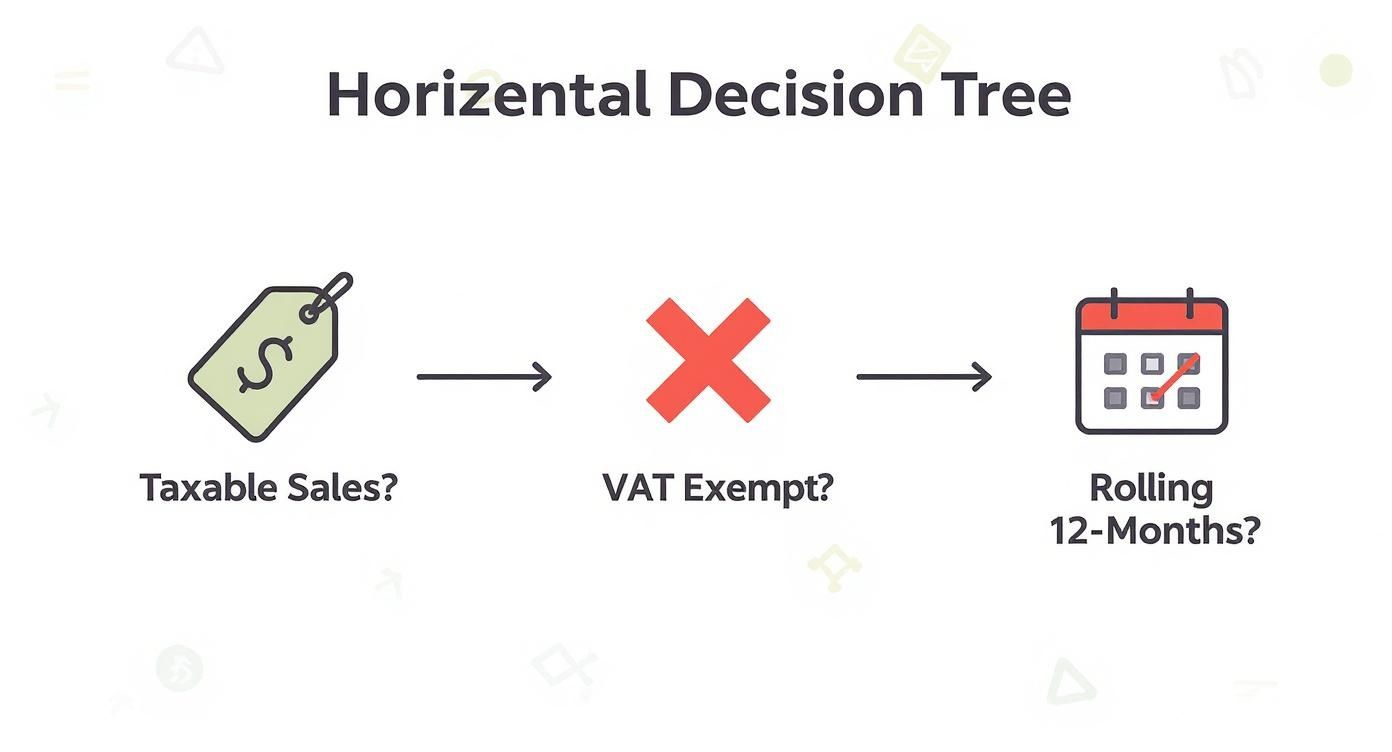
The main takeaway? This is not a once-a-year job. You need to monitor your turnover every single month to make sure you do not accidentally cross the threshold.
Choosing the Right VAT Scheme
Getting registered is only half the battle; you also have to pick a VAT scheme. While the standard scheme (where you account for VAT based on invoice dates) is the default, other options might be a much better fit for your business.
Choosing the right VAT scheme from the start can significantly simplify your bookkeeping and improve your cash flow. It is not just about compliance; it is about making VAT work for your business.
Consider these common schemes:
- Cash Accounting Scheme: A great help for cash flow. You only pay VAT over to HMRC once your client has actually paid you.
- Flat Rate Scheme: This simplifies things massively. You pay a fixed percentage of your turnover to HMRC and keep the difference. The catch? You generally cannot reclaim VAT on your purchases.
Here at UmbrellaCompany.com, we help contractors figure out which scheme makes the most sense for them, making sure their VAT affairs are organised and efficient right from day one.
How VAT Registration Changes Your Business
Becoming VAT-registered is a big step. It is more than just ticking a box; it fundamentally changes the way you handle your business finances, introducing new duties but also some welcome opportunities.
Your main new responsibility is to start charging the correct rate of VAT on your invoices. Think of yourself as a temporary custodian for this money, it does not belong to you. You are simply collecting it on behalf of HMRC, and you will need to report it and pay it over to them on a regular basis.
New Administrative Responsibilities
The most immediate change you will notice is the increase in administration. Staying organised suddenly shifts from being good practice to a legal requirement. If you get it wrong, you could face penalties.
Here is what is added to your to-do list:
- Charging Correct VAT: You must add the right percentage of VAT to your invoices for any taxable goods or services. For most contractors, this will be the standard rate of 20%.
- Filing VAT Returns: You will have to submit regular VAT returns to HMRC, usually every quarter. This return details all the VAT you have charged (output tax) and all the VAT you have paid on your own expenses (input tax).
- Adhering to MTD Rules: Your bookkeeping must comply with Making Tax Digital (MTD) for VAT. This is not optional; you will need to use MTD-compatible software to keep digital records and file your returns directly with HMRC.
This extra layer of administration is precisely why many contractors decide to get specialist support. Our dedicated service for accounting for contractors is designed to lift this weight, making sure your returns are spot-on and filed on time, every time.
The Financial Benefits of Registration
While the administration side needs careful attention, VAT registration has a huge financial upside: you can reclaim the VAT you spend on your business expenses. This is where it really starts to pay for itself.
The ability to reclaim input VAT is the single most significant financial benefit of registration. For contractors purchasing expensive equipment or software, this can lead to substantial cost savings and improved cash flow.
Just think about all the VAT you pay on business essentials. That new laptop, your software subscriptions, professional memberships, even the fuel for business travel, all of it includes VAT. Once you are registered, you can deduct this 'input tax' from the 'output tax' you collect from clients. The result? A smaller overall VAT bill to pay to HMRC.
As your business gets used to being VAT-registered, managing your finances effectively is key to staying compliant and growing. This UK accounting and finance outsourcing guide offers some great context on handling these new processes.
Ultimately, while registration certainly adds to your workload, it also gives you a powerful tool for cutting your business costs.
Voluntary Registration and Special Cases
You do not have to wait until your turnover hits the £90,000 threshold to get a VAT number. In fact, many businesses choose to register early.
This is known as voluntary registration, and while it might sound like you are just creating extra paperwork for yourself, it can be a surprisingly shrewd move in the right situation.
So, why would anyone below the VAT registration threshold UK choose to opt in? The big reason is to reclaim VAT. If you have hefty start-up costs or regularly buy expensive equipment, software, or stock, being able to claim back the VAT on those purchases can give your cash flow a serious boost right from the start.
Registering can also polish your professional image. When you are dealing with larger, VAT-registered clients, being registered yourself just makes things feel more seamless. It signals that your operation is established and serious.
The Pros and Cons of Registering Voluntarily
Deciding to register before you have to is a classic case of weighing up the benefits against the extra administration. It is a trade-off between potential cost savings and more bookkeeping duties. At UmbrellaCompany.com, we often help contractors figure out if this move makes sense for their business goals.
To help you think it through, here is a look at the main advantages and disadvantages.
Should You Register for VAT Voluntarily?
| Potential Advantages | Potential Disadvantages |
|---|---|
| Reclaim Input VAT: You can claim back VAT on business purchases and expenses, even some incurred before you officially registered. | Increased Administration: You are responsible for filing regular VAT returns and must comply with Making Tax Digital (MTD) rules. |
| Enhanced Credibility: A VAT number can make your business appear larger and more established to clients and partners. | Price Increase for B2C: You have to add VAT to your prices, which could make you less competitive if your customers cannot claim it back. |
| Avoids Surprise Registration: Getting it done early means you are prepared and will not get caught out by a sudden spike in turnover. | Complexity: You become responsible for charging the correct VAT rates and keeping meticulous records for HMRC. |
Ultimately, choosing to register for VAT voluntarily is a strategic decision, not just a compliance chore.
For contractors with high initial outlays, the ability to reclaim VAT on everything from a new laptop to specialist software can provide a crucial financial advantage.
When You Cannot Register for VAT
It is also worth knowing that sometimes, VAT registration is simply not an option. If your business only supplies VAT-exempt goods or services, you cannot register. This typically covers sectors like finance, insurance, education, and health.
Understanding these quirks is vital. For contractors, some expenses can be tricky to navigate, especially things like home office costs. You can get a better handle on these by checking out our guide on working from home tax deductions. Making sure you are well-informed helps you make smart decisions for your business, both now and down the line.
What is on the Horizon for the VAT Threshold?
The UK VAT registration threshold is not set in stone. Think of it more like a moving target that the government adjusts based on the country's economic weather and broader policy goals. For any savvy business owner, understanding that the goalposts can shift is crucial for long-term planning.
One of the biggest factors influencing these decisions is a curious economic effect called ‘bunching’. This is where you see a big cluster of small businesses intentionally putting the brakes on their growth, making sure their turnover stays just shy of the threshold. They do this to sidestep the administration and potential price hikes that come with registering for VAT, which inadvertently creates an artificial ceiling on their own expansion.
The Great Threshold Debate
This brings us to the constant tug-of-war for policymakers: should they ease the administrative load on small businesses, or should they protect tax revenues? It is a tricky balancing act that keeps the debate about the ‘right’ threshold level alive and kicking.
Recently, there has been talk of nudging the threshold up from £90,000 to £100,000. The argument in favour is pretty straightforward, it would free up a new wave of small businesses from VAT duties, letting them get on with what they do best. But critics are not so sure. They argue that a relatively small increase might just move that ‘bunching’ point a bit further up the scale, rather than sparking any real, widespread growth.
The heart of the matter is whether a higher threshold truly helps businesses grow, or just gives a little more breathing room to those already bumping up against the ceiling. Tax policy is always evolving, and keeping yourself in the loop is a fundamental part of a solid business strategy.
Of course, every change has a knock-on effect on the nation's finances. Raising the UK VAT registration threshold to £100,000, for instance, is projected to cost HMRC about £100 million in lost VAT receipts. If you want to dig deeper into these conversations, the ICAEW offers some great insights into the ups and downs of the VAT threshold.
As a contractor or freelancer, it pays to keep your ear to the ground, especially when the government’s Budget statements are announced. This way, you will never be caught off guard and can tweak your financial planning accordingly. Here at UmbrellaCompany.com, we are always watching these developments so we can bring you the most up-to-date advice.
Frequently Asked Questions
When it comes to the VAT registration threshold UK, it is natural for a few questions to pop up. To give you a bit more clarity, here are some straightforward answers to the queries we hear most often from contractors and small business owners.
What Happens if I Register for VAT Late?
If you miss your registration deadline, HMRC can issue you with a penalty. It is not a flat fee; instead, it is a percentage of the VAT you owe, calculated from the date you should have registered to the date you actually did.
Worse still, you will be liable for all the VAT you should have been charging during that period. This is significant, you have to pay this amount to HMRC even if you forgot to add it to your client invoices. That means it comes straight out of your pocket.
Can I Deregister from VAT?
Yes, you absolutely can. You can apply to deregister if you expect your VAT-taxable turnover to drop below the deregistration threshold, which currently sits at £88,000 for any 12-month period.
You will need to formally apply to HMRC and explain why you expect your turnover to fall. Once they approve your application, you stop charging VAT on your sales and can no longer reclaim it on your business purchases. It is a common move for businesses that are winding down or scaling back.
Does Income from Outside the UK Count?
This is where it gets a little tricky, thanks to what HMRC calls 'place of supply' rules. As a general rule, for business-to-business (B2B) services you provide to clients based outside the UK, the income is usually considered outside the scope of UK VAT. This means it does not count towards the £90,000 threshold.
However, the rules can be different if you are selling to individuals (B2C) or shipping goods abroad. Given how nuanced this can be, we always recommend getting professional advice to make sure your turnover calculations are spot on. Keeping tabs on your income streams is just as vital as hitting your deadlines, something you can read more about in our guide to the self-employed tax return deadline.
At UmbrellaCompany.com, we give you the tools and expertise to handle your financial responsibilities with confidence. Compare trusted umbrella companies and find the right fit for your contracting career today.


