


It all boils down to one fundamental point: signing up with an umbrella company makes you their employee, giving you a continuous employment record across different contracts. On the other hand, going with agency PAYE means you are an employee of the recruitment agency, but only for that one specific assignment.
So, the choice really hinges on what you value more. Is it the continuity and simplicity of a single employer, or do you prefer a more direct, albeit fragmented, relationship for each job?
Understanding Your Core Payroll Choices
For any UK contractor, figuring out how you get paid is a massive decision. It has a direct knock-on effect on your employment rights, how much admin you have to deal with, and even your ability to get a mortgage or a loan down the line.
This guide is designed to give you a detailed, practical comparison of the two main payroll models out there. The goal is to arm you with the information you need to make the right call for your career and contract situation.
At UmbrellaCompany.com, we specialise in helping contractors navigate these options. We are firm believers that getting to grips with how each setup works is the crucial first step to maximising your take-home pay and building long-term financial security. Let’s break down the definitions and highlight the key differences you need to know from the get-go.
Defining the Two Models
Before we can properly compare umbrella vs PAYE, we need to be crystal clear on what each one actually is and where it fits into the contracting supply chain.
- Umbrella Company: Picture an umbrella company as a central employer for professional contractors. You officially become their employee, and they handle all the payroll legwork for the different contracts you take on. This creates a solid, seamless employment history, which is incredibly useful even if you’re hopping between projects and clients.
- Agency PAYE: With this setup, the recruitment agency that finds you the role also acts as your direct employer for tax purposes. They are the ones who process your wages and deduct your Income Tax and National Insurance Contributions (NICs). The catch is that this employment relationship usually evaporates the moment your contract ends.
The primary distinction lies in continuity. An umbrella offers a single, unbroken employment record across many assignments, whereas agency PAYE creates a separate employment instance for each new contract with a new agency.
At a Glance Comparison
This table neatly summarises the core differences between the two payroll structures, giving you a quick overview of how they stack up.
| Feature | Umbrella Company | Agency PAYE |
|---|---|---|
| Your Employer | The umbrella company | The recruitment agency |
| Employment Status | Continuous employee | Employee for one contract |
| IR35 Relevance | Primarily for 'inside IR35' roles | Primarily for 'inside IR35' roles |
| Statutory Rights | Full rights (sick pay, holiday) | Full rights (sick pay, holiday) |
| Administrative Burden | Minimal; submit timesheets | Minimal; handled by agency |
| Typical Costs | Weekly or monthly margin | No direct cost to you |
How Each Payroll Model Works in Practice

Before you can confidently pick between umbrella vs PAYE, you need to get a feel for how each one actually works day-to-day. While they both get your taxes sorted, the journey your money takes from the client to your bank account is surprisingly different.
Let's walk through the practical mechanics of each model so you know exactly what to expect.
The Umbrella Company Process
Going down the umbrella route means you become their employee. This is a game-changer because it standardises your payroll, no matter how many different clients or agencies you work with. The whole setup is designed to be simple and consistent.
You'll start by signing a contract of employment with your chosen umbrella. Just like that, you have a continuous employment record, which is a massive help when you need to apply for a mortgage or loan.
From there, the process is pretty straightforward:
- Do the Work: You carry out your duties for the end client as you normally would.
- Submit Your Timesheet: At the end of the week or month, you send your approved timesheet over to the umbrella company.
- Invoicing & Payment: The umbrella then invoices your agency (or sometimes the client directly). Once that invoice is paid, the umbrella receives the full contract value for your work.
- Payroll Is Run: This is where the magic happens. The umbrella company processes your payroll, deducting their margin, the Employer's National Insurance, the Apprenticeship Levy, and your own tax and employee NI.
- You Get Paid: The final net amount lands in your bank account. You'll get a detailed payslip breaking down every single deduction, so you know exactly where your money has gone.
The key thing to grasp is that the umbrella company acts as a central hub. It manages the entire financial chain and handles all the statutory employment stuff for you, leaving you with just one job: submitting your timesheet.
The Agency PAYE Process
When you choose agency PAYE, your employment relationship is directly with the recruitment agency that found you the role. You are their employee, but only for that specific assignment.
It's a more direct route, for sure, with fewer links in the payment chain. The downside is that your employment is tied to each individual contract. If you hop between different agencies, you'll end up with a fragmented work history.
This is how the agency PAYE model works in practice:
- You finish your work and send your timesheet straight to the recruitment agency.
- The agency runs its own payroll, deducting Income Tax and National Insurance just like any standard employer would.
- You receive your net salary directly from the agency.
The flow of money is much simpler: from the client, to the agency, and then straight to you. All your employment rights, like sick pay and holiday pay, are managed by that agency for the duration of that specific contract.
Operational Breakdown: Umbrella vs Agency PAYE
To make the operational differences crystal clear, the table below summarises the key distinctions you'll encounter in your day-to-day routine.
| Feature | Umbrella Company | Agency PAYE |
|---|---|---|
| Contract of Employment | With the umbrella company (continuous) | With the recruitment agency (per assignment) |
| Timesheet Submission | Submitted to the umbrella company | Submitted to the recruitment agency |
| Invoice Management | Umbrella invoices the agency/client | Agency invoices the client |
| Who Pays You | The umbrella company | The recruitment agency |
| Payslip Details | Shows umbrella margin and all employment costs | Shows standard PAYE deductions |
| Continuity of Employment | Maintained across multiple contracts | Broken between contracts/agencies |
Looking at it this way helps you compare how each model really fits with your working style and how much admin you're prepared to handle.
The Shifting Sands of UK Contracting Regulations
The UK contracting market never stands still. It is constantly being reshaped by new rules, and staying on top of them isn't just about ticking boxes, it's about protecting yourself and your income. Right now, the government is cracking down hard on dodgy umbrella schemes, a move that has a direct impact on how you choose between an umbrella company and agency PAYE.
For too long, the temporary labour market has been a bit of a wild west, leaving many workers vulnerable. A 2023 government consultation pulled back the curtain on just how big the problem was. Their figures showed that of the 700,000 or so workers using umbrella companies, a shocking 275,000 (almost 40%) were caught up with providers HMRC considered non-compliant. They were being exposed to shady schemes designed to skim their pay.
This wasn't just a few bad apples; it was a systemic issue. And it has triggered major reforms designed to hold the entire supply chain accountable for tax malpractice.
A New Era of Shared Responsibility: Joint and Several Liability
One of the biggest changes coming down the track is joint and several liability (JSL). It sounds technical, but its purpose is simple: to put fraudulent operators out of business.
This new legislation will make the recruitment agency (and sometimes the end client) jointly responsible for any unpaid PAYE tax and National Insurance if an umbrella company in their supply chain fails to pay its dues.
This is a fundamental shift in risk. It means agencies can no longer turn a blind eye to the providers they work with. The financial and legal fallout is simply too great.
By making the top of the supply chain liable for tax shortfalls, HMRC is forcing everyone to do their homework. This is a deliberate strategy to squeeze non-compliant schemes out of the market, which ultimately makes it a safer place for contractors like you.
What does this mean for you? It means your agency will be far more careful about the umbrella companies it allows on its preferred supplier list (PSL). This added layer of scrutiny is a good thing, as it dramatically cuts your risk of getting tangled up in a scheme that could leave you with a surprise tax bill from HMRC down the line.
Why Accreditation Is No Longer Just a ‘Nice-to-Have’
In this new climate, choosing a compliant and accredited umbrella company is absolutely critical. Accreditations from bodies like the FCSA (The Freelancer & Contractor Services Association) or Professional Passport have gone from being a bonus to a necessity. Think of them as your seal of approval.
These organisations conduct rigorous, independent audits to make sure an umbrella company is operating by the book. They check that:
- All tax and National Insurance is paid correctly and on time.
- Holiday pay is calculated and handled properly.
- Payslips are transparent and easy to understand.
- The business is financially stable and run ethically.
Working with an accredited provider gives both you and your agency peace of mind. It shows you are taking your tax obligations seriously, which is crucial when navigating complex rules like IR35.
Ultimately, these regulatory changes are good news for genuine contractors. They are cleaning up the industry and making it much harder for rogue operators to survive. By understanding this new landscape and making compliance your top priority, you can choose a payment structure that is not just efficient, but completely secure.
A Detailed Analysis of Take-Home Pay and Deductions

Let’s get straight to the point: understanding what you'll actually take home is the biggest reason you are comparing umbrella vs PAYE. Both routes keep you on the right side of HMRC, but the way your payslip is structured couldn't be more different. It's easy to get lost in the numbers, so it is vital to look past the headline rate and really get to grips with the deductions.
This section will pull back the curtain on payslips for both options. We will break down every line, explain what it all means, and show you how to compare apples with apples. By the end, you'll have the confidence to see which route is the right financial fit for you.
Decoding the Umbrella Company Payslip
When you go through an umbrella company, the day rate your agency offers you is called the assignment rate. This isn't your salary. Think of it as the total pot of money the umbrella company receives for the work you do, which includes all the costs of employing you.
Before your own salary is even calculated, several deductions are made from this assignment rate. These are the mandatory costs every single UK employer has to cover.
- Employer’s National Insurance Contributions (NICs): A statutory tax paid by all UK employers on their employees' earnings.
- Apprenticeship Levy: A government tax on larger employers to help fund apprenticeship schemes.
- Employer’s Pension Contributions: The mandatory employer top-up into your workplace pension.
- The Umbrella Margin: This is simply the fee the umbrella company charges for its admin services. It's usually a flat weekly or monthly amount.
After these employment costs are taken off the assignment rate, the figure that is left is your gross pay. From here, the deductions look familiar: Income Tax and your own employee NICs.
The most common trip-up is seeing Employer's NI on your payslip. It is crucial to remember this is deducted from the uplifted assignment rate, not your personal earnings. A good agency will always increase the rate to cover these extra costs.
Understanding the Agency PAYE Payslip
An agency PAYE payslip is much simpler because it looks just like one you'd get in any permanent job. The rate the agency quotes you is your gross pay, period. The only things taken off are your personal deductions: Income Tax, employee NICs, and your pension contributions.
The agency deals with its own employment costs, like Employer's NI, completely behind the scenes. They factor these into their overall charge to the end client, so you'll never see them on your payslip. This simplicity is a big plus, but it often means the initial rate you are offered is lower than what you'd see for an equivalent umbrella role.
A Real-World Pay Comparison
Let’s use an example. A contract is advertised with a £400 per day assignment rate for an umbrella contractor. The same agency might offer that role via their own PAYE at a lower rate, maybe around £345 per day. So, why the big difference? The agency has uplifted the umbrella rate specifically to cover those employment costs we talked about.
Here’s a rough sketch of how the take-home pay would compare. As you will see, the net pay often ends up being incredibly close.
Hypothetical Weekly Breakdown
| Line Item | Umbrella Company (£400/day) | Agency PAYE (£345/day) |
|---|---|---|
| Total Income/Assignment Rate | £2,000 | £1,725 |
| Employer's NI & Levy | – £245 | (Paid by agency) |
| Umbrella Margin | – £25 | N/A |
| Gross Pay for Tax | £1,730 | £1,725 |
| Income Tax & Employee NI | – £490 | – £488 |
| Net Take-Home Pay | ~ £1,240 | ~ £1,237 |
Despite the totally different structures, the final take-home pay is almost identical. The trick is making sure that umbrella assignment rate has been genuinely uplifted to account for the extra costs. For a precise breakdown based on your own rate, your best bet is to use a specialised tool. You can get a personalised illustration with our PAYE vs umbrella calculator to see exactly how your numbers would stack up.
When all is said and done, a compliant umbrella company and an agency PAYE setup should deliver a very similar financial outcome. Your decision, therefore, should probably hang on other factors (like whether you need a continuous employment record or just prefer administrative simplicity) rather than a perceived difference in your pay packet.
Comparing Employment Rights and Contractor Flexibility
Deciding between an umbrella company and agency PAYE goes way beyond the numbers on your payslip. It fundamentally shapes your employment rights, your flexibility as a contractor, and even your ability to make big life moves, like getting a mortgage. This is where the two options really diverge.
The single biggest pull for an umbrella company is the continuity of employment it offers. By acting as your one, consistent employer across different gigs and agencies, an umbrella gives you an unbroken employment history.
This is gold dust when you are trying to prove a stable income for a mortgage, a loan, or even some visa applications. A choppy history of short-term contracts from various agencies can make lenders nervous, but a single, continuous record smooths everything over.
Your Statutory Rights as an Employee
Whether you go with an umbrella or agency PAYE, you are legally an employee. That means you get full statutory employment rights – it is a non-negotiable part of UK law.
The difference lies in how those rights are managed.
- With an Umbrella Company: Everything is bundled under one employer. Your holiday pay, sick pay, and pension contributions are all handled by your umbrella. This continuity means your benefits build up steadily over time, no matter how many different clients you work for. Many contractors find the various benefits of an umbrella company extend well beyond simple payroll.
- With Agency PAYE: You get the same rights, but they are tied to each specific contract and agency. When a contract ends, so does that particular employment. This can get messy when you are trying to track accrued holiday pay or manage pension pots, especially if you hop between recruitment agencies.
The Value of Administrative Simplicity
For contractors in their prime earning years, the sheer simplicity of an umbrella company is often the deciding factor. These are people often juggling multiple short-term gigs who just want a "set it and forget it" solution for their payroll and admin.
Recent government data shows exactly who finds this model attractive. Men make up about twice as many umbrella employees as women, and a whopping 70% of these workers are aged between 25 and 54. This is a significant jump compared to the 50% of the general UK adult population in that age bracket, pointing to a dynamic workforce that needs flexibility without the admin burden.
For a busy contractor, having a single contact for all pay queries, a consistent payslip, and unified HR support provides a real sense of stability in an otherwise fluid career. It lets you focus on the work, not on chasing paperwork from old employers.
Ultimately, it comes down to what you value most. If a solid, continuous employment record and minimal personal admin are your priorities, the umbrella model is a very strong contender. If you are happy with a direct relationship with your agency for each separate role and don't mind a more fragmented employment history, agency PAYE is a perfectly straightforward choice.
Making the Right Choice for Your Contracting Career
So, umbrella or agency PAYE? It’s a decision that genuinely shapes your contracting life, and there’s no single right answer. The best choice for you comes down to the nuts and bolts of your situation: your contracts, your career plans, and how you prefer to manage your money.
It’s a practical call. You need to weigh up things like how long your contract is for, whether you'll need a continuous employment history for a mortgage application, and frankly, how much admin you are willing to put up with. The right payroll model is simply the one that fits your professional and financial goals.
A Practical Checklist for Your Decision
To cut through the noise, ask yourself a few direct questions. Your answers should point you in the right direction.
- How long is my current contract? If you’re just dipping your toe in with a very short-term gig, the simplicity of agency PAYE can be a real winner. But if you are lining up back-to-back contracts, an umbrella company offers that all-important continuity.
- Do I need a continuous employment record? This is a big one. If you have got plans for a mortgage, loan, or even a visa application on the horizon, the unbroken employment history an umbrella provides is a massive advantage.
- Is my contract inside IR35? Both umbrella and agency PAYE are built for inside IR35 work. The choice here isn't about which one is compliant, but which one handles the compliance admin in a way that suits you best.
- How much do I hate paperwork? Be honest. An umbrella company takes all the payroll and HR faff off your plate. You just submit your timesheet, and they handle the rest.
It's also worth knowing that the ground is shifting under our feet. Big regulatory changes are coming from HMRC in April 2026, which will push PAYE and NIC responsibilities further up the supply chain. This is a direct reaction to widespread non-compliance – before the consultation, over a third of the 700,000 contractors using umbrellas were with dodgy providers. Now, more than ever, doing your homework is crucial.
This decision tree helps visualise how your priorities might steer you one way or the other.
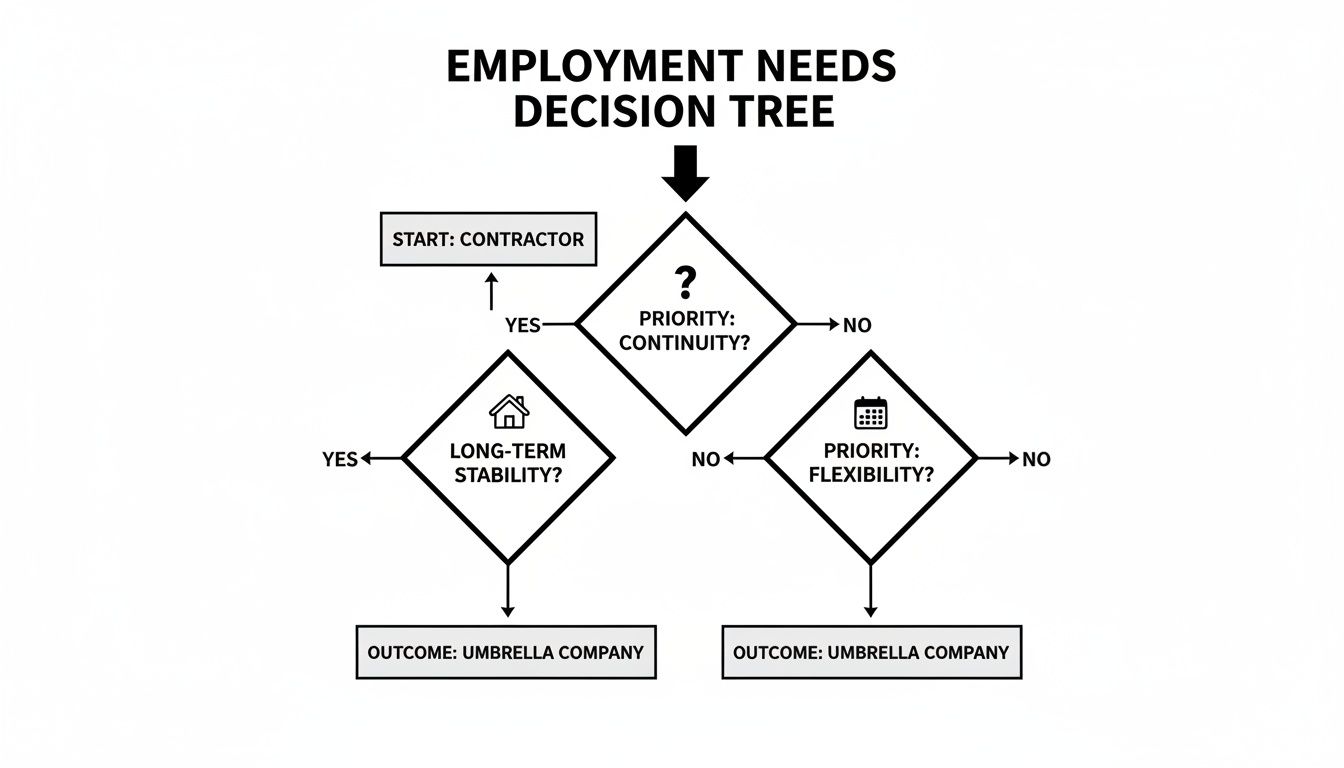
As you can see, if you’re playing the long game (thinking about financial stability and a solid employment record) an umbrella company often comes out on top.
By thinking through these points, you can pick the setup that really works for you and build a contracting career on solid foundations. If you’re ready to see what’s out there, we can help you find a compliant provider you can trust.
Your Questions Answered
When you are weighing up your options, a few common questions always seem to pop up. Let's tackle them head-on so you can make a decision you are confident in.
Will I Earn More Through Agency PAYE Than an Umbrella?
Not usually, no. It’s a common misconception because an umbrella payslip has more deductions listed on it, like Employer’s NI and the Apprenticeship Levy, which can look a bit alarming at first.
But here’s the key: the assignment rate an agency offers for an umbrella contract is almost always higher to cover those exact costs. When you run the numbers on an uplifted umbrella rate versus a standard agency PAYE rate for the same job, the net pay you actually receive should be almost identical. If a company promises you’ll take home significantly more, treat it as a massive red flag, it is likely a non-compliant tax avoidance scheme.
Is Using an Umbrella Company Still Safe After All the HMRC Changes?
Yes, provided you choose a compliant, accredited provider, it's an incredibly safe way to work. The recent reforms from HMRC, especially the rules around joint and several liability, were brought in specifically to weed out dodgy operators and make everyone in the supply chain accountable.
These changes actually work in your favour, making the whole industry safer for contractors. If you work with a provider accredited by a recognised body like the FCSA or Professional Passport, you can relax knowing your taxes are handled correctly and you are playing by the rules.
Choosing an accredited umbrella isn’t just about ticking a compliance box; it's about giving yourself peace of mind. These reforms have made it much easier to spot the good guys who have your best interests at heart.
Can I Switch Between Agency PAYE and an Umbrella?
Of course. One of the best things about contracting is the freedom to pick the setup that makes sense for each contract. You might decide agency PAYE is fine for a quick two-week gig, but then move to an umbrella company for a longer-term project to keep your employment record clean and continuous.
You are free to chop and change as you please, but there are times when consistency pays off. If you are thinking about applying for a mortgage or a large loan anytime soon, sticking with a single, compliant umbrella company gives you that unbroken history of employment that lenders really like to see.
At UmbrellaCompany.com, our entire focus is on helping contractors like you find a reliable, compliant payroll partner. Our free comparison tool makes it easy to find a trusted umbrella company that fits what you need.


