


Deciding how you get paid as a contractor is a massive decision, and it usually boils down to two main routes: using an umbrella company or going through agency PAYE. While both use the standard Pay As You Earn (PAYE) system to handle tax and National Insurance, the way they operate day-to-day is very different.
This guide will explain what each model means for your work life, helping you choose the right path for your contracting career.

The fundamental difference comes down to your employment relationship. An umbrella company becomes your continuous employer across multiple contracts, managing all your payroll. With agency PAYE, the recruitment agency is your employer, but only for the length of that specific contract.
What Is an Umbrella Company?
An umbrella company acts as an intermediary between you (the contractor) and your end client or agency. When you join, you become a full employee of the umbrella company. This provides you with a single, continuous source of employment, even if you move between different assignments and clients.
This setup brings simplicity and stability. We handle all the administration, from invoicing your agency to processing your salary and ensuring all tax and National Insurance contributions are paid directly to HMRC. It is a popular route for contractors whose work falls inside IR35, as it provides a clear, compliant employment framework. To learn more, read our guide on how the IR35 reforms affect contractors.
What Is Agency PAYE?
Agency PAYE is a more direct arrangement. With this option, you become an employee of the recruitment agency that found you the role. The agency’s own payroll department handles your salary, deducting the correct amount of income tax and your employee National Insurance contributions.
The main drawback is that your employment is tied directly to that one contract. As soon as the assignment finishes, your employment with that agency also ends, unless they line up another role for you immediately.
Umbrella Company vs Agency PAYE At a Glance
The PAYE system is the bedrock of UK tax collection, covering over 30.3 million workers. Within that, around 700,000 contractors choose to work through one of the UK's roughly 500 umbrella companies to access the unique benefits they offer.
To help you see the differences clearly, here’s a quick summary table.
Feature | Umbrella Company | Agency PAYE |
|---|---|---|
Your Employer | The umbrella company | The recruitment agency |
Employment Continuity | Continuous employment across multiple contracts | Employment is tied to each individual contract |
Employment Rights | Full statutory rights (sick pay, holiday pay) | Statutory rights provided by the agency |
Employer’s NI | Deducted from the assignment rate | Paid by the agency (not from your rate) |
Additional Costs | A weekly or monthly margin for the service | No additional fees for you as the worker |
Administrative Burden | Minimal; the umbrella handles all paperwork | Very low; the agency manages payroll |
As you can see, the choice isn't just about how you get paid. It's about employment continuity, costs, and who is ultimately responsible for your rights and taxes. Each path has distinct advantages depending on your contracting style and priorities.
How Each Payment Model Works Day to Day

Understanding the weekly routine is crucial when deciding which route is right for you. The real difference between an umbrella and agency PAYE is not just in the numbers; it is in the flow of money, who you talk to about your pay, and the day-to-day administration.
Let's walk through what happens from the moment you log your hours to the money hitting your bank account.
The Umbrella Company Process Step by Step
Working through an umbrella company introduces a few more parties into the process: you, the agency, the end client, and the umbrella company. But the process is designed to be completely hands-off for you as the contractor.
Here’s how a typical payment cycle unfolds:
Submit Your Timesheet: At the end of your working week or month, you send your approved timesheet to both your recruitment agency and your contact at the umbrella company.
Invoicing the Agency: The umbrella company then raises an invoice to the agency for your work. This invoice is for the assignment rate, which is the total amount the client pays for your services.
Funds Received and Processed: The agency pays the invoice, and the money lands with the umbrella company, where the payroll work begins. They calculate your gross pay and figure out all the necessary deductions.
Deductions Are Made: Before your salary is calculated, certain employment costs are taken from the assignment rate. This includes the umbrella's margin, Employer's National Insurance, the Apprenticeship Levy, and any employer pension contributions.
Your Salary Payment: What's left after those employment costs becomes your gross pay. From this, the usual employee deductions are made: income tax (PAYE), your employee National Insurance, and any student loan repayments. You then receive your net pay with a payslip that breaks everything down.
The big advantage here is the paper trail. Every deduction is clearly itemised on your payslip, giving you total transparency and ensuring full HMRC compliance. A good umbrella company ensures you know exactly how your take-home pay is calculated from the initial assignment rate.
How Agency PAYE Works in Practice
The agency PAYE model is far more direct because there are fewer links in the payment chain. Your relationship is purely with the recruitment agency; they are your employer for that contract.
This stripped-back approach makes for a much simpler workflow.
The Agency PAYE Payment Cycle:
Timesheet Submission: You send your approved timesheet straight to the agency’s own payroll department.
Internal Payroll Processing: The agency’s in-house team handles your pay. They are responsible for calculating and deducting your income tax and employee National Insurance.
Payment and Payslip: You get paid directly by the agency, and they issue you a payslip detailing the deductions. Crucially, the agency covers its own employer costs (like employer’s NI) separately. These are not taken from your agreed pay rate.
Key Administrative Differences
When you boil it down, the main difference you'll feel day-to-day between an umbrella company vs PAYE is who you call when you have a question about your pay.
With an umbrella company, you get a dedicated point of contact who specialises in contractor payroll, completely separate from the agency that placed you. For many contractors, this is a huge plus.
Under agency PAYE, it's all in one place. The agency is your single point of contact for everything, from the contract itself to your payslip queries. It comes down to personal preference: do you want a payroll specialist, or an all-in-one contact?
Comparing Your Take-Home Pay and Deductions
The most pressing question for any contractor weighing up an umbrella company versus PAYE is simple: "How much will I actually take home?" It’s a crucial one because the headline rate you’re offered can be misleading if you don’t know what gets taken out before it hits your bank account.
Let's explore the financial realities of both models. We will use a hypothetical contractor on a daily rate of £400 to show you exactly how your earnings are processed and what your net pay is likely to look like.
The Umbrella Company Calculation Explained
When you work with an umbrella company, you receive an assignment rate. Think of this as an all-inclusive figure that is meant to cover not just your pay, but all the associated employment costs too. It is vital to remember this isn't your gross salary.
Before any personal tax is calculated, a few items are deducted from this top-line assignment rate:
Umbrella Company Margin: This is their fee for handling all payroll and administration. It’s usually a fixed weekly or monthly amount.
Employer’s National Insurance: As your technical employer, the umbrella must pay this legally required contribution to HMRC.
Apprenticeship Levy: This is another mandatory employer tax that helps fund apprenticeship programmes across the UK.
Employer Pension Contributions: If you are in a workplace pension, the employer's portion is also taken from the assignment rate.
Once those employment costs are settled, what’s left becomes your gross pay. From here, the usual employee deductions apply, such as income tax (PAYE), your employee National Insurance, and any student loan repayments.
The Agency PAYE Calculation Explained
Agency PAYE is much more direct. The rate you are quoted is your actual gross pay for the work you do. The recruitment agency, acting as your direct employer for that contract, deals with its own employment costs separately.
This means things like the employer’s National Insurance and the Apprenticeship Levy are the agency's responsibility, not yours. They do not come out of the pay rate you've been advertised. Your payslip will only show the standard deductions you would expect as any other employee: income tax and your own NI contributions.
The core difference boils down to transparency and where the employment costs sit. With an umbrella, the assignment rate bundles these costs in, and they're then itemised on your payslip. With agency PAYE, the agency handles these costs behind the scenes.
This infographic lays out some of the key financial metrics side-by-side.
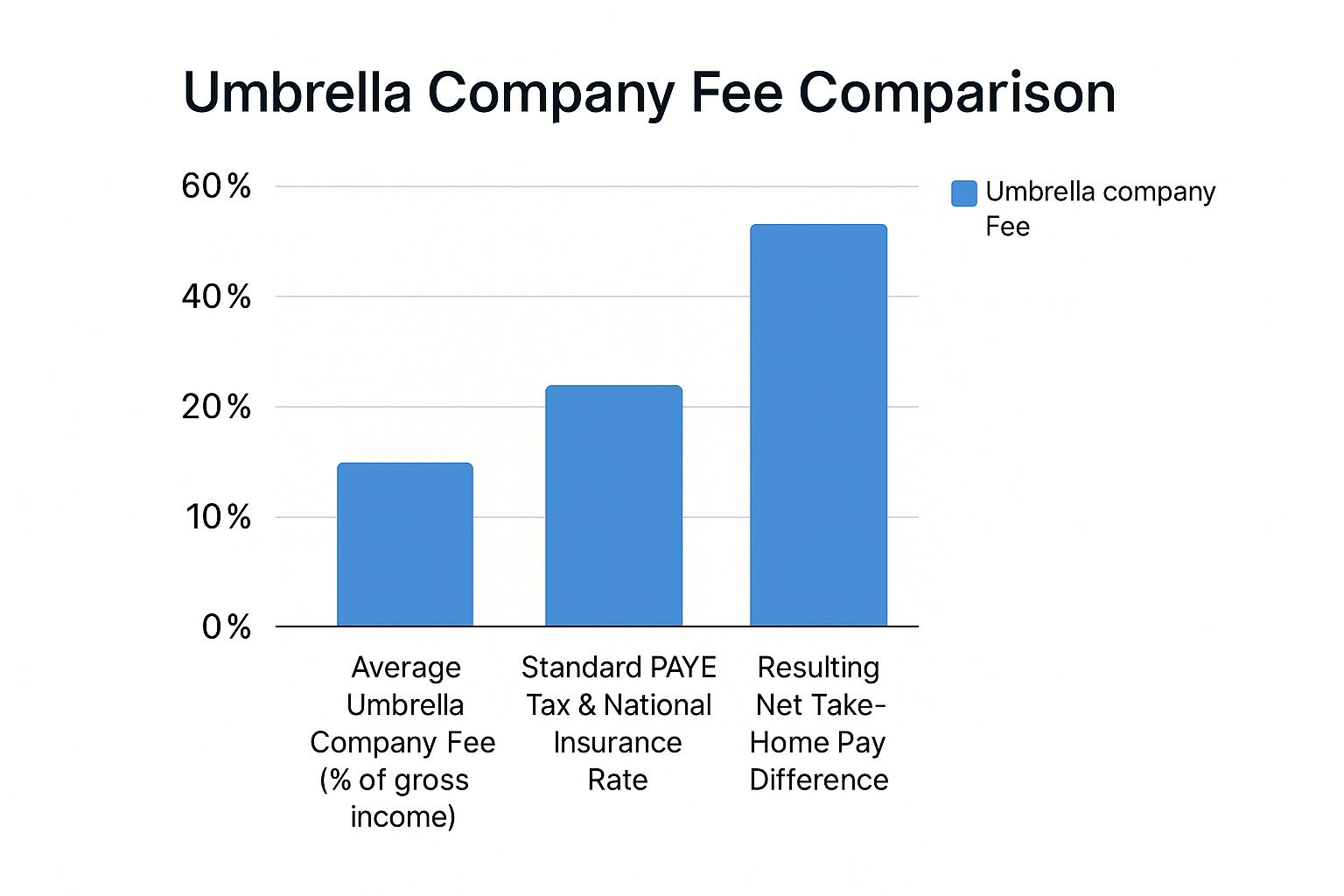
The numbers make it clear how the umbrella margin, when added to the other employment deductions, affects the final take-home figure compared to a direct PAYE setup.
A Side-by-Side Net Pay Example
Let's put this into practice with our contractor on £400 a day, working a five-day week. The figures below are illustrative to show you how the maths works.
Hypothetical Net Pay Calculation Umbrella vs PAYE
Calculation Stage | Umbrella Company Example (£) | Agency PAYE Example (£) |
|---|---|---|
Daily Rate / Assignment Rate | 400.00 | 340.00* |
Weekly Invoice Value (5 days) | 2,000.00 | 1,700.00 |
Umbrella Margin | -25.00 | N/A |
Employer’s NI & Levy | -230.00 (approx) | Paid by agency |
Gross Pay for Tax Purposes | 1,745.00 | 1,700.00 |
Employee’s Tax & NI | -580.00 (approx) | -550.00 (approx) |
Final Net Take-Home Pay | ~ £1,165.00 | ~ £1,150.00 |
*The agency PAYE rate is lower because the agency has to price its own employment costs into the margin it makes, rather than passing them directly to the contractor.
As you can see, even though the umbrella company’s initial assignment rate is much higher, the net pay often ends up being very close once all deductions are accounted for. This is why you should always compare the final take-home pay, not just the headline rate.
The choice often comes down to weighing this net figure against the other benefits an umbrella provides, like a continuous employment record, which is a lifesaver for things like mortgage applications. If you're curious about where IR35 fits into all this, our detailed guide explains what is IR35 and why it matters to UK contractors.
To go a step further than the basic tax implications, you can get a better handle on maximising your income by understanding common freelancer tax deductions. This will help you make a much more informed decision, no matter which payment structure you end up choosing.
Navigating IR35 and Your Employment Rights
Two of the biggest things any UK contractor has to think about are IR35 and statutory employment rights. Understanding how an umbrella company vs PAYE setup handles these is vital for protecting yourself, both financially and legally.
The route you choose has a direct impact on how you stand with HMRC's off-payroll working rules (IR35) and whether you can access fundamental benefits like sick pay and holiday pay. Let’s break down the different levels of security and simplicity each one offers.
IR35 Compliance Made Simple
For many contractors, the biggest draw of an umbrella company is how it makes IR35 a non-issue. When you work through a compliant umbrella, you are a genuine employee of that company. Because of this employment status, the IR35 rules simply do not apply to your assignments.
It all works because the entire payment chain is run through a standard PAYE payroll, exactly like any other employee in the UK. The umbrella company takes on the full responsibility for ensuring the right tax and National Insurance are deducted, lifting a massive compliance headache from your shoulders.
By becoming an employee of the umbrella, you are effectively taken out of scope for the complex IR35 legislation on that particular contract. This gives you peace of mind and lets you get on with your work, rather than trying to decipher intricate tax rules. For a deeper look, check out our guide on whether IR35 applies when working through an umbrella company.
On the other hand, if you opt for agency PAYE, your IR35 status still comes down to the end client's decision on your contract. The agency might be handling the PAYE deductions, but the core question of whether your role is one of 'disguised employment' remains, and the client still has to do their homework.
Securing Your Employment Rights
Tax is one thing, but a major point of difference is how you access statutory employment rights. This is where the continuous employment an umbrella company provides really shows its value.
As a full employee of the umbrella, you build up a continuous employment record, even when you are moving between different contracts or have short gaps in work. That stability is incredibly important when it comes to accessing key benefits.
Benefits under an umbrella company include:
Statutory Sick Pay (SSP): You’re entitled to SSP if you’re too ill to work, which is a crucial safety net.
Holiday Pay: Your holiday pay is properly accrued and paid out, ensuring you get compensated for your time off.
Workplace Pension: You will be auto-enrolled into a workplace pension scheme, helping you save for the long term.
Maternity/Paternity Pay: Your continuous employment history gives you access to statutory parental leave and pay.
When you work through agency PAYE, you get these rights too, but only for the length of that specific contract. If you have gaps between jobs or work for several different agencies, your employment record becomes a patchwork. This can make it tricky to prove the continuous employment you often need for things like mortgage applications or credit checks.
Ultimately, the umbrella model is built to give you a consistent, stable employment foundation that looks and feels a lot like being a permanent employee. When you're looking beyond just the take-home pay, that’s a significant factor to consider.
Which Option Is Right for Your Contracting Career?
Choosing between an umbrella company and agency PAYE is not just a financial calculation; it’s a strategic decision that will genuinely shape your day-to-day contracting life. The right path comes down to your professional goals, how much administration you're willing to tolerate, and what you value in your work.
To help you decide, we will look at a couple of real-world contractor scenarios. This should help you align your payment structure with where you see your career going.
The Career Contractor Juggling Multiple Roles
Imagine you are a seasoned IT contractor who thrives on variety. You are constantly moving between short-term projects, often for different recruitment agencies. For you, continuity and simplicity are everything.
Your Challenge: Trying to manage separate employment records for every single contract is an administrative headache. It creates a disjointed work history that can make it difficult to get a mortgage or a loan. Every new agency means a fresh stack of payroll paperwork.
The Best Fit: An umbrella company is almost certainly the answer here. It gives you a single, continuous record of employment, regardless of how many clients or agencies you work with. That kind of stability is invaluable to lenders.
Key Benefit: You get one employer, one tax code, one workplace pension, and one consistent payslip. This frees you up to focus on the actual work, not on juggling paperwork.
This streamlined approach makes your financial life simpler and provides the solid employment history that banks and other institutions want to see, even if your career is built on a series of different contracts.
The Contractor on a Single, Long-Term Assignment
Now for a completely different situation. You are a project manager who has landed a single, 18-month contract inside IR35 with a large corporation, all handled through one agency. You have no plans to change roles for the foreseeable future.
Your Challenge: Your priority is maximising your take-home pay on this specific project. The extra benefits of continuous employment are not as critical when you are settled into a long-term assignment.
The Best Fit: In this case, agency PAYE could be the more direct and cost-effective route. With no umbrella margin to account for, your net pay might be slightly higher, assuming the agency is offering a competitive PAYE rate.
Key Benefit: The process is very simple. You deal directly with the agency for all your payroll matters, keeping the relationship straightforward and contained within that one contract.
The crucial factor here is the contract's length and stability. If you are confident the role is secure and you don’t need the overarching employment benefits an umbrella provides, the directness of agency PAYE can be very appealing.
A Framework for Your Decision
To make a confident choice in the umbrella company vs PAYE debate, think about these key areas. Your answers should point you towards the structure that best supports your professional life.
1. Career Goals and Contract Frequency
Multiple Short-Term Roles: Do you plan on switching projects or clients fairly often? If so, the continuous employment from an umbrella company offers invaluable stability.
One Long-Term Role: Is your focus locked on a single, extended contract? Agency PAYE's simplicity might be a better fit.
2. Attitude Towards Administration
Prefer Simplicity: Do you want a "hands-off" approach where a specialist handles all the payroll complexities? An umbrella company excels at this.
Happy with Direct Contact: Are you comfortable dealing directly with an agency's in-house payroll team for any questions? Agency PAYE is much more direct.
3. Need for Comprehensive Benefits and Insurance
Value Added Security: Do you want the peace of mind that comes with comprehensive insurance cover and a single point of contact for statutory rights like sick pay? An umbrella is built for this.
Basic Coverage is Enough: Are you happy with the statutory rights the agency provides just for the duration of the contract? Agency PAYE will cover the basics.
4. Financial Priorities
Maximise Take-Home Pay (Short-Term): Is your number one priority the highest possible net pay for a specific contract? Agency PAYE may have a slight edge, provided the rate is fair.
Value Long-Term Stability: Is a consistent employment record for future goals, like getting a mortgage, more important to you? The umbrella model is designed for exactly this.
Your decision hinges on what you need your payment structure to do for you beyond just processing your salary. By understanding the nuances of different roles, such as those detailed in our guide on the sectors most affected by IR35, you can make a more informed choice.
There is no single "best" answer. The smart approach is to weigh these factors against your own circumstances, making sure your choice supports not just your current contract but your entire contracting career.
Frequently Asked Questions

We understand that the world of umbrella companies versus PAYE can seem confusing, and it's natural to have questions. To help you get a clear picture, here are our answers to some of the most common queries from contractors.
Is My Take-Home Pay Always Higher with Agency PAYE?
Not necessarily, as this is a common misconception. While you will not see a separate umbrella margin on an agency PAYE payslip, the headline pay rate is often lower than the assignment rate you would get for the same job via an umbrella company. Agencies must cover their own costs, like employer’s National Insurance, and they factor this into the rate they offer you directly.
The only way to know for sure is to compare the final net pay illustrations from both. You should also remember that the umbrella service fee covers more than just payroll, including things like comprehensive insurance and a continuous employment record, which have real value.
Can I Claim Expenses Through an Umbrella Company?
The rules on this have been very tight since 2016. If your work is subject to ‘Supervision, Direction, or Control’ (SDC) from the client, and this applies to the vast majority of contractors, you cannot claim tax relief on travel and subsistence expenses.
Be extremely wary of any scheme that heavily promotes widespread expense claims. This is a massive red flag for a non-compliant tax avoidance setup that could land you with a large bill from HMRC in the future. Always stick with an accredited provider, such as an FCSA or Professional Passport member.
Does Using an Umbrella Company Affect My Mortgage Application?
It can, but often in a good way. Working with a compliant umbrella company actually strengthens a mortgage application for many contractors. It gives you a continuous record of employment and a clear history of regular payslips, something lenders prefer over the fluctuating income of a limited company director or a fragmented work history.
Most mortgage lenders and brokers now know the umbrella model well. They understand how to assess your income properly, making the process of securing a mortgage far more straightforward than with other contracting setups.
What Happens to My Holiday Pay?
As an employee of an umbrella company, you have a legal right to statutory holiday pay. This builds up based on the hours you work and equates to 28 days a year for a full-time role. Any compliant umbrella will show a clear breakdown on your payslip of how much holiday pay has been accrued and set aside for you.
You can then ask for this pay to be released when you take time off. While some contractors prefer to have it "rolled up" and paid out with each payslip, the best practice is for the umbrella to hold it separately. This ensures you are paid when you are actually on leave.
Why Do I Pay Employer’s National Insurance Through an Umbrella?
This is probably the most frequent point of confusion in the umbrella company vs PAYE debate. When you work through an umbrella, the assignment rate you're offered is an all-in figure designed to cover all employment costs. Because the umbrella company is your legal employer, it is their responsibility to pay employer’s National Insurance.
This cost is therefore deducted from the assignment rate before your own gross pay is calculated. On agency PAYE, the agency covers this cost themselves from their margin, which is why the direct pay rate for the same job is usually lower. A good umbrella company will always make this deduction completely transparent on your payslip.
Ready to find a compliant and reliable payroll solution for your contracting career? At UmbrellaCompany.com, we make it easy to compare trusted umbrella companies and find the perfect fit for your needs. Get started in just one minute.


