


So, you're stepping into the world of UK contracting. One of the very first, and most important, decisions you'll make is how to structure your business. Will you go down the umbrella company route or set up your own limited company? This guide will help you understand the differences so you can make an informed choice.
The fundamental difference is straightforward. Working through an umbrella company effectively makes you an employee for tax purposes. It’s simple, quick, and comes with statutory employment rights. On the other hand, setting up as a limited company puts you in the director's chair. This opens the door to greater tax efficiency, but it also hands you a hefty pile of administrative responsibility.
Choosing Your Contracting Structure: A Quick Guide

This is not a decision to take lightly. To help you figure out which path is right for your professional goals, this guide will unpack the real-world differences between the two. We will look at the financial implications, how IR35 regulations come into play, and which structure fits different types of contracting careers.
To get started, here’s a high-level summary to help you quickly see which structure might be the better fit for you.
Umbrella vs Limited Company At a Glance
| Consideration | Best for Umbrella Company | Best for Limited Company |
|---|---|---|
| Simplicity | Perfect if you want minimal admin and no company paperwork to manage. | You will be a company director, responsible for accounts and tax returns. |
| IR35 Status | The most compliant and straightforward option for 'inside IR35' roles. | Best suited for contracts that are genuinely 'outside IR35'. |
| Contract Length | Great for short-term contracts or if you're just starting out. | More cost-effective for long-term, high-value contracts. |
| Financial Control | The umbrella handles all your invoicing and payments for you. | You have full control over your business finances, invoicing, and expenses. |
This table gives you a quick snapshot, but there is a lot more to consider. Your personal circumstances, attitude to risk, and long-term career plans will all play a big part in making the right choice.
How Does an Umbrella Company Work?

Think of an umbrella company as a central employer for a community of contractors working on different temporary jobs. When you sign up, you officially become their employee under a proper contract of employment. The whole setup is designed to be straightforward.
The umbrella company steps in to manage the relationship with your recruitment agency or the end client. They take care of all the invoicing and payment chasing for you.
Once they receive payment for your work, they process your income through the PAYE (Pay As You Earn) system, just like any standard employer. This means they calculate and deduct the correct income tax and National Insurance contributions, then pay the remaining net salary straight into your bank account. If you want to dig deeper into the mechanics, you can find out more about what an umbrella company is in our detailed guide.
This structure also gives you a safety net of statutory employment rights. You will be entitled to holiday pay, sick pay, and be enrolled into a workplace pension. In essence, it lets you enjoy the flexibility of contracting without the headache of running your own company, making it a great option if you value convenience and peace of mind.
Running Your Own Limited Company

When you decide to operate through your own limited company, often called a Personal Service Company (PSC), you are not just a contractor anymore. You become the director and shareholder of your own business. This creates a distinct legal entity, which crucially shields your personal finances from business debts through limited liability.
As the director, you are firmly in the driver's seat. You control the company’s finances, from sending out invoices to deciding which business expenses to claim. But with this control comes a hefty dose of legal and administrative responsibility. It is on you to get everything right.
You will need to file annual accounts with Companies House, handle your Corporation Tax returns with HMRC, and manage the company’s payroll. A critical first step for anyone going down this road is figuring out the UK business bank account opening process, as you must keep company and personal funds separate.
The real prize, for many, is the potential for tax efficiency. Directors typically pay themselves a small salary and take the rest of their income as dividends. Since dividends are taxed at a lower rate than salary, this can significantly boost your take-home pay. It is a powerful setup, but it is best suited to career contractors who are comfortable with the idea of truly running their own company.
Comparing Umbrella and Limited Company Structures
Choosing between an umbrella company and your own limited company is not just a simple pros and cons list. It’s about understanding how each structure really works in the day-to-day life of a contractor. We are going to look at the key differentiators here, putting the tax-efficient dividend model of a limited company head-to-head with the straightforward PAYE setup of an umbrella employee.
Another massive factor is the administrative burden. Think of umbrella employment as a 'plug-and-play' option, whereas running a limited company means you are hands-on as a company director. We will also dive into how much control you have over business expenses and your overall finances to give you a clear, practical picture.
This infographic breaks down some of the top-level differences in potential costs, tax implications, and general complexity.
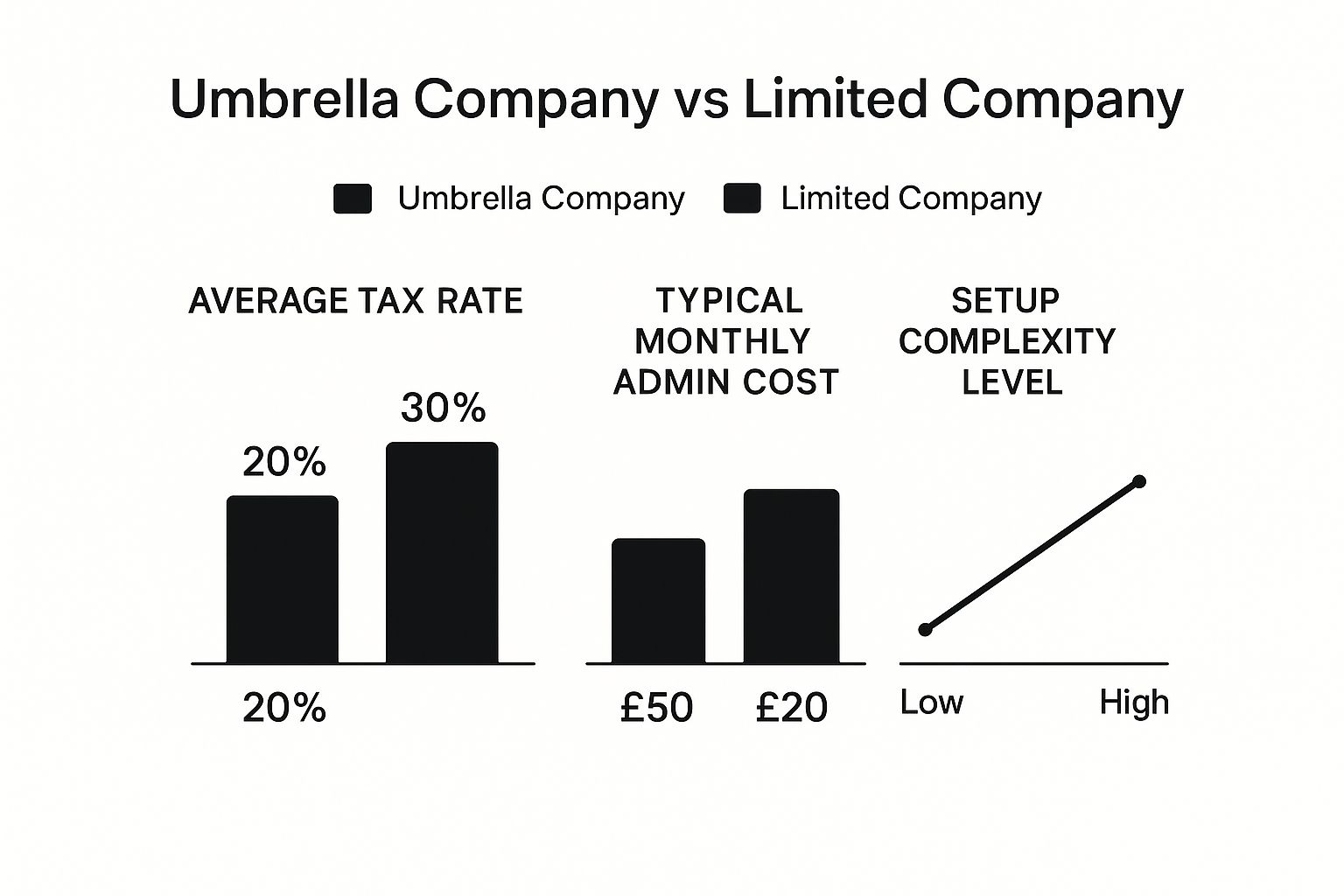
As you can see, while a limited company often comes with lower ongoing admin costs, the initial setup is more involved. It also requires careful tax planning to be more efficient than the umbrella route.
To really get to grips with the practical differences, let's break them down side-by-side.
Key Differences Umbrella Company vs Limited Company
The table below offers a snapshot comparison, highlighting the core responsibilities and features of each path. It is a great starting point for seeing where your priorities might lie.
| Feature | Umbrella Company | Limited Company |
|---|---|---|
| Legal Status | You are an employee of the umbrella company. | You are a director and shareholder of your own separate legal entity. |
| Administration | Minimal. The umbrella handles invoicing, payroll & tax. | You are responsible for all company admin, accounts, and tax returns. |
| Tax & NI | Deducted at source via PAYE, just like a permanent employee. | Paid via a mix of salary (PAYE) and dividends. Corporation Tax applies to profits. |
| Control | Limited control over finances. You receive a net salary. | Full control over company finances, including salary, dividends, and expenses. |
| IR35 Responsibility | The umbrella company manages IR35 compliance. | You are responsible for determining your IR35 status for most contracts. |
| Costs | A weekly or monthly margin is deducted from your income. | Accountancy fees, software costs, and potential setup fees. |
| Employment Rights | Entitled to statutory rights like holiday and sick pay. | No automatic employment rights; must arrange your own pension, etc. |
Ultimately, the right choice is not just about the numbers on a payslip. It's about weighing up the simplicity and security of being an umbrella employee against the control, responsibility, and potential financial rewards of running your own limited company.
How IR35 Shapes Your Decision
You cannot really talk about umbrella and limited companies without mentioning the off-payroll working rules, better known as IR35. It is often the single biggest factor pushing contractors one way or the other.
At its core, the legislation is there to spot ‘disguised employees’, contractors who work like regular staff but use a limited company structure to pay less tax. Whether your contract is classed as 'inside' or 'outside' IR35 will have a massive impact on your choice.
If your contract is deemed ‘inside IR35’, most of the tax benefits of running a limited company simply disappear. This is where an umbrella company becomes the far more sensible, and compliant, option.
Following the government's reforms in 2017 and 2021, the responsibility for figuring out your IR35 status usually falls to the end client, as we explain in our guide on what IR35 is. This has made many clients very cautious. To avoid any risk, they often insist that contracts are handled through PAYE, which naturally leads contractors straight to an umbrella company to ensure everyone in the chain is playing by the rules.
Crunching the Numbers: Costs vs. Take-Home Pay
Let's get down to what really matters for many contractors: your bottom line. How you structure your business has a direct impact on your earnings, so understanding the costs and potential take-home pay is crucial.
With an umbrella company, the costs are refreshingly straightforward. You will pay a fixed weekly or monthly margin for their services, which is deducted from your invoiced amount. On the other hand, running a limited company involves more varied and complex costs, you are looking at accountant fees, business insurance, software subscriptions, and potentially Corporation Tax.
So, what are we talking about in real terms? Most compliant umbrella companies charge a margin somewhere between £15 and £30 per week. It is a clear, predictable cost. You can get a feel for the market by checking out this handy umbrella company comparison guide.
It is generally true that a limited company can lead to higher take-home pay, particularly on long-term, high-value contracts that are safely outside IR35. But this is not a given. That potential for higher earnings comes with the trade-off of more financial responsibility and a much heavier administrative load compared to the plug-and-play simplicity of an umbrella.
To see how the numbers stack up for your specific situation, our detailed analysis on which payroll solution gives the highest take-home pay is the perfect next step.
Making the Right Decision for Your Career
So, how do you decide between an umbrella company vs a limited company? Ultimately, the right choice hinges on your individual situation, appetite for admin, and long-term contracting goals.
An umbrella company is often the perfect starting point for first-time contractors. It is also a great fit if you are working on shorter assignments or have a contract that has been deemed 'inside IR35'. It’s a straightforward, compliant path that gets you up and running with minimal fuss.
On the other hand, running a limited company is usually the domain of seasoned contractors. Think higher day rates, long-term contracts firmly outside IR35, and a willingness to take on the legal duties of a company director.
Research often shows that a contractor's preference lines up with their contract length, which is why umbrella companies are a very popular choice for gigs lasting under three months. You can see more on these contractor trends at goforma.com.
Don't forget, the path you take today is not set in stone. Plenty of contractors begin their journey with an umbrella company for its simplicity and then transition later on. When you are ready for that step, our guide on how to switch from an umbrella to a limited company can walk you through it.
A Few Common Questions
We get asked these all the time. Here are some quick answers to the big questions contractors face when weighing up their options.
Can I Switch from an Umbrella to a Limited Company?
Absolutely. It is a well-trodden path for many contractors. Starting out with an umbrella company for your first contract or two is a great way to test the waters of contracting without diving straight into company administration.
When you have found your feet, perhaps with a longer-term contract on the horizon, you can make the move. The cleanest way to do this is between contracts to keep the paperwork simple and avoid any overlap.
Which Option Is Better for Getting a Mortgage?
You can get a mortgage either way, but lenders will look at your application through a different lens depending on your setup. As an umbrella employee, you have payslips and a clear record of employment, which is the kind of straightforward evidence most high-street lenders are used to seeing.
If you are a limited company director, it is a different ball game. Lenders will typically want to see at least two years of full company accounts and your corresponding personal tax returns. Whichever route you take, our advice is always the same: find a specialist mortgage adviser who gets contracting. They know exactly how to present your income to lenders.
Key Takeaway: Both paths lead to a mortgage, but the proof you will need is very different. Umbrella working gives you a simple paper trail, while running a limited company means building up a longer history of business accounts.
What Happens if My Contract is Inside IR35 but I Have a Limited Company?
If your contract is deemed ‘inside IR35’, it is a game-changer. The entity paying your company (whether that’s the agency or the end client) is legally required to deduct income tax and National Insurance from your invoice before it even hits your company bank account. It is handled just as if you were an employee on their payroll.
This effectively wipes out the tax efficiencies that make a limited company so attractive for that specific contract. For this reason, many contractors with a limited company will choose to use an umbrella for any inside IR35 roles. It's simply a more straightforward and compliant way to handle the situation.


