


Picking the best umbrella company in the UK is not a one-size-fits-all deal. It is about finding the right fit for your contracting career. The perfect choice hinges on your industry, your daily rate, and what you value most, whether that is flexibility in your pension contributions or having a dedicated person to call when you have a query.
What Defines the Best UK Umbrella Company

Let's be clear: defining the "best" umbrella company goes way beyond just comparing their weekly or monthly margin. A cheap margin is tempting, but it is worthless if the provider is not fully compliant with HMRC regulations. A genuinely good umbrella company steps up and acts as a proper, reliable employer, protecting your earnings and making sure we handle your tax affairs by the book.
The umbrella company scene has grown significantly, particularly after the IR35 reforms pushed many contractors towards compliant employment structures. Today, an estimated 700,000 workers in the UK labour market are paid through umbrella companies, which process billions in payroll every year. This sheer scale highlights why choosing a reputable partner is so critical; getting it wrong with a non-compliant provider can lead to a nasty tax bill.
This guide gives you a straightforward framework for weighing up your options. The goal is to provide you with the confidence to navigate the market, sidestep any dodgy schemes, and pick a partner that genuinely has your back.
Core Pillars of a Top Umbrella Company
The bedrock of any decent provider is built on three things: compliance, transparency, and support. That low margin we talked about? It means nothing without these. A compliant company will never dangle suspiciously high take-home pay percentages in front of you; that is a massive red flag for a tax avoidance scheme.
Instead, their focus is on providing clear, easy-to-understand payslips and solid employment support. This means they manage your PAYE tax and National Insurance contributions correctly, offer all the statutory benefits you are entitled to, and ensure we pay you on time, every single time.
The best umbrella company is one you can trust completely. They should operate with total transparency, hold accreditations from bodies like the FCSA or Professional Passport, and provide excellent support when you need it.
Comparing Key Attributes
To help you tell the good from the bad, think about how different providers measure up in these key areas. A reputable company will always be upfront about its services and how it operates.
| Attribute | A Compliant Provider Offers | A Non-Compliant Scheme Might Offer |
|---|---|---|
| Accreditation | FCSA or Professional Passport membership | No recognised UK accreditations |
| Pay Calculation | Transparent payslips with clear deductions | Vague or complex pay structures |
| Insurance | Comprehensive cover included as standard | Minimal or no insurance provided |
| Support | A dedicated account manager or support team | Limited or unresponsive customer service |
| Employee Benefits | Access to pension, sick pay, holiday pay | No statutory employment benefits offered |
Ultimately, choosing the best UK umbrella company is about finding a partner that is both secure and efficient. You can explore our guide on FCSA accredited umbrella companies to get a better handle on what compliance looks like in practice. It is all about making sure your contracting career is built on a solid foundation.
Key Criteria for Evaluating Umbrella Companies
When choosing the best UK umbrella company, it is easy to get fixated on the weekly margin. But a truly great provider does far more than just process your payroll; they offer security, proper support, and complete peace of mind. To find a partner you can trust, you need to look at a few essential factors that separate the good from the questionable.
The process starts with checking their compliance credentials and ends with seeing what kind of real-world support they actually offer. Making the right choice means knowing what makes a service genuinely protective, not just basic.
HMRC Compliance and Accreditation
The absolute non-negotiable is HMRC compliance. A legitimate umbrella company runs a standard Pay As You Earn (PAYE) scheme, correctly taking off income tax and National Insurance Contributions (NICs) before you get paid. It is simple. Any company promising take-home figures that look too good to be true is almost certainly a disguised remuneration scheme and should be avoided at all costs.
To be sure a company is committed to doing things by the book, look for accreditations from independent professional bodies. The two you really need to know in the UK are:
- FCSA (The Freelancer & Contractor Services Association): This is the UK's leading membership body for compliant umbrella employers. Its members go through tough annual checks against a very strict code of conduct.
- Professional Passport: This body also carries out independent compliance audits, making sure providers are meeting all the required operational and regulatory standards.
Picking an accredited provider massively cuts your risk of stumbling into a tax avoidance scheme and facing an HMRC investigation down the line.
Transparent Pay Calculations
You should never be left guessing how we have worked out your pay. The best umbrella companies give you clear, detailed payslips that break down every single deduction, from their own margin to employer's NICs, income tax, and your pension contributions.
A sure sign of a trustworthy provider is their willingness to give you a full pay illustration before you even sign up. This document should spell out all deductions and show exactly how your gross contract value becomes your net take-home pay.
If a payslip is a confusing mess or the company gets defensive when you ask them to explain their figures, take that as a major red flag. Transparency is not a "nice to have"; it is fundamental. You can use our umbrella company comparison tool to see how the top providers lay out their calculations.
Comprehensive Insurance Cover
As an employee of an umbrella company, you must be covered by their business insurance. It is a crucial benefit that shields you from financial risk when you are working on a client's site. A standard package will always include:
- Professional Indemnity Insurance: This covers you if a client claims your work was negligent or contained mistakes.
- Public Liability Insurance: This protects you if you accidentally injure someone or damage property.
- Employers' Liability Insurance: This is a legal must-have and covers you if you are injured while working.
Always check the level of cover. Most offer standard limits, but some jobs or sectors might demand higher levels of indemnity. Make sure the policy is right for your specific contract.
Pension Scheme Options
Every UK employer, including umbrella companies, has to offer a workplace pension through auto-enrolment. It is the law. The best providers, however, go a step further by offering more flexible options, such as salary sacrifice pension schemes.
This arrangement lets you contribute to your pension from your gross pay, before we take off tax. It is a highly tax-efficient way to save for retirement, particularly if you are a higher-rate taxpayer. When you are comparing your options, ask what pension provider they use and if they support salary sacrifice.
Contractor Support Services
Finally, think about the level of support you will actually get. A top-tier umbrella company is more than just a payroll machine; it acts like a proper employer. This means having a dedicated account manager or at least a responsive support team you can call with any questions.
Look at the technology they use, too. A simple, user-friendly online portal for submitting timesheets, checking payslips, and managing your details makes the admin side of contracting so much easier. Good support shows a provider genuinely values its contractor employees.
Understanding Compliance Risks and IR35
Choosing the wrong umbrella company can do a lot more than just create a bit of admin hassle; it can land you in serious financial and legal hot water. To navigate the market safely, you need a sharp eye for compliance, especially with the minefield that is IR35 and the ever-present threat of dodgy tax schemes.
This section will show you exactly what to look for and, more importantly, what to run away from. We will break down how to spot disguised remuneration schemes that promise the earth but often end with a nasty letter from HMRC. Getting this right means building your contracting career on solid, secure ground.
Spotting Tax Avoidance and Disguised Remuneration
The single biggest danger in the umbrella market is the disguised remuneration scheme. These outfits often dangle the promise of 80-90% take-home pay, a figure that is simply not possible under a compliant PAYE system. Their model usually involves paying you a tiny salary and labelling the rest as something non-taxable, like a loan or an investment.
Make no mistake, these schemes are illegal, and HMRC pursues them aggressively. Contractors who get tangled up in them, even by accident, can face years of back taxes, interest, and crippling penalties.
A simple rule of thumb: If a take-home pay quote seems too good to be true, it absolutely is. A compliant umbrella will always give you a detailed payslip showing every single deduction for PAYE tax and National Insurance Contributions.
The Critical Role of a Compliant Umbrella in IR35
For any contract determined to be 'inside IR35', using a compliant umbrella company is the most straightforward way to manage your pay. When a role falls inside IR35, it means we class your working relationship as 'deemed employment' for tax purposes, so your earnings must go through PAYE.
A proper umbrella company acts as your employer, handling all the necessary tax and NICs correctly. This structure gives your end client peace of mind and ensures you are meeting your own tax obligations. To get a deeper understanding, have a look at our guide on how IR35 affects contractors.
Why New Legislation Makes Your Choice More Important Than Ever
The rules for umbrella companies are always changing, with HMRC constantly tightening the screws on non-compliance. The post-IR35 world already puts huge pressure on reliable PAYE processing, but upcoming reforms are set to raise the stakes even higher.
New government rules are on the way to introduce a form of joint liability. This could make recruitment agencies, and maybe even end clients, responsible for unpaid tax if an umbrella in their supply chain goes bust without paying its dues. This move, along with HMRC's relentless pursuit of disguised remuneration schemes, shows just how risky a non-compliant partner can be.
What does this mean for you? It means agencies and clients will be more selective than ever, refusing to work with anyone but fully accredited, financially sound providers. Choosing a reputable umbrella is not just a good idea anymore; it is becoming essential for winning contracts.
Compliance Red Flags vs Green Flags
To make things easier, here is a quick reference table to help you tell the difference between a dodgy scheme and a trustworthy, accredited umbrella provider. Learning to spot these signs is your first line of defence.
| Red Flag (Warning Sign) | Green Flag (Positive Sign) |
|---|---|
| Promises of exceptionally high take-home pay (e.g., over 80%). | Provides a realistic pay illustration with clear deductions for tax and NICs. |
| Vague or confusing payslips that do not clearly itemise deductions. | Clear, transparent payslips that are easy to understand. |
| Not accredited by a recognised UK body like FCSA or Professional Passport. | Holds current accreditation from FCSA or Professional Passport. |
| Pays part of your earnings as a non-taxable 'loan' or other complex payment. | All payments are processed through a standard UK PAYE payroll system. |
| Lack of clear contact information or a physical UK office address. | Provides a dedicated account manager and has a verifiable UK presence. |
| Charges a very low or even zero margin. | Charges a fair, transparent margin that reflects a sustainable business model. |
Staying vigilant and putting compliance first is the key. It allows you to find a great UK umbrella company that not only pays you correctly but also protects your financial future.
Comparing Providers for Different Contractor Needs
Finding the ‘best’ UK umbrella company is not about picking a single winner. It is about finding the one that is the right fit for your specific situation as a contractor. What works perfectly for a high-earning IT professional might be a poor choice for someone stepping into their first public sector role.
One person might be laser-focused on the lowest possible margin, while another will gladly pay a bit more for a top-tier pension scheme or specialist support. It all comes down to your professional profile and what you value most.
This section breaks down four common contractor scenarios to show you how different features and services deliver value in different contexts. The goal is to get past the generic sales pitches and give you practical advice based on real-world needs.
The High-Earning IT Contractor
IT contractors, especially those commanding high daily rates, have a unique set of priorities. Their main goal is usually to maximise their take-home pay in the most tax-efficient way possible, all while keeping admin to a bare minimum. For them, the best umbrella company does much more than just run payroll.
The standout feature they should be looking for is an advanced salary sacrifice pension scheme. This is a game-changer. It allows them to channel a significant chunk of their gross earnings straight into their pension pot, which can dramatically lower their overall tax bill. A slick, easy-to-use digital portal for timesheets and payslips is also a must-have, as time spent on paperwork is time not spent earning.
You can dive deeper into this in our detailed guide on finding the best umbrella company for IT contractors.
For a high-earning contractor, it is all about financial efficiency. A provider with a flexible and powerful salary sacrifice pension can deliver far more value than one with a slightly cheaper weekly margin but only basic pension options.
This decision tree gives you a visual on the first critical checks any contractor should make before signing up.
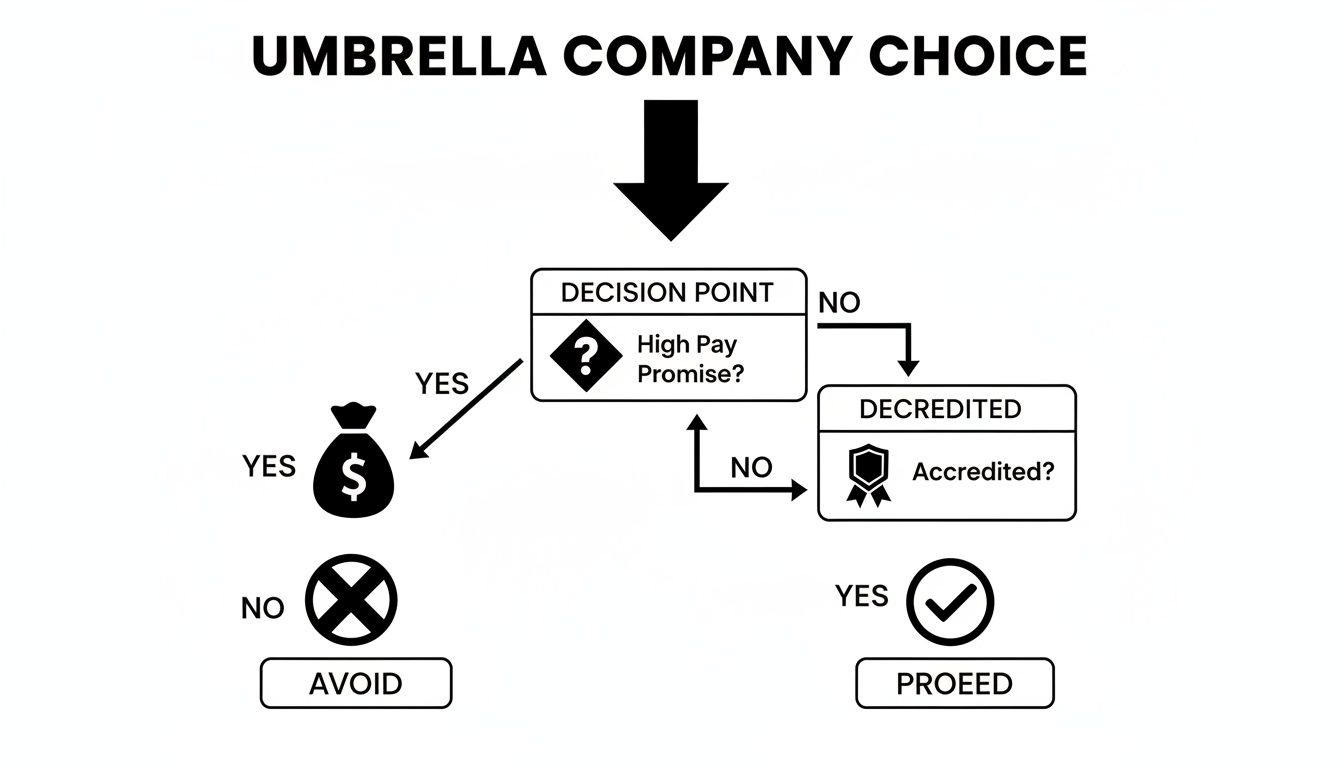
As the flowchart shows, checking for proper accreditation and steering clear of dodgy high-pay promises are the absolute first steps to finding a provider you can trust.
The Public Sector Professional
If you are contracting in the public sector, such as healthcare or education, you are operating in a different world. End clients and agencies are incredibly risk-averse, so compliance and a proven track record are non-negotiable. The best umbrella for these professionals is one with a long, squeaky-clean history.
They should prioritise providers who are not only FCSA or Professional Passport accredited but who also have deep experience with public sector frameworks. This is crucial because it means they understand the specific compliance and vetting hoops you have to jump through. In this arena, stability and reputation trump a rock-bottom margin every time.
A public sector contractor needs:
- An established reputation: Look for umbrellas that have been around for years and have great feedback from others in your field.
- A clear compliance record: The provider must be fully accredited and completely transparent about how they operate.
- Responsive support: Getting an account manager who actually understands the nuances of public sector contracts is a massive plus.
The First-Time Contractor
Making the jump into contracting can feel like a big leap into the unknown. Newcomers are often getting their heads around timesheets, payment cycles, and their employment rights for the first time. For them, the best umbrella is one that holds their hand and makes the whole onboarding process feel simple.
The weekly margin is far less important than the quality of the support and guidance they receive. A provider that takes the time to patiently explain payslips, pension options, and holiday pay can make all the difference. Excellent customer service is not a perk here; it is a necessity.
Look for a provider with:
- A dedicated onboarding team: Someone to help with the initial setup and answer all those early questions without making you feel silly.
- Accessible support: Easy-to-reach account managers who can explain payroll jargon in plain English.
- A helpful online portal: An intuitive platform with guides and FAQs can empower a new contractor to get to grips with their finances quickly.
The Creative Freelancer
Creative professionals, like designers and writers, often juggle multiple, shorter-term projects. Their income stream can be a bit more unpredictable, so flexibility is often high on their wish list.
The ideal umbrella for a creative might offer things like flexible payment schedules or a super-simple process for handling business expenses. While the scope for claiming expenses via an umbrella is narrow, a provider with a painless system for it can be a real bonus. They also tend to appreciate a modern, tech-savvy approach that matches their own dynamic way of working.
How We Help You Compare the Best UK Umbrella Companies
Now that you have a handle on what makes a good umbrella company, it is time for the practical bit: comparing them head-to-head.
Our whole goal at UmbrellaCompany.com is to cut through the marketing fluff and make this decision as simple and clear as possible. We have designed our comparison tool to do just that, letting you make a choice based on real data that is relevant to you.
This is not just about finding the cheapest option. It is about finding the right one. Let's walk through how to use our portal to find a compliant, reliable provider that fits your specific contracting situation.

Step 1: Enter Your Contract Details
First things first, our tool needs a bit of information about your contract. This is not just for show; this context is what allows us to generate accurate, personalised pay illustrations that reflect what you will actually see in your bank account.
You will need to enter:
- Your daily or hourly rate: This is the starting point for any take-home pay calculation.
- Your IR35 status: This is a big one. Whether your contract is inside or outside IR35 drastically changes how we process your pay.
- Your work pattern: Just the number of days or hours you work each week.
With this data, our system can produce a precise pay illustration from every provider, giving you a realistic preview of your net earnings from the get-go.
Step 2: Filter Down to What Really Matters
Once the initial results are up, it is time to narrow the field. This is where you move beyond just the headline numbers and start focusing on the quality and type of service you need.
Our comparison tool has built-in filters to help you find providers that meet specific standards. The screenshot below gives you a glimpse of how easy it is to fine-tune your search.
As you can see, you can quickly toggle options to prioritise accredited providers, making sure you are only looking at companies that have been properly vetted for compliance.
Being able to filter the results is a game-changer. It means you can instantly create a shortlist of providers that tick your non-negotiable boxes, like having FCSA accreditation or offering specific perks like enhanced pension schemes.
Step 3: Analyse the Shortlist and Make Your Choice
With a filtered list in front of you, you can do a final, more detailed comparison. Do not just fixate on the weekly margin; look at the entire package on offer.
Drill down into the full pay illustration, double-check the insurance cover provided, and have a scan through reviews from other contractors.
A lower margin might catch your eye, but a provider that costs a few pounds more could offer much better customer support, a more generous pension scheme, or a slick online portal that saves you hours of admin. Our tool lays all this information out for you, side-by-side, so you can make a balanced, informed decision. It is the most effective way to find the best UK umbrella company suited to you.
Frequently Asked Questions
Choosing the right umbrella company is a big decision, and it is completely normal to have a few lingering questions. To help you feel confident about your choice, we have put together straight-talking answers to the queries we hear most often from contractors.
Think of this as the final check before you sign up. We will cover what a fair margin really looks like, your rights if you want to switch providers, and how things like holiday pay and sick pay actually work.
What Is a Fair Weekly Margin for an Umbrella Company?
The weekly margin is simply the fee an umbrella company charges for handling your payroll and admin. A fair price usually sits somewhere between £20 and £30 per week.
Be wary of margins that look too good to be true. A compliant, well-run umbrella has real costs to cover, including staff, insurance, and accreditations. An unusually low price might be a red flag that they are cutting corners on compliance or support, which could leave you exposed.
Do not just chase the lowest margin. The best umbrella companies strike a balance between a fair fee, rock-solid compliance, proper insurance, and genuinely helpful support.
Always double-check that the margin is the only income the umbrella keeps from your contract rate. We should process everything else as your gross pay before making the usual tax deductions.
Can I Switch Umbrella Companies During a Contract?
Yes, absolutely. You are free to switch umbrella companies mid-contract. It is your choice, and the process is usually pretty straightforward, designed to cause minimal disruption to your work and pay.
If you are not happy with the service, transparency, or support you are getting, you should not feel stuck. Any decent, compliant umbrella company will have a simple process for both joining and leaving.
Here is how it generally works:
- Choose your new provider: Use a comparison tool to find a new, accredited umbrella company that fits your needs.
- Tell your agency: Let your recruitment agency know you are switching and give them the new company’s details so they can redirect payments.
- Pass on your P45: You will need to give your new umbrella the P45 from your old one. This is crucial for getting your tax code transferred correctly and avoiding emergency tax.
- Complete the new registration: Fill out the sign-up forms for your new provider.
A good umbrella will guide you through this, making the switch as painless as possible.
How Is Holiday Pay Calculated and Paid?
As an employee of an umbrella company, you are legally entitled to paid holidays. This works out to 5.6 weeks (28 days) per year for a full-time contract, and it is adjusted pro-rata if you work fewer hours.
This holiday pay is accrued from your gross earnings. Umbrella companies tend to handle it in one of two ways:
- Paid in Advance: We add the holiday pay you earn each week or month directly to your payslip. This is a popular method, but it means you need to be disciplined enough to put that money aside yourself for when you take time off.
- Accrued and Retained: The umbrella company holds onto your accrued holiday pay for you. When you decide to take a holiday, you just request for it to be paid out.
A reputable provider will be crystal clear about how we calculate your holiday pay and let you choose how it is managed. Always check your payslip to see exactly what is happening.
Do Umbrella Companies Provide Sick Pay and Pensions?
Yes, one of the main upsides of using an umbrella company is that you get access to statutory employment rights, including sick pay and a pension.
- Statutory Sick Pay (SSP): If you are too ill to work, you can claim SSP, as long as you meet the standard criteria (like being off for at least four days in a row).
- Workplace Pension: By law, all umbrella companies must automatically enrol their eligible employees into a workplace pension scheme. You will contribute, and so will the umbrella company (as your employer).
The best umbrella companies often offer more than just the basics. Many provide salary sacrifice pension schemes, which are a very tax-efficient way to build up your retirement pot, especially if you are a higher-rate taxpayer. It is always worth asking about their pension options when you are comparing.
What Insurance Cover Should an Umbrella Company Provide?
Proper insurance cover is a non-negotiable part of the service and should always be included in the weekly margin. It is there to protect you from financial risks while you are on a client’s project. Any standard package must include:
- Employers' Liability Insurance: This is a legal must-have. It covers you if you get ill or are injured because of your work.
- Public Liability Insurance: This protects you if you accidentally injure someone or damage their property while working.
- Professional Indemnity Insurance: This covers claims of professional negligence, such as making a mistake or giving bad advice.
Before you sign anything, check the levels of cover they offer and make sure they are high enough for your contract and industry. The best providers are transparent about their policies and will happily provide you with the documentation.
Ready to find an umbrella company that is compliant, supportive, and reliable? UmbrellaCompany.com makes it simple. Our comparison tool helps you filter providers by what matters most to you, from FCSA accreditation to enhanced pension options. Compare the UK's best umbrella companies today!


