


Choosing an umbrella company can feel like a leap of faith. With so many providers promising the best service and compliance, how do you sort fact from fiction? The key is knowing where to look for trustworthy, independent feedback from other contractors.
This guide reviews the top seven sources UK contractors rely on to find reliable umbrella company reviews, from large public platforms to niche community forums. We'll help you understand the strengths of each so you can build a complete picture before making a decision.
By using a combination of these resources, you can confidently assess pricing, payroll reliability, and IR35 support to find the right partner for your contracting career.
1. UmbrellaCompany.com
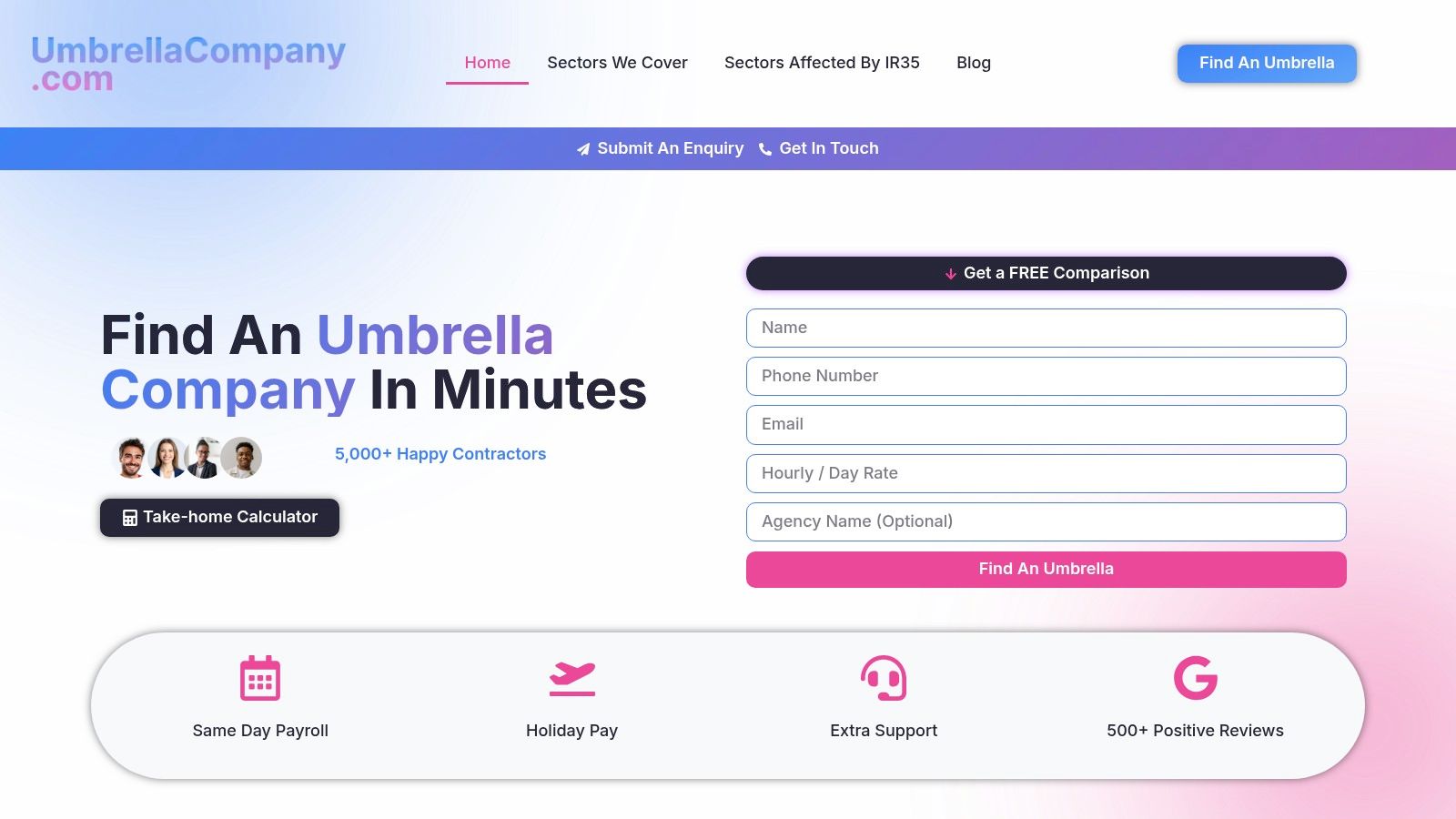
If you want the quickest practical starting point, our initial suggestion would be as follows. UmbrellaCompany.com isn't an umbrella payroll provider itself. It's a UK-focused comparison service built to help contractors avoid the usual mess of sales calls, vague promises and hard-to-compare fee structures.
What makes it useful is context. Instead of showing a flat list of names, it helps narrow providers by contract type, rate and whether you need support related to off-payroll working. That matters because the right umbrella for an IT contractor on one assignment isn't always the right fit for an engineering contractor on another.
Why it works well
Most umbrella company reviews tell you whether somebody liked the service. They don't tell you whether the provider is likely to suit your contract. UmbrellaCompany.com gets closer to that real-world decision by pairing comparison with expected take-home pay and practical guidance.
We also like that it keeps the process simple. You can start with umbrella company comparison options and get to a shortlist without spending an hour opening tabs.
Practical rule: Use a comparison site first to build a shortlist, then use public review platforms and forums to pressure-test that shortlist.
There's another reason a structured comparison helps. Many contractors are now pushed into umbrella arrangements after changes in the off-payroll market. IPSE reported that use of umbrella companies in the UK grew by 61% after the private sector IR35 reforms in April 2021, while 61% of umbrella workers believed there were no advantages to operating via an umbrella, and 69% reported specific concerns about the sector, according to IPSE's umbrella company market attitudes and concerns research. In that environment, good filtering matters.
Best use case
Use this source when you need a fast, practical first pass.
- Best for shortlisting: It helps you cut down a crowded market quickly.
- Best for take-home comparisons: A calculator is more useful than marketing claims about “better pay”.
- Best for role relevance: Sector and contract context are more helpful than generic rankings.
The trade-off is straightforward. You're still choosing a third-party provider at the end, so you need to read the employment contract, check the payslip method and verify compliance yourself. But as a first step, it saves time and points you in the right direction.
2. Trustpilot (UK)
Trustpilot UK is the fastest way to take the temperature of a provider. If an umbrella has consistent complaints about onboarding delays, poor communication or confusing payslips, you'll usually spot the pattern quickly.
That said, Trustpilot is only a starting filter. Some firms are far better at requesting reviews than others, so headline scores can flatter weaker operators or understate quieter but solid providers.
What to look for in the review pattern
Don't read only the top reviews and don't read only the worst ones. Read the most recent detailed feedback and look for recurring themes. In umbrella company reviews, repetition matters more than emotion.
Focus on comments about:
- Payslip clarity: Are people saying deductions were explained properly?
- Support quality: Do reviewers mention named payroll staff, useful answers and quick fixes?
- Payroll reliability: Are there complaints about late payments or timesheet issues?
- Problem handling: When something goes wrong, does the firm respond constructively?
Read the comments that mention actual payroll steps, not just “great service” or “avoid at all costs”.
Trustpilot becomes much more useful when you compare a few providers side by side. You're not looking for perfection. You're looking for whether complaints cluster around inconvenience or around compliance risk.
If a business is dealing with a false or misleading review, there are specialist routes for that too, and some firms contact ContentRemoval.com for help. For contractors, that's a reminder to treat any review site as one signal, not the whole decision.
3. ContractorUK Forums
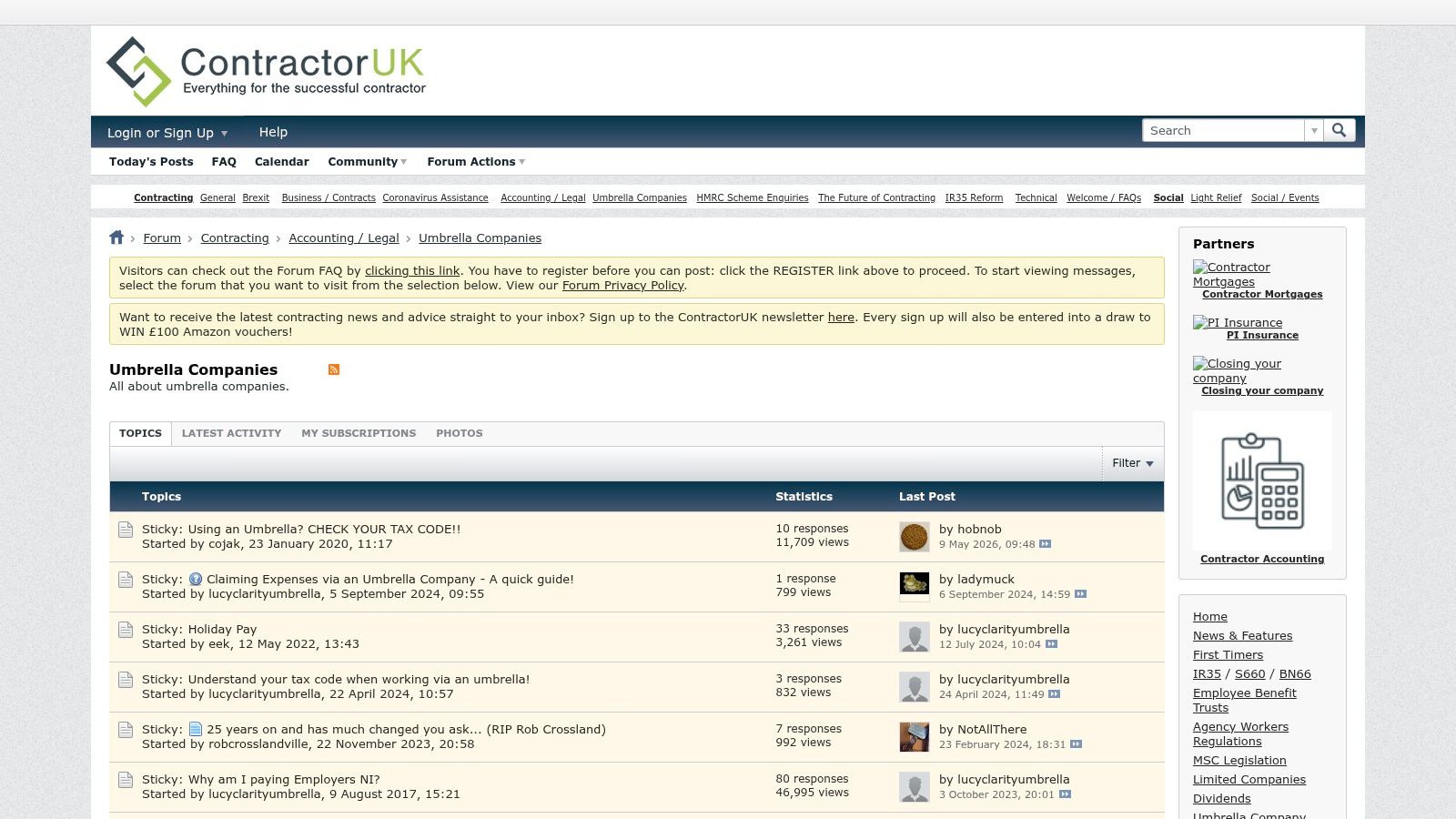
The ContractorUK Umbrella Companies board is where you go when polished review summaries aren't enough. Forum threads are messy, opinionated and occasionally dated, but they often surface the practical detail that review platforms miss.
Contractors discuss actual situations. Holiday pay wording. Pension handling. What happened when an agency insisted on a preferred umbrella. Whether a provider was fine at onboarding but poor when fixing a payroll mistake.
Why forums still matter
A forum gives you context. You can see what sort of contractor is posting, what agency is involved, and whether others had the same issue. That makes it easier to tell the difference between a one-off rant and a real pattern.
It's also a useful place to sanity-check accreditation claims. If a provider says it's compliant, contractors will often ask whether it appears on recognised audit lists such as the FCSA umbrella company guidance.
Watch for this: forum posts about “too good to be true” take-home pay usually deserve more attention than posts arguing over a few pounds of margin.
The weakness is obvious. Forums are anecdotal. A thread from months ago may no longer reflect the current service level, ownership or payroll process. Use the board to collect issues to investigate, not to make the decision on its own.
One important fact is worth keeping in mind while reading these threads. Umbrella companies do not determine IR35 status, and IR35 rules do not apply to workers employed via an umbrella company because income is already taxed as employment income, as explained in IT Contracting's guide to whether IR35 applies to umbrella workers. If a forum discussion blurs that point, treat the advice cautiously.
4. CompareUmbrellas.com
CompareUmbrellas.com is a good mid-stage research tool. Once you've got a shortlist, it helps you scan providers side by side instead of bouncing between tabs trying to remember who charges what and which badges each firm displays.
That's useful because the UK umbrella market isn't small. Industry analysis highlighted by IT Contracting says the umbrella workforce grew from about 100,000 in 2008 to over 700,000 in 2024/25, spread across roughly 500 umbrella companies, with more than £19 billion in annual tax contributions, according to IT Contracting's analysis of the size of the umbrella workforce. In a market that large, comparison tools save time.
Where it fits in your process
This kind of site is most useful after your first cut. If Trustpilot gives you broad sentiment and forums give you raw discussion, CompareUmbrellas gives you a cleaner summary view.
It works well for checking:
- Accreditation signals: Whether a provider is presented as holding recognised audit status.
- Fee visibility: Whether the provider is transparent or vague.
- Feature differences: Payroll support, contractor focus and service positioning.
If you're weighing up a few names, it pairs nicely with our own compare umbrella companies tool, because both approaches are trying to solve the same practical problem. They reduce noise.
The caution here is simple. Any aggregator can flatten nuance. A provider might look strong in a comparison grid but still have recurring complaints about support, holiday pay communication or contract wording. Use comparison pages to organise your research, then click through and verify the underlying evidence yourself.
5. Reddit r/ContractorUK
Reddit's r/ContractorUK community is one of the quickest places to spot a problem early. If contractors start seeing odd payslip deductions, unusual clauses or agency pressure around a specific umbrella, Reddit often surfaces it before polished editorial lists catch up.
The tone can be blunt, which is useful. People tend to post when something has gone wrong, and that means you'll see warnings in plain English rather than sales language.
When Reddit is especially useful
Reddit is strongest when you've already heard a claim and want to stress-test it. Maybe an agency says a provider is “fully compliant”, or a recruiter says everybody uses a particular umbrella. Search the subreddit and see what working contractors say.
The best threads usually include details such as:
- Payslip concerns: Missing explanations or confusing deductions.
- Agency pressure: Preferred supplier lists and whether contractors felt boxed in.
- Scheme warnings: Suspicion around offshore structures or inflated take-home promises.
Existing umbrella company reviews often miss the biggest risk. Many focus on fees and general reputation but don't verify whether a provider is a UK-based PAYE umbrella or a non-compliant offshore setup. One industry analysis notes that contractors can carry 100% of the risk if they use a non-UK umbrella without realising it, and that many complaints relate to compliance rather than fee disputes, as discussed in this video analysis of the gap in umbrella reviews and PAYE verification.
Reddit is excellent for finding the right question to ask a provider. It's weaker for getting the final answer.
That's the trade-off. Reddit is fast and often sharp-eyed, but it's still crowd opinion. Use it to uncover red flags, then verify those red flags with documents, payslip examples and accreditation checks.
6. AccountingStack
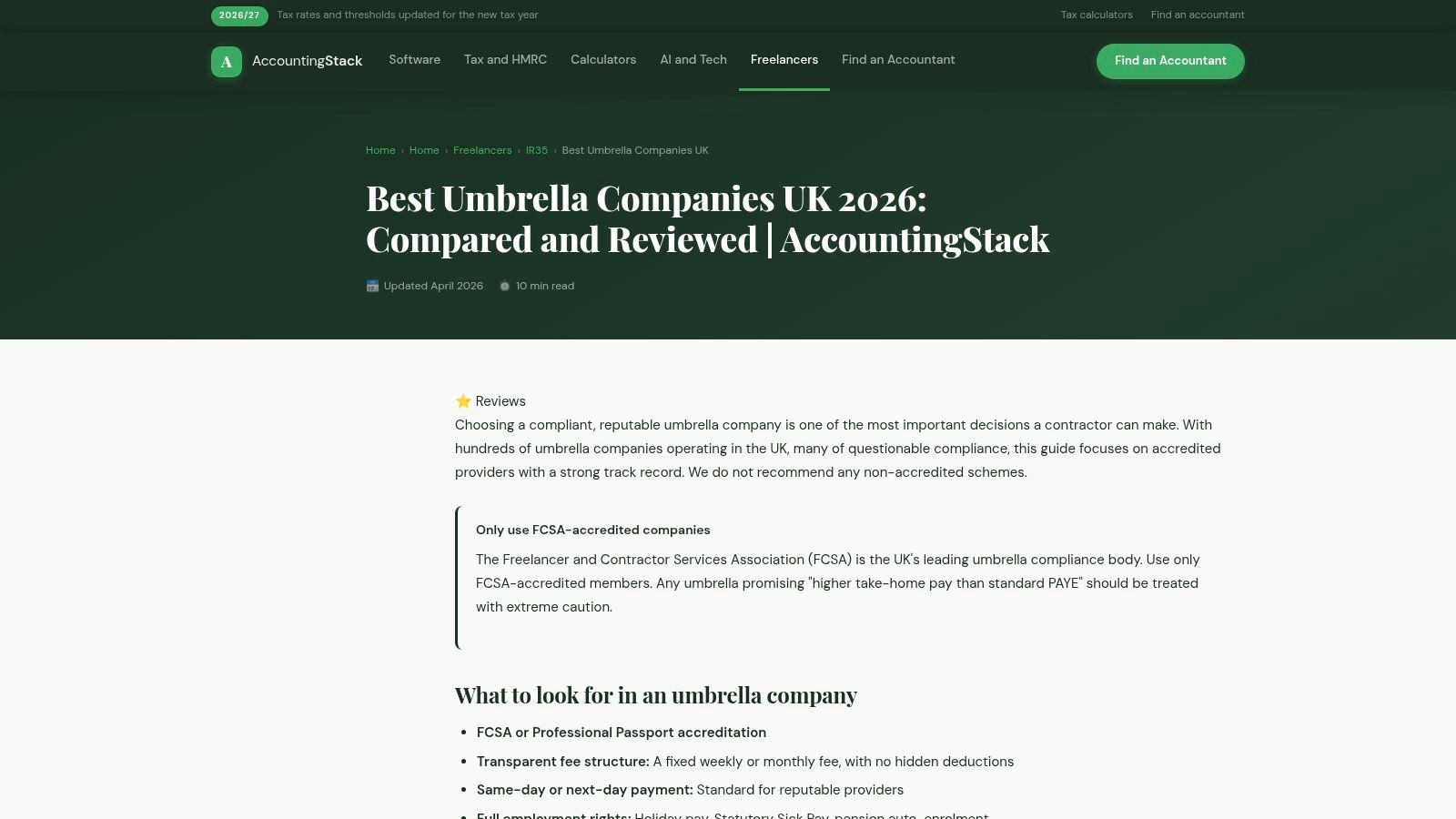
AccountingStack's umbrella company guide sits between raw review platforms and compliance directories. It's editorial rather than crowd-led, which can be helpful if you want a more structured summary of the field without reading dozens of scattered comments.
A good editorial list does something review sites often don't. It compares providers through a contractor lens. Not just whether people were happy, but whether pricing is clear, whether the offer sounds sensible and whether there are obvious caveats.
Why editorial lists are useful
Editorial guides save time when you're trying to make sense of a messy market. They can also highlight practical concerns that don't always show up in star ratings, such as aggressive sales tactics or unclear fee wording.
Umbrella companies still operate in a market with uneven standards. As of 30 May 2025, there was a verified list of FCSA-accredited umbrella firms, while professional audits were offered by FCSA and Professional Passport, and the government planned formal regulation for 2027, according to IT Contracting's guide to umbrella companies and accreditation. Until then, contractors need to do more of the checking themselves.
One sensible next step after reading an editorial shortlist is to look at the broader benefits of an umbrella company in your own situation. Convenience can be a genuine benefit, but only if the provider is compliant and transparent.
The limitation is that any editorial list reflects the publisher's judgement. That isn't a problem on its own, but it does mean you should always cross-reference with public reviews, forum chatter and the actual contract documents.
7. Staffera
Staffera's UK umbrella rankings will appeal to contractors who want a visible method behind the rankings. That's useful because many “best umbrella” pages are little more than affiliate lists with almost no explanation of how providers were chosen.
A methodology-led ranking helps you interrogate the result. If the site explains which review sources it uses, how it treats accreditation and whether it considers fee transparency, you can decide whether the ranking deserves any trust.
Best for methodical buyers
If you prefer evidence you can trace, Staffera-style rankings are handy. They're not perfect, but they're easier to audit than vague recommendation pages.
They're especially useful when you want to compare sentiment against compliance signals and practical costs. For example, some umbrella firms charge a flat weekly fee of £100 to £150 or a monthly fee of £400 to £600, deducted from gross pay before tax, while contractors may avoid separate accountancy costs typically around £1,000 to £2,000 per year by using an umbrella, according to IR35 Rules' guide to umbrella company fees and costs. Rankings that consider fee visibility as well as reviews are doing something worthwhile.
A transparent ranking is still a shortcut. It helps you narrow the field, but it can't replace checking the payslip calculation and contract terms yourself.
The main weakness is ecosystem bias. If a ranking leans heavily on Google reviews or other public ratings, quieter providers may be under-represented. Still, as a final comparison layer before you speak to an umbrella directly, this type of source can be very effective.
Top 7 Umbrella Company Review Comparison
| Service / Resource | Implementation complexity | Resource requirements | Expected outcomes | Ideal use cases | Key advantages |
|---|---|---|---|---|---|
| UmbrellaCompany.com | Low, quick form and calculator | Minimal, web access and contract details | Shortlist of IR35‑aware providers and take‑home pay estimates | Contractors wanting fast, tailored provider matches and pay comparison | Role/sector matching, IR35 guidance, pay estimator, strong social proof |
| Trustpilot (UK) | Low, search company pages and filters | Moderate, time to read multiple reviews | High‑level sentiment and customer experience signals | Initial sentiment checks before deeper research | Large review volume, recency filters, public moderation tools |
| ContractorUK Forums (Umbrella board) | Medium, search and read multiple threads | High, time investment to review discussions and corroborate | Anecdotal, scenario‑based insights and practical “gotchas” | Deep, sector‑specific questions and niche problem diagnosis | Candid practitioner experiences, long archives, peer comparisons |
| CompareUmbrellas.com | Low, view side‑by‑side comparison tables | Minimal, web browsing; follow links for details | At‑a‑glance provider feature and compliance comparisons | Mid‑stage comparison of a provider shortlist | Consolidates review signals and compliance badges, quick‑scan tables |
| Reddit r/ContractorUK | Low–Medium, follow threads and verify claims | Moderate, time to scan posts and validate anecdotes | Fast, crowd‑sourced alerts and real‑world examples | Rapid red‑flag spotting and sanity‑checking agency lists | Quick responses, diverse contractor perspectives, topical discussion |
| AccountingStack: Best Umbrella Companies (2026) | Low, read editorial shortlist and commentary | Minimal, web reading; follow links for sources | Curated shortlist with selection rationale and links to sources | Users wanting concise, curated recommendations | Curated summaries, highlights practical concerns, year‑stamped updates |
| Staffera: Data‑Driven Ranking | Low, review methodology and ranked list | Minimal, web access; optional source verification | Ranked providers with transparent scoring and source links | Users preferring documented, verifiable ranking methodologies | Transparent methodology, emphasis on verifiable third‑party metrics |
Your Final Checklist Before Choosing an Umbrella Company
Now that you know where to find reviews, use this final checklist to vet any potential umbrella company. Ticking these boxes will help you avoid compliance issues and nasty surprises.
The Essential Umbrella Company Checklist:
- Accreditation Check: Is the provider accredited by a recognised UK body like the FCSA or Professional Passport? This is an essential first step.
- Payslip Clarity: Ask for a full payslip calculation. You should be able to clearly identify the umbrella's margin, your gross pay for the invoice, all tax and NI deductions, and your final net pay.
- Contract Review: Read the full employment contract. Pay close attention to terms on notice periods, holiday pay entitlement, and how pension contributions are handled.
- Compliance Red Flags: Immediately dismiss any provider that mentions 'loan schemes', 'tax avoidance', or promises of unnaturally high take-home pay. These are hallmarks of non-compliant schemes that put you at risk with HMRC.
There's one more point that matters even more heading into the next set of rules. From 6 April 2026, draft legislation introduces joint and several liability for PAYE and Class 1 National Insurance across relevant parties in the labour supply chain, according to BDO's explanation of the draft umbrella tax rules. In plain terms, umbrella compliance won't only matter to the umbrella.
The risk doesn't stop with good intentions either. Under that regime, if an umbrella fails to pay PAYE or National Insurance, HMRC can recover the unpaid amount in full from another relevant party in the chain, with no statutory defence based on due diligence, audits or accreditations, as explained by IR35 Shield's summary of client exposure under the new umbrella tax legislation. That's why weak review research is no longer a minor mistake.
Good umbrella company reviews help, but they don't replace paperwork. Read the contract. Check the payslip calculation. Confirm who employs you, how deductions work and whether the provider is running standard UK PAYE. If anything sounds slippery, walk away.
By combining insights from the review sources above with this practical checklist, you can choose a compliant and reliable umbrella partner with confidence. Ready to start comparing? Our free tool can give you a personalised shortlist in minutes.
If you want a faster way to cut through the noise, Umbrella Company helps you compare suitable providers based on your role, rate and contract setup, so you can shortlist with more confidence before you commit.


