


Picking the right umbrella company isn't just a box-ticking exercise; it's a decision that directly affects your take-home pay, your legal standing, and your peace of mind as a contractor. The best providers are completely transparent about their fees, operate with bulletproof compliance, and offer real, human support when you need it. This guide will show you how to check their accreditations, margins, and service quality.
How to Choose a Compliant UK Umbrella Company

This is your first step towards a smooth and successful contracting career. With hundreds of providers out there, it can be tough to tell the good from the bad. The aim of this guide is to give you a solid framework for sizing them up, so you can make a choice you’re confident in.
We will break down the essentials: what to look for, what to avoid, and why it matters. Getting this right from the start means you can sidestep common traps and protect your hard-earned money.
Why Due Diligence is Non-Negotiable
The UK contracting market is huge, but unfortunately, it's also a minefield of non-compliant operators. Recent HMRC data showed that around 700,000 people worked through umbrella companies in the 2022-2023 tax year. Worryingly, over a third of them (roughly 275,000 or more) were engaged with companies that were not playing by the rules on tax and employment.
This has, quite rightly, prompted the government to bring in reforms to push legal responsibility further up the supply chain. What does that mean for you? It means doing your own homework is more critical than ever.
Key Evaluation Criteria
When you're comparing potential umbrella companies, zero in on these core areas:
- Accreditation: Look for stamps of approval from professional bodies like the FCSA (The Freelancer & Contractor Services Association) or Professional Passport. These organisations run rigorous, independent audits to prove an umbrella is compliant. We have more info on what FCSA accreditation means for you.
- Transparency: A good provider will be upfront about everything. You should see a clear margin, a full breakdown of deductions, and an explanation of how your pay is calculated. If a company promises a take-home pay percentage that seems too good to be true, it almost certainly is.
- Customer Support: When you have a question about your payslip, you need a quick, clear answer. Look for providers with accessible and knowledgeable teams who can actually help with your queries about tax, pay, and your rights.
To make this easier, we have put the most important factors into a simple table to help you evaluate your options at a glance.
Key Factors for Evaluating Umbrella Companies
This table summarises the high-level criteria you should use when comparing different providers.
| Evaluation Criterion | What to Look For | Why It Matters for Contractors |
|---|---|---|
| Accreditation | FCSA or Professional Passport membership. | Provides independent verification that the company adheres to strict compliance and ethical standards. |
| Margin & Fees | A clear, fixed weekly or monthly margin. No hidden fees. | Ensures you know exactly what the service costs and helps you accurately forecast your income. |
| Compliance | Full adherence to PAYE, National Insurance, and IR35 rules. | Protects you from future tax liabilities and potential investigations by HMRC. |
| Support & Service | Responsive and knowledgeable customer service team. | Guarantees you have reliable support for payroll queries and employment-related questions. |
Ultimately, a trustworthy umbrella company should feel like a partner, making your contracting life simpler and more secure, not adding another layer of stress.
Understanding How Umbrella Companies Work
Before you start digging into umbrella company reviews uk, it's worth getting your head around what these companies actually do. In a nutshell, an umbrella company becomes your employer for the duration of your contract, taking care of all the fiddly admin so you can focus on the job.
It works like this: you land a contract, usually through a recruitment agency. Instead of the agency or client paying you directly, they pay the umbrella company. The umbrella then processes that payment, sorts out all the necessary tax deductions and their own fee, and pays a salary straight into your bank account. It’s as simple as that.
This setup gives you the freedom of contracting but with the legal protections and stability of being an employee. You get proper payslips, and all your PAYE tax and National Insurance contributions are handled for you, keeping you completely square with HMRC.
The Payment Journey From Client to Contractor
Getting to grips with how the money flows is crucial for trusting the process. It takes the mystery out of the deductions on your payslip and shows you exactly how your take-home pay is worked out. Any compliant umbrella will follow the same transparent steps.
Here’s a typical breakdown of how you get paid:
- You Do the Work: First, you complete your timesheets and get them signed off by your client or agency.
- Agency Pays the Umbrella: Once approved, the agency wires the contract funds (your assignment rate) over to your umbrella company.
- Deductions Are Made: The umbrella company then deducts the employment costs from this amount. This covers Employer's National Insurance, the Apprenticeship Levy, and their own margin (their fee for the service).
- Your Gross Pay Is Calculated: What’s left after those deductions becomes your gross pay. This is the figure that your personal tax and employee National Insurance contributions are calculated on.
- You Get Paid: The final amount lands in your bank account. You’ll also get a detailed payslip breaking down every single calculation.
This clear, step-by-step process is all about transparency. A good umbrella company will always give you a full reconciliation on your payslip, showing the journey from the initial agency rate to your final net pay. There should never be any hidden fees or confusing charges.
Your Rights as an Umbrella Employee
One of the biggest plus points of this model is that you are, in the eyes of the law, an employee of the umbrella company. This isn't just a technicality; it gives you access to important statutory rights that you miss out on as a sole trader or limited company director.
These legal entitlements include:
- Statutory Sick Pay (SSP): A financial cushion if you're too unwell to work.
- Statutory Holiday Pay: You build up paid time off for every hour you work.
- Maternity, Paternity, and Adoption Pay: Real support when you're starting or growing your family.
- Access to a Workplace Pension: Your umbrella must enrol you into a pension scheme.
This employment status provides a vital safety net. It neatly combines the freedom to choose your own projects with the security and legal protections that come with being an employee. For a deeper dive into the mechanics, you can learn more about how an umbrella company works in our dedicated guide.
Detailed Comparison of Leading UK Umbrella Providers
Choosing the right umbrella company means cutting through the marketing noise and digging into the details that actually affect your contracting career. To help you with your umbrella company reviews uk, this section gives you a balanced, side-by-side look at the top providers, using criteria that matter in the real world.
We will focus on the core things that impact your money and your day-to-day experience. This includes the weekly or monthly margin, how easy it is to get set up, the level of insurance you get, pension options, and any extra perks that genuinely add value.
This comparison is designed to show you not just what each provider offers, but who they’re really for. Whether you’re just starting out or you’re a contracting veteran, this analysis will help you find a partner that fits your specific situation.
The infographic below gives a simple visual of how an umbrella company fits between you, your agency, and the end client.
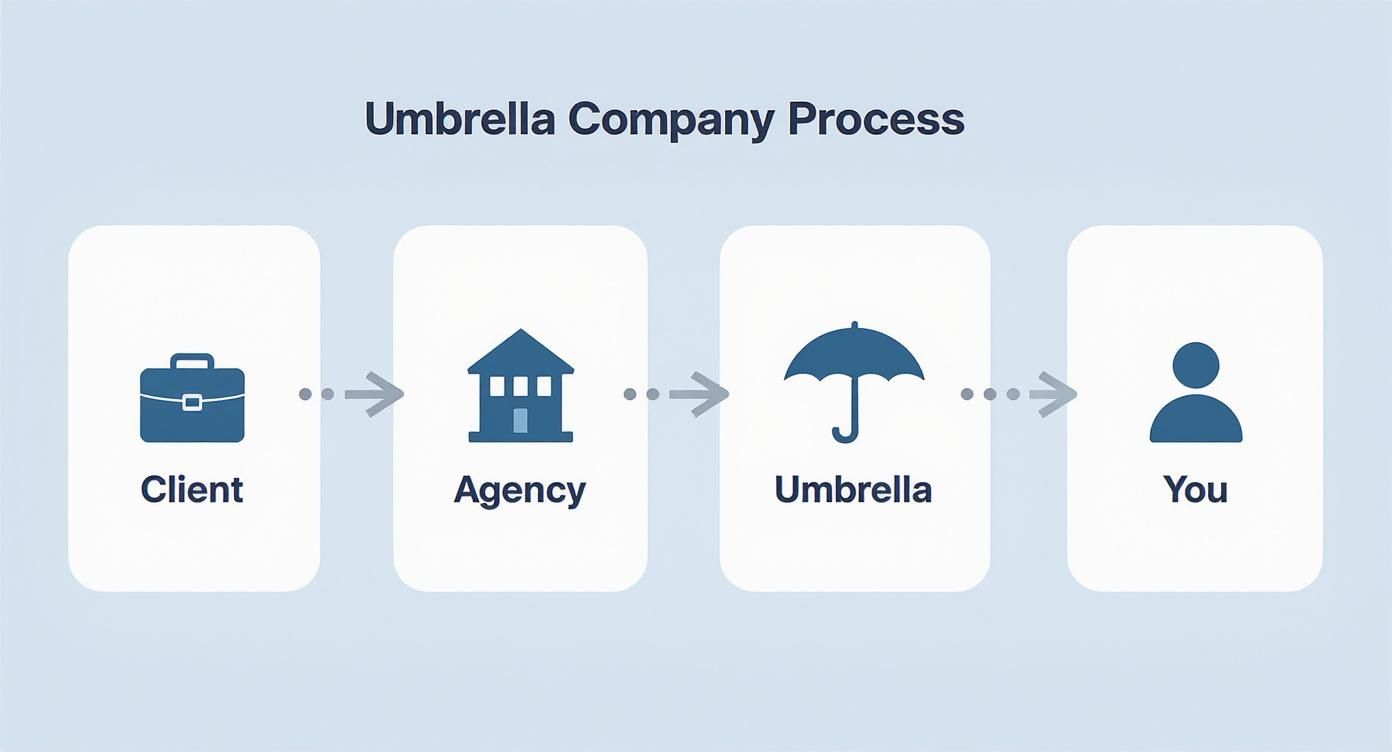
As you can see, it's a straightforward payment chain. The umbrella company sits in the middle, managing your employment and payroll, which takes a lot of the admin burden off your shoulders.
Margin Fees and Overall Value
The margin is the fee an umbrella company takes for its services, and it's an obvious point of comparison. But a word of caution: the cheapest option isn't always the best. A slightly higher margin can often be justified by better customer service, more comprehensive insurance, or valuable employee benefits.
For example, some providers have a fixed weekly margin, which is great for contractors on shorter gigs. Others use a monthly margin, which usually works out cheaper if you're on a longer contract. You really need to look at the whole package, not just the headline fee.
A provider with a £25 weekly margin but minimal support and basic insurance might offer less real value than one charging £28 that includes extensive insurance cover, a dedicated account manager, and a rewards platform.
Onboarding and Contractor Support
A smooth, quick onboarding process is a great sign of a well-run company. The best providers get you signed up with minimal fuss, providing clear instructions and having support on hand to help you out. Long, complicated registration forms can be a major red flag.
Just as important is the quality of support you get once you're up and running. When you have a question about your payslip or need some advice, you want to talk to a knowledgeable team that responds quickly. Look for providers with multiple ways to get in touch, for instance, phone, email, or live chat, and always check recent reviews to see what others say about their customer service.
Provider Breakdown: A Closer Look at the Contenders
To give you a clearer picture, let’s compare some of the UK’s most reputable umbrella companies. This table breaks down their key features to help you make a more informed choice. For a more exhaustive list, have a look at our guide to the best umbrella companies in the UK.
Side-by-Side Review of Top Umbrella Companies
Here’s a detailed feature and cost comparison of the UK's most popular and reputable umbrella companies. This should give you a good starting point for finding the right fit.
| Provider | Margin Fee | Key Features and Benefits | Accreditation Status | Best Suited For |
|---|---|---|---|---|
| Provider A | £24.00 per week | Same-day payments, dedicated account manager, comprehensive insurance package (£25m). | FCSA Accredited | Contractors seeking top-tier service and robust insurance for high-value projects. |
| Provider B | £22.50 per week | User-friendly online portal, flexible pension contributions, rewards programme with retail discounts. | Professional Passport Approved | Tech and creative contractors who value digital efficiency and employee perks. |
| Provider C | £15.00 per week (Introductory Offer) | Low-cost entry point, straightforward payroll processing, fully compliant service. | FCSA Accredited | First-time contractors or those on lower day rates looking for a no-frills, compliant option. |
| Provider D | £98.00 per month | Fixed monthly fee, specialist IR35 support, and inclusive continuity of employment. | FCSA & Professional Passport | Experienced contractors on long-term assignments who require consistent costs and IR35 guidance. |
This table highlights that there's no single "best" option; it all comes down to what you value most, whether that's low cost, premium service, or specific features.
Insurance Cover and Pensions
All compliant umbrella companies have to provide statutory insurance, including Public Liability, Professional Indemnity, and Employers' Liability. What you need to watch for is the level of cover, which can vary quite a bit. If you work in a higher-risk field like engineering or construction, a provider offering beefed-up insurance levels is a must-have.
Your pension is another massive consideration. By law, your umbrella company must enrol you in a workplace pension scheme. The best ones offer flexibility, letting you contribute to their standard scheme or continue paying into your own private pension via a salary sacrifice arrangement, which can be very tax-efficient.
Real-World Scenarios: Which Provider Fits Best?
To bring this all to life, let’s imagine a couple of typical contractor scenarios.
- The IT Contractor on a 6-Month Project: An IT contractor working inside IR35 needs a simple monthly margin and a great online portal for timesheets. Provider D would be a strong fit because of their fixed monthly fee and specialist IR35 support.
- The First-Time Social Care Contractor: Someone new to contracting in the public sector needs a compliant, low-cost option with excellent customer support to help them get started. Provider C, with its introductory offer and FCSA accreditation, offers a secure and affordable way in.
These examples show that the "best" umbrella company really is subjective. It all depends on your individual circumstances. Your sector, contract length, pay rate, and what you prioritise will all shape your final decision. By using these criteria to structure your own umbrella company reviews uk, you can find a partner that gives you security, value, and peace of mind.
How to Spot a Dodgy Umbrella Scheme
Getting tangled up with a non-compliant umbrella company is one of the worst mistakes a contractor can make. The fallout can range from a surprise tax bill from HMRC right through to serious legal trouble. The best defence is knowing the warning signs so you can spot a rogue operator before it's too late.
The government is getting much tougher on tax avoidance schemes. Big changes are planned for April 2026, which will introduce something called 'joint and several liability' (JSL). In simple terms, this means if a dodgy umbrella company disappears without paying its tax and National Insurance, recruitment agencies and even the end client could be on the hook for the bill. This is a massive shift designed to make the entire supply chain take compliance seriously, which is ultimately good news for contractors. You can get more insight on this at New Red Planet.
Unrealistic Take-Home Pay Promises
The biggest and most obvious red flag is the promise of ridiculously high take-home pay. A compliant umbrella company works under the exact same PAYE tax system as any regular UK employer. Once you account for all the legitimate deductions, your net pay should land somewhere between 60-75% of your contract rate.
If a company is shouting about you keeping 80%, 90%, or even more of your earnings, your alarm bells should be ringing. Those figures are just not possible through a legitimate PAYE payroll.
These schemes typically work by disguising a chunk of your income as something non-taxable, like a loan, an annuity, or some kind of investment payment. It might look great on the surface, but it's blatant tax avoidance, and HMRC is actively hunting these arrangements down.
Confusing or Opaque Payslips
Your payslip from a compliant provider should be straightforward. It needs to clearly show the journey of your money, from the full assignment rate the agency pays, all the way down to the final net figure that hits your bank account.
Be extremely wary if your payslip:
- Mentions odd payment descriptions like 'loans', 'bonuses', 'dividends', or 'annuities'. These are classic signs of a disguised remuneration scheme.
- Shows only a tiny portion of your income going through PAYE, with the rest paid out separately.
- Doesn't clearly break down the umbrella's margin and all the employer's costs (like Employer's NI).
The Danger of Mini Umbrella Company Fraud
Another nasty scheme doing the rounds is Mini Umbrella Company (MUC) fraud. This is a complex setup where your employment is fragmented across multiple tiny companies, often without you even knowing. Each "mini" company is created specifically to stay under the VAT threshold and to illegally claim the Employment Allowance.
This is outright fraud and puts you, the contractor, at significant risk. If you see the name of your "employer" changing on your payslips every few months, or you're registered with a company you've never heard of, you could be caught up in an MUC scheme.
Your Due Diligence Checklist
To protect yourself, you absolutely have to do your homework. When you're vetting a potential umbrella company, don't be afraid to ask some direct questions. A fully compliant provider will have no problem answering them.
Critical Questions to Ask:
- Are you accredited by the FCSA or Professional Passport? Can you show me the proof?
- Can you send me a full, detailed pay illustration based on my specific contract rate? I want to see every single deduction.
- Will 100% of my income be processed through PAYE and be subject to standard UK tax and National Insurance?
- Do you use any offshore payment arrangements, loans, or any other methods to pay me?
- What insurance cover do I get as standard, and what are the actual coverage limits?
By asking these questions and keeping an eye out for the red flags, you can filter out the cowboys with confidence. When it comes to umbrella company reviews uk, remember that compliance is everything.
Decoding Your Umbrella Company Payslip

If you're new to contracting, your first umbrella company payslip can be a bit of a shock. It looks very different to a standard employee payslip, with a handful of extra line items and deductions you probably won't recognise. Getting your head around this document is essential; it’s your proof that you’re being paid correctly and, just as importantly, compliantly.
This section will walk you through the key parts of a compliant payslip. We’ll trace the money’s journey, from the initial rate your agency pays to the final amount that hits your bank account. By the end, you'll be able to read your payslip with confidence and know exactly what every deduction is for.
From Assignment Rate To Gross Pay
It all begins with the assignment rate. This is the full amount your recruitment agency pays to the umbrella company for the hours you've worked. It's really important to grasp that this is not your take-home pay; it's the total cost of having you on the project.
Before your personal salary can be worked out, the umbrella company has to deduct all the employment costs from this assignment rate. These are the same costs any UK employer is legally required to pay.
These employer costs usually include:
- Employer's National Insurance Contributions: A mandatory tax every employer pays on employee earnings.
- The Apprenticeship Levy: A UK-wide tax on large employers that helps to fund apprenticeship schemes.
- The Umbrella Company's Margin: This is their fee for handling your payroll and providing their services.
Once these costs are taken off the assignment rate, the figure that's left is your gross pay. This is the amount that your own personal tax and employee National Insurance contributions are calculated on.
Understanding Your Deductions and Net Pay
With your gross pay established, the next lot of deductions are the ones you’d see on any standard employee payslip. These are your personal tax obligations, which the umbrella company calculates and pays to HMRC for you.
The main deductions from your gross pay are:
- PAYE Tax: This is your income tax, worked out based on your tax code.
- Employee's National Insurance: Your own contributions towards state benefits like the State Pension.
- Pension Contributions: Any payments into your workplace pension, if you’re enrolled in one.
After these deductions, the final number is your net pay, which is the money that actually lands in your bank account. A transparent payslip will show every single one of these stages clearly, giving you a full breakdown. Some providers also offer very detailed pay illustrations; our in-depth review of PayStream explores what you can expect from a top-tier service.
Holiday Pay and Its Impact
Holiday pay is another crucial line item. As an employee of the umbrella company, you are entitled to statutory paid leave, which is accrued based on the hours you work. This is calculated as 12.07% of your gross taxable pay.
You generally get two choices for how you receive your holiday pay. It can be paid out with each payslip, giving your regular income a small boost, or it can be accrued (saved up) and paid when you actually take time off. Your contract of employment should spell out exactly which method applies to you.
It's also worth noting that upcoming changes to the National Minimum Wage will directly affect how umbrella companies calculate pay. Assignment rates will need to rise to reflect the new minimums, making compliant payroll systems more important than ever. We're seeing more real-time auditing to ensure workers get their correct entitlements, especially after over 500 companies were named and shamed in 2024 for minimum wage failings.
Wrapping It Up: Making a Confident Choice
Picking the right umbrella company is a big deal. It’s one of those foundational decisions you make as a contractor that can make life much easier or much harder. After you’ve weighed up the margins, checked out the services, and looked into their compliance history, it’s time to pull it all together and make a choice you feel good about.
If all the umbrella company reviews uk have taught you anything, it should be this: compliance is king. A low margin might catch your eye, but it’s worthless if it means sacrificing a proper FCSA or Professional Passport accreditation. Sticking with a compliant partner is your best defence against surprise tax bills down the line. It’s about protecting your money and your peace of mind.
Matching the Company to Your Needs
The “best” umbrella company really depends on you. Where you are in your contracting career and what sector you work in will change what you should be looking for.
For instance, if you're a first-time contractor, you’ll want to prioritise simplicity and good support. Look for a provider that offers:
- An easy, no-fuss sign-up process so you can get started without a headache.
- A friendly and patient customer service team that doesn't mind answering what might feel like silly questions.
- Payslips that actually make sense at a glance.
On the other hand, if you're a seasoned professional in a specialist field like IT or engineering, your checklist will look quite different. You'll likely need an umbrella that provides:
- Beefier professional indemnity and public liability insurance policies.
- Expert support for navigating tricky contracts or IR35 challenges.
- More sophisticated pension options, like salary sacrifice schemes.
Your own due diligence is your most powerful tool here. Think of this guide as a starting point, not the final word. It’s here to help you form the right questions to ask. Any umbrella company worth its salt will welcome your questions and give you straight answers.
By thinking carefully about what you really need and always putting compliance first, you’ll find a partner who does more than just process your pay. You’ll find one that genuinely supports your contracting career. That thoughtful approach is what lets you move forward, knowing you have a solid, trustworthy organisation in your corner.
Your Umbrella Company Questions Answered
Getting to grips with contracting can throw up a lot of questions, especially when you're deciding on the best way to get paid. To help clear things up, we’ve put together answers to some of the queries we hear most from contractors looking into umbrella company reviews uk and figuring out their next steps.
Are All UK Umbrella Companies The Same?
Not at all. While every compliant provider has to play by the same HMRC rules and use the PAYE model, that’s where the similarities often end. The real differences are in the details.
You'll find variations in their weekly or monthly margin, the quality of their customer service, the insurance cover they provide, and any extra perks or employee benefits on offer. It's crucial to look beyond just the headline fee. A slightly higher margin could be a small price to pay for comprehensive insurance or a dedicated account manager who actually answers the phone when you need them.
What Is The Difference Between FCSA and Professional Passport Accreditation?
Think of accreditations from the FCSA (Freelancer & Contractor Services Association) and Professional Passport as a seal of quality. Both are highly respected professional bodies that put umbrella companies through rigorous audits to ensure they’re compliant with UK tax law and best practices.
While their auditing methods have slight variations, both accreditations are seen as the gold standard for compliance in the industry. In fact, many recruitment agencies will only engage contractors who use an FCSA or Professional Passport accredited umbrella, making it a pretty critical factor in your choice.
Can I Switch Umbrella Companies If I'm Not Happy?
Yes, absolutely. If your current provider isn't cutting it, you can definitely make a switch, and it’s usually a simple process.
First, you'll need to give notice to your current umbrella company, as per your contract of employment. While that’s happening, you can get registered and onboarded with your new choice. The most important part is to keep your recruitment agency in the loop. They need to update their systems to send your payments to the new company, ensuring you get paid on time without any hitches.
Ready to weigh up your options? Find a compliant, accredited partner that fits your contracting life with UmbrellaCompany.com. Our comparison tool makes it simple to review the UK's top providers.
Find your perfect umbrella company today at https://umbrellacompany.com.


