


When a contract falls ‘inside IR35’, using an umbrella company is not just an option. It has become the standard, compliant way for many contractors to get paid. It neatly solves the IR35 puzzle by making you an employee, handling all the tax and National Insurance (NICs) administration through PAYE, so you do not have to.
This guide explains how an umbrella company solves the IR35 problem, how your pay is processed, and how to choose a safe, compliant provider.
How an Umbrella Company Solves the IR35 Problem
If you are a contractor, the term IR35 (or the 'off-payroll working rules') probably sounds more complicated than it needs to be. At its heart, the legislation is HMRC’s way of tackling what it calls ‘disguised employment’. This happens when a contractor works through their own limited company but, for all intents and purposes, their day-to-day relationship with the client is the same as a permanent employee.
The purpose of IR35 is to make sure people who work like employees also pay tax and National Insurance like employees. When a contract is assessed as 'inside IR35', it is HMRC's way of saying it considers you a 'deemed employee' for tax purposes. This is exactly where an umbrella company steps in.
The Umbrella Company as Your Employer
Think of an umbrella company as a specialist payroll partner for your contracting career. Instead of you running a limited company for an inside-IR35 project, the umbrella company simply employs you under a proper contract of employment.
This one change completely sidesteps the IR35 issue. Because you are now a legitimate employee of the umbrella company, you are no longer working through your own intermediary (like a Personal Service Company). The IR35 rules, therefore, just do not apply to the arrangement anymore.
Your umbrella company takes care of all the background administration, keeping everything above board. Here is how it generally works:
- We employ you, giving you full statutory employment rights like holiday pay and sick pay.
- We invoice the agency or your end client for the work you do.
- We process your wages via PAYE, correctly deducting income tax and NICs.
- We give you a clear payslip showing all the deductions, including our own margin.
Why Umbrella Companies Became the Go-To Solution
Everything changed with the IR35 reforms in 2017 (for the public sector) and 2021 (for the private sector). The responsibility for deciding a contractor's IR35 status was moved from the contractor to the end client. Suddenly, businesses faced huge financial risks if they got an assessment wrong, as they would be liable for any unpaid taxes.
To manage this risk, many large organisations now insist that any contractor on an 'inside IR35' role must use one of their approved umbrella companies. It is a clean, straightforward way to ensure payroll is handled correctly and removes any doubt or risk from the chain.
This shift has caused the umbrella sector to grow massively. Recent figures suggest around 700,000 workers in the UK now use an umbrella company, a direct result of clients taking a safety-first approach to IR35. By offering a simple and compliant path, the umbrella company IR35 model has become the default solution for thousands of UK contractors.
How Your Pay Is Processed Inside IR35
Getting your head around an umbrella company payslip is one of the biggest hurdles for new contractors. It is totally understandable. When you are used to a simple PAYE payslip or invoicing through your own limited company, the breakdown can look a bit unusual.
Let’s clear up the confusion. At UmbrellaCompany.com, we believe in being completely upfront, so we will walk you through exactly how the money flows from the end client all the way to your bank account.
It all starts with the assignment rate. This is the figure you agree with the recruitment agency for the work you will be doing. A common mistake is thinking this is your salary, but it is not. Think of it as the total pot of money the agency pays the umbrella company to cover all the costs associated with employing you.
This visual shows how an umbrella company steps in to solve the compliance headache that an 'inside IR35' determination can cause.
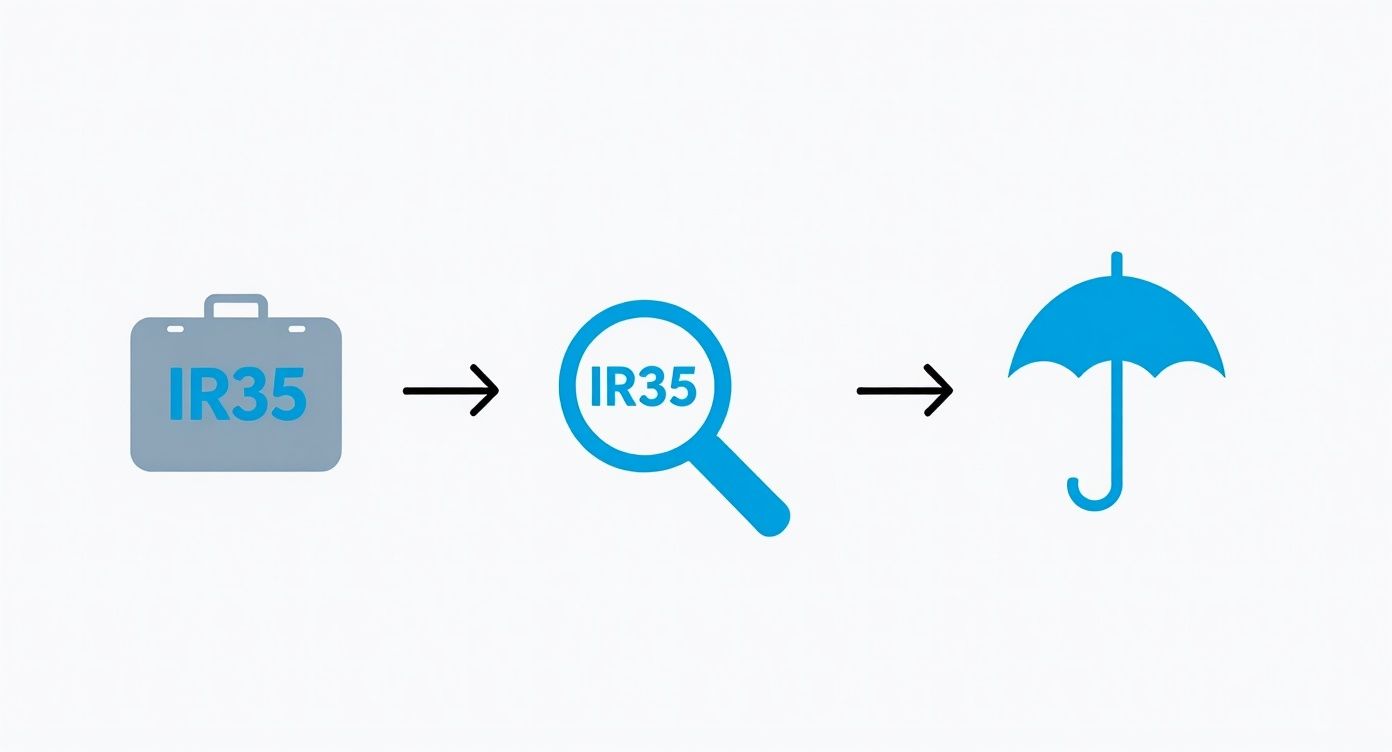
As you can see, the umbrella company becomes your official employer, taking the complex tax and legal responsibilities off your plate and the end client's.
From Assignment Rate to Gross Pay
Once the agency sends us the funds (the assignment rate), the first thing we do is deduct the employment costs. These are not your personal taxes; they are the statutory costs that any UK employer has to pay when they employ someone.
This is a critical point: these costs come off the top of the assignment rate before your gross pay is calculated.
These employment costs include:
- Employer’s National Insurance: The mandatory contribution every employer pays on their employees' earnings.
- Apprenticeship Levy: A UK tax paid by larger employers to help fund apprenticeship schemes.
- Our Margin: This is our fixed fee for running the payroll, handling all the administration, and being your employer of record. We take the same small amount each time we process your pay.
Negotiating your assignment rate is key. You need to make sure the rate is high enough to comfortably cover these legitimate employment costs and still leave you with the level of gross pay you are expecting. This is not a sneaky charge, it is the standard, compliant way all umbrella companies work.
What is left after these deductions is your gross pay. This figure is the equivalent of a permanent employee's salary, and it is the number your personal tax deductions will be based on. For a deeper dive into this, check out our guide on what happens if you're inside IR35.
From Gross Pay to Your Bank Account
Now that we have calculated your gross pay, the rest of the process is very straightforward. We process your salary exactly like any other employee in the UK, handling all your personal tax obligations and making sure everything is reported correctly to HMRC.
The deductions from your gross pay are the familiar ones:
- Income Tax: Taken at your marginal rate, based on your personal tax code.
- Employee’s National Insurance: Your personal contribution to the system.
- Pension Contributions: If you have opted into our workplace pension, this is where your contributions are deducted.
- Student Loan Repayments: If you have a student loan, these are deducted automatically based on your earnings.
The final figure, after all those deductions, is your net pay. You will often hear this called your "take-home pay", it is the amount that lands in your bank account on payday.
Example Umbrella Company Payslip Calculation
To put this all together, let’s look at a simplified, real-world example. Say you have agreed to a weekly assignment rate of £2,000. Here is how that would break down.
| Item | Calculation Example (£) |
|---|---|
| Assignment Rate Received | £2,000.00 |
| Less Employment Costs: | |
| Employer's NI Contribution | – £226.58 |
| Apprenticeship Levy | – £8.59 |
| Our Weekly Margin | – £25.00 |
| Your Gross Pay | £1,739.83 |
| Less Your Personal Deductions (PAYE): | |
| Income Tax | – £354.20 |
| Employee's NI Contribution | – £105.78 |
| Your Net Take-Home Pay | £1,279.85 |
(Please note: These figures are for illustration only. Your actual take-home pay will vary depending on your specific tax code, NI category, and other personal circumstances.)
This whole process is designed to ensure one thing: full compliance. By paying all employer and employee taxes and National Insurance at source, you can be confident that you are meeting all your obligations to HMRC. Once you understand this flow, you can look at any umbrella payslip and know exactly where every penny has gone.
Umbrella Company vs Agency PAYE
So, your contract has been deemed inside IR35. Now what? Typically, you will be faced with two main options for getting paid: joining an umbrella company or going onto the recruitment agency's own PAYE payroll.
Both routes will ensure your tax and National Insurance are handled correctly, but they offer very different experiences, particularly when it comes to your long-term contracting career. Choosing the right one really boils down to your personal circumstances and what you prioritise.
The Key Benefit: Continuity of Employment
Hands down, the single biggest advantage of using an umbrella company is achieving continuity of employment. When you join an umbrella, you become their employee. This means that even as you move between different contracts, clients, and recruitment agencies, your employer stays the same.
This creates one single, unbroken employment record, which is incredibly valuable when you need to prove a stable income for big life events. Think about things like:
- Applying for a mortgage
- Securing a personal loan
- Arranging other types of credit
If you go down the agency PAYE route, your employment technically begins and ends with each individual contract. This can leave you with a fragmented work history that might make lenders a bit nervous, potentially making it harder to get the green light for finance.
For career contractors juggling multiple short-term roles, that single, continuous employment record from an umbrella company is a game-changer for financial planning and stability.
A Comparison of Your Options
While both options get your taxes paid compliantly, the devil is in the detail. Agency PAYE can feel like the path of least resistance. After all, it is handled by the same people who found you the role. But an umbrella company is a specialist service built from the ground up for contractors like you.
Working with a dedicated umbrella provider gives you a consistent, single point of contact for all your payroll questions, no matter which agency or client you are working with. For contractors who plan to be in the game for the long haul, that simplicity is a huge plus.
To help you figure out what is right for you, let’s look at how the two options stack up for an inside IR35 assignment.
Umbrella Company vs Agency PAYE Inside IR35
Here is a side-by-side look at the key differences between the two main payroll models for inside IR35 contracts.
| Feature | Umbrella Company | Agency PAYE |
|---|---|---|
| Employment Status | You are a continuous employee of the umbrella company across multiple contracts. | You are an employee of the agency, but only for the duration of that specific contract. |
| Employment History | Provides a single, unbroken record of employment, ideal for mortgage or loan applications. | Creates a series of separate, short-term employment periods, which can be less appealing to lenders. |
| Statutory Rights | Full access to statutory rights like sick pay and holiday pay, which accrue over time. | Entitled to statutory rights, but they do not carry over between different agency contracts. |
| Pension | You can join one workplace pension scheme and contribute to it seamlessly across all contracts. | You may have to join a new pension scheme with each different agency, complicating your retirement savings. |
| Administrative Burden | One single employer means less paperwork when you switch roles. You deal with one HR and payroll team. | Requires new starter forms and paperwork for each new contract with a different agency. |
| Cost | A small, fixed weekly or monthly margin is deducted from the assignment rate for the service. | Typically no direct cost, but the assignment rate might be adjusted to cover the agency's administrative overhead. |
In a nutshell, agency PAYE is a perfectly fine, straightforward solution if you are just taking on a one-off contract. However, for contractors who value a stable employment record and want to keep their administration to a minimum, an umbrella company is almost always the smarter choice for managing a long-term career inside IR35.
How to Find a Compliant Umbrella Company
Choosing the right umbrella company is one of the most critical decisions you will make when contracting inside IR35. The market is packed with providers, and while the majority are perfectly legitimate, a small but dangerous minority run non-compliant schemes that could land you with a life-changing tax bill down the line.
Your financial security has to be the number one priority. Let’s walk through how to tell a reputable partner from a risky tax avoidance scheme, so you can make your choice with total confidence.

Look for Professional Accreditation
Honestly, the easiest way to draw up a shortlist of trustworthy providers is to check for accreditation from independent professional bodies. In the UK, the two names you need to know are the FCSA (Freelancer & Contractor Services Association) and Professional Passport.
These organisations put their members through rigorous, independent audits to make sure they meet the highest compliance standards. An accredited umbrella company has already proven that:
- They handle PAYE correctly and pay every penny of tax due to HMRC.
- Their processes are transparent and above board.
- They provide all the employment rights and statutory benefits you are entitled to.
Picking an accredited provider gives you a powerful layer of assurance that you are in safe hands. They have been externally audited and given the all-clear, which is why most recruitment agencies will only deal with accredited partners.
Using an accredited umbrella company is the gold standard for compliance. It signals that the provider has voluntarily submitted to a thorough audit of their business practices, demonstrating a clear commitment to operating lawfully and protecting contractors' interests.
Your Compliance Checklist
When you are sizing up a potential umbrella company for IR35, run it through this simple checklist. A compliant provider will tick every single box without a moment's hesitation.
- Transparent Payslips: Before you sign anything, they must give you a clear Key Information Document (KID). Once you are on board, you should get detailed payslips that break down every deduction. You need to see the assignment rate, all the employment costs, your gross pay, and every tax deduction clearly itemised.
- Realistic Take-Home Pay: A compliant umbrella company works out your pay using standard PAYE tax and National Insurance rates. If a company quotes a take-home pay figure above 70-75% of your contract rate, a huge alarm bell should be ringing.
- Clear and Simple Margin: The only fee a legitimate company should charge is a fixed weekly or monthly margin for their service. There should be no surprise joining fees, exit penalties, or other hidden costs.
- UK-Based PAYE: All your earnings must be processed through a standard UK PAYE system. Any mention of offshore accounts, loans, or weirdly complex payment structures is a massive red flag.
Red Flags of Tax Avoidance Schemes
Unfortunately, dodgy schemes are still out there, often luring contractors in with tempting but misleading promises. Knowing the warning signs is absolutely crucial for protecting your finances.
The single biggest giveaway is the promise of unrealistically high take-home pay, often advertised at 85%, 90%, or even 95%. These schemes are specifically designed to sidestep UK tax law and are aggressively pursued by HMRC.
Be on high alert if a provider mentions any of the following:
- 'Loans' or 'annuities': They might try to explain that part of your payment is a non-taxable loan, annuity, or some kind of credit facility. This is a classic disguised remuneration scheme, and HMRC will eventually come knocking for the unpaid tax.
- Splitting your pay: Your payment might be carved up into a small, taxed 'salary' and a much larger, untaxed payment that comes from a different entity, sometimes based offshore.
- Lack of transparency: They might get cagey about their payment structure, refuse to give you a full payslip reconciliation, or dodge direct questions about their compliance.
Getting involved with these schemes, even by accident, can be devastating. HMRC has the power to investigate your tax history going back years and can issue retrospective tax bills, plus interest and penalties, that can be financially crippling. At the end of the day, you are responsible for your tax affairs, so choosing a compliant partner is non-negotiable. Learn more about the importance of compliance by reading our guide on finding an FCSA accredited umbrella company.
The Risks of Non-Compliance and New Tax Rules
Working with a non-compliant umbrella company is not just a misstep; it is a direct and significant financial threat to you as a contractor. The fallout from getting tangled up in dodgy schemes can be severe, from disguised remuneration scams that leave contractors with life-changing tax debts to complex mini-umbrella company fraud that poisons the entire supply chain. It is vital to understand how these schemes work and why HMRC has them locked in its sights.

Disguised Remuneration: The Contractor's Nightmare
The most common trap is disguised remuneration. These schemes lure you in with promises of unbelievably high take-home pay, all by pretending that most of your earnings are not taxable income. They do this by paying you a tiny salary through PAYE and then funnelling the rest through some non-taxable method, often dressing it up as a ‘loan’, ‘annuity’, or ‘investment’.
Of course, this 'loan' is never meant to be repaid. It is simply a flimsy disguise to hide your real earnings from HMRC. The problem is, the tax liability does not just vanish into thin air. When HMRC inevitably uncovers these arrangements, it will come after you, personally, to pay back all the underpaid tax, plus interest and hefty penalties, often reaching back many years.
The buck stops with you. The responsibility for paying the correct tax ultimately rests with the individual. This is exactly why HMRC can chase you directly for unpaid taxes years down the line, even if you had no idea what was really going on at the time.
The Government Crackdown and New Regulations
The government and HMRC are taking firm action to stamp out these practices in the temporary labour market. Recent legislation has completely changed the game, placing far more responsibility on the entire supply chain, especially recruitment agencies. This is a huge reason why agencies are now so meticulous about vetting the umbrella companies they work with.
New rules can now make a recruitment agency jointly liable for any unpaid tax and National Insurance if the umbrella company they use fails to pay it. This legislative muscle is designed to clean up a sector affecting an estimated 700,000 individuals working through umbrella companies in the UK. The government's resolve was hammered home in the Spring 2024 budget, which allocated an extra £1 billion to HMRC to specifically hunt down tax evasion, with the umbrella sector named as a priority.
Why Vetting Your Umbrella Partner Is Now Non-Negotiable
This increased scrutiny and shared liability mean that reputable agencies will only work with fully compliant, accredited umbrella companies. They simply cannot afford the financial or reputational fallout from being linked to a dodgy provider.
Understanding these new rules is crucial for contractors. It explains why choosing a compliant umbrella company for IR35 contracts is more than just a box-ticking exercise; it is an essential move to protect your own finances and professional reputation. The off-payroll working rules have changed dramatically, and staying informed is your best defence. You can get up to speed in our detailed guide on what has changed with the IR35 reforms and off-payroll rules.
At the end of the day, working with a non-compliant provider is a gamble that simply is not worth taking. The promise of extra take-home pay is a mirage that can lead to devastating financial hardship. By understanding the risks and choosing a fully vetted, accredited partner, you ensure your contracting career is built on a secure and compliant foundation.
Common Questions About Umbrella Company IR35
Stepping into the world of umbrella companies and IR35 can feel like learning a new language. To help you feel completely confident, we have put together clear, straightforward answers to the questions we hear most often from contractors. The aim here is to cut through the jargon and give you a handy reference guide.
Does Using an Umbrella Company Mean I Am Inside IR35?
Yes, in a nutshell. An umbrella company is a payroll model built specifically for contractors whose work has been determined to be ‘inside IR35’. The whole point of the setup is to make sure you are taxed at source through PAYE, just as a permanent employee would be.
This is what satisfies HMRC’s requirements for inside-IR35 engagements. By becoming an employee of the umbrella company for the duration of your contract, you effectively sidestep the IR35 rules, as they no longer need to apply directly to you. It is the most common and compliant way to handle inside-IR35 work.
Can I Claim Expenses Through an Umbrella Company?
Generally, no. Since tax rules changed back in 2016, the ability for contractors to claim tax relief on things like daily travel and lunch has been heavily restricted. This is because HMRC views most contractors working this way as being under the Supervision, Direction, or Control (SDC) of their end client.
While there might be the odd, very specific circumstance where a legitimate business expense is claimable, it is extremely rare for the average contractor. Any compliant, trustworthy umbrella company will be crystal clear about this and will not dangle the promise of big tax savings through expenses.
Why Is Employer’s National Insurance Deducted from My Rate?
This is easily one of the most common points of confusion for contractors new to the umbrella company IR35 model. The ‘assignment rate’ you agree with your agency or client is not your take-home pay; it is an all-inclusive figure that has to cover every cost associated with hiring you.
This includes mandatory employer costs, like Employer’s National Insurance and the Apprenticeship Levy. The umbrella company gets this single payment and is legally required to deduct these statutory costs before calculating your gross pay for tax. A good provider will always show these deductions transparently on your payslip.
Think of the assignment rate as the total budget the client has set aside for your role. It is the full cost of having you on board, which naturally includes the employment taxes that any UK employer must pay. It is not your salary.
Is My Take-Home Pay Higher with an Umbrella Company?
Compared to being on an agency’s own PAYE payroll, your take-home pay through an umbrella company should be almost identical. The only real difference in your net pay will come from the small, fixed margin the umbrella company charges for running your payroll.
You should be extremely wary of any provider that promises significantly higher take-home pay, especially figures of 85% or more. This is the biggest red flag there is for a non-compliant tax avoidance scheme, which could land you in serious trouble with HMRC down the line.
Why Is Compliance So Important Now?
The UK government is cracking down on the unregulated parts of the umbrella industry. The scale of the problem is huge, with HMRC estimating that tax compliance failures in the sector could lead to £2.85 billion in unpaid taxes between 2025 and 2030. This figure highlights the deep-rooted issues of tax avoidance and fraud. In fact, HMRC data revealed that £500 million was lost to disguised remuneration schemes in 2022-2023 alone. You can read more about the taxman's perspective on the true cost of IR35 non-compliance on ContractorUK.com.
New rules now mean that recruitment agencies and others in the supply chain can be held liable for unpaid taxes. This means compliance is not just your problem anymore, it is a shared responsibility, making the choice of a fully vetted, accredited umbrella partner more critical than ever.
Trying to make sense of IR35 can be tough, but you do not have to figure it out alone. At UmbrellaCompany.com, we make it simple to find and compare trusted, compliant umbrella companies that fit your specific needs. Get started in just a minute and find your perfect match today.
Find your compliant umbrella company at https://umbrellacompany.com


