


When you sign up with a compliant UK umbrella company, you become their employee. It’s a simple change on paper, but it fundamentally shifts your rights, especially when it comes to paid holidays. In this guide, we will explain everything you need to know about your entitlement.
Crucially, your holiday pay is your own money, set aside from your assignment rate, and it is calculated at a very specific rate: 12.07% of your gross taxable pay. Understanding this is the first step to making sure you are always paid what you’re owed.
Your Right to Paid Holidays as a Contractor
The moment you join a reputable umbrella company, your status changes. You’re no longer just a contractor in the eyes of the law; you are officially an employee of that umbrella firm. This is a critical distinction, as it unlocks a whole host of statutory employment rights under UK law, with paid time off being one of the most important.
This is not an optional perk or a bonus. It is a fundamental part of your compensation package, guaranteed by the UK's Working Time Regulations 1998. These rules grant almost all workers 5.6 weeks of paid holiday each year. As an employee of the umbrella company, that right applies directly to you. Your holiday pay is simply an allocation of the funds you generate from your assignment, put aside to ensure you have a paid income even when you are taking a well-earned break.
The 12.07% Explained
You will see the figure 12.07% pop up everywhere when discussing umbrella company holiday pay. It might look a bit random, but it is not an arbitrary number. It’s the standard, government-approved formula for working out your statutory holiday entitlement.
Here’s how it’s calculated:
- A standard year has 52 weeks.
- Your statutory holiday entitlement is 5.6 weeks.
- This leaves 46.4 working weeks in the year (52 – 5.6).
To get the percentage, you just divide the holiday weeks by the working weeks (5.6 ÷ 46.4) and multiply by 100. The result? 12.07%. We then apply this percentage to your gross taxable pay to calculate the pot of money that funds your leave.

This calculation is rooted in official UK government guidance on holiday entitlement, which confirms the 5.6-week allowance for almost all workers. It reinforces the fact that paid holiday is a legal right, not a discretionary benefit. This protection is one of the key benefits of an umbrella company that contractors value.
Accrued vs Rolled-Up Holiday Pay
When you are contracting through an umbrella company, we can handle your holiday pay in one of two ways. It is important to understand the difference, because how you get paid for your time off will affect your cash flow and how you plan for breaks. The two compliant methods are accrued holiday pay and rolled-up holiday pay.
Neither one is inherently better than the other. The best choice really boils down to your personal financial habits and how you like to manage your money. Let's break down how each system works.
Understanding Accrued Holiday Pay
Think of the accrued method as a dedicated savings account for your holidays. With every payment you receive, we set aside 12.07% of your gross taxable income and hold it in a reserve. This pot of money grows with every week or month you work.
This is a brilliant way to budget. Because the money is kept separate, you are not tempted to dip into it as part of your regular income. When you decide to take a holiday, you simply ask us to release the funds, giving you an income stream while you are not working. It offers real peace of mind, especially if you are planning a longer trip or just prefer the discipline of having your holiday funds saved for you.
The accrued model is the most transparent and widely recommended approach by industry bodies. It ensures a clear separation between your regular earnings and your holiday funds, which is vital for both financial planning and legal compliance.
Essentially, this system mirrors how traditional employment works, you get paid for your holiday when you actually take it. It’s a straightforward and secure way to manage your entitlement.
What is Rolled-Up Holiday Pay?
Rolled-up holiday pay takes a different approach. Instead of putting your holiday funds aside, we add the 12.07% directly to your weekly or monthly pay packet. It is paid out to you straight away, and you will see it clearly marked as a separate item on your payslip.
The big plus here is the immediate boost to your cash flow. You get all your earnings as soon as you have made them, which can be a great help with day-to-day bills. The catch? It demands a lot more financial discipline. Since the money is not being saved for you, it is entirely up to you to put it aside to cover any time off you plan to take.
It is worth noting the legal backdrop. For a while, rolled-up pay was technically non-compliant after a European Court of Justice ruling. However, recent UK government reforms for irregular-hours and part-year workers have made it a legally sound option again, as long as it’s calculated correctly and shown transparently on payslips. You can find out more about how the whole payment process fits together in our guide on how umbrella companies work.
A Side-by-Side Comparison
To help you decide, here’s a direct comparison of the two methods. Your preference will likely come down to how you like to manage your finances.
Accrued Holiday Pay vs Rolled-Up Holiday Pay
| Feature | Accrued Holiday Pay (Paid When Taken) | Rolled-Up Holiday Pay (Paid Weekly/Monthly) |
|---|---|---|
| Cash Flow | Standard cash flow with a separate holiday fund building up. | Higher immediate cash flow as holiday pay is included in each payment. |
| Budgeting | Easier to budget for holidays as funds are automatically saved. | Requires strong personal discipline to save for time off. |
| Administration | Requires you to request payment when you take a holiday. | Simpler administration as payment is automatic with each payslip. |
| Best For | Contractors who prefer a structured saving plan for longer breaks. | Contractors confident in their financial discipline and who value cash flow. |
As you can see, the choice is about trading convenience and security for flexibility and cash flow. Make sure you choose an umbrella company that offers the method that best suits your needs.
How Your Holiday Pay Is Calculated
Getting to grips with how we work out your holiday pay is the best way to feel confident about your payslip. It can seem a bit complicated at first, but it is actually quite a straightforward process once you see it broken down. We will walk you through it, step-by-step, from your assignment rate right down to the final figure.
Let's use a simple, real-world example. Imagine you are a contractor on a £500 daily rate. When your agency pays us, that £500 is known as the assignment rate. It is the total pot of money that covers your pay and all the associated employment costs.
From Assignment Rate to Gross Pay
First things first, we need to get from that assignment rate to your gross taxable pay. These two figures are not the same thing. Your gross pay is what is left after we have handled all the legitimate, necessary employment costs.
Think of these as the standard costs any UK employer has to cover:
- Employer’s National Insurance Contributions (NICs): A legal requirement for all employers.
- The Apprenticeship Levy: Another statutory cost.
- Our Umbrella Margin: This is our small fee for managing your employment and payroll.
Once we deduct these from the initial £500 assignment rate, the figure we are left with is your gross pay. This is the crucial number because it is the baseline for calculating both your income tax and your holiday pay.
Applying the 12.07% Rule
With your gross pay sorted, the next bit is easy. We apply the standard holiday pay accrual rate, which is 12.07%. This specific percentage comes directly from the government and is the official way to work out the statutory minimum holiday entitlement of 5.6 weeks a year.
Let's stick with our example. After deducting the employment costs from your £500 daily rate, let's say your gross taxable pay for the day works out to £435.
To get your holiday pay, we just multiply your gross pay by that magic number:
£435 (Gross Pay) x 0.1207 = £52.50
And there you have it. For that day's work, you have earned £52.50 in holiday pay. This is then either tucked away in your holiday pot (accrued) or paid out with your wages, depending on which method you have chosen.
This simple diagram shows the two different paths your holiday pay can take.
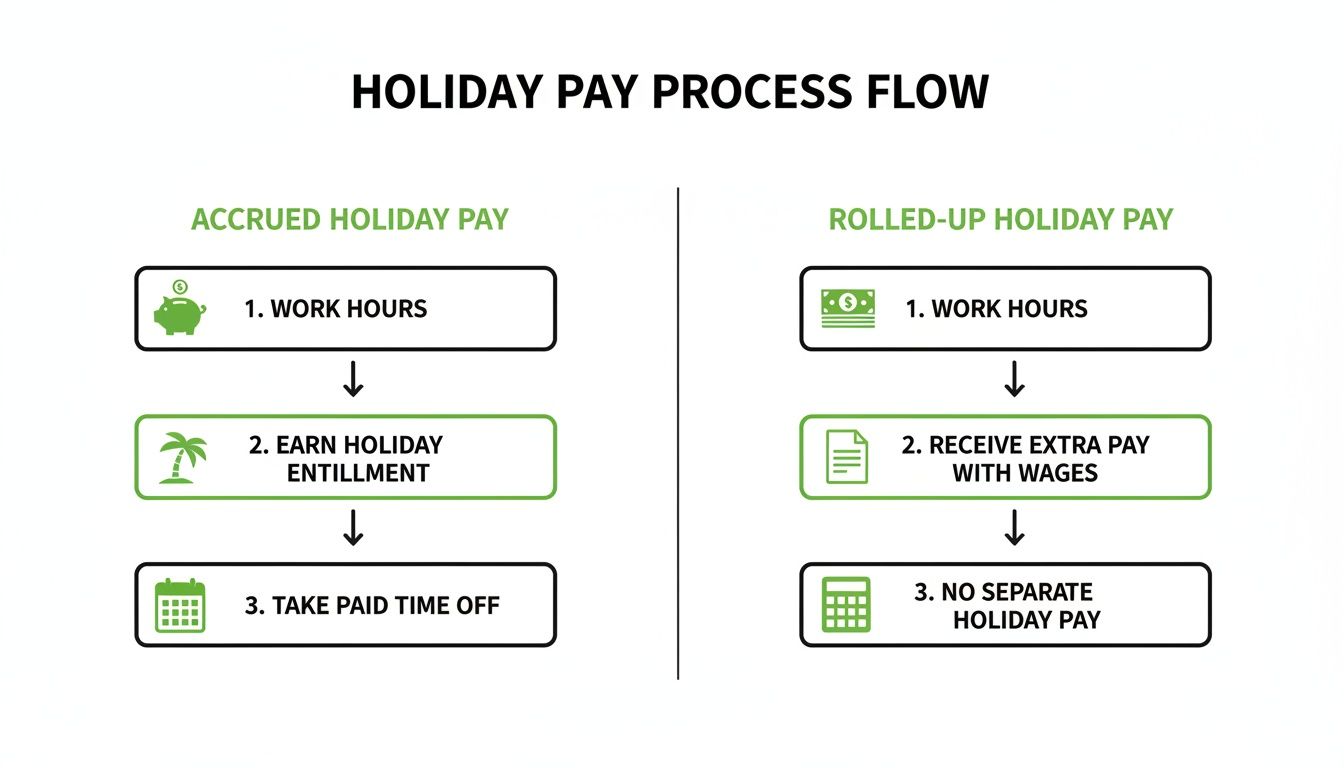
As you can see, it is either saved up for when you take time off or paid straight to you with your normal earnings.
A Step-by-Step Calculation Example
To bring it all together, let's run through the full calculation for a single day's work at £500. Just bear in mind these figures are for illustration, your actual deductions might vary slightly.
- Assignment Rate: We start with the full £500.
- Deduct Employment Costs: From this, we take our margin (say, £20) and the Employer’s NICs (e.g., £45).
- £500 – £20 – £45 = £435 (This is your Gross Taxable Pay).
- Calculate Holiday Pay: Now we apply the 12.07%.
- £435 x 12.07% = £52.50 (This is your Holiday Pay).
- Final Gross Pay Figure: That £52.50 of holiday pay is included within your total gross pay of £435. It is this total amount that your personal tax (PAYE) is calculated on. If you want to dig deeper into that side of things, we have a full guide on how PAYE is calculated.
This whole process is designed to be completely transparent, so you can see exactly where every penny goes.
How Other Factors Affect Your Gross Pay
It is also worth knowing that a few other things can influence your gross pay before the holiday pay calculation happens. These are usually voluntary deductions you might choose to make.
A common example is making pension contributions through a salary sacrifice scheme. Because those contributions are taken out before tax, they reduce your gross taxable pay. This means the amount of holiday pay for that period will be slightly lower, as it is being calculated from a smaller starting figure. It’s a perfectly normal and compliant part of the payroll process.
Once you understand each of these moving parts, you can be completely confident that we are calculating your holiday pay correctly, every single time.
The Impact of Tax and National Insurance on Your Holiday Pay
One of the most common questions we get from contractors is about how tax works with holiday pay. It’s a great question, and the answer is refreshingly simple: your umbrella company holiday pay is always treated as taxable income.
This means it’s subject to the same deductions as the rest of your earnings. It makes no difference whether you have your holiday pay set aside in a pot (accrued) or paid out with each payslip (rolled-up). When the money hits your bank account, it has already been processed through PAYE, with standard income tax and employee's National Insurance Contributions (NICs) deducted.
The best way to think about it is that your holiday pay is not some separate, tax-free bonus. It is an integral part of your gross taxable pay, which all stems from the assignment rate your agency pays to us. HMRC sees it as income, pure and simple, so it has to be taxed to keep everything compliant.
How Tax and NI Appear on Your Payslip
Your payslip will clearly show how these deductions are handled. When you receive a payment that includes holiday pay, you will not see separate tax lines for your regular pay and your holiday pay. Instead, they are bundled together into a single gross taxable income figure for that week or month.
PAYE income tax and employee's NICs are then calculated on this combined total.
- Gross Pay: This figure includes your standard earnings for the period plus any holiday pay being paid out.
- Deductions: The payslip will list deductions for PAYE tax and employee's NICs, which are calculated on the total gross pay.
- Net Pay: This is the final amount you take home after all deductions have been taken care of.
This unified approach makes sure the right amount of tax is paid, which means no nasty surprises or unexpected tax bills from HMRC later on.
The Role of Employer's National Insurance
Now, there’s one more piece to this puzzle: Employer's National Insurance. This is a statutory cost that every UK employer, including UmbrellaCompany.com, is legally required to pay on its employees' earnings. It’s crucial to know that this is deducted from the initial assignment rate we receive from your agency before we calculate your own gross pay.
The assignment rate is the total pot of money that has to cover all employment costs, Employer's NI, our margin, and then what’s left becomes your gross pay. So, while Employer's NI is not a tax on you, it does indirectly affect the total amount available to become your taxable income, which your holiday pay is then based on. You can get the full story in our detailed guide on what Employer's National Insurance contributions are.
The deduction of Employer's NI from the assignment rate is a standard, compliant practice across the industry. It is not a tax on you personally, but a cost of employment that is factored into the overall rate for the contract.
Understanding this helps you see the complete picture of your pay, ensuring there are no surprises when you check your payslip. Recent changes in tax policy have shown just how much these costs matter.
For instance, rises in Employer's NI can noticeably squeeze take-home pay, even while the 12.07% holiday pay entitlement remains a constant. A contractor on a £250 daily rate could see their weekly take-home pay drop by over £15 just from an Employer's NI hike, despite their holiday pay being handled correctly. It just goes to show how interconnected all these elements really are.
Ultimately, your holiday pay is a hard-earned part of your income. By understanding that it is subject to the same tax and NICs as your regular salary, you can budget with confidence and stay in complete control of your finances.
Common Holiday Pay Problems and How to Avoid Them
While most umbrella companies play by the rules, it pays to be aware of the potential pitfalls. Knowing the red flags can help you steer clear of dodgy schemes and make sure you get every penny of the umbrella company holiday pay you are legally entitled to.
Honestly, staying informed is your best line of defence. Once you understand how a compliant payroll should work, you will spot the providers cutting corners a mile off, protecting your hard-earned cash.

Unclear or Hidden Holiday Pay
One of the biggest red flags is a payslip where your holiday pay is impossible to find. Any compliant, trustworthy provider will always itemise your holiday pay, whether it is being accrued or paid out, as a distinct, separate line. Simple as that.
If your payslip just shows a single gross pay figure without a clear breakdown of the holiday pay element, you need to be asking questions. Immediately. This lack of transparency can be a sign of a disguised compliance scheme, where your holiday pay is effectively swallowed up by other figures, making it impossible to track.
Always remember: your holiday pay is your money. It is either held in trust for you or paid out directly. It should never be a mystery. A reputable umbrella will be proud to give you clear, detailed payslips that account for every penny.
Withholding Accrued Funds When You Leave
Another nasty surprise some contractors face is finishing an assignment only to find their umbrella company is unlawfully holding onto their accrued holiday pay. Let's be clear: under UK employment law, any outstanding holiday pay you have built up must be paid out in your final payslip.
Some non-compliant firms try to sneak clauses into their contracts saying you will lose any unused holiday pay if you do not claim it by a certain date or when you leave. These clauses are often completely unenforceable and a massive warning sign. Your accrued holiday fund is your legal entitlement, not a bonus the company can decide to pocket.
How to Protect Yourself from Holiday Pay Issues
The key to avoiding these headaches is being proactive. Before you sign on the dotted line, take a few simple steps to vet the provider and look after your own interests.
Here are four essential things you should always do:
- Request a full pay illustration: Ask for a detailed take-home pay calculation that clearly shows how they handle holiday pay. It should break down the assignment rate, all employment costs, your gross pay, and the holiday pay calculation itself.
- Check for accreditations: Look for providers who are accredited by respected, independent bodies like the FCSA (The Freelancer & Contractor Services Association) or Professional Passport. This proves they have been audited for compliance.
- Review their leaving policy: Read the terms and conditions carefully. Find the section that details what happens to your unused holiday pay when your contract ends. It should state, without ambiguity, that all accrued funds will be paid out to you.
- Question anything unclear: If you do not understand something in the contract or on a sample payslip, do not just let it slide. Ask for a clear explanation in writing before you commit to anything.
Ensuring National Minimum Wage Compliance
It’s not just about paying you what you’re owed; compliant umbrella companies also have to make sure your total pay, including holiday pay, always meets the National Minimum Wage (NMW) for every hour worked. And recent NMW increases have a direct impact on this.
For instance, the rise in the NMW forces agencies and umbrellas to adjust assignment rates to cover all their costs compliantly. As a detailed analysis from SafeRec points out, for a 40-hour week at the new NMW rate, the holiday pay component alone is nearly £60. This pushes the required assignment rate up significantly just to stay on the right side of the law. You can discover more insights about how the NMW impacts contractor pay on their blog.
This all reinforces why transparent accounting for holiday pay is not just good practice, it is a legal necessity.
Choosing a Compliant Umbrella Company
Now that you have got a solid grasp of umbrella company holiday pay, you’re in a much better position to pick the right partner for your contracting career. Getting this decision right from the start is the surest way to keep your finances safe and your employment rights protected.
Let's quickly recap the essentials. Paid holiday is not a perk; it is your legal right as an employee of an umbrella company. The standard, government-backed calculation of 12.07% is how the industry funds your statutory 5.6 weeks of annual leave. Whether you opt for accrued or rolled-up pay really comes down to what suits your own financial habits.
Key Questions for Potential Providers
To sort the good from the bad, you need to ask some direct questions before signing on the dotted line. A reputable umbrella will have no problem giving you straight answers. If you get vague responses or sense any hesitation, treat it as a massive red flag.
Here’s a checklist of questions to run by any umbrella company you are considering:
How will my holiday pay appear on my payslip? Always ask to see a sample payslip. A compliant provider will show holiday pay as a distinct line item, whether it is being set aside (accrued) or paid out with your wages.
What’s your exact process for paying out my accrued holiday funds when I leave? They should confirm immediately that all outstanding holiday pay will be in your final payslip. This is not just good practice; it’s a legal requirement.
Do I get a choice between accrued and rolled-up pay? While both methods are perfectly compliant, offering a choice is the mark of a flexible, contractor-focused provider. They should be able to clearly explain both options so you can decide what’s best for you.
Can you give me a full pay illustration based on my specific assignment rate? This breakdown should be crystal clear, showing every single deduction, their margin, employer's costs, and exactly how your gross pay and holiday pay are worked out.
Asking these simple questions upfront empowers you to find a partner you can trust. It’s the best way to make sure your contracting journey is both profitable and hassle-free.
Still Got Questions? Let’s Clear Things Up
It is natural to have a few lingering questions about how your holiday pay works. To make sure you are completely clear, here are straight answers to the queries we hear most often from contractors.
What Happens to My Holiday Pot If I Leave?
Simple: they have to pay it out. Any holiday pay you’ve built up but not yet taken must be paid to you in your final payslip. This is not a nice-to-have from the umbrella company; it’s a legal requirement in the UK.
Be very wary of any provider whose contract hints that you might lose this money for any reason. If you see a "use it or lose it" clause, that’s a massive red flag. Walk away.
Can an Umbrella Force Me to Take Rolled-Up Pay?
While rolled-up holiday pay is perfectly compliant and popular for its simplicity, a good umbrella company should give you the choice. Many contractors much prefer to let their holiday pay build up, creating a fund for when they actually want to take a proper break.
The best providers will walk you through both methods, accrual and rolled-up, and let you decide what works for your own financial habits. If they only offer one option with no flexibility, it might suggest a rigid, "one-size-fits-all" attitude that does not put contractors first.
Is It Always 12.07%?
For the most part, yes. The 12.07% figure is the standard because it directly translates to the legal minimum of 5.6 weeks of paid holiday per year. This is what nearly every UK contractor will see on their payslip calculations.
Occasionally, you might land a contract where the end client or agency offers a more generous holiday allowance. This is known as 'contractual' holiday pay and would mean a higher percentage is used. But for the statutory minimum that everyone is entitled to, 12.07% is the magic number.
Navigating umbrella company holiday pay does not have to be complicated, as long as you are with a provider that is transparent and plays by the rules. At UmbrellaCompany.com, we make it easy to compare accredited UK umbrella companies, so you can find a partner you can trust to protect your rights and pay you correctly. Every single time. Compare trusted umbrella companies with us today.


