


So, you have landed a contract and now you are staring at the paperwork, wondering what the best way to handle your pay is. This is where an umbrella company for contractors comes in. It is a simple, hassle-free way for independent professionals in the UK to get paid.
Think of it as a payroll service that slots in between you and your client, handling all the tricky bits like tax and National Insurance for you.
What Exactly Is an Umbrella Company?

At its core, an umbrella company employs temporary workers like contractors and freelancers for the duration of their fixed-term projects. Instead of going through the process of setting up your own limited company, the umbrella company simply becomes your legal employer.
This setup gives you the best of both worlds: the freedom that comes with contracting, but with the stability and rights of being a proper employee. We deal with all the admin, processing your pay through the PAYE (Pay As You Earn) system, just like any permanent staff member. This means you can be confident the right amount of tax and National Insurance Contributions are paid directly to HMRC on your behalf.
How the Model Works in Practice
The whole process is designed to be straightforward. You find your contract, you sign up with us, and we then sort out a contract with your recruitment agency or the end client. All you have to do is submit your timesheets, and we handle everything else.
This structure is a lifesaver for contractors whose work falls ‘inside IR35’, offering a fully compliant way to manage your earnings. To give you a clearer picture, here is who is involved in the chain:
- The Contractor (You): The expert doing the actual work for the client.
- The Umbrella Company: We employ you, run your payroll, and keep you on the right side of the taxman.
- The Recruitment Agency: The matchmaker who usually finds you the contract role.
- The End Client: The company where you are carrying out your assignment.
For anyone just starting your freelancing career, getting a grip on the admin side can be daunting. An umbrella company smooths out that transition beautifully.
By becoming an employee of the umbrella company, you gain a continuous employment record. This is a huge advantage, as it can make it much easier to apply for mortgages, loans, and other forms of credit.
In short, using an umbrella company takes the headache of tax law and company admin completely off your plate. It frees you up to focus 100% on what you do best, your actual job.
How Does the Payment Process Actually Work?
Understanding how money moves from your client to your bank account is key to feeling comfortable and confident as a contractor. The payment process when you are with an umbrella company for contractors is designed to be straightforward and transparent, taking all the admin headaches off your plate.
Just think of us as a central payroll hub. You do the work for your client, your agency gives it the nod, and we step in to handle all the tricky financial bits. It is a setup that guarantees you are paid correctly, on time, and are always fully compliant with HMRC.
In a way, the whole system is a great example of smart business process improvement methods. It takes a potentially messy chain of payments and turns it into a smooth, reliable service you can count on.
The Journey of Your Payment, Step by Step
So, what happens once you have finished your work for the week or month? From the moment you send off your timesheet to the cash landing in your account, there is a clear sequence of events that kicks into gear.
Here is a quick rundown of how it all unfolds:
You Submit Your Timesheet: First things first, you log the hours or days you have worked and send the record to your recruitment agency or client for approval. This is what gets the ball rolling.
The Agency Invoices the Client: Once your timesheet gets the green light, your agency sends an invoice to the end client for the work you have done.
The Client Pays the Agency: The client then settles up and transfers the payment to your recruitment agency.
The Agency Pays Us: Finally, the agency passes on those funds, your gross contract value, to us, your umbrella company. This is our cue to manage your payroll.
This infographic simplifies it even further, showing the three-step journey once we are in the picture.
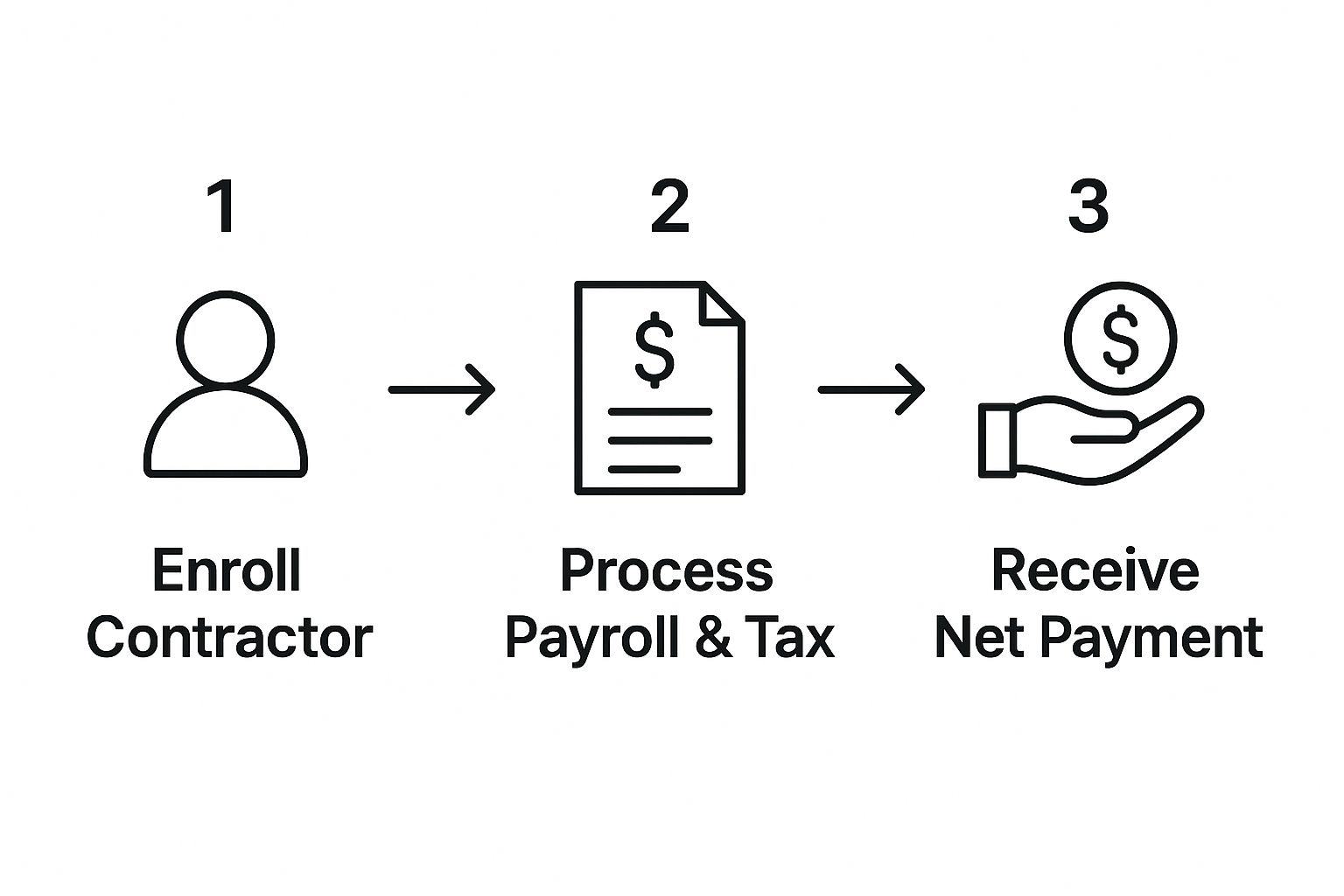
As you can see, we take care of the entire payroll and tax process after you are set up, making your experience as simple as checking your bank account for your net pay.
Calculating Your Take-Home Pay
As soon as the money from your agency hits our account, our payroll professionals get to work. We do not just pass the money on; we are acting as your official employer. That means we have a legal duty to make several important deductions on your behalf.
This is the most crucial part of the process, where your gross contract value is turned into your net take-home pay. It is worth knowing that all compliant umbrella companies follow the exact same PAYE (Pay As You Earn) rules set out by HMRC.
Transparency is non-negotiable. A good umbrella company will always give you a detailed payslip breaking down every single deduction from your gross earnings. There should never be any hidden fees or confusing charges.
So, what actually gets deducted? The calculations cover:
- Our Margin: This is our fee for running your payroll. It is a small, fixed amount, usually taken weekly or monthly, and it is the only income the umbrella company keeps.
- Employer's National Insurance: As your employer, we are required by law to pay this contribution to HMRC.
- Employer's Pension Contribution: If you are opted into a workplace pension, we will make this contribution for you.
- Apprenticeship Levy: This is a UK tax on employers that helps fund apprenticeship training schemes.
Once these employment costs are taken off, the remaining amount becomes your gross pay for tax purposes. From there, we deduct the standard employee contributions: your income tax and your employee National Insurance. The figure left over is your net pay, which we then transfer directly into your bank account. For a more detailed look, check out our guide on how umbrella companies work.
A Practical Payslip Example
Let's put some numbers to it to make things clearer. Say your weekly contract value is £1,000.
- Contract Value: £1,000
- Umbrella Margin: – £25
- Employment Costs (e.g., Employer's NI): – £115
- Gross Pay (for tax): £860
- Income Tax & Employee NI: – £180
- Net Pay to Your Account: £680
This simple example shows how your initial contract rate is processed to get to your final take-home pay. Every penny is accounted for, keeping you fully compliant and giving you a crystal-clear view of where your money goes.
Your Financial and Legal Protections

Contracting gives you incredible freedom, but it can sometimes feel like working without a safety net. This is where a compliant umbrella company for contractors really proves its worth, acting as a safe harbour that gives you the crucial financial and legal backing you need.
When you join a legitimate umbrella company, you become their employee. It is that simple. And with that comes a whole framework of statutory employment rights, a major advantage you just do not get as a limited company director or sole trader.
Gaining Full Employment Rights
One of the biggest perks is getting immediate access to the full range of rights that come with being an employee in the UK. This creates a solid foundation, freeing you up to concentrate on your actual contract work with real peace of mind.
These statutory entitlements include:
- Statutory Sick Pay (SSP): If you are too ill to work, you are entitled to SSP. It is a vital financial cushion when you need it most.
- Holiday Pay: You will build up paid time off based on the hours you work, meaning you can take those well-deserved breaks without watching your income disappear.
- Workplace Pension: We automatically enrol you into a workplace pension scheme. It is a straightforward way to save for the future, with contributions from both you and us as your employer.
- Statutory Maternity, Paternity, and Adoption Pay: If you are starting or growing your family, you are covered by these essential provisions.
This setup also creates a continuous employment record, which can be a game-changer for your personal finances. When you apply for a mortgage or a loan, lenders want to see stability. Having a single, consistent employment history with us makes that whole process much smoother.
Avoiding Non-Compliant Schemes
Sadly, the industry has its share of dodgy operators who try to tempt contractors with promises of ridiculously high take-home pay. These schemes often use disguised remuneration tactics, like paying you a tiny salary through PAYE and the rest as a tax-free 'loan' that nobody ever expects you to repay.
HMRC is crystal clear on this: tax avoidance schemes do not work. Getting involved, even accidentally, can leave you facing a massive, unexpected tax bill and penalties years down the road. It is always the individual contractor who is held liable for any unpaid taxes.
Knowing the red flags is your best defence. Be very wary of any company that:
- Promises take-home pay of 80%, 90%, or even more.
- Talks about payments through loans, annuities, or other strange-sounding methods.
- Is not upfront about their fee structure or has hidden charges.
- Lacks accreditation from respected UK bodies like the FCSA (Freelancer & Contractor Services Association) or Professional Passport.
The Scale of the Problem and Future Protections
The number of non-compliant schemes out there is a serious issue. Back in 2023, it was estimated that around 700,000 temporary workers in the UK were using an umbrella company. The worrying part? Roughly 39% of them were found to be mixed up with non-compliant providers, particularly in sectors like construction and care. To get a better handle on this, you can discover more insights about HMRC's response to umbrella company reform.
This is exactly why the UK government is finally cracking down. New legislation is on the way to tackle these fraudulent practices. The plan is to shift the responsibility for unpaid tax further up the supply chain, to the recruitment agency or even the end client. This move is all about making the entire chain more accountable and protecting contractors from being drawn into these risky arrangements.
By choosing a compliant and accredited partner like us, you can be sure you are never exposed to these risks. We operate with total transparency, guarantee we are fully compliant with HMRC rules, and give you the robust legal and financial protections you deserve as a professional.
Solving the IR35 Puzzle
If you are a contractor in the UK, you have almost certainly run into the term IR35. It's a piece of tax legislation that can seem needlessly complex, but an umbrella company offers a surprisingly simple, stress-free path forward, especially when your contract falls ‘inside IR35’.
When a contract is deemed 'inside IR35', it just means HMRC views your working relationship as being very similar to that of a permanent employee. As a result, your earnings have to be taxed in the same way, through the PAYE system. This is where an umbrella company steps in and makes life a whole lot easier.
Becoming an Employee by Choice
The moment you join an umbrella company, you officially become our employee for the duration of your contract. That one simple move is the key to unlocking full IR35 compliance.
As your official employer, we handle everything. We process all your payments through PAYE, making sure the correct Income Tax and National Insurance contributions are deducted and paid straight to HMRC. The compliance headache, which can be a real burden for independent contractors, is completely lifted from your shoulders. You get to just focus on doing great work for your client.
Limited Company vs Umbrella for Inside IR35
To see why this is such a good solution, it helps to look at the alternative. Imagine trying to run an inside-IR35 contract through your own limited company (often called a Personal Service Company or PSC). The administrative hoops you would have to jump through are significant.
You or your accountant would be stuck calculating a ‘deemed payment’, which essentially forces you to process most of your contract income as if it were a salary anyway. This wipes out the tax efficiencies that make a PSC attractive in the first place, leaving you with all the admin but none of the financial perks.
An umbrella company cuts through all that complexity. There are no deemed payments to worry about, no risk of getting the sums wrong. You just get a clear, compliant payslip every single time. It is genuine peace of mind.
This straightforward, clean approach is precisely why so many clients and recruitment agencies now prefer contractors to use an umbrella company for contractors when taking on inside-IR35 roles. It creates a transparent and low-risk setup for everyone involved.
Why It Provides Complete Peace of Mind
Ultimately, the goal is to let you concentrate on what you do best, without constantly looking over your shoulder at complex tax rules. IR35 was created to stop what HMRC calls ‘disguised employment’. By becoming a legitimate employee of an umbrella company, you are no longer in that grey area.
So, what does this mean for you day-to-day?
- Zero IR35 Risk: We are your employer, so we handle all the tax calculations. The risk of non-compliance is completely removed from you.
- No Complex Admin: You can forget about managing company accounts or calculating deemed salary payments for your inside-IR35 work.
- Guaranteed Compliance: You can work confidently, knowing you are paying the right tax and NI, just like any other employee in the UK.
This structure provides a secure and solid foundation for your contracting career. If you would like to dig deeper into the legislation itself, have a look at our guide that answers the question, what is IR35?. Using an umbrella company effectively solves the IR35 puzzle, turning it into a non-issue for your work.
The Real Benefits for Contractors
Opting for an umbrella company is not just about ticking a compliance box. For many UK contractors, it is a smart move that blends professional freedom with the kind of stability you would normally associate with a permanent job.
Think of it this way: you get to focus purely on your work and clients, while all the tedious admin and payroll complexities are handled for you. It strips away the headaches of running a business, leaving you with the best parts of contracting.
Ultimate Simplicity and Zero Admin
The most immediate win of using an umbrella company for contractors is the sheer lack of paperwork. Anyone who has looked into setting up a limited company knows just how much is involved.
You are suddenly responsible for company accounts, annual returns, corporation tax, and the fiddly rules around dividends. With an umbrella company, all of that just vanishes.
You do not need to be a director, an accountant, or a payroll expert. Your only administrative task is submitting your timesheet. We handle everything else, giving you back valuable time and energy.
Full Employment Rights and Protections
By becoming an employee of the umbrella company, you instantly gain all the statutory rights that come with traditional employment. This provides a crucial safety net that simply does not exist if you are a sole trader or limited company director.
Key employment benefits include:
- Statutory Pay: You are entitled to Sick Pay, Maternity Pay, and Paternity Pay, which offers a financial cushion during important life events.
- Holiday Pay: You accrue paid time off for every hour you work. Taking a well-earned break does not have to mean a complete loss of income.
- Workplace Pension: You will be automatically enrolled into a compliant pension scheme, helping you save for your future with employer contributions.
A Continuous Employment Record
Here is one of the most powerful, yet often overlooked, benefits: a continuous record of employment. As you move between different contracts and clients, your employer remains the same, the umbrella company.
This consistency is gold dust when you are applying for a mortgage or a loan. Lenders favour stability, and a seamless employment history makes you a much more attractive applicant. It can make a huge difference, smoothing out what is often a stressful process for independent workers.
Comparing Your Contractor Options
To help you see the bigger picture, it is useful to compare the different ways of working. Each path offers a different balance of flexibility, administrative responsibility, and financial management.
This table breaks down the key differences between using an umbrella company, running your own limited company, or operating as a sole trader.
| Feature | Umbrella Company | Limited Company (PSC) | Sole Trader |
|---|---|---|---|
| Admin Level | Very Low (timesheets only) | High (company accounts, tax returns) | Medium (self-assessment tax) |
| IR35 Risk | None (fully managed by us) | High (your responsibility) | High (your responsibility) |
| Employment Rights | Yes (full statutory rights) | No (director responsibilities) | No (self-employed) |
| Mortgage Applications | Easier (continuous employment) | More Complex (requires accounts) | More Complex (requires accounts) |
| Ideal For | Inside IR35 roles, simplicity | Outside IR35, higher earnings | Low earnings, simple business |
Ultimately, choosing an umbrella company is a vote for simplicity, security, and peace of mind. It provides a robust, compliant framework that supports your contracting career, letting you enjoy the flexibility you want with the stability you need.
How to Choose a Compliant Umbrella Company

Choosing the right partner is probably the most critical decision you will make in your contracting career. A compliant umbrella company for contractors gives you security and lets you focus on your work. Picking the wrong one, a non-compliant scheme, can land you in serious hot water with HMRC.
The key is knowing what to look for and, just as importantly, which red flags to run a mile from.
Your first line of defence is learning to spot the warning signs of a tax avoidance scheme. These organisations prey on contractors with promises that sound far too good to be true, because they are. If you see any provider advertising 85% or 90% take-home pay, be extremely wary.
These schemes work by using complex, non-compliant payment models. A common tactic is to pay you a tiny salary and disguise the rest as a "loan" or some other form of credit that you never actually repay. HMRC is cracking down hard on these arrangements, and it is always the contractor who ends up liable for the unpaid tax, often years down the line.
Vetting a Potential Provider
A legitimate umbrella company will always be transparent, professional, and properly accredited. They have nothing to hide and will welcome your questions. When you are sizing up potential providers, there are several clear indicators of good, compliant practice.
Here is a practical checklist to help you make your decision:
- Accreditation: Check for membership with respected UK bodies like the FCSA (The Freelancer & Contractor Services Association) or Professional Passport. These organisations carry out tough annual audits to make sure their members meet the highest compliance standards.
- Transparent Margin: The company should only charge a simple, fixed margin for its service. There should be no hidden fees, joining costs, or sneaky exit penalties. If the fee structure feels overly complicated, that is a major red flag.
- Clear Payslips: Ask for a sample payslip. It needs to clearly show all the statutory deductions, including income tax, employee’s and employer’s National Insurance, and the Apprenticeship Levy, alongside their margin.
- Positive Reviews: Have a look at independent review sites to see what other contractors are saying. A long track record of genuine, positive feedback is a great sign that you are dealing with a reliable company.
Key Questions to Ask Before Signing Up
Do not ever feel awkward about asking direct questions before you commit to an umbrella company. Their answers will tell you everything you need to know about their legitimacy and how they really operate.
A compliant provider will be happy to answer your questions clearly and directly. If you receive vague answers or feel pressured to sign up quickly, it is best to walk away.
Here are some essential questions to have ready:
- Are you accredited by the FCSA or Professional Passport?
- What is your exact weekly or monthly margin, and are there any other costs at all?
- Can you send me a full pay illustration based on my specific contract rate?
- What insurance cover is included as standard?
- How quickly will I be paid after I submit my timesheet?
By arming yourself with this knowledge, you can confidently choose a compliant partner who will protect your earnings and support your contracting career. For a closer look at what makes a provider compliant, explore our guide on finding a tax-efficient umbrella company in the UK.
Your Umbrella Company Questions Answered
To wrap things up, let’s tackle some of the most frequent questions we hear from contractors. Understanding these points is key to moving forward with confidence and making the right choice for your career.
Can I Still Claim Business Expenses?
This is a big one, and the short answer is: not usually for travel and food. Since 2016, the rules have become much stricter for contractors working through an umbrella company. You generally cannot claim tax relief on travel and subsistence expenses anymore.
It all comes down to something called Supervision, Direction, or Control (SDC). If someone at the client's site tells you how to do your work, where to do it, or when, HMRC considers you to be in a similar position to a permanent employee. Because of this, your daily commute and lunch costs are not seen as claimable business expenses. Any compliant umbrella company will stick to these HMRC rules, no exceptions.
What Is the Difference Between Agency PAYE and an Umbrella?
At first glance, they can seem similar because you get paid via PAYE with both. But there is a crucial difference. When you are on an agency’s PAYE, you are their employee only for that one contract. As soon as the work ends, so does your employment.
An umbrella company, on the other hand, offers continuity of employment. You remain our employee as you move from one contract to the next, even if you are working with different agencies. This creates a single, unbroken employment record, which is a massive help when you are applying for a mortgage or a loan. It shows lenders a stable history, plus you get a much better package of employment rights and HR support.
While agency PAYE is a simple payroll mechanism for a single assignment, an umbrella company offers a more robust employment solution for a long-term contracting career, providing stability and a broader range of benefits.
How Quickly Will I Get Paid?
We know that getting paid on time is a top priority for every contractor. The whole process is designed to be as quick and straightforward as possible. As soon as you have submitted your approved timesheet and we have received the money from your agency, we will process your payment, usually on the very same day.
Here is what a typical week looks like:
- You submit your timesheet (say, on a Friday afternoon).
- We receive funds from the agency (let's say by Wednesday).
- We run your payroll and send the money to your account (that same Wednesday).
This system ensures you get your net pay reliably and without delay, every single time.
Is There a Minimum Contract Length?
No, not really. The umbrella model is incredibly flexible, making it a perfect fit whether you are on a short-term gig for a few weeks or a major project that lasts for years. This adaptability is one of its biggest perks, letting you take on all sorts of roles without the hassle of changing your employment status.
Ready to find the perfect umbrella company for your needs? At UmbrellaCompany.com, we make it easy to compare trusted, accredited providers in just a minute. Find your ideal match today at https://umbrellacompany.com.


