


If you’re a contractor in the UK, getting your head around the relationship between an umbrella company and IR35 isn't just helpful, it's essential. Think of IR35 as HMRC’s way of checking whether you’re genuinely self-employed or, for tax purposes, a ‘disguised employee’. A compliant umbrella company offers a clear path forward, especially for contracts that fall 'inside IR35', by taking care of all your tax and National Insurance contributions for you.
Your Simple Guide to IR35 and Umbrella Companies

Anyone contracting in the UK eventually comes face-to-face with the off-payroll working rules, better known as IR35. It’s a piece of legislation that has fundamentally reshaped how many contractors handle their tax.
Introduced back in 2000 with major updates in 2017 and 2021, IR35 was created to stop tax avoidance. Its main job is to draw a clear line between legitimate freelancers and those HMRC sees as 'disguised employees'. As a result, fully compliant umbrella companies have become a go-to solution for many contractors, helping them stay on the right side of the rules and avoid any nasty surprises from HMRC.
What You Will Learn in This Guide
We've designed this guide to cut through the jargon and confusion. In it, we'll walk you through exactly how an umbrella company and IR35 fit together, giving you the clarity you need to make the best decisions for your contracting career.
Here’s a quick look at what we'll cover:
- Defining IR35: We’ll break down what 'inside' and 'outside' IR35 actually mean for your day-to-day work and pay.
- The Umbrella Solution: You'll see precisely how an umbrella company makes life simpler when you're working on a contract that's inside IR35.
- Choosing a Partner: You'll learn the key signs of a trustworthy umbrella provider and how to steer clear of dodgy, non-compliant schemes.
- Shared Responsibility: We'll explain how IR35 compliance isn't just on you; it involves everyone in the chain, from your end client to your recruitment agency.
Before we dive in, let’s quickly recap the core concepts you'll encounter.
Key IR35 Concepts at a Glance
This table provides a quick summary of the core terms related to IR35 legislation that every UK contractor should understand.
| Concept | What It Means for You |
|---|---|
| Inside IR35 | HMRC considers your contract to be one of 'employment' for tax purposes. You'll need to pay income tax and National Insurance Contributions, similar to a permanent employee. |
| Outside IR35 | Your contract is seen as genuine self-employment. You can operate through your own limited company and manage your own tax affairs, often more tax-efficiently. |
| Disguised Employee | This is HMRC’s term for a contractor who works in a way that is indistinguishable from a permanent employee but bills for their services through a limited company to reduce their tax liability. |
| Status Determination Statement (SDS) | The official document from your end client that declares whether your contract falls inside or outside IR35. They are legally required to provide this. |
Understanding these terms is the first step towards navigating the rules confidently.
By the end of this article, you’ll have a solid grasp of the landscape. For a deeper dive into the basics before we continue, have a look at our detailed guide on what IR35 is. Right then, let's get started on securing your financial future while you enjoy the freedom of contracting.
What IR35 Really Means for Your Contracts

Let's cut through the jargon. At its heart, the IR35 legislation (also known as the off-payroll working rules) is all about fairness. It’s designed to make sure that contractors who work in a very similar way to permanent employees pay roughly the same Income Tax and National Insurance.
This isn't an attack on genuine freelancers. Far from it. IR35 is simply HMRC's way of spotting what it calls 'disguised employees'. These are individuals who operate through their own limited company but whose day-to-day relationship with a client looks and feels just like traditional employment.
Getting your IR35 status right is critical. A wrong call can lead to a hefty, unexpected tax bill, so understanding where you stand is the first step to staying compliant.
The Three Key Tests of Employment
So, how do HMRC and your client decide if a contract is 'inside' or 'outside' IR35? They look past the paperwork to the reality of your working relationship, focusing on three core principles.
Think of it like hiring a self-employed plumber for a specific job versus hiring a full-time maintenance person. The same logic applies whether you're an IT consultant, a graphic designer, or a project manager.
Here's what they're looking for:
- Control: Who's really in the driving seat? If your client dictates how, when, and where you do your work, it points towards being inside IR35. Our genuine plumber decides the best way to fix the leaky pipe and fits the job into their own schedule. They're not told to start at 9 am sharp and take lunch at 1 pm.
- Substitution: Could you send someone else to do the job? A hallmark of a real business is the ability to send a qualified substitute in your place. If you must provide the service personally, it looks a lot more like employment. If our plumber is double-booked, they can send another qualified engineer from their firm to handle the job.
- Mutuality of Obligation (MOO): Is there an unspoken promise of more work? In a true contractor-client relationship, the engagement ends when the project is done. If the client is expected to keep offering you work and you're expected to take it, that suggests an ongoing employment relationship, not a series of distinct projects.
These aren't the only factors, but they form the bedrock of any IR35 assessment. For a deeper dive, our guide on how to tell if you're inside or outside IR35 has more detailed examples.
Who Makes the IR35 Decision
This is where things have really changed. Following reforms in 2017 (for the public sector) and 2021 (for the private sector), the decision is no longer on your shoulders. For most contracts with medium and large companies, the end-client is now responsible for determining your IR35 status.
They must carry out an assessment and issue a Status Determination Statement (SDS).
The SDS is the official document that states whether your contract falls inside or outside IR35. Your client is legally required to show 'reasonable care' in making this decision and must share the outcome with both you and the party that pays you (like a recruitment agency).
This shift was a game-changer. It means clients now have skin in the game, as they hold the liability if they get the assessment wrong.
Inside vs Outside: What It Means for Your Pay
The result of that SDS directly shapes how you get paid and who handles the tax.
- Inside IR35: Your contract is treated like employment for tax purposes. This means the 'fee-payer' (usually your agency or the client) has to deduct PAYE tax and National Insurance contributions before you receive your money. This is exactly where an umbrella company fits in perfectly, acting as your employer and managing all these deductions compliantly.
- Outside IR35: You're operating as a genuine, independent business. You can continue to work through your own limited company (often called a Personal Service Company or PSC) and you're responsible for managing all your own business taxes. For anyone on this path, understanding independent contractor agreements is a non-negotiable first step.
Ultimately, your IR35 status defines the entire financial and legal framework of your contract. It's one of the most important things to get your head around as a modern UK contractor.
How an Umbrella Company Solves the IR35 Puzzle
When a contract is determined to be 'inside IR35', it can feel like you’ve been handed a complex puzzle with no instructions. The good news is that a compliant umbrella company offers a remarkably simple solution, effectively taking the puzzle right off your desk.
The core of it is this: when you join a reputable umbrella provider, you become our employee. That one change fundamentally alters the entire contractual chain and your relationship with IR35.
Instead of your limited company contracting with an agency, the umbrella company steps into the middle. We sign a contract with your recruitment agency (or the end-client), and you sign a contract of employment with us. This creates a clean, direct employment relationship that HMRC understands and accepts.
The Practical Steps from Timesheet to Payslip
Once this structure is in place, the process is designed to be seamless, taking all the administrative weight off your shoulders. You get to focus on doing great work for your client, and we handle the rest.
The mechanics are very direct. You complete your work, submit your timesheet to us and the agency for approval, and we take it from there.
This process essentially transforms what would be complex contractual invoicing into a simple payroll function. Here’s a quick look at the journey your payment takes from the client to your bank account.
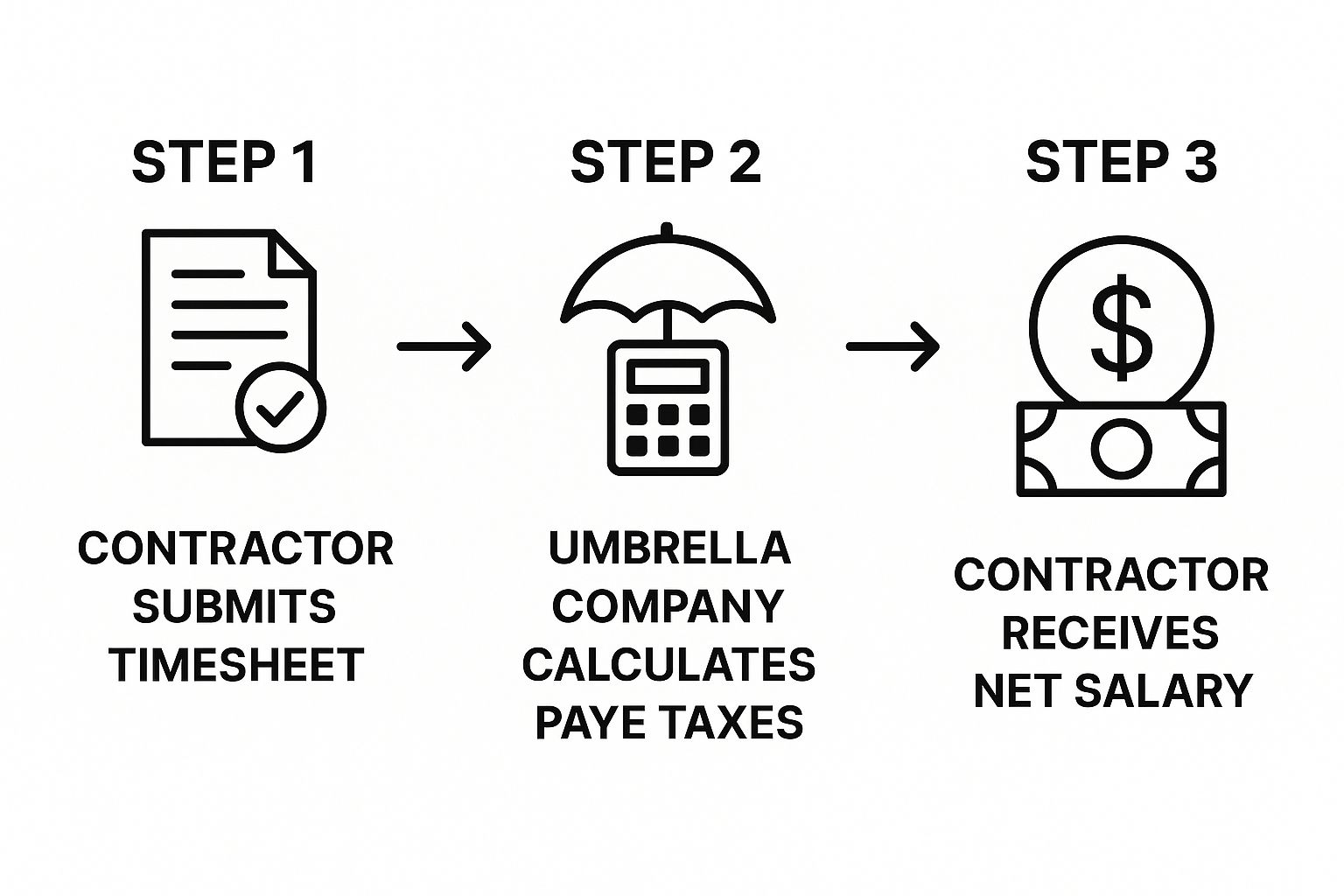
As you can see, your main responsibility is simply logging the hours you've worked. We handle everything else.
Your Status as an Employee
By becoming an employee of the umbrella company, the whole question of IR35 becomes moot for your engagement. The 'disguised employee' test is no longer relevant because you are now an actual, acknowledged employee of the umbrella.
We take care of all the necessary deductions, including:
- Income Tax (PAYE)
- Employee's National Insurance Contributions
- Employer's National Insurance Contributions
- Apprenticeship Levy
- Holiday Pay entitlement
- Pension contributions
All of this is clearly itemised on your payslip, giving you total transparency and the peace of mind that your taxes are being handled correctly. This structure is exactly why many ask if IR35 even applies when working through an umbrella company. The simple answer is that your employment status removes the ambiguity that IR35 was created to address.
The Rise of Umbrellas and the Need for Caution
Recent shifts in the IR35 rules have cemented umbrella companies as a key part of the UK's flexible workforce. Their use shot up after the off-payroll working reforms. In fact, by 2022–2023, an estimated 700,000 workers were engaged through umbrella companies, showing just how crucial they are for managing contractor payroll.
However, this rapid growth has also attracted some non-compliant operators. Worryingly, reports suggest that at least 275,000 of these workers were involved with tax avoidance schemes. These arrangements create huge risks for contractors and lead to substantial losses for HMRC, which is why compliance is now under a much brighter spotlight.
Working through a compliant umbrella company removes the risk and administrative headache of IR35 compliance from you, your agency, and your end-client. It provides a robust, transparent framework that satisfies HMRC’s requirements.
This provides security for the entire supply chain. End-clients and recruitment agencies can confidently engage contractors for inside-IR35 roles, knowing that all tax and employment duties are being managed properly. In essence, the umbrella company acts as the compliant payroll department for your assignments, letting you enjoy the freedom of contracting with the stability of employment.
Choosing a Compliant Umbrella Company You Can Trust

While an umbrella company is a brilliant solution for inside IR35 contracts, the market isn't without its pitfalls. The biggest danger by far comes from non-compliant providers, which are often just disguised tax avoidance schemes.
These dodgy setups can leave contractors like you facing huge, unexpected tax bills and penalties from HMRC years down the line. Protecting yourself starts with knowing how to spot the red flags and understanding what genuine compliance actually looks like.
Making an informed choice is the single most important step you can take to safeguard your financial future. It's what ensures your relationship with an umbrella company and IR35 rules is secure and free from stress.
Spotting the Red Flags of Non-Compliance
A compliant umbrella company operates in a very straightforward way. It deducts income tax and National Insurance Contributions via PAYE, just like any other UK employer. Any provider that deviates from this model should be treated with extreme caution.
If something sounds too good to be true, it almost certainly is. Promising take-home pay of 85% or more is a classic warning sign that a scheme is not legitimate.
Here are the most common warning signs to watch out for:
- Unrealistically High Take-Home Pay: Any promise of keeping more than 75-80% of your contract value is a major red flag. It usually means not all of your income is being correctly declared for tax.
- Complex Payment Structures: Be wary of arrangements that split your pay into a tiny salary and a much larger, non-taxable payment. These are often disguised as 'loans', 'annuities', or 'bonuses', which are creative labels that are not HMRC-approved.
- Offshore Payments: If any part of your payment is routed through an offshore account (for example, in the Channel Islands or Isle of Man), this is a clear sign of a potential tax avoidance scheme. All your payments should come from a UK-based company.
- Lack of Transparency: A trustworthy provider will give you a clear illustration of your pay, detailing every single deduction. If a company is vague about its margin or how it calculates your payslip, you should be suspicious.
The Gold Standard: Accreditation Bodies
So, how can you be certain a provider is legitimate? The most reliable way is to check for accreditation from a recognised, independent professional body. In the UK, the two most respected organisations are the FCSA and Professional Passport.
These bodies act as the industry's watchdogs. They conduct rigorous, independent annual audits to ensure their members stick to the highest standards of compliance and follow all relevant HMRC regulations.
Choosing an umbrella company that is accredited by the FCSA or Professional Passport is the best way to protect yourself. It provides independent verification that the provider is operating legally and ethically, giving you complete peace of mind.
These accreditations aren't just a badge; they're a guarantee of compliance. They confirm that the umbrella company’s internal processes, contracts, and payment calculations have been thoroughly vetted by third-party experts.
Why Accreditation Matters
Working with an accredited provider protects everyone in the supply chain. It assures your recruitment agency and end-client that you are engaged compliantly, which is becoming more and more important as HMRC cracks down.
Think of it as a quality seal. It signifies:
- Verified Compliance: The company has passed a strict audit against UK tax and employment laws.
- Financial Stability: Accredited members must prove they are financially robust.
- Transparent Operations: They are committed to providing clear payslips and honest communication.
At UmbrellaCompany.com, we only partner with accredited providers. We believe it's a non-negotiable standard for anyone serious about contracting safely. To learn more, check out our comprehensive guide on choosing the right umbrella company for contractors. Making this one check is the simplest way to avoid future trouble with HMRC.
Understanding Your Role in the Supply Chain
Getting your head around IR35 isn't just a contractor's problem anymore. It's a shared headache that ripples right through the entire supply chain. Recent rule changes have really shaken things up, putting a huge emphasis on everyone being compliant and making your choice of umbrella company more important than ever.
The big shift happened with the off-payroll reforms in 2017 for the public sector and 2021 for the private sector. Before then, it was up to you, the contractor, to figure out your IR35 status. Now, that responsibility has been dumped squarely on the end-client for most contracts.
This was a game-changer. Suddenly, clients became liable for getting it wrong, which explains why so many now take a very cautious approach. It’s the reason you'll see many organisations insisting that contractors work through a compliant umbrella company for any role deemed 'inside IR35'.
HMRC Is Turning Up the Heat
And it looks like things are about to get even stricter. You need to understand this bigger picture, because it shows why clients and agencies are now scrutinising their partners so carefully. A dodgy umbrella company isn't just a risk to you; it's a liability for everyone involved in your contract.
HMRC is now introducing a concept called ‘joint and several liability’ to force compliance all the way down the line. What this means, in simple terms, is that if a non-compliant umbrella company skips out on paying the correct PAYE tax and National Insurance, HMRC can come knocking on other doors to collect the debt.
That debt could land on the recruitment agency that placed you, or even the end-client you did the work for. It’s a massive incentive for every single business in that chain to make absolutely sure their partners, especially payroll providers, are playing by the rules.
This new legislation is set to kick in from April 2026. It’s a major development that could hit sectors like IT recruitment particularly hard, where contracting is the norm. Research suggests only about a third of agencies are currently auditing their umbrella partners, so there’s a real scramble on to get their houses in order. You can learn more about how HMRC’s tax liability shift is creating new financial risks for recruitment agencies and what it means for the industry.
Who Is Responsible for IR35 Determination?
So, who actually has to make the call on your IR35 status? It really depends on who you're working for. The rules are different for small private companies versus larger organisations and the public sector.
The table below breaks down exactly where the responsibility lies.
| Sector | Client Size | Who Determines IR35 Status |
|---|---|---|
| Public | All sizes | The public sector client |
| Private | Medium or Large | The end-client |
| Private | Small (meets 2 of 3 criteria) | The contractor’s own Personal Service Company (PSC) |
| (i.e., turnover < £10.2m, balance sheet < £5.1m, employees < 50) |
As you can see, unless your client is a genuinely small private business, the decision is out of your hands. This is why understanding the rest of the supply chain's perspective is so crucial.
What This All Means for You
Believe it or not, all this extra scrutiny is actually good news if you're a diligent contractor. It means the best clients and agencies are actively weeding out the cowboys and will only work with accredited, transparent umbrella companies.
When you choose a compliant provider, you’re not just covering your own back. You’re making yourself a more attractive, lower-risk option for the top-tier contracts.
Think of it this way: compliance is a team sport now. By picking a fully vetted, accredited umbrella company, you’re showing everyone in the supply chain that you’re a professional who takes this seriously. That protects them and cements your own reputation.
This is exactly why most agencies maintain an Approved Supplier List (ASL). These are the umbrella companies they’ve already checked out and trust. To get on that list, an umbrella almost always needs accreditation from bodies like FCSA or Professional Passport.
By choosing one of them from the get-go, you ensure you can work with the best agencies without any compliance hiccups, keeping your career on track. Your choice directly affects everyone’s peace of mind.
Making the Right Choice for Your Contracting Career
Getting your contracting career right comes down to two things: a solid grasp of IR35 and knowing how a compliant umbrella company operates. We’ve seen that IR35 is simply HMRC’s way of ensuring fair taxation, and a properly accredited umbrella is the safest way to get paid for any contract that falls 'inside IR35'.
If you take only one thing away from this guide, let it be this: do your due diligence. Who you choose to handle your payroll isn't a small decision; it has a real impact on your financial health and your professional reputation.
Your Final Checklist for Compliance
The simplest, most effective check you can do is to only partner with an umbrella company that holds a current accreditation from a respected professional body, like the FCSA or Professional Passport. This is your first line of defence against dodgy tax avoidance schemes.
It’s a step that protects you, your recruitment agency, and even your end-client from the hefty financial penalties that come with getting it wrong. Verifying that accreditation means you're working with a provider that has been independently audited and confirmed to operate legally and above board.
The right choice provides peace of mind, allowing you to focus on your work, confident that your tax affairs are being managed correctly and transparently.
Building a Secure and Flexible Career
Armed with the knowledge from this guide, you can now make confident decisions that keep your career both flexible and secure. Understanding the link between an umbrella company and IR35 gives you the power to spot compliant partners and steer clear of the pitfalls.
Of course, a successful contracting career isn't just about the tax technicalities. It’s also built on strong professional relationships, which often starts with effectively communicating with recruiters to land the best roles for your skills.
If you ever find yourself unsure about a provider or just need a hand finding a fully compliant umbrella solution, our team at UmbrellaCompany.com is here to help. We are committed to giving you the clarity and support you need to thrive.
Your Top Questions Answered
When you're a contractor, the world of IR35 and umbrella companies can feel like a bit of a minefield. It’s no surprise we get a lot of questions. Let's clear up some of the most common ones.
Can I Still Use My Limited Company for an Inside IR35 Job?
Technically, yes, but in reality, it's rarely worth the hassle. Once a contract is classed as 'inside IR35', your client or agency has to deduct tax and National Insurance from your payment before it even hits your company bank account.
This is called a 'deemed payment', and it completely wipes out the tax advantages of running a limited company in the first place. For inside-IR35 roles, a compliant umbrella company is a much cleaner, simpler option. They’re built specifically to handle PAYE, taking all that complex admin off your plate.
What if I Think My Client Got My IR35 Status Wrong?
If you're convinced your client has made the wrong call on your IR35 status, you have every right to challenge it. The first port of call is always to have a direct conversation with them.
You’ll need to put a case together showing why your working practices point to an 'outside IR35' role. Focus on the key tests: control, substitution, and mutuality of obligation. By law, your client must have a proper dispute process and get back to you within 45 days. If they stand by their decision, you're left with a choice: either take the contract on an 'inside' basis or decide to walk away.
How Do Expenses Work When I'm with an Umbrella Company?
This is a big one, and something that dodgy providers love to get wrong. As an employee of an umbrella company, you play by the exact same expense rules as any other employee in the UK.
The golden rule to remember is that you almost never get tax relief on your daily commute to the journey from your home to your regular workplace. Legitimate business expenses, like travel to a one-off client site or the cost of specific training, can be claimed, but only if they meet HMRC’s strict criteria.
A good, reputable umbrella company will be upfront and honest about what you can and can't claim. They'll keep you compliant and safe from future tax headaches, and they will never, ever suggest you claim for your everyday travel.
How Can I Be Sure an Umbrella Company Is Actually Compliant?
This is probably the most important question you can ask. Thankfully, the answer is pretty simple. The safest bet is to pick a provider that has been officially accredited by a recognised professional body.
In the UK, the two names to look for are the FCSA (The Freelancer & Contractor Services Association) and Professional Passport.
These organisations put their members through tough, independent audits to make sure they're following every HMRC rule and sticking to industry best practices. You can find a list of their approved members right on their websites. And a final tip: if any provider dangles a take-home pay figure that looks too good to be true, like 85% or more, run a mile. It’s the clearest red flag there is for a tax avoidance scheme. Checking for accreditation is your best line of defence.
At UmbrellaCompany.com, we connect you with fully accredited and compliant umbrella companies to ensure your contracting career is safe and secure. Find your perfect umbrella solution with us today!


