


So, what exactly does "umbrella companies meaning" refer to? Think of it as a central payroll service for contractors. It’s an organisation that employs you, the contractor, under a proper contract of employment. This allows you to work on various temporary assignments for different clients without the administrative burden of running your own limited company.
We handle all the administrative heavy lifting, like processing your pay and making sure your PAYE tax and National Insurance contributions are correctly paid to HMRC. In this guide, you will learn what an umbrella company does, why they are so common, how to read your payslip, and how to choose a compliant partner for your contracting career.
What Does an Umbrella Company Actually Do?

Let's break down how this works in practice. The umbrella company becomes your official employer, creating a vital legal link in the contracting chain between you, your recruitment agency, and the end client you are working for.
Instead of you sending an invoice to your agency or client, the agency pays the umbrella company for the work you have done. The umbrella company then processes this payment, deducts the necessary taxes through PAYE (just like a standard employee), and pays the rest to you as a salary.
The Contracting Process Simplified
This whole setup creates a clean, compliant, and straightforward process for everyone involved. You find a contract and agree on your rate. Then, you join an umbrella company, which signs a contract with your agency while you sign an employment contract with the umbrella.
The benefits for you as a contractor are clear:
- Total Compliance: All your taxes, National Insurance, and other statutory payments are calculated and paid directly to HMRC for you. No more tax-return stress.
- Continuous Employment: You might jump between different clients and projects, but you stay employed by one company. This creates a solid, unbroken employment history.
- Employee Rights: As a legal employee of the umbrella, you get access to statutory rights like sick pay, holiday pay, and a workplace pension.
At its core, an umbrella company exists to take the complex administration and tax worries off your plate. This frees you up to focus on what you do best: delivering great work for your clients.
To make this even clearer, here is a simple breakdown of how the process flows and who does what.
The Umbrella Contracting Process At a Glance
| Step | Who Is Responsible | What Happens |
|---|---|---|
| 1. Find a Contract | You (The Contractor) | You secure a new contract role through a recruitment agency. |
| 2. Join an Umbrella | You & Umbrella Company | You register with a compliant umbrella company and sign an employment contract. |
| 3. Sign Contracts | Umbrella & Agency | The umbrella company signs a business-to-business contract with your agency. |
| 4. Submit Timesheets | You (The Contractor) | You complete your work and submit your approved timesheets to the agency/umbrella. |
| 5. Agency Pays Umbrella | Recruitment Agency | The agency invoices the end client and pays the gross funds for your work to the umbrella. |
| 6. Umbrella Pays You | Umbrella Company | The umbrella processes your payroll, deducts all taxes and its margin, and pays you a net salary. |
As you can see, the relationships are clear and designed to keep everything compliant and above board.
Why This Matters for You
Having a continuous record of employment is a huge plus, especially when you need to apply for a mortgage or a loan. Lenders value the stability it demonstrates, which can be a real hurdle for independent professionals.
On top of that, you can say goodbye to chasing invoices, managing company accounts, or filling out a Self-Assessment tax return. If you want to dig deeper into the nuts and bolts, you can learn more about how an umbrella company works in our detailed guide.
Ultimately, an umbrella service offers the best of both worlds: the freedom and flexibility of contracting, combined with the administrative simplicity and security of being an employee.
Why Are Umbrella Companies So Common in UK Contracting?
The explosion in popularity of umbrella companies is not just a random trend. It is a direct consequence of huge shifts in UK tax law that have reshaped the contracting landscape. For many, they have become an essential part of the flexible workforce, acting as a vital link between skilled contractors and the clients who need them.
Their importance really took off after the government overhauled the IR35 off-payroll working rules. These reforms, rolled out in 2017 for the public sector and then across the private sector in 2021, completely changed how contractors could be hired.
The IR35 Effect
Before these changes, it was up to you, the contractor, to decide your own IR35 status. The new rules flipped that on its head, shifting the responsibility (and the risk) onto the end client for most engagements.
Faced with the threat of massive tax bills for getting it wrong, many organisations became nervous about hiring contractors through their own limited companies. This created a sudden, massive need for a simpler, less risky way of working. Umbrella companies stepped in to fill that gap perfectly. By employing contractors directly, they take the entire IR35 headache away from the client and ensure all tax and National Insurance is handled correctly through PAYE.
This legislative shift is the single biggest reason why understanding what an umbrella company does is so critical for any modern UK contractor. It turned them from a niche service into a mainstream necessity for getting onto many projects.
The Sheer Scale of the Umbrella Market
The move towards umbrella employment has been huge. In fact, government estimates suggest that at least 700,000 temporary workers were paid via an umbrella company in the UK during 2022-23. That figure alone shows just how deeply embedded they are in the contracting world, supporting a workforce that keeps the UK economy ticking. You can explore the rise of umbrella companies in this insightful article to get a sense of the scale.
This model is now the go-to for thousands of recruitment agencies and end clients who need to prioritise compliance and keep their administration simple. It has created a reliable system that lets businesses bring in flexible talent without getting tangled up in complex tax legislation.
This means for many contractors, using an umbrella is no longer just an option, it is often a requirement for landing the best roles. It gives everyone in the chain peace of mind, from the client to the agency to the contractor. For a closer look at the specific advantages this offers, check out our guide on the benefits of using an umbrella company. Ultimately, this structure ensures everyone is playing by the rules while keeping the UK's flexible labour force in motion.
How to Understand Your Umbrella Payslip
Your first payslip from an umbrella company can look a bit confusing at first glance, and that is perfectly normal. The most important thing to get your head around is that the assignment rate you agreed with your agency is not your take-home pay. Think of it as a larger, all-inclusive figure that has to cover both your gross pay and all the costs of employment.
A traditional employer handles these costs behind the scenes, but with an umbrella company, they are all laid out transparently on your payslip. This includes things like Employer’s National Insurance and the Apprenticeship Levy, which are legal requirements for any UK employer.
This timeline gives you a sense of how legislative changes, particularly around IR35, have shaped the contracting world and the deductions you now see.
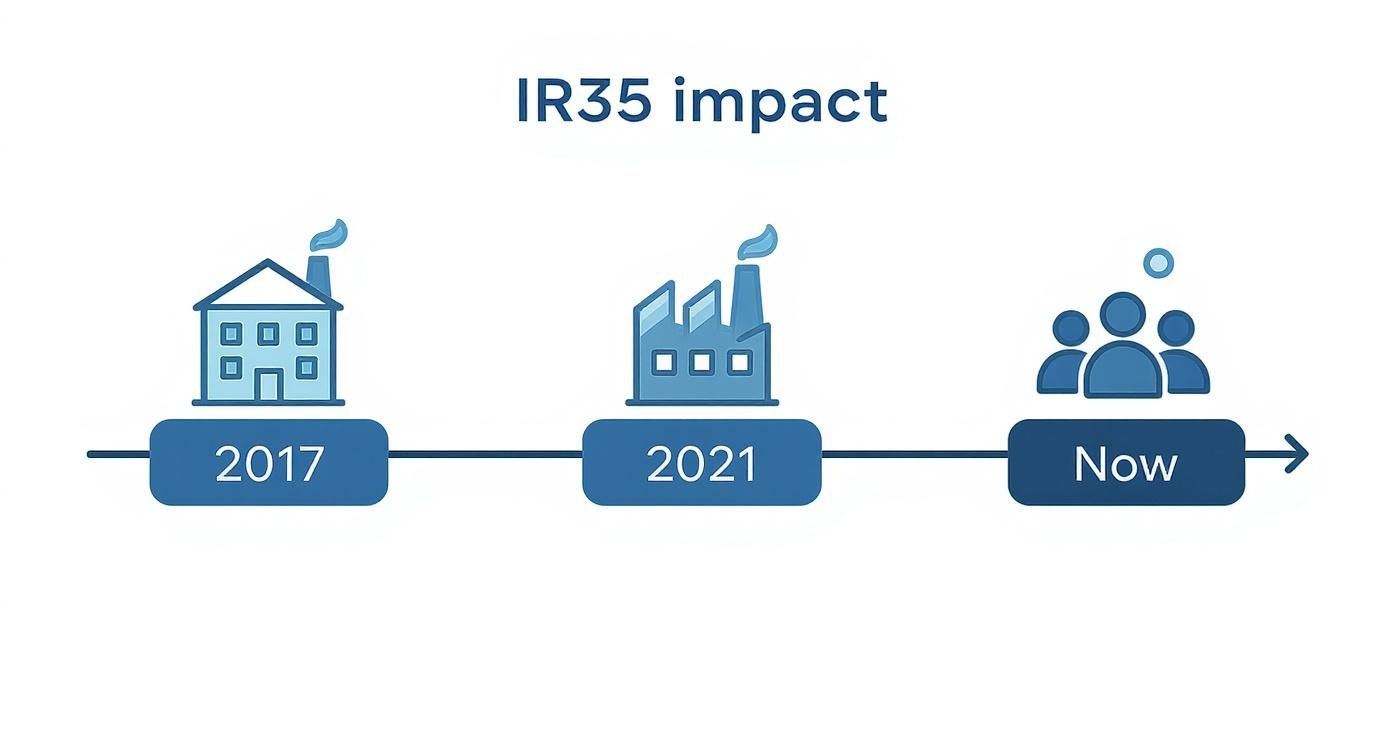
As the IR35 rules expanded, the need for compliant payroll solutions like umbrella companies became much more critical for contractors and clients alike.
Decoding Your Key Deductions
To give you complete clarity, let's break down the main items you will see on your payslip. Getting to grips with these is the first step to feeling confident about your earnings and spotting any red flags of a non-compliant scheme.
Here are the standard deductions you should always expect to see:
- Umbrella Company Margin: This is simply the fee the umbrella company charges for its services. It is usually a fixed amount taken weekly or monthly, and it covers all their administrative work, from processing your pay to ensuring everything is HMRC-compliant.
- Employer's National Insurance: As your legal employer, the umbrella company is required to pay Employer's National Insurance Contributions (NICs) to HMRC on your earnings. This is a statutory cost of employment, plain and simple.
- The Apprenticeship Levy: This is a UK tax on employers used to fund apprenticeship training. It is set at 0.5% of the annual pay bill and applies to all employers with a bill over £3 million.
- Employer's Pension Contributions: Under auto-enrolment rules, your employer has to contribute to your workplace pension. This is another standard, unavoidable employment cost.
It is vital to remember that these are not extra costs being unfairly passed on to you. They are legitimate employment costs that must be paid from the assignment rate before your own gross pay is calculated. A compliant provider will always show these clearly.
From Gross to Net: A Practical Example
Let's walk through how this all works with some simple figures. Imagine your weekly assignment rate agreed with the agency is £2,000.
- Start with the Assignment Rate: The process begins with the £2,000 invoiced to your agency.
- Deduct Employment Costs: From this amount, the umbrella deducts its margin (for instance, £25), Employer's NI, the Apprenticeship Levy, and any pension contributions. This total represents the cost of employing you.
- Calculate Your Gross Pay: What is left after those deductions is your gross pay. This is the figure that your personal tax and employee NI are calculated on.
- Deduct Your Personal Taxes: Finally, PAYE tax and your own Employee's NI contributions are deducted from your gross pay. For a deeper dive into this system, you can learn more about how Pay As You Earn works on our blog.
- Receive Your Net Pay: The final amount is your net, or take-home, pay that lands in your bank account.
Understanding this flow from the assignment rate right down to your net pay empowers you to check every payslip and make sure you are being paid correctly and compliantly.
Weighing the Pros and Cons of an Umbrella Company
Deciding whether to use an umbrella company is a big choice for any contractor, and there is no single right answer. It really boils down to your career goals, how you like to manage your finances, and how much paperwork you are willing to handle. Let's take a balanced look at the good and the not-so-good.
For many contractors, the biggest draw is the sheer simplicity. Once you are set up, your life gets a lot easier. You just submit your timesheets, and the umbrella company handles everything else, from invoicing the agency to calculating your tax and National Insurance. This frees you up to focus on the actual work you are paid to do, without the administrative headache.
Another huge plus is that you gain statutory employment rights. As a legal employee of the umbrella, you get access to things like statutory sick pay, holiday pay, and maternity or paternity leave. This provides a safety net that you simply do not get when you are running your own limited company.
The Upsides of Umbrella Employment
This straightforward, no-fuss approach has clear benefits that appeal to a lot of contractors, particularly those just starting out or working on shorter contracts.
Here are the key advantages:
- IR35 Peace of Mind: Because you are treated as an employee for tax purposes, IR35 does not apply. This completely sidesteps any risk or worry about HMRC questioning your employment status.
- Continuity of Employment: Working through one umbrella gives you a continuous employment record, even if you are moving between different clients and contracts. This is a massive help when you are applying for a mortgage or a loan, as lenders value that kind of stability.
- Minimal Administration: Forget about managing company accounts, filing corporation tax returns, or wrestling with complex bookkeeping. It is a genuine ‘plug-and-play’ solution for getting paid as a contractor.
Understanding the Drawbacks
Of course, it is not all perfect. It is just as important to look at the potential downsides. The most obvious one is the cost. You will pay a weekly or monthly margin for the umbrella's services, which gets deducted from your earnings. While this fee covers all the administration, it is still an outgoing you need to account for.
While an umbrella company offers unmatched simplicity and compliance, this comes at the cost of reduced tax planning flexibility. Unlike a limited company director, you cannot optimise your income through a mix of salary and dividends.
You also have less direct control over your finances compared to running your own limited company. Your entire income is processed through PAYE, which means there is very little room for tax efficiency. This lack of flexibility is a key reason why many experienced, higher-earning contractors often prefer the limited company route.
Ultimately, it is a trade-off. An umbrella company buys you security, simplicity, and compliance, but you pay for it with a fee and less financial control. A limited company, on the other hand, offers far greater potential for tax planning but demands a lot more administrative effort and comes with more risk.
How to Choose a Compliant Umbrella Company

Picking the right umbrella company is not just about administration. It is a huge decision that protects your money, your professional reputation, and ultimately, your peace of mind. While the market is full of fantastic, reputable providers, there are also some non-compliant schemes out there designed to mislead contractors.
These schemes often make tempting promises that are too good to be true. They will try to lure you in with offers of incredibly high take-home pay, sometimes claiming you can keep as much as 80-90% of your contract earnings. This is a massive red flag and should set alarm bells ringing immediately.
Remember, a compliant umbrella company processes all your income through PAYE, just like any regular UK employer. This means your net pay should be very similar to what a permanent employee on the same salary would take home. Any company promising you a significantly higher return is almost certainly bending (or breaking) the law, putting you at serious risk of a future HMRC investigation.
Key Warning Signs of a Tax Avoidance Scheme
Spotting a non-compliant provider early is crucial. Keep an eye out for these tell-tale signs, and if you encounter any of them, it is best to walk away.
Here are the biggest red flags to watch for:
- Unrealistically High Take-Home Pay: Any promise of keeping 80% or more of your earnings is a major warning sign. Under UK tax law, it is simply not possible.
- Mentions of ‘Loans’ or ‘Annuities’: If your payslip mentions part of your income being paid as a non-taxable 'loan', 'credit', or some other convoluted payment structure, this is a classic tax avoidance tactic.
- Lack of Transparency: A trustworthy provider will be completely open about their margin and all deductions. If a company is vague or avoids direct questions about their fees, be very wary.
The Importance of Professional Accreditation
The easiest way to make sure you are dealing with a legitimate provider is to check for professional accreditation. In the UK, the two most respected and recognised bodies are the FCSA (The Freelancer & Contractor Services Association) and Professional Passport.
These organisations carry out rigorous, independent audits to ensure their members are operating to the highest standards of compliance. Choosing an accredited provider gives you the confidence that they are managing your finances correctly and ethically. You can learn more about what it means to be an FCSA-accredited umbrella company and why it is so important for your protection.
Choosing an FCSA or Professional Passport accredited umbrella company is the single most effective step you can take to safeguard yourself from non-compliant schemes and potential tax liabilities.
Essential Questions to Ask Any Provider
Before you sign on the dotted line with any umbrella company, make sure you ask them these direct questions to check they are compliant:
- Are you accredited by the FCSA or Professional Passport?
- Can you provide a full pay illustration based on my specific contract rate?
- Will my entire income be processed through PAYE?
- Are there any hidden costs, like joining or leaving fees?
A compliant provider will answer these questions clearly and confidently. Their transparency is a strong sign that you're choosing a partner who operates with integrity and has your best interests at heart.
The Future of Umbrella Company Regulation
The world of umbrella companies is on the brink of a major shake-up. For years, there have been calls to tighten the rules and clamp down on non-compliant operators. Now, the UK government is finally stepping in with significant reforms aimed at protecting contractors and cleaning up the industry for good.
This is not just a minor tweak to the rules. The new legislation is set to fundamentally change who is responsible for what across the entire contracting supply chain. It is a critical development that everyone involved in contracting needs to understand.
https://www.youtube.com/embed/xB734c4v9mY
A New Era of Accountability
Mark your calendars for 6th April 2026. That is when substantial new government regulations are set to kick in, and they are bringing a huge change with them: ‘joint and several liability’.
In simple terms, this means that if a non-compliant umbrella company fails to pay its PAYE and employer National Insurance, the legal responsibility can now be passed up the chain to the recruitment agency or even the end client. The government expects this move to claw back £500 million by 2030, affecting thousands of agencies and umbrellas. You can dive deeper into the new umbrella company legislation and what it means on our blog.
This change forces every business in the supply chain to conduct thorough due diligence, making it much harder for rogue operators to exist.
What does this mean for you, the contractor? It is genuinely good news.
With agencies and clients now on the hook for any unpaid tax, they have a powerful incentive to make sure they only partner with fully compliant, accredited umbrella companies. The days of anyone turning a blind eye to questionable practices are numbered, which ultimately creates a much safer and more reliable market for contractors.
Got Questions? We’ve Got Answers
It is completely normal to have a few lingering questions when you are figuring out how umbrella companies work. At UmbrellaCompany.com, we get asked these all the time by contractors, so we have put together some quick, straightforward answers to clear things up.
Can an Agency Force Me to Use Their Preferred Umbrella Company?
Absolutely not. While many agencies maintain a ‘preferred supplier list’ (PSL) of umbrella companies they have already vetted and trust, the final decision is always yours.
If an agency ever insists you use one specific provider and refuses to be flexible, treat it as a major red flag. This kind of pressure can sometimes point towards a non-compliant setup behind the scenes.
Who Is My Actual Employer – the Umbrella or the Client?
Legally, you are an employee of the umbrella company. They are the ones who issue your contract of employment, handle all the HR administration, and pay your salary through PAYE.
Even though you are doing the work on-site for the end client and follow their day-to-day direction, your official employment relationship is with the umbrella.
This is a really important distinction. It means the umbrella company is responsible for your statutory employment rights, such as holiday pay, sick pay, and getting you set up with a workplace pension.
What Happens When My Contract Ends?
Your employment with the umbrella company does not just stop when a project does. It continues, which is great for creating a continuous record of employment, something that makes getting a mortgage or a loan much easier.
Once you have lined up your next assignment, you just let them know. They will then sort out a new contract with the agency or client, and you carry on as before.
Ready to find a trusted partner for your contracting career? We make it simple to compare compliant, accredited umbrella companies that fit your specific needs.
Find your perfect match in minutes at UmbrellaCompany.com.


