


So, you’re a UK contractor trying to get your head around umbrella companies and IR35. You’ve come to the right place. We are going to cut through the jargon and explain exactly why working through an umbrella company has become the go-to, compliant solution for contracts that fall ‘inside IR35’.
It’s a setup that takes the compliance headache away from both you and your client, and we will show you how.
Your No-Nonsense Guide to IR35 and Umbrella Companies
If you're contracting in the UK, you cannot escape two terms: IR35 and umbrella companies. They are completely intertwined. At its core, the IR35 legislation (or ‘off-payroll working rules’) is HMRC’s way of making sure that contractors who work like employees pay roughly the same tax and National Insurance as them.
Since the reforms rolled out in 2017 and 2021, it is now usually your client’s job to decide your IR35 status. If they determine your contract is ‘inside IR35’, it is a signal that for tax purposes, your working relationship looks a lot like traditional employment. This is the exact point where an umbrella company steps in as the standard, hassle-free way forward.
What You Will Get From This Guide
When you join an umbrella company, you technically become their employee. It is a simple but crucial shift. Because you are now an employee on a payroll, IR35 no longer applies to your engagement. All your earnings are processed through PAYE (Pay As You Earn), just like any other employee in the country.
We will walk you through this whole process, step by step, so you can properly understand:
- How an umbrella company works as your payroll provider for inside-IR35 roles.
- The real differences between using an umbrella and running your own limited company.
- How your pay is actually calculated and what all those deductions on your payslip mean.
- The essential steps for picking a safe, accredited, and trustworthy umbrella partner.
Our goal is simple: to give you the confidence you need to manage your contracting career. We want you to be certain that you are meeting all your tax obligations while working with a provider that genuinely has your back. By the time you have finished reading, you will have a clear, practical grasp of how the whole umbrella company IR35 model works for you.
What Exactly Is IR35 and Why Does It Matter?

Let's cut through the jargon. At its heart, IR35 (also known as the ‘off-payroll working rules’) is a piece of tax legislation from HMRC. Its sole purpose is to spot contractors who, despite operating through their own limited company, are essentially working just like permanent employees.
HMRC calls this ‘disguised employment’. It is the classic "if it walks like a duck and quacks like a duck…" scenario. If your day-to-day working relationship with a client mirrors that of an employee, the rules say you should be paying similar Income Tax and National Insurance. That’s the entire reason IR35 exists, and it is why getting your status right is absolutely critical.
The Key IR35 Status Tests Explained
So, how is this status decided? To figure out if a contract falls ‘inside’ (like an employee) or ‘outside’ (genuinely self-employed) IR35, your end client and HMRC look at the reality of your working arrangement. It is not just about what your contract says, but about what actually happens on the ground.
They weigh up a few key indicators:
- Control: How much direct control does the client have over you? If they dictate how, when, and where you do the work, that looks a lot like employment. A true contractor retains a high degree of autonomy.
- Substitution: This is a big one. As a genuine business owner, you should have the right to send a suitably qualified substitute to do the work in your place. If the client insists on you personally and a replacement is not an option, that is a strong pointer towards being inside IR35.
- Mutuality of Obligation (MOO): In a typical job, the employer is obliged to provide work, and the employee is obliged to do it. For contractors, that obligation should not exist beyond the current project. Once the work is done, there is no expectation of more work being offered or accepted.
Getting your head around these tests is the first step. For a deeper dive, check out our full guide on what IR35 is and why it matters to UK contractors.
Here's a simple way to think about it: if you took your limited company out of the picture entirely, would the relationship between you and the client look just like a standard employer-employee one? If the answer is yes, then the contract is almost certainly inside IR35.
The Reforms That Changed Everything
It was not always this complicated. Originally, the burden of determining IR35 status was squarely on the contractor's shoulders. But that all changed with the public sector reforms in 2017, followed by the private sector in April 2021.
Now, for the vast majority of contracts, your end client is legally responsible for assessing your IR35 status. This was a massive shift. Unsurprisingly, many clients became risk-averse, worried about the hefty financial penalties for getting it wrong.
This change is the single biggest reason for the explosion in umbrella companies for IR35 contracts. Many clients now insist that if a role is deemed inside IR35, the contractor must work through an umbrella. Why? Because the umbrella company employs you and pays you via PAYE, which completely removes the IR35 risk for them and the recruitment agency.
These reforms have cemented the umbrella company's place in the modern contracting world. They offer a simple, compliant payroll route for any inside-IR35 contract, making them an essential tool for today's contractor.
How an Umbrella Company Makes IR35 Compliance Simple
Getting an inside IR35 determination from a client can feel like a headache waiting to happen. But it does not have to be. This is exactly the situation umbrella companies were designed for. They step in and act as your employer, making the whole process surprisingly straightforward.
Think of it this way: you become a legal employee of the umbrella company for that specific contract. You are not employed by the agency or the end client. That simple switch is what makes everything click into place.
Once you are on their books, you gain full statutory employment rights. This means you are entitled to things like sick pay, holiday pay, and a workplace pension. It is a layer of security that you just do not get as a director of your own limited company.
How the Money Flows
To really get your head around it, you need to follow the money. The payment chain is clean and transparent, designed to make sure every party in the chain (you, the agency, and the client) is fully compliant.
Here’s how it works in practice:
- Client Pays the Agency: Your client pays the recruitment agency for the work you’ve done, based on your agreed daily or hourly rate.
- Agency Pays the Umbrella: The agency then passes this payment, known as the assignment rate, over to your umbrella company. Crucially, this rate includes all the necessary employment costs.
- Umbrella Runs Your Payroll: From that assignment rate, the umbrella deducts its margin and the required employer costs (like Employer’s NI). What’s left is your gross pay.
- You Get Paid: Just like any other employee, your gross pay is subject to standard deductions: PAYE Income Tax and your Employee National Insurance Contributions (NICs). The final net amount lands in your personal bank account, and you get a proper payslip breaking it all down.
This structure guarantees that the right amount of tax is paid to HMRC on time, every single time. No ifs, no buts.
Taking the IR35 Burden Off Your Shoulders
The real magic of this model is what it does to the IR35 problem. As soon as you become an employee of an umbrella company, your pay is handled through PAYE.
This means that for that particular contract, IR35 effectively becomes a non-issue. Why? Because your income is already being taxed at source, just like a permanent employee's. There’s no room for any 'disguised employment' accusation because the rules have already been satisfied.
This setup removes the compliance risk for everyone. The client is happy because they have engaged a contractor who is being taxed correctly. The agency is protected. And most importantly, you are shielded from any future HMRC investigation into that specific contract. You can dive deeper into this in our guide on whether IR35 applies if you work through an umbrella company.
The Go-To for Inside-IR35 Contracts
Since the IR35 reforms put the responsibility for status determination squarely on the client, many big organisations now simply insist on contractors using an umbrella company for any role deemed inside IR35. It is widely seen as the safest and most efficient route.
By taking care of all the payroll and tax admin, an umbrella company provides a solid, hassle-free framework. It frees you up to concentrate on what you do best (delivering great work for your client) with the peace of mind that all the tax stuff is being handled properly. It has become the established, go-to pathway for navigating the UK's off-payroll working rules.
How to Read and Understand Your Umbrella Payslip
Getting your head around your first umbrella payslip can be a bit of a shock. It looks busier than a standard employee payslip, packed with extra lines and figures you might not recognise. But do not worry, once you know the lingo, it is actually pretty simple to decipher.
We are going to walk through it step-by-step. The most crucial thing to grasp is the difference between the assignment rate (the total amount the agency pays your umbrella) and your actual gross pay for tax purposes. Get that clear, and you will see exactly where every penny is going.
This diagram gives you a bird's-eye view of how the money flows from the client, through the agency and umbrella, and finally to you.
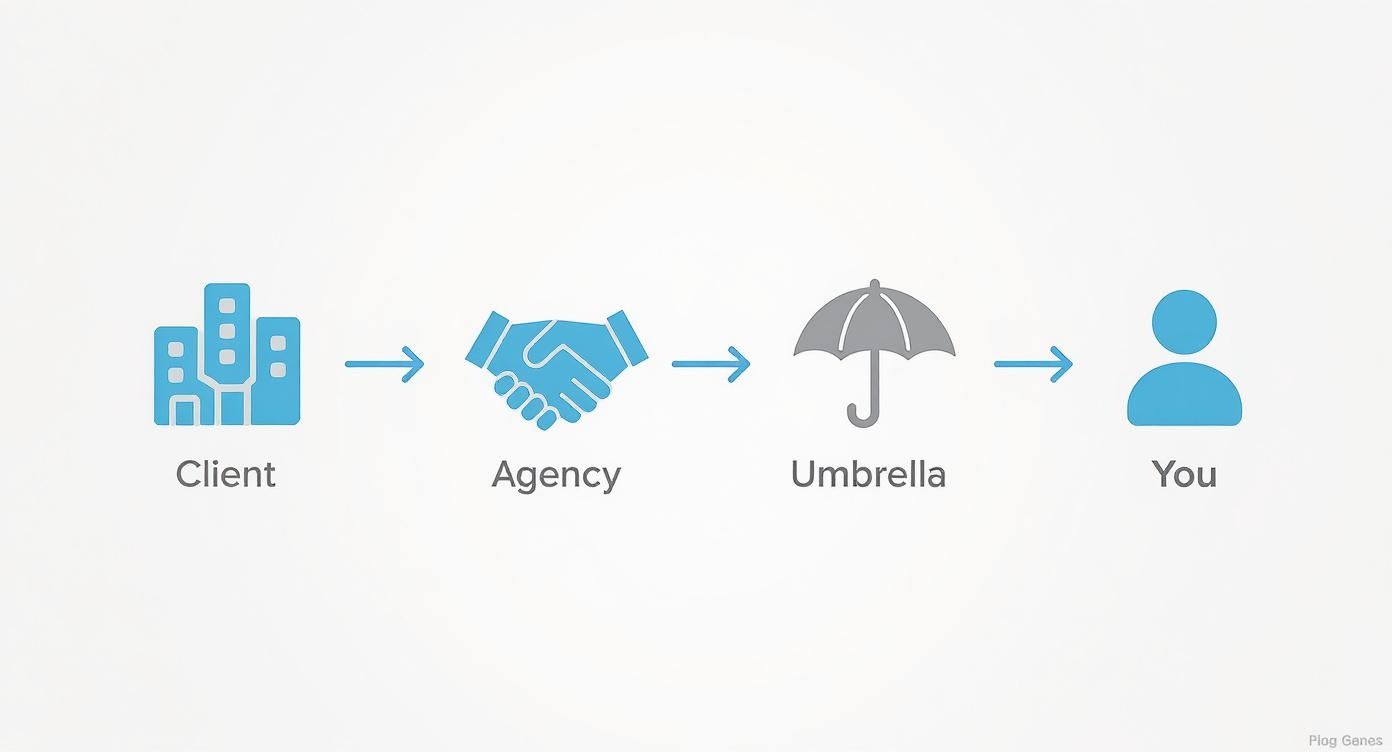
As you can see, the umbrella company sits in the middle, taking the full contract value and then processing your pay as a fully compliant employee.
The Assignment Rate: What It Is and What It Includes
Let's start with the most important number on the page: the assignment rate. This is the total sum your recruitment agency pays the umbrella company for the work you have done. It is vital to remember this is not your salary. Think of it as the total project cost for your services.
This single figure has to cover all the statutory costs of employing you before your personal pay can even be calculated. Any compliant, legitimate umbrella company will deduct these costs directly from the assignment rate.
These are the standard, non-negotiable costs every single UK employer has to pay:
- Employer’s National Insurance Contributions (NICs): A mandatory tax on earnings that all UK employers must pay for their staff.
- The Apprenticeship Levy: A UK-wide tax on large employers that helps to fund apprenticeship schemes.
- The Umbrella Company's Margin: This is their fee for the service. It’s usually a fixed amount, either weekly or monthly, and it is how they make their money.
- Employer's Pension Contributions: The minimum contributions your employer is legally required to make into your workplace pension.
Only after these costs have been deducted is your gross pay calculated. This is the figure that your personal tax will be based on.
A good way to think about it is that the assignment rate is the total budget for your role. The umbrella uses part of that budget to cover the legal costs of having you on their books, and the rest becomes your taxable salary.
Your Personal Deductions
Once your gross pay is worked out, the rest of the payslip should look much more familiar. These deductions are the same as for any other employee in the country. The umbrella simply deducts them and sends them to HMRC for you.
You will see the usual suspects listed:
- PAYE (Pay As You Earn) Income Tax: Your standard income tax, calculated using your personal tax code.
- Employee’s National Insurance Contributions (NICs): Your own contributions towards state benefits like the state pension.
- Student Loan Repayments: If you have one, this will be deducted automatically based on your earnings.
- Your Pension Contributions: Any personal contributions you choose to make to your workplace pension pot.
The figure left after all these personal deductions is your net pay, often called your take-home pay. This is the amount that lands in your bank account.
Sample Payslip Breakdown: Umbrella vs. Limited Company (Inside IR35)
To really bring this to life, let’s compare how the deductions look for the same inside-IR35 contract, but processed through a compliant umbrella company versus a Personal Service Company (PSC) operating inside IR35. Notice where the employer costs are deducted in each scenario.
| Deduction Type | Compliant Umbrella Company | PSC (Inside IR35) |
|---|---|---|
| Assignment Rate / Invoice Value | £2,000 | £2,000 |
| Umbrella Margin | -£25 | -£0 |
| Employer's NI | -£224.22 | Paid by Agency/Client |
| Apprenticeship Levy | -£9.88 | Paid by Agency/Client |
| Employer's Pension | -£58.74 | -£0 |
| Your Gross Pay (Taxable) | £1,682.16 | £1,727.57 (Deemed Salary) |
| PAYE Income Tax | -£305.80 | -£317.00 |
| Employee's NI | -£123.86 | -£129.31 |
| Employee's Pension | -£83.91 | -£0 (Can make company contributions) |
| Net Pay (Take-Home) | £1,168.59 | £1,281.26 |
Note: Figures are illustrative and based on typical 2024/25 tax rates. Your actual take-home will vary based on your tax code, pension contributions, and the umbrella's margin.
As you can see, while the umbrella route involves more deductions from the assignment rate, the PSC route requires the fee-payer (agency or client) to handle the employer's costs. The "deemed salary" calculation for a PSC can be complex, which is why many contractors prefer the straightforward payroll processing offered by an umbrella for inside-IR35 work.
How to Spot a Compliant Payslip
A clear, transparent, and fully itemised payslip is the number one sign of a trustworthy umbrella company. You should be able to trace the money from the initial assignment rate all the way down to your final net pay, with no mysterious deductions.
Be extremely wary of any payslip that promises unrealistically high take-home pay. If you see vague headings like ‘loan’, ‘credit’, or ‘annuity’, it is a massive red flag for a non-compliant tax avoidance scheme that could land you in serious trouble with HMRC.
It is also crucial to stay aware of changes on the horizon. For example, new legislation is set to take effect from April 2025 which will shift the liability for unpaid PAYE tax in the supply chain. This is a significant government move to clamp down on non-compliance. You can learn more about the IR35 compliance changes for 2025 here.
By understanding these moving parts, you can check your payslip with confidence each month, making sure you are being paid correctly and staying on the right side of the law.
Choosing a Safe and Compliant Umbrella Company

When your contract falls inside IR35, picking the right umbrella company is probably the most critical decision you will make. A good, compliant provider is just a payroll partner. They make sure your taxes are handled correctly, leaving you to get on with the job.
But here’s the catch: the market is a bit of a wild west. It is unregulated, and some outfits play fast and loose with the rules.
You have to be on your guard. The biggest risk comes from dodgy providers running what are essentially tax avoidance schemes. They will try to hook you with promises of ridiculously high take-home pay, often between 80% and 95%. If you see numbers like that, it is a massive red flag.
These schemes work by trying to disguise your income as something it is not, like an offshore loan, an annuity, or some other complicated financial product. It might look good on paper, but getting involved can land you in serious trouble with HMRC, facing hefty back-tax bills and penalties years down the line.
Look for Independent Accreditation
So, how do you sort the good from the bad?
Honestly, the most reliable sign of a trustworthy umbrella company is independent accreditation. A handful of professional UK bodies carry out deep-dive audits on their members to make sure they are operating completely by the book.
The two main names you need to look for are:
- The FCSA (The Freelancer & Contractor Services Organisation): The FCSA is widely seen as the gold standard. Their accreditation process is incredibly thorough, checking every aspect of a provider’s business to ensure they are fully compliant with UK tax law.
- Professional Passport: This is another highly respected body that conducts robust compliance checks. If a provider has Professional Passport accreditation, it means their processes have been scrutinised and meet HMRC’s strict guidelines.
Sticking with an accredited provider is your best defence. It is a clear signal that the company is serious about operating ethically and transparently. You can find out more about why this is so important in our guide to choosing an FCSA-accredited umbrella company.
Your Practical Compliance Checklist
Accreditation is a great start, but you should still do your own checks before signing anything.
The umbrella company sector is huge, with around 700,000 people in the UK working this way. Worryingly, HMRC reckons that over a third of these contractors are with non-compliant providers, creating a massive tax shortfall. This has even led to new rules making recruitment agencies liable for unpaid taxes in their supply chain.
Before you commit, run through this simple checklist:
- Check for Accreditation Logos on Their Website: Reputable providers will proudly display their FCSA or Professional Passport logos. Do not just take their word for it; double-check their membership on the official FCSA or Professional Passport websites.
- Get a Key Information Document (KID): By law, they have to provide you with a KID before you sign up. This document must show a clear illustration of your pay, breaking down the assignment rate and all the deductions you can expect.
- Analyse the Pay Illustration: Go through the KID with a fine-tooth comb. Does it clearly show Employer’s NICs, the Apprenticeship Levy, and the umbrella’s margin all being deducted from the assignment rate? If anything looks fishy or is missing, walk away.
- Ask Them How They Work: A legitimate provider will have no problem explaining their payroll process. Ask them outright how they handle compliance and what steps they take to protect you.
- Reject Unrealistic Promises: It is simple, really. If a company claims you will take home more than a standard PAYE calculation would give you, it is almost certainly a tax avoidance scheme.
Taking these straightforward steps will help you find a safe, reliable umbrella partner. It protects you, your money, and your reputation, letting you focus on your contract work without the looming worry of a future HMRC investigation.
Umbrella Company vs Limited Company: The Key Differences
Choosing how to structure your contracting career is one of the biggest decisions you will make. For most, it boils down to two main routes: joining an umbrella company or setting up your own limited company, often called a Personal Service Company (PSC).
Each path has its own set of pros and cons, and honestly, the right choice for you will almost always hinge on your IR35 status.
Think of it this way: an umbrella company is the go-to, compliant solution for contracts that fall inside IR35. On the other hand, a limited company is usually the most tax-efficient way to go for work that is confirmed to be outside IR35. Let's break down what that really means for you.
Simplicity vs Control
At its heart, the decision is a classic trade-off: do you want simplicity or do you want total control?
An umbrella company is all about making your life easy. Once you are signed up, they take care of everything: payroll, tax, National Insurance, even chasing down your invoices. You just submit your timesheets and get paid, just like a regular employee. There is virtually zero admin on your part.
Running your own limited company puts you squarely in the driver's seat. As the company director, you have complete control over your business finances, deciding how and when you get paid. But with that control comes a heap of legal and administrative responsibilities, from filing annual accounts and managing Corporation Tax to handling VAT returns.
Understanding the Key Operational Differences
To really get a feel for which is right for you, it helps to see them side-by-side. Your attitude to risk, how much admin you are willing to take on, and crucially, your contract’s IR35 status will point you in the right direction.
For a much deeper dive, you can read our complete guide comparing an umbrella company vs a limited company.
Here’s a look at how the two models stack up in practice.
Operational Model Comparison: Umbrella vs PSC
This table gives a clear, at-a-glance summary of the key differences between operating through an umbrella company and your own PSC.
| Feature | Umbrella Company | Limited Company (PSC) |
|---|---|---|
| Best For | Inside IR35 contracts | Outside IR35 contracts |
| Admin Level | Very Low. Submit timesheets and you are done. | High. You are responsible for all company admin. |
| Employment Status | You are an employee of the umbrella company. | You are a director of your own company. |
| Tax & NI | Processed automatically via PAYE. | You manage Corporation Tax, VAT, and PAYE. |
| Take-Home Pay | Lower due to PAYE deductions on all income. | Higher potential through salary and dividends. |
| Employment Rights | Yes. You get statutory sick pay, holiday pay, etc. | No. You have no statutory employment rights. |
| Setup Time | Minutes. You can be ready to work the same day. | Days or weeks to incorporate the company and open accounts. |
As you can see, they are fundamentally different ways of working, each tailored to a specific contracting situation.
Financial Implications and Take-Home Pay
For many contractors, the bottom line is what matters most. The impact on your take-home pay is probably the biggest difference between the two setups.
When you are with an umbrella company, all of your earnings are processed as salary. That means they are subject to standard PAYE Income Tax and National Insurance Contributions. It is simple and straightforward, but it generally means your net pay will be lower.
A limited company, when used correctly for outside-IR35 contracts, offers far greater tax efficiency. By taking a small salary and drawing the rest of your income as dividends, you can legally lower your overall tax bill. This is the main financial reason contractors choose to run a PSC.
But here’s the crucial part: if your contract is inside IR35, all of those tax advantages vanish. HMRC rules force you to pay yourself a "deemed salary" that is taxed in exactly the same way as an employee's, completely wiping out the financial benefit of a PSC.
You are left with all the admin and none of the reward. This is precisely why for inside-IR35 contracts, the simplicity and security of an umbrella company almost always makes it the most logical and practical choice.
Frequently Asked Questions
Here are some of the most common questions contractors ask us about umbrella companies and IR35. We have pulled together some clear, no-nonsense answers to help you navigate your options with confidence.
Can I Still Claim Expenses Through an Umbrella Company?
This is a massive point of confusion, so let's clear it up. Once a contract is determined to be inside IR35, the expense rules become very strict. They are essentially the same as for any permanent employee. This means the days of claiming tax relief for your daily commute from home to your main client site are over.
The only expenses you can really claim are those incurred ‘wholly, exclusively, and necessarily’ in the performance of your duties. A classic example is if you have to travel between two different client sites during the workday. That is a business journey, not a commute. Before you spend a penny, always check with a compliant umbrella company to get a straight answer on what is allowable.
Should I Keep My Limited Company if I Use an Umbrella?
That really comes down to your long-term plans. If you are looking at a future filled exclusively with inside-IR35 contracts, then running a limited company (or PSC) could just be an extra layer of admin and cost you do not need.
However, a lot of contractors find a happy medium by making their limited company dormant. It is a great little strategy. Your company stays legally registered, but you do not have to actively manage it. It means that if the perfect outside-IR35 role pops up down the line, you can fire the company back up in no time, without the faff of starting from scratch.
What Is the Assignment Rate on My Payslip?
Getting your head around the assignment rate is the key to understanding your umbrella payslip. This figure is the total amount your agency pays the umbrella company for your services. It is crucial to remember that this number is not your salary or take-home pay.
Think of the assignment rate as the total project budget for hiring you. It has to cover all the mandatory employment costs before your own gross pay can be worked out. This includes things like Employer’s National Insurance, the Apprenticeship Levy, and the umbrella’s margin.
Only after these legitimate, legally required costs have been deducted is your gross pay calculated. From that gross pay figure, your personal tax and employee's National Insurance are then deducted, giving you your final net pay. Any good, transparent payslip will lay this all out clearly for you.
At UmbrellaCompany.com, we provide the tools and resources you need to find a trusted, compliant provider. Use our free comparison service to find the perfect umbrella company for your next inside-IR35 contract.


