


Picking the right umbrella company is one of the most critical decisions you'll make as a UK contractor. A proper umbrella companies comparison isn't just about finding the lowest fee; it's about digging into compliance, employment benefits, and what your take-home pay will actually be. This ensures you end up with a trustworthy partner, not a liability.
How to Compare Umbrella Companies: A Practical Guide
Trying to navigate the world of umbrella companies can feel overwhelming, especially with so many options available. This guide is designed to give you a straightforward, practical framework for making your choice. We will show you how to assess providers based on the criteria that genuinely impact your contracting career.
By focusing on the right details, you can quickly learn to spot the difference between a supportive, compliant partner and a high-risk scheme. Our goal is to arm you with the knowledge to make an informed decision that protects your earnings and gives you peace of mind.
What to Look For in a Provider
A genuine comparison involves looking at several key areas at once. Just picking the company with the lowest advertised margin is a classic mistake and can be incredibly risky. Instead, you need to weigh up a few core pillars to get the full picture.
The main things to focus on for your umbrella companies comparison are:
- Compliance and Accreditation: Is the company accredited by a reputable UK body like the FCSA or Professional Passport? This is non-negotiable. It’s the clearest sign they’re committed to operating compliantly. You can learn more about what makes an FCSA accredited umbrella company a safer bet in our detailed guide.
- Transparent Fee Structure: The provider must be crystal clear about their margin (whether it's weekly or monthly) and guarantee there are no hidden costs waiting for you later.
- Real Employment Benefits: Look beyond the bare minimum legal requirements. Do they offer a decent workplace pension, comprehensive insurance cover, and perhaps even access to perks like healthcare schemes or retail discounts?
- Reputation and Support: What is their customer service actually like? Check independent reviews online and see how they handle contractor queries about pay, tax, or IR35. A good team is invaluable when you need a straight answer.
To help you get started, here’s a quick overview of the most important factors.
Key Comparison Criteria at a Glance
This table breaks down the most important factors to consider when comparing umbrella companies. It’s designed to help you cut through the noise and focus on what truly matters for your contracting work.
| Comparison Factor | Why It Matters for Contractors | What to Look For |
|---|---|---|
| Accreditation | Provides assurance that the company is audited against strict UK compliance standards, protecting you from tax avoidance schemes. | FCSA or Professional Passport logos displayed on their website. Always verify their membership on the official accreditation sites. |
| Margin Structure | This directly impacts your take-home pay. The margin is the only income the umbrella company should generate from your contract. | A fixed, flat fee (e.g., per week or month). Avoid percentage-based fees, which end up penalising higher earners. |
| Statutory Benefits | As their employee, you are legally entitled to sick pay, holiday pay, and a pension. A compliant umbrella ensures these are managed correctly. | Clear policies on how you accrue and claim holiday pay. Details of their workplace pension scheme should be easy to find. |
| Service & Support | When you have questions about your pay or contract, you need a responsive and knowledgeable team to provide clear answers, fast. | Positive independent reviews, a dedicated contact person, and clear communication channels (phone, email). |
Ultimately, using these criteria as a checklist will help you systematically evaluate your options and choose a provider that’s not just cheap, but compliant, supportive, and reliable.
A Look at the UK Umbrella Company Landscape
Before you can really get started with an umbrella companies comparison, it helps to understand the world they operate in. The UK's flexible labour market has grown massively in recent years, mainly because of major legislative changes that have completely altered how contractors, agencies, and clients handle their tax responsibilities.
This boom has placed umbrella companies right at the heart of the contracting scene. But with growth comes risk. We are seeing more and more problems surface, from dubious payment schemes to complex tax avoidance models, which makes it a minefield for contractors trying to do the right thing.
The IR35 Effect
The Off-Payroll working rules, known to everyone as IR35, have been the single biggest driver behind the rise of umbrella companies. When the government rolled these rules out, first to the public sector in 2017 and then the private sector in 2021, it shifted responsibility for determining a contractor's tax status from the contractor to the client.
This move made many businesses nervous. To stay compliant, many now insist that any contractor working on a role deemed 'inside IR35' must be paid via PAYE (Pay As You Earn). For most contractors, that means one thing: joining an umbrella company. If you're new to this, our guide on how an umbrella company operates breaks it all down.
This shift did not just create a surge in demand for umbrella services; it solidified their role as a critical go-between in the UK's flexible workforce. Unfortunately, it also created the perfect environment for dishonest operators to take advantage of the confusion.
The numbers speak for themselves. In the 2022–2023 tax year, UK businesses paid around 700,000 workers through umbrella companies. That is about 14% of the entire UK temporary workforce, which just shows how central they have become.
Sorting the Good from the Bad
With hundreds of providers out there, the real challenge for any contractor is telling a compliant, trustworthy partner from a high-risk scheme. HMRC is trying to crack down on non-compliance, but ultimately, the responsibility to check who you are working with falls squarely on your shoulders.
A legitimate, compliant umbrella company will always:
- Give you a proper contract of employment.
- Process all of your income through PAYE, making the correct deductions for tax and National Insurance.
- Provide a clear, easy-to-understand payslip showing every single deduction, including their own margin.
- Ensure you get all your statutory rights as an employee, like holiday pay, sick pay, and a workplace pension.
On the other hand, a non-compliant or fraudulent setup will often tempt you with promises of sky-high take-home pay. These schemes might use what is known as disguised remuneration, paying you through non-taxable 'loans' or 'grants', which are illegal tax avoidance tactics. Getting caught up in one of these, even unknowingly, can lead to significant problems with HMRC, including huge back-tax bills and penalties.
All of this means that doing a proper umbrella companies comparison is much more than a simple admin task. It is a vital step in protecting your money and your professional reputation. If you focus on providers with proper accreditation, total transparency, and a proven track record of compliance, you can choose an umbrella company that genuinely supports you.
Comparing Fees, Compliance, and Contractor Benefits
When you are comparing umbrella companies, it’s easy to get sidetracked by flashy offers. But to make a genuinely smart choice, you need to cut through the noise and focus on the three things that actually matter: the fee structure, their compliance record, and the real-world value of the benefits they offer.
Getting this balance right is the difference between a smooth, secure contracting career and a lot of unnecessary headaches. A low weekly margin looks great on paper, but it’s completely worthless if the provider is playing fast and loose with HMRC rules or offers zero support when you need it.
Let's break down how to properly evaluate each of these areas, so you can weigh the true cost against the security you are getting.
First, here's a quick snapshot of the UK's contractor landscape, which gives some context to just how big this industry has become.
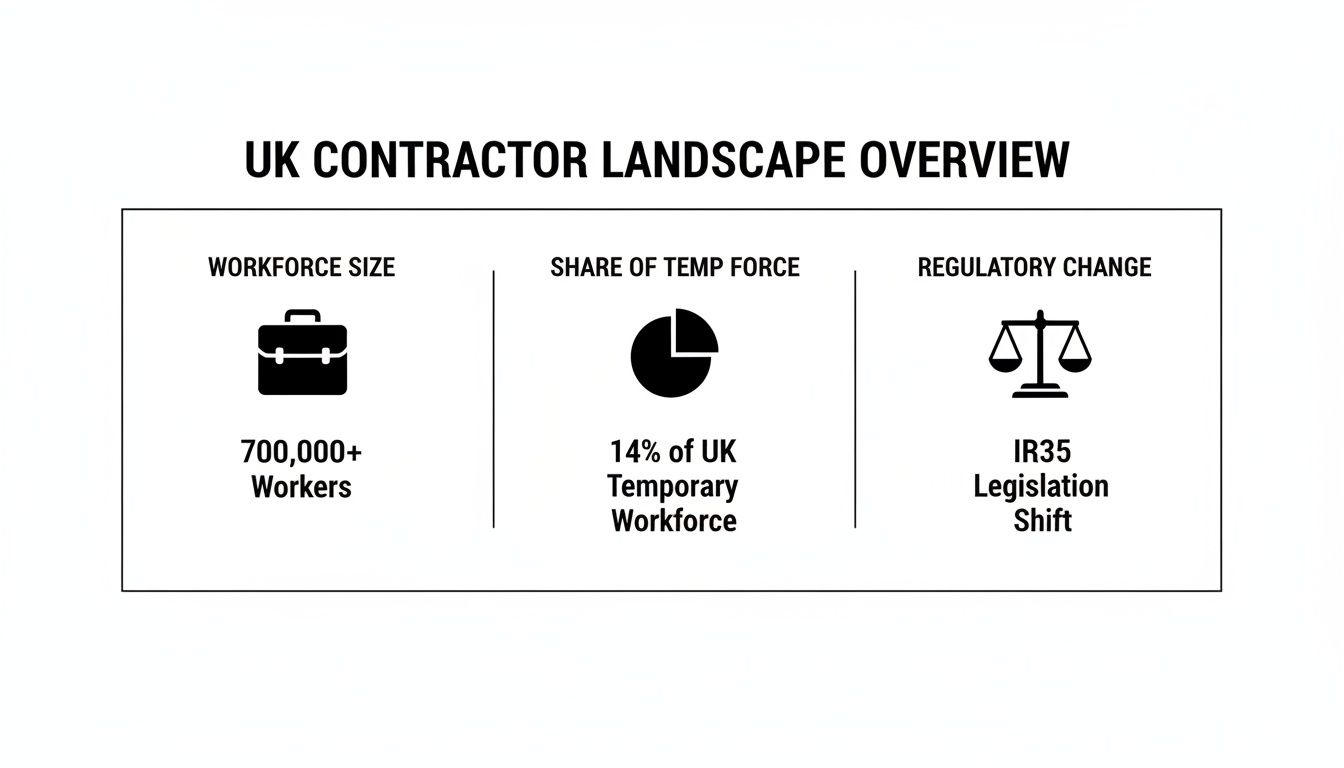
With over 700,000 workers now operating this way, it’s clear the umbrella model is a major part of the temporary workforce, largely thanks to the IR35 reforms.
What's The Real Cost? Decoding Their Fees
The fee, usually called a "margin," is the slice an umbrella company takes from your invoice to cover their costs for running your payroll and providing their services. Critically, this should be the only income they make from you.
You will generally come across two different models:
- Fixed Margin: This is a simple, flat amount charged each week or month (for example, £25 a week). It’s completely transparent. You know exactly what you’re paying, no matter how high your day rate climbs. This is widely seen as the industry standard.
- Percentage-Based Margin: Here, the umbrella takes a percentage of your total invoice value. This model tends to penalise higher earners, as you end up paying more for the exact same administrative work as your income grows.
A fixed margin is almost always the better, fairer option for contractors. It lets you budget properly and means you won't be punished for landing a better-paying contract.
Compliance: The One Area You Cannot Afford To Compromise On
Let’s be blunt: compliance is the single most important factor when you are choosing an umbrella company. Picking a non-compliant provider is a one-way ticket to trouble, exposing you to huge financial and legal risks, including a painful investigation from HMRC and a bill for unpaid tax.
This is where professional accreditations are your best friend.
Look for providers that are accredited by either the FCSA (The Freelancer & Contractor Services Association) or Professional Passport. These organisations are not just rubber-stamping bodies; they carry out intensive, independent audits to make sure their members are sticking to strict UK tax laws and employment standards.
An accredited provider gives you confidence that:
- Your taxes are being handled correctly: They operate PAYE by the book, deducting the right amount of tax and National Insurance.
- They are financially sound: The audits check that the business is run properly, so there's less risk of it suddenly going bust.
- They are not running tax avoidance schemes: Accreditation is your confirmation that they aren’t involved in disguised remuneration or any other illegal setups.
It's easy to check a provider's status. Do not just take their word for it or trust a logo on their website. Go directly to the FCSA or Professional Passport websites and verify they are a current member.
Looking Beyond The Basics: What Benefits Are You Actually Getting?
Because you are technically an employee of the umbrella company, you’re entitled to statutory employment benefits. But the real difference between a standard service and a premium one often lies in the extra perks they offer. A solid benefits package can deliver far more value than a slightly lower weekly margin.
Here’s what you should be comparing:
- The Bare Minimum: Every compliant umbrella must provide statutory sick pay, maternity/paternity leave, and a workplace pension. Think of this as the baseline, not a selling point.
- Insurance Cover: Most decent providers will include a comprehensive insurance package as part of their service. This should always include Professional Indemnity, Public Liability, and Employers' Liability. Make sure you check the cover levels meet your client's contract requirements.
- The Added Value: This is where the best providers really distinguish themselves. Look for valuable extras like private healthcare plans, life insurance, critical illness cover, or even access to retail discount portals. Some also offer continuous professional development (CPD) resources to help you stay sharp.
When you are weighing your options, think about the real-world value. A provider charging £25 a week that includes decent insurance and a health plan could easily be a better deal than a £20-a-week option that gives you nothing more than the legal minimums. The goal is to find that perfect balance: a fair price, robust support, and, above all, guaranteed compliance.
Analysing Payslips and Take-Home Pay Scenarios

It’s tempting to pick the umbrella with the lowest weekly margin, but it's a classic mistake to think that automatically means more money in your pocket. The only way to know what you’ll actually earn is to get a detailed pay illustration and, later, scrutinise your first real payslip. This is where your umbrella companies comparison gets real.
This hands-on analysis is crucial. It cuts through the sales pitches to show you exactly how your gross contract value turns into net pay. More importantly, it helps you spot the red flags of dubious schemes that promise sky-high returns by conveniently ‘forgetting’ to make essential tax deductions.
Breaking Down a Compliant Payslip
A legitimate umbrella company payslip is a transparent breakdown of every single deduction from your gross invoice. Before your personal tax is even calculated, the umbrella has to cover its own costs as your employer.
These employment costs, which are taken from the assignment rate you agree with your agency, always include:
- Employer's National Insurance Contributions (NICs): A non-negotiable legal requirement for any UK employer.
- The Apprenticeship Levy: A UK tax levied on employers to fund apprenticeship schemes.
- The Umbrella Company's Margin: This is their fee for their payroll and administrative services.
- Employer Pension Contributions: The mandatory minimum payment into your workplace pension.
Only after these costs have been settled is your gross taxable pay calculated. From that figure, the usual employee deductions are made, such as PAYE tax, your own National Insurance, and any personal pension top-ups.
Real-World Contractor Scenarios
Let's see how this plays out with a couple of practical examples. We will look at two different contractors to see how their take-home pay is worked out and why fixating on the margin can be so misleading.
Scenario 1: The IT Consultant
An IT consultant lands a contract with a day rate of £450. Working five days a week, their weekly invoice comes to £2,250.
A common myth is that the umbrella's margin is the biggest slice taken from your pay. In reality, statutory costs like Employer's NI and PAYE tax will always have a much bigger impact on your net pay than a typical £20-£30 weekly margin.
Here’s a simplified look at the process:
- Invoice Value: £2,250
- Employment Costs Deducted: Employer’s NI, Apprenticeship Levy, Umbrella Margin (£25), Employer Pension.
- Gross Taxable Pay: The amount left over after employment costs.
- Final Deductions: PAYE tax, Employee's NI, and personal pension contributions are subtracted from the gross taxable pay.
- Net Take-Home Pay: The final sum that hits their bank account.
Scenario 2: The Part-Time Project Manager
A project manager works 20 hours a week at an hourly rate of £50, generating a weekly invoice of £1,000. While the invoice value is lower, the calculation process is exactly the same.
The key thing to remember is that the deduction process is standardised across all compliant umbrella companies. Any difference in take-home pay between providers should be tiny, usually just the difference in their margin. If one company is promising you significantly more than others, it is a massive red flag.
The Impact of Economic Pressures
Understanding your payslip becomes even more vital when the economy is tight. For instance, umbrella workers across the UK have been feeling the squeeze from the rising cost of living. A contractor on £45 per hour might net between £520 and £540 for a 15-hour week from a gross invoice of £675. That figure already accounts for all employer costs, PAYE, and the umbrella margin, leaving very little room for manoeuvre as household bills climb.
To get a clearer picture of your own potential earnings, your best bet is to use a good calculation tool. You can use our payroll calculator to estimate your take-home pay based on your specific contract rate. It gives you a realistic illustration and helps you compare offers with confidence.
The Critical Role of IR35 Compliance and Support
In the world of UK contracting, nothing should be more important to you than compliance. When you sign up with an umbrella company, you’re placing a huge amount of trust in them to get your tax affairs right. A good, accredited provider is your shield against financial risk, but a non-compliant one can leave you dangerously exposed to HMRC.
Any proper umbrella companies comparison must put compliance first. This is not just about ticking boxes; it's about protecting your professional reputation and your finances from some pretty severe penalties. Getting this wrong can be genuinely life-altering.
The Dangers of Non-Compliant Schemes
HMRC is cracking down hard on tax avoidance, and rogue umbrella companies are squarely in their sights. These schemes often bait contractors with promises of unbelievably high take-home pay, with anything around 85% or more being a massive red flag. They manage this through illegal methods like disguised remuneration, where part of your earnings is paid as a non-taxable ‘loan’ or some other form of credit.
Let's be clear: these arrangements are tax avoidance, pure and simple. If HMRC catches you using one, even if you did not realise what was happening, you will be held liable for all the unpaid tax, plus interest and hefty financial penalties. It's a gamble no contractor should ever consider taking.
Another unpleasant trick is mini-umbrella company (MUC) fraud. This is a convoluted setup where your employment is funnelled through a chain of small, disposable limited companies designed to fraudulently claim employment allowances. The entire structure is built to evade tax, and when it inevitably collapses, you can be left with a huge, unexpected tax bill.
What Robust IR35 Support Looks Like
Beyond just processing your pay correctly, a top-tier umbrella company gives you proactive support and guidance on IR35. The off-payroll working rules can be a minefield, so having an expert partner to help you navigate your employment status for tax purposes is invaluable.
This kind of support should include:
- Clear Communication: They should be able to explain exactly how IR35 affects you and why working through an umbrella is a compliant route for 'inside IR35' roles.
- Status Determination Statement (SDS) Advice: While they do not determine your status, they should be able to help you make sense of the SDS your end client provides.
- Contract Reviews: Some of the better providers even offer contract reviews to ensure the terms align with a compliant employment relationship.
A truly supportive umbrella company acts as your employer in every sense of the word. They don’t just handle your payslip; they provide the compliant framework that allows you to work on contracts with peace of mind.
The non-compliance crisis in the umbrella industry really came to a head in recent years. During 2022–2023, HMRC identified a staggering £500 million lost to disguised remuneration schemes, almost all facilitated by rogue umbrellas. This official figure does not even touch the hundreds of millions more lost to MUC fraud, which exploited gaps in regulatory oversight.
Ultimately, choosing a compliant provider is not just a suggestion; it’s an absolute must. By prioritising providers with FCSA or Professional Passport accreditation, you are actively protecting yourself against tax avoidance schemes and ensuring your income is processed correctly through PAYE for contractors, which is, and always will be, the gold standard for compliance.
How to Make Your Final Decision

Alright, let's pull all this together and land on a final, confident choice. A solid umbrella companies comparison is about more than just the weekly margin; it's about digging into the practical details that shape your day-to-day contracting life. This workflow will help you cut through the noise and pick a provider you can actually trust.
Think of it as transforming a messy, complex task into a straightforward series of checks. By following these steps, you can assess each potential partner methodically and ensure you’ve covered all the important bases before you sign anything.
Step 1: Create Your Initial Shortlist
First things first: you need to filter out any provider that lacks proper, verifiable credentials. This is the fastest way to get the high-risk options off your list.
- Check Accreditation: Only ever consider companies accredited by either the FCSA or Professional Passport. Do not just take their word for it or trust a logo on their website. Go directly to the official FCSA or Professional Passport sites and check that their membership is active. This is a non-negotiable first step.
- Review Online Feedback: Next, see what other contractors are saying. Look for independent reviews on platforms like Trustpilot or Google. You can usually ignore the odd one-off rant, but be on the lookout for recurring themes. Consistent complaints about late payments, poor communication, or hidden fees are massive red flags.
Step 2: Request and Analyse Pay Illustrations
Once you have narrowed it down to three or four accredited providers, it's time to see how the numbers really stack up. A take-home pay illustration is simply a projection of your net pay based on your specific contract rate.
Ask each company on your shortlist for a detailed illustration. When they come back, line them up and compare them carefully. A compliant provider’s illustration will be transparent, showing every statutory deduction like Employer’s National Insurance and the Apprenticeship Levy.
If one company’s projected take-home pay looks significantly higher than the others, be extremely suspicious. This is a classic sign of a non-compliant model that could land you in serious trouble with HMRC. The difference between compliant providers should be tiny, usually just the amount of their weekly or monthly margin.
Step 3: Assess Their Service and Support
The final step is to actually test their customer service and get clarity on the finer details of their offer. This is your chance to get a feel for how responsive and helpful they’ll be once they have your business.
Get a list of specific questions ready to ask their team. This simple check helps you gauge their knowledge and honesty before you commit.
Here are a few good ones to ask:
- What is your exact margin, and are there any other fees? You want clear confirmation that there are no joining fees, leaving penalties, or extra administrative charges.
- What insurance cover is included as standard? Check the levels of Professional Indemnity, Public Liability, and Employers' Liability insurance. Make sure they meet your contract's requirements.
- Can you explain your holiday pay process? You need to know if it is paid out immediately ("advanced") with each payment, or if it is held back ("accrued") for you to claim later.
- What are the details of your workplace pension scheme? Ask who the pension provider is and what the contribution setup looks like.
By following this structured workflow, you’re methodically weeding out the unsuitable options and focusing only on providers that are compliant, transparent, and genuinely supportive. It ensures your final decision is based on a proper, balanced evaluation, giving you the confidence to start your next contract on the right foot.
Your Top Questions About Comparing Umbrella Companies Answered
Picking the right umbrella company throws up a lot of questions. It’s only natural. To give you the confidence you need to make a solid choice, we have tackled some of the most common queries contractors have when they start comparing their options.
Think of this as your straightforward guide to getting the essentials right.
What’s the Single Most Important Thing to Look For?
While it’s easy to get focused on fees and perks, compliance is the absolute number one priority. Nothing else comes close.
The single best indicator of a trustworthy provider is their accreditation with a recognised UK body like the FCSA or Professional Passport. This is your guarantee that they are regularly and rigorously audited against strict industry standards. It means you can trust them to handle your tax and National Insurance contributions correctly.
Choosing a non-compliant umbrella, even one with a tempting low margin, is a massive gamble. It opens you up to serious financial and legal risks from HMRC. No weekly saving is worth that headache.
Why Do All the Take-Home Pay Quotes Look the Same?
When you get pay illustrations from a few compliant umbrella companies, you will notice the figures are nearly identical. That’s not a mistake; it's a very good sign. It shows they are all playing by the same PAYE rules.
Every legitimate provider has to make the exact same statutory deductions from your income, such as Employer’s National Insurance, the Apprenticeship Levy, and your own PAYE tax. The only thing that should really change your net pay is the small difference in their weekly or monthly margin.
If a company promises you a take-home pay that is significantly higher than their accredited rivals, see it as a huge red flag. This nearly always points to a disguised remuneration scheme or some other tax avoidance tactic that could land you in deep water with HMRC.
Can I Switch Umbrella Companies if I'm Not Happy?
Yes, absolutely. As a contractor, you are not tied into a long-term, binding contract with your umbrella company. If the service is poor, they are slow to respond, or you just feel it’s time for a change, you are free to switch.
The process is usually quite simple:
- Give notice to your current umbrella. Just check your contract to see what the required notice period is.
- Choose and register with your new provider. You will need to give them your details to get set up.
- Tell your agency you’ve switched. This is crucial, as they need to direct future payments to the new company.
Any good umbrella company will make this transition as seamless as possible for you.
Ready to find a compliant, trustworthy partner for your next contract? The UmbrellaCompany.com comparison tool makes it simple to filter and compare FCSA-accredited providers, ensuring you find the perfect fit for your needs. Start your comparison today!


