


If you’re a contractor in the UK, getting your head around IR35 can feel like trying to solve a particularly tricky puzzle. This guide explains how an umbrella company works, how it helps with IR35 compliance, and what you need to look for in a provider. We will cover everything from your employment status to choosing a compliant partner.
An umbrella company often acts as the missing piece, stepping in to become your employer for specific contracts. They handle all the PAYE tax and National Insurance for you, which is an absolute must for any work that falls 'inside IR35'.
How Umbrella Companies Solve The IR35 Puzzle

When a contract gets flagged as 'inside IR35', it’s basically HMRC’s way of saying that, for tax purposes, your working arrangement looks more like employment than genuine self-employment. This puts a hefty compliance burden on both you and your end client. An umbrella company offers a clean and simple solution to this headache.
By signing up with a compliant umbrella company, you become their employee for that specific engagement. That’s it. You’re now taxed at source through Pay As You Earn (PAYE), just like any other employee. This simple switch takes all the complicated admin off your plate and ensures you’re paid correctly and on time.
What An Umbrella Company Actually Does
Think of an umbrella company as a go-between. It sits in the middle, connecting you with your recruitment agency or end client. The umbrella company signs a contract with the agency and, in turn, gives you a proper contract of employment. This creates a clear, legal employment relationship that HMRC is happy with.
For contractors working on inside IR35 jobs, this setup brings some real advantages:
- Guaranteed Compliance: Your Income Tax and National Insurance Contributions (NICs) are all sorted and paid directly to HMRC. This completely removes the risk of an IR35 investigation for that particular contract.
- Simplicity and Peace of Mind: Forget about complex tax calculations or worrying if you’ve paid HMRC the right amount. You just submit your timesheets, and the umbrella company does the rest.
- Access to Employment Rights: As a formal employee, you get access to statutory rights like holiday pay, sick pay, and a workplace pension. It’s a safety net that most contractors have to go without.
Comparing Your Options For An Inside IR35 Role
When your role is deemed inside IR35, you have a choice to make. You can either process the payment through your own limited company (a Personal Service Company, or PSC) as a 'deemed salary', or you can use an umbrella company. Here’s a quick breakdown of how they stack up.
| Feature | Operating Inside IR35 (via PSC) | Working via an Umbrella Company |
|---|---|---|
| IR35 Liability | The fee-payer is responsible, but the PSC still carries admin burdens. | Completely removed. The umbrella handles all tax as your employer. |
| Administration | You still need to run your PSC, file accounts, and manage bookkeeping. | Minimal. Just submit timesheets and the umbrella handles the payroll. |
| Take-Home Pay | Potentially slightly higher as there are no umbrella margins. | Slightly lower due to the umbrella company’s margin for their service. |
| Employment Rights | None. You are a director of your own company. | Full statutory rights (holiday pay, sick pay, pension). |
| Simplicity | More complex. You have to calculate and process the deemed payment. | Very straightforward. You are paid like a regular employee. |
| Flexibility | Good if you have a mix of inside and outside IR35 contracts. | Ideal for purely inside IR35 work. Less flexible for mixed work. |
For many, the sheer simplicity and peace of mind offered by an umbrella company make it the obvious choice for inside IR35 work, even if it means a slightly smaller take-home pay.
A Growing Trend In UK Contracting
The shift towards using umbrella companies isn't just a small one; it's been massive. Ever since the off-payroll working rules were rolled out to the private sector in April 2021, their popularity has exploded. In fact, HMRC statistics show that businesses worked with around 700,000 contractors through umbrella companies in the 2022–2023 tax year alone. This huge number really shows how essential they’ve become for keeping things compliant.
The umbrella model simplifies your tax obligations, freeing you up to focus on what you do best (your actual work) without the constant stress of IR35 hanging over you. It provides a solid, reliable framework for managing your contractor finances within the rules.
Ultimately, figuring out does IR35 apply if I work through an umbrella company is the first step. By choosing this path for your inside-IR35 roles, you’re adopting a tried-and-tested method for navigating the UK’s complex contracting world safely and efficiently.
Getting to Grips With Your IR35 Status Determination
Before you can pick the right way to work, you need to figure out where you stand. It all starts with the Status Determination Statement (SDS). This is the official verdict from your end client on whether your contract and the way you work fall ‘inside’ or ‘outside’ IR35.
Getting your head around the logic behind this decision is a game-changer. It shows you exactly why, for so many roles that land inside IR35, teaming up with an umbrella company is the simplest and most compliant way forward.
The Three Key Pillars of IR35
HMRC isn't just looking at the fine print on your contract; it is interested in the reality of your day-to-day working relationship. Its assessment boils down to three core principles, hammered out over decades of employment law.
- Control: This is all about who’s calling the shots on how you do your work. If your client is dictating your hours, telling you which methods to use, and looking over your shoulder, it looks a lot like employment. A true contractor, on the other hand, is usually just told what the final deliverable needs to be.
- Substitution: Could you send someone else with the right skills to do the job for you? The genuine right to send a substitute, and pay for them yourself, is a massive signpost pointing towards self-employment. If you absolutely have to deliver the service personally, it looks far more like a traditional job.
- Mutuality of Obligation (MOO): This one sounds a bit jargon-heavy, but it’s simple. It’s the obligation for an employer to offer work and for an employee to accept it. In the contracting world, when a project ends, that should be it, with no expectation of more work. If there's an unspoken understanding that one project will just roll into the next, that suggests an ongoing employment relationship.
These aren't just boxes to tick. HMRC weighs them all up to get the full picture of your engagement. If you want to dive deeper into this, you can learn more about whether your contract is inside IR35 or outside.
Real-World Signs of an Inside IR35 Role
The theory is one thing, but seeing how it plays out in the real world makes it all click. Certain clauses in your contract or just the way you work day-to-day can wave a big red flag for clients, pushing a role inside IR35.
Imagine a project manager brought in for a six-month assignment. If the contract says they have to be in the client's office from 9 AM to 5 PM, use a company laptop, and report to a line manager who signs off on their holidays, that screams a high degree of control.
Now, if that same contract says the work must be done by that specific person and no one else, that kills any right of substitution. And finally, if everyone just assumes the contract will be extended for the next project without a new agreement, you've got Mutuality of Obligation.
When your end client looks at these factors, they have a legal duty to take reasonable care. Deciding a role is 'inside IR35' is their way of saying that if your limited company wasn't in the picture, you'd look and feel just like a regular employee for tax purposes.
Why Your Contract Wording Matters
The terms written in your contract are the starting point for your IR35 status. To see how these clauses are usually put together, it can be helpful to look over a UK Independent Contractor Agreement template.
But be warned: HMRC will always look past the paper to see what’s really going on. Your working practices have to match what the contract says. If your agreement allows for a substitute but, in reality, your client would never let you send one, that clause is essentially worthless.
Ultimately, getting an ‘inside IR35’ determination isn’t a failure. It’s just a clarification of how you need to be taxed for that particular job. It’s a signal that the right way to get paid is with tax and National Insurance taken care of at the source, which is precisely what a compliant umbrella company is set up to do.
The Umbrella Company Process from Start to Finish
On the surface, how an umbrella company operates might seem a bit complicated. But in practice, it’s much more straightforward than you think. The easiest way to picture it is as a simple chain linking you, the umbrella company, your recruitment agency, and the end client.
Once you see how everyone connects, it becomes clear who’s responsible for what. From the initial contract to your first payslip, this structure ensures the whole process is transparent and compliant. Let's walk through it, step-by-step.
Step 1: Onboarding and Contracts
It all starts when you land a contract that’s been deemed ‘inside IR35’ and decide an umbrella company is the right path for you. Your first move is to register with your chosen provider. This just involves some standard onboarding paperwork to get you set up on their system.
You’ll sign a contract of employment directly with the umbrella company, which officially makes you their employee. At the same time, the umbrella company sets up a business-to-business contract with your recruitment agency (or, in some cases, straight with the end client). This creates the compliant, three- or four-way contractual chain needed to get you paid correctly.
Step 2: Timesheets and Invoicing
With the paperwork sorted, you get to work on your assignment. Just like any other contract, you’ll fill out timesheets detailing the hours or days you’ve worked. You then pop these over to your client or agency to get them approved. Simple as that.
Once your timesheet gets the green light, it triggers the payment process. The umbrella company sends an invoice to the recruitment agency for the work you’ve done. This invoice is for the assignment rate, the total value agreed for your services, which is set high enough to cover all the necessary employment costs.
Step 3: Receiving and Processing Funds
The agency then pays this invoice, and the funds land with your umbrella company. This payment represents the total contract value for that period. As soon as the money arrives, the umbrella company’s payroll team gets to work processing your salary.
This is where the magic happens. A compliant umbrella provider will run these funds through a standard UK payroll system, exactly like a permanent employer would, and calculate all the required deductions.
Step 4: Understanding Your Payslip
This is probably the bit you’re most interested in: how your take-home pay is actually worked out. Your payslip should give you a crystal-clear breakdown of how you get from the gross assignment rate to the final figure that hits your bank account.
Here are the key deductions made from the assignment rate:
- The Umbrella Margin: This is the flat fee the umbrella company charges for their services, usually taken weekly or monthly.
- Employer's National Insurance: As your legal employer, the umbrella company is required by law to pay this contribution to HMRC.
- Employer's Pension Contributions: This covers the mandatory workplace pension contributions on your behalf.
- The Apprenticeship Levy: A UK tax that employers pay to help fund apprenticeship training.
After these employment costs are taken off the assignment rate, what’s left is your gross salary. From there, the usual employee deductions are made, like your own National Insurance, Income Tax (PAYE), and any personal pension contributions. The final amount is your net, or take-home, pay.
The infographic below illustrates the key factors that determine if a role falls inside IR35, which is often what leads contractors to use an umbrella company in the first place.
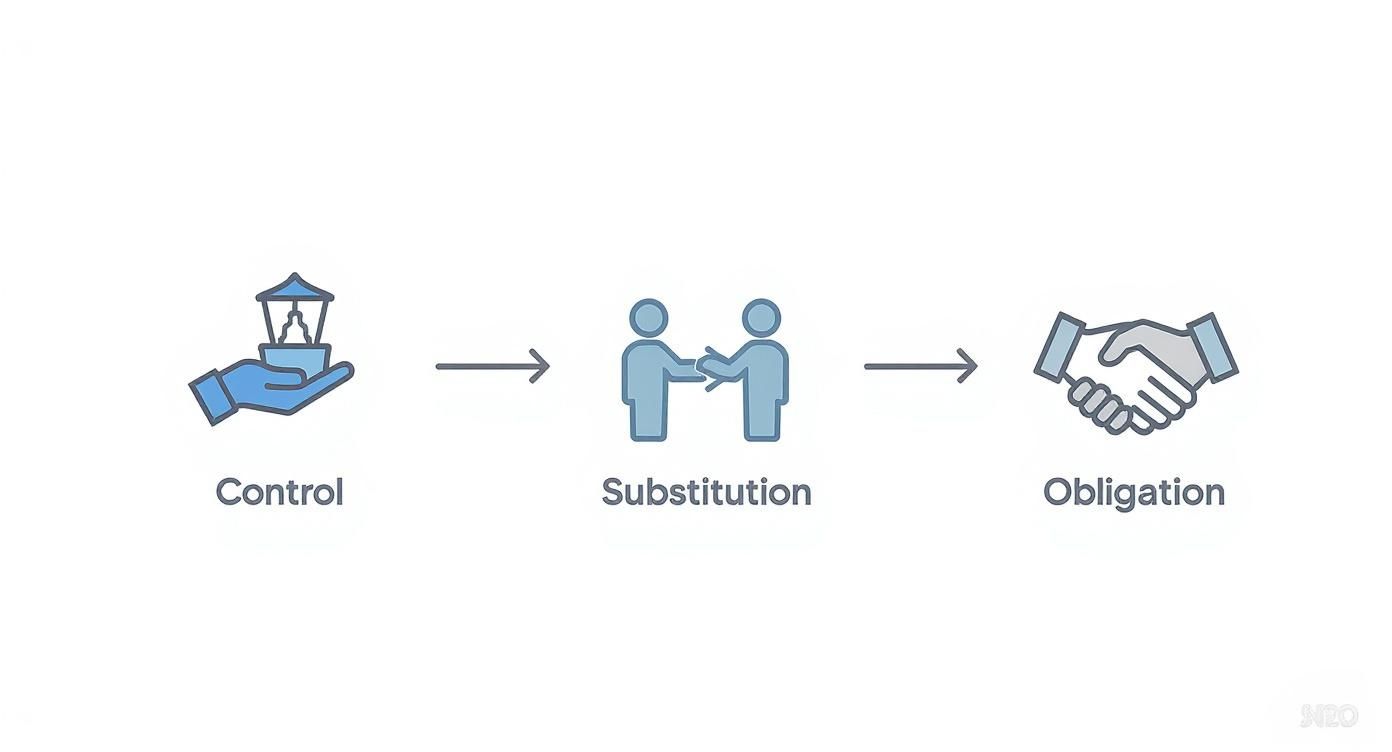
This shows how clients assess a contract against tests like Control, Substitution, and Obligation, which explains why many roles end up being classified as 'inside IR35'.
A Key Takeaway: The assignment rate is not your salary. It is a comprehensive rate that includes the funds needed to cover all employment costs plus your gross pay. A transparent payslip is the hallmark of a compliant provider.
If you’d like to dig even deeper into the payment flows and contractual relationships, have a look at our detailed guide on how does an umbrella company work. The whole setup is designed to handle IR35 compliance smoothly, taking the admin burden off your shoulders so you can focus on what you do best.
The Pros and Cons of Umbrella Companies for IR35
Deciding how to manage your contracting life isn't a small decision, and like anything, there are always trade-offs. Let's get into the nitty-gritty of using an umbrella company, especially when you've got an inside IR35 contract on your hands.
For many contractors, especially those new to inside-IR35 rules, an umbrella company can feel like a breath of fresh air. But it's not a one-size-fits-all solution. To figure out if it's the right move for you, you need a clear, honest look at both sides of the coin: the good, the bad, and the financial implications.
The Upside: Why Contractors Choose the Umbrella Route
Let's be honest, the biggest draw for most is sheer simplicity. Using an umbrella company strips away the administrative headache of running your own limited company. No more worrying about corporation tax, VAT returns, or complex accounting. You just focus on delivering great work for your client.
The other huge advantage is guaranteed compliance. Once you're an employee of an umbrella company, they handle all your Income Tax and National Insurance contributions through PAYE. This completely sidesteps any personal IR35 risk for that specific contract, which is a massive weight off your shoulders.
And it doesn't stop there. As a proper employee, you get access to statutory rights that you'd otherwise miss out on. These include:
- Statutory Sick Pay: A safety net if you're too ill to work.
- Holiday Pay: You build up paid time off, so you can actually take a break without your income flatlining.
- Workplace Pension: The umbrella company will set you up with a pension and make employer contributions.
This all helps build a continuous employment record. When it comes time to apply for a mortgage or a loan, lenders tend to smile on a consistent employment history. An umbrella provides just that.
In essence, an umbrella company for an inside IR35 contract wraps the freedom of contracting in the secure, stable framework of traditional employment. It's a hybrid that offers a practical solution to a complex problem.
The Downside: What Are the Trade-Offs?
Of course, nothing comes for free. The most obvious trade-off is the cost. Umbrella companies charge a fee, known as their margin, for managing your payroll and administration. It’s usually a fixed weekly or monthly amount taken from the money they process on your behalf.
The other major point to get your head around is how employment costs are handled. As an employee, your employer must pay Employer’s National Insurance and the Apprenticeship Levy. In the umbrella model, these costs are factored into and deducted from the assignment rate you agreed with the agency or client.
This can be a real sticking point for contractors who do not see it coming. It's vital to understand that the assignment rate isn't your direct salary; it's an all-inclusive figure designed to cover your gross pay plus all these necessary employment costs. This is exactly why a transparent, detailed payslip is the number one sign of a trustworthy, compliant umbrella company.
Umbrella Model for Inside IR35 Contracts: A Balanced View
To really see if this is the right path for your inside-IR35 work, it helps to see the pros and cons laid out side-by-side.
| Advantages | Disadvantages |
|---|---|
| Complete IR35 Compliance: Your tax obligations for the role are fully met, giving you total peace of mind. | Cost of Margin: You pay a fee for the administrative service provided by the umbrella company. |
| Statutory Employment Rights: You get access to sick pay, holiday pay, and a workplace pension. | Employment Costs Deducted: Employer’s NI is taken from the assignment rate before your pay is calculated. |
| Minimal Administration: Just submit your timesheets and your pay is processed. No company accounts to manage. | Lower Take-Home Pay: Compared to an outside-IR35 contract, your net pay will be lower due to PAYE. |
| Continuity of Employment: Creates a stable employment history, which is a big help for mortgages or loans. | Less Autonomy: You have less direct control over your financial affairs than you would running a PSC. |
So, what's the verdict? It all comes down to what you prioritise. If you're looking for simplicity, security, and a cast-iron guarantee of compliance for an inside IR35 role, the benefits of an umbrella company often make it a very sensible choice.
How To Choose A Compliant Provider And Avoid Scams

Picking the right umbrella company is one of the most important decisions you'll make as a contractor on an inside IR35 assignment. A compliant partner makes sure you're paid correctly and legally, whereas a dodgy scheme can leave you facing serious financial trouble and stiff penalties from HMRC.
This is your guide to doing the essential homework. We'll walk through the real dangers of fraudulent schemes, from disguised remuneration to mini-umbrella company fraud, so you know what you're up against. You’ll learn the clear red flags to spot and, just as importantly, the positive signs of a trustworthy, compliant provider.
The Dangers of Non-Compliant Schemes
The financial fallout from getting involved with a non-compliant umbrella company is no joke. HMRC reckons that in 2022–2023, at least £500 million in tax was lost to these schemes, and that’s not even counting the hundreds of millions more lost to 'mini umbrella company' fraud.
Because of this, new laws are making recruitment agencies, and sometimes even the end clients, liable for unpaid tax. These dodgy schemes often hook contractors with promises that sound too good to be true, leaving them personally on the hook for unpaid taxes, interest, and penalties years later. It’s a risk you just can't afford to take.
Red Flags To Watch Out For
Spotting a non-compliant umbrella company is actually pretty simple if you know the signs. Be on high alert if a provider makes any of these promises:
- Unrealistically High Take-Home Pay: Any offer to let you keep 85% or more of your contract value is a massive red flag. Compliant PAYE payroll just does not work that way.
- Payments via Loans or Grants: If your payslip shows money coming to you as 'loans', 'grants', or anything other than taxable income, you're likely looking at a disguised remuneration scheme. All of your earnings should be treated as salary.
- Lack of Transparency: Vague answers about how your pay is worked out or a flat-out refusal to provide a clear payslip breakdown is a dealbreaker.
- Offshore Operations: Companies based in offshore tax havens are best avoided. They often operate outside of UK tax law, putting you at risk.
A simple rule of thumb: if an offer sounds too good to be true, it almost certainly is. There are no secret loopholes that let one compliant provider pay you more than another. Your take-home pay should be very similar across all legitimate umbrella companies.
Hallmarks of a Trustworthy Provider
Thankfully, spotting a good, compliant provider is just as straightforward. When you're weighing up your options, look for companies that have solid processes for managing your contracts; it’s a key sign of their professionalism and reliability. For a deeper dive, understanding contract lifecycle management best practices can give you a better idea of what to look for.
The single most important thing, though, is official accreditation from a reputable UK body. These organisations carry out tough annual audits to make sure their members are meeting the highest standards of compliance.
We strongly recommend you only work with providers accredited by:
- The FCSA (The Freelancer & Contractor Services Association): This is the UK's leading membership body for compliant providers.
- Professional Passport: Another highly respected, independent assessor that vets payment intermediaries.
This accreditation is your best guarantee that a provider is above board, processing your pay correctly, and keeping you safe from risk. For a full checklist, have a look at our guide on finding a good umbrella company.
Got Questions? We’ve Got Answers
Stepping into the world of umbrella companies and IR35 can feel a little confusing at first. It’s only natural to have a few questions. We’ve put together some quick, straightforward answers to the queries we hear most often from contractors just like you.
Think of this as your final checklist to clear up any lingering doubts before you dive in.
Does Using an Umbrella Company Mean I’m Outside IR35?
This is a common mix-up, but the answer is no. Think of it this way: the end client is the one who decides if a specific role falls ‘inside’ or ‘outside’ IR35. They look at the job itself and your working practices.
If they determine the role is ‘inside IR35’, it’s because the work is similar to that of a permanent employee for tax purposes. By joining an umbrella company for that contract, you effectively become their employee. They handle all your tax and National Insurance through PAYE, which neatly satisfies HMRC’s rules for an inside-IR35 engagement.
So, while the role is still technically ‘inside’, the umbrella structure takes the IR35 compliance burden completely off your shoulders.
Why Do I Have To Pay Employer’s National Insurance?
In the eyes of the law, the umbrella company is your employer. That means they’re legally required to pay Employer’s National Insurance Contributions (NICs) on your earnings, just like any other business in the UK. There’s no getting around it.
This is why the assignment rate you see advertised by a client or agency is an all-inclusive figure. It’s not just your take-home pay; it’s a total pot of money designed to cover all employment costs, which includes the Employer’s NI, the Apprenticeship Levy, your holiday pay, and the umbrella’s margin. A compliant, trustworthy provider will always break this down clearly on your payslip.
Key takeaway: The assignment rate is the total cost to the client for your services, not your personal salary. Any good umbrella company will walk you through this from the very start.
Can I Claim Business Expenses Through an Umbrella Company?
The rules on this tightened up significantly back in 2016. For the vast majority of umbrella contractors, claiming tax relief on day-to-day travel and food costs for your main workplace is no longer an option. This is because HMRC generally considers you to be under ‘Supervision, Direction, or Control’ (SDC).
While there might be some highly specific, work-related expenses you can claim, it’s not the norm. You should always double-check the exact policy with your chosen provider. Be very suspicious of any company promising you can claim huge, vague expenses, as it’s one of the biggest red flags for a non-compliant tax avoidance scheme.
What If My Next Contract Is Outside IR35?
That’s a perfectly normal part of being a career contractor. Many contractors find themselves switching between inside and outside IR35 roles. It’s simple: you just use the umbrella company for your inside IR35 contracts to stay compliant.
When you land a contract that’s genuinely determined to be ‘outside IR35’, you’re free to operate through your own Personal Service Company (PSC) as usual. A lot of contractors keep both options open, picking the right one for each job. This flexibility lets you adapt to the market while making sure you’re always playing by the rules.
Ready to navigate IR35 with confidence? At UmbrellaCompany.com, we make it easy to find and compare accredited, compliant umbrella companies. Find the perfect fit for your next contract in minutes.


