


So, you have heard the term ‘umbrella company’ thrown around, but what does it actually mean for you as a contractor? This guide explains everything you need to know.
Put simply, an umbrella company is a business that employs independent contractors who work on temporary or fixed-term assignments. It slots in between you and your end client (or the recruitment agency), taking care of all the payroll admin so you do not have to.
What Does an Umbrella Agency Actually Do?
Let's cut through the jargon. Think of an umbrella company as a central payroll hub for contractors. It becomes your official employer, handling all the fiddly bits like tax, National Insurance contributions, and pension payments.
This setup gives you the freedom of contracting without the headache of running your own limited company. The whole point is to offer a simple employment structure for a temporary workforce. When you join, you officially become an employee of the umbrella company. This gives you a single, continuous employment record, even if you move between different projects and clients.
A Simple Analogy
Imagine you are a freelance photographer who shoots for different magazines and brands throughout the year. Instead of sending separate invoices and figuring out the tax for each job, you join a photographers' collective.
This collective invoices the magazines on your behalf, pays you a regular salary with all the tax sorted, and lets you focus on what you do best: taking great photos. That collective is your umbrella company. It creates a stable employment relationship, making your financial admin much simpler.
For a deeper dive into the nuts and bolts, you can learn more about how an umbrella company works in our detailed guide.
To give you a clearer picture, here is a quick summary of what an umbrella company does.
Umbrella Agency at a Glance
| Feature | Description |
|---|---|
| Employment Status | You become a formal employee of the umbrella company under a contract of employment. |
| Payroll Management | All your earnings are processed through PAYE, with tax and NI deducted at source. |
| Invoicing & Payments | The umbrella invoices the end client/agency and pays you a salary after deductions. |
| Statutory Rights | As an employee, you get access to holiday pay, sick pay, and a workplace pension. |
| Administrative Burden | Minimal. The umbrella handles timesheets, payroll, and compliance for you. |
Essentially, the umbrella company takes the administrative weight off your shoulders. This leaves you free to concentrate on your contract work.
Key Functions and Responsibilities
An umbrella company is there to simplify your contracting life by managing a few critical tasks. Its main duties include:
- Processing Your Payroll: It calculates and deducts the right amount of Income Tax and National Insurance through the PAYE (Pay As You Earn) system.
- Managing Invoices: The umbrella company raises invoices to your recruitment agency or client for the work you have completed.
- Providing Employment Rights: Because you are an employee, you get statutory benefits like holiday pay, sick pay, and access to a workplace pension.
- Ensuring Tax Compliance: It takes away the stress of self-assessment tax returns for your contract income and makes sure you are fully compliant with HMRC rules.
How an Umbrella Company Works in Practice
So, you have decided to use an umbrella company. What happens next? Understanding how the money flows is the key to getting your head around the whole setup. It is actually quite simple and designed to take the admin burden off your shoulders from the moment you land a new contract.
Here is how we handle it. First, we get the right paperwork in place. The umbrella company (that is us) signs a contract with your recruitment agency. Then, you sign a separate employment contract with us. This creates a clear, legally sound chain connecting everyone involved.
The Payment Journey
The way you get paid follows a consistent and transparent path. It all kicks off when you submit your timesheets. Based on those hours, the umbrella company sends an invoice to your agency or the end client.
Once the agency settles that invoice, the money lands in the umbrella company's account. It is important to know that this payment is the full contract value, not your salary just yet. From there, the umbrella processes this income through its PAYE system, exactly like any other employer in the UK would.
This diagram breaks down the flow of money and agreements, showing how it moves from the client, through the agency and umbrella, and finally to you.
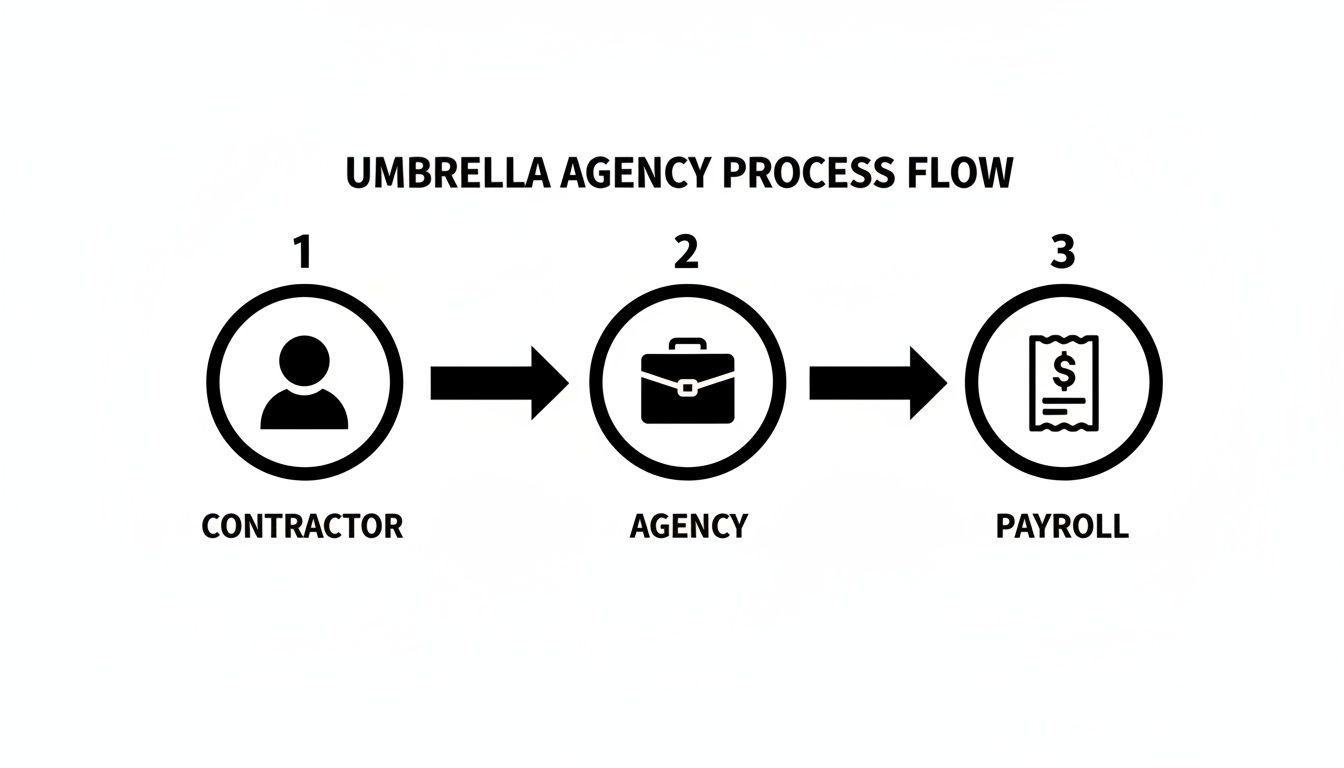
As you can see, the umbrella company sits right in the middle. It manages the financial side of things and acts as your official employer.
Understanding Your Payslip
After the funds are processed, you will receive your salary along with a detailed payslip. This document is crucial because it shows you exactly where every penny has gone. It will clearly itemise every deduction made from the gross contract funds received from the client.
A fully compliant payslip will always show:
- The umbrella company’s margin, which is their fee for the service.
- Standard statutory deductions like Income Tax and National Insurance Contributions.
- Any money being paid into your workplace pension scheme.
- Other employer costs, including the Apprenticeship Levy and Employer's National Insurance.
It is absolutely vital to remember that costs like Employer's NI are a legal requirement for any UK employer. A compliant umbrella company will always show these deductions clearly on your reconciliation statement so you have full visibility of how your take-home pay is calculated. This transparency is your best defence against non-compliant schemes that try to hide these costs.
Umbrella Company vs Other Contractor Models

Knowing the umbrella agency definition is a great start, but the real test is seeing how it stacks up against the other ways of working. As a contractor in the UK, you have options. Each one comes with its own unique blend of responsibilities, perks, and headaches.
Picking the right path really boils down to your personal situation and where you are heading in your career. The main alternatives you will come across are running your own Personal Service Company (PSC), often just called a limited company, or getting paid directly through agency PAYE. Each one strikes a different balance between control, admin, and your rights as a worker.
To help you get your head around the choices, here is a quick comparison of the three main models.
Contractor Work Models Compared
| Factor | Umbrella Company | Personal Service Company (PSC) | Agency PAYE |
|---|---|---|---|
| Admin Burden | Very Low – they handle it all | Very High – you're the director | None – the agency does it |
| Employment Status | Employee of the umbrella | Company Director | Employee of the agency |
| IR35 Risk | No risk to you | Your responsibility (unless client is large/medium) | No risk to you |
| Take-Home Pay | Good (PAYE after costs) | Potentially the highest | Lowest |
| Continuity | Yes, continuous employment | Yes, your company is continuous | No, employment ends with each contract |
| Best For | Simplicity, short-term contracts, IR35 concerns | Career contractors, higher earners, outside IR35 | Very short-term or temporary work |
This table gives you a snapshot, but let's dive into what each of these really feels like day-to-day.
Personal Service Company (PSC)
Going down the PSC route means you are not just a contractor; you are the director of your very own limited company. It is the path that offers the most control and, often, the highest take-home pay, thanks to tax-efficient strategies like mixing a small salary with larger dividend payments.
But all that freedom comes with a serious amount of admin. You are legally on the hook for everything.
- Filing annual accounts and confirmation statements with Companies House.
- Managing Corporation Tax, VAT returns, and PAYE for your salary.
- Sorting out business insurance like professional indemnity and public liability.
- Getting to grips with complex IR35 legislation yourself, which carries a hefty risk if you get it wrong.
For a much deeper dive, check out our guide on the differences between an umbrella company vs a limited company. This model is really built for career contractors who are in it for the long haul and do not mind wearing a business owner's hat.
A PSC puts you in the driver's seat, but you are also the sole mechanic responsible for keeping the engine running. An umbrella company, on the other hand, handles all the maintenance for you, letting you focus purely on the journey.
Agency PAYE
The most straightforward alternative is simply getting paid via agency PAYE. In this setup, the recruitment agency that finds you the gig also acts as your employer for tax purposes. They will sort out your Income Tax and National Insurance deductions before the money hits your bank account, just like a regular employee.
While it is incredibly simple, it has its downsides. Your employment only lasts as long as that specific contract. If you find your next role through a different agency, that continuity of employment is broken. This can be a real pain when you are applying for a mortgage or a loan. You also miss out on some of the statutory benefits an umbrella employee gets, like a workplace pension.
Agency PAYE is the no-frills option. It is all about simplicity, but it does not offer the comprehensive employment wrapper you would get elsewhere.
Understanding IR35 and Umbrella Company Compliance
The IR35 off-payroll working rules completely changed the game for UK contractors. In short, these rules are HMRC's way of making sure contractors who work like permanent employees pay a similar amount of tax and National Insurance.
This is precisely where a good, compliant umbrella company steps in. If a contract is deemed ‘inside IR35’, working through an umbrella is often the cleanest and most straightforward route for everyone involved: the contractor, the agency, and the end client.
The logic is simple. When you are with an umbrella company, you are their PAYE employee. This setup inherently ticks all the boxes for HMRC on an inside IR35 role because your tax and NI contributions are deducted right at the source, just like any other employee.
Removing the Compliance Burden
One of the biggest reliefs of using a compliant umbrella company is that it takes the IR35 risk off the table for you, your recruitment agency, and the client. That sense of security is huge. The tricky business of determining your employment status for tax has been sorted, and the correct deductions are handled automatically.
This model has become indispensable since the IR35 reforms. In fact, HMRC figures show that during 2022-2023, UK umbrella companies were a cornerstone of the flexible labour force, engaging a massive 700,000 workers. It just goes to show how vital they have become for helping clients and contractors navigate tax compliance.
The Critical Need for Caution
But with this surge in demand, a darker side has emerged: dishonest operators. It is absolutely crucial to pick a trustworthy provider to avoid getting tangled up in non-compliant tax avoidance schemes. These dodgy outfits often lure people in with promises of unbelievably high take-home pay, but they can land you in serious trouble with HMRC later on.
A legitimate umbrella company will always be completely transparent about its margin and show you every single deduction on your payslip. For a more detailed breakdown, our guide on the relationship between IR35 and umbrella companies is a great resource.
Always remember: if an offer sounds too good to be true, it almost certainly is. Sticking with a fully compliant, accredited provider is the only way to protect your finances and your professional reputation. Your financial security really does depend on it.
How to Choose a Compliant Umbrella Agency
Picking the right umbrella company is one of the most important calls you will make as a contractor. Your choice has a direct impact on your take-home pay, your tax compliance, and frankly, your ability to sleep at night. A good partner makes sure you are paid correctly and on time, but a dodgy one could land you with a nasty surprise tax bill from HMRC.
The very first red flag is an offer that seems too good to be true. Be wary of any provider promising unrealistic take-home pay, often flaunted as 80% or higher. These outfits are usually tax avoidance schemes, often using tactics like disguised remuneration where they pay you in non-taxable 'loans'. If it sounds like a dream, it is almost certainly a nightmare waiting to happen.

Look for Professional Accreditation
By far the most reliable way to find a provider you can trust is to check for accreditation from a professional body. In the UK, the two names you need to look for are the FCSA (The Freelancer & Contractor Services Association) and Professional Passport.
These organisations do not just hand out badges. They carry out rigorous, independent audits to make sure their members are hitting the highest standards for compliance and ethical conduct. When you choose an accredited provider, you are getting peace of mind that they operate above board. For a deeper dive, you can read more about the benefits of working with an FCSA-accredited umbrella company in our guide.
Key Red Flags to Avoid
Sadly, non-compliant schemes are a serious problem. During 2022-2023 alone, HMRC identified a staggering £500 million in losses from disguised remuneration schemes. Almost all of these were linked to umbrella companies using convoluted structures to dodge their tax obligations. You can get more insight into this issue and the wider UK umbrella market over at goqdos.com.
To keep yourself safe, keep a sharp eye out for these warning signs:
- Unusually High Take-Home Pay: Any promise of keeping more than a standard PAYE calculation would allow is a massive red flag.
- Confusing or Hidden Fees: A compliant company will charge a simple, fixed weekly or monthly margin. Run a mile from anyone taking a percentage of your earnings or using a baffling fee structure.
- Payments from Multiple Sources: Your salary should come from one place (the umbrella company itself, which is your UK-based employer).
- Being Asked to Sign Loan Agreements: You are being paid for your work; it is not a loan. This is a classic tax avoidance tactic.
A compliant umbrella company will always provide a clear and detailed payslip. It should show every single deduction, including their margin, PAYE tax, National Insurance, and any pension contributions. Full transparency is not just a nice-to-have; it is the hallmark of a provider you can trust.
Your Umbrella Agency Questions Answered
To wrap things up, let's tackle a few of the most common questions contractors have about umbrella agencies. Think of this as a quick-fire round to clear up any lingering doubts.
Do I Have to Use an Umbrella Company?
No, it is not compulsory. But here is the thing: for any contract that falls ‘inside IR35’, you will find that most clients and recruitment agencies now insist on it.
This is not them being difficult; it is about managing risk. By making sure you are paid through a compliant umbrella company, they know for a fact that all the right tax and National Insurance are being handled via PAYE. It neatly takes the compliance headache away from them and has become the standard way to handle inside IR35 roles.
What’s the Real Appeal?
For many modern contractors who just want to get on with their work without the administrative burden, working through an umbrella has some pretty clear advantages.
The main attractions are:
- Zero Admin: You can forget about the hassle of running a limited company. No invoicing, no chasing payments, and no business tax returns to worry about.
- A Single Employment Record: Even if you jump between different contracts and clients, you have one continuous record of employment. This is a massive help when you need to apply for a mortgage or a loan.
- Proper Employee Rights: As a legal employee of the umbrella, you get the protections that come with it. This means statutory holiday pay, sick pay, and a workplace pension are all part of the package.
What Will This Cost Me?
Any legitimate, compliant umbrella company will charge a simple, fixed margin for handling your payroll and admin. This is a flat fee, usually taken weekly or monthly, and it comes off your gross contract earnings before any tax is calculated.
You should expect this margin to be somewhere between £15 and £30 per week. If a provider starts talking about charging a percentage of your earnings or dangles unbelievably high take-home pay in front of you, walk away. These are giant red flags for dodgy, non-compliant tax avoidance schemes.
Ultimately, choosing a transparent, compliant provider is the most important decision you will make. It is the only way to protect your finances and be certain you are meeting all your tax obligations.
Navigating the contracting world can feel like a maze, but you do not have to figure it out on your own. UmbrellaCompany.com makes it easy to compare accredited, trustworthy umbrella companies in minutes, helping you find the right fit for you.
Ready to find a compliant partner? Visit UmbrellaCompany.com to get started.


