


Picking an umbrella company is one of the most important financial decisions any UK contractor will make. Getting it right means your taxes are handled, your employment rights are protected, and you can focus on your work. A proper uk umbrella company comparison is the only way to be sure you are with a provider you can trust. Get it wrong, and you could be facing serious financial and legal headaches down the line.
In this guide, we will explain why comparing providers is so critical, what separates a great umbrella from a risky one, and provide a clear framework to help you make an informed choice.
Why a UK Umbrella Company Comparison Is Crucial in 2026

This is not just about administration. The umbrella company you choose directly affects your take-home pay, your legal standing, and ultimately, your peace of mind. With the rules for contractors constantly changing, taking the time to compare your options properly has never been more important.
Making a poor choice can backfire badly. We are talking about everything from surprise tax bills from HMRC to legal trouble that could jeopardise future contracts. Here at UmbrellaCompany.com, we want to give you the practical knowledge to see the difference between a good provider and a risky one.
Evolving Legislation and Increased Accountability
The government is cracking down on non-compliance, and the entire contracting supply chain is now being held accountable. New legislation from the Finance Bill 2025-26 is expected to introduce stricter measures, building on existing rules that hold recruitment agencies and end clients financially responsible for unpaid taxes caused by a non-compliant umbrella company.
This is a massive shift. It means recruitment agencies and even end clients can be held financially responsible for unpaid taxes caused by a non-compliant umbrella company. With an estimated £2.8 billion in tax revenue at stake by 2029-30, this legislation is designed to push rogue operators out of the market for good.
For you, this means that a thorough uk umbrella company comparison is no longer just a personal task, it is a professional necessity. The agencies and clients you work with will be more cautious than ever, and they will want to see that you are partnered with a transparent, accredited umbrella.
What Truly Matters in a Comparison
A smart comparison looks past the weekly margin. While cost is obviously a factor, your focus should be on these core areas to make sure you are signing up with a provider that is genuinely secure and trustworthy.
- Compliance and Accreditation: Is the company accredited by a professional body like the FCSA (The Freelancer & Contractor Services Association)? This is the single best indicator that they operate correctly and to a high standard. You can learn more in our detailed guide on what FCSA accreditation means for you.
- Transparent Fees and Payslips: A legitimate provider will always have a simple, fixed margin with no hidden charges. Your payslip should be crystal clear, showing every deduction for tax, National Insurance, and their margin, leaving no room for confusion.
- Comprehensive Insurance: Check that the essentials, Professional Indemnity, Public Liability, and Employers' Liability insurance, are included as standard in their service. You should not have to pay extra for this fundamental protection.
- Reliable Service and Support: Good service means you get paid on time, every time. It also means having access to an easy-to-use online portal and a support team that actually knows what they are talking about and can answer your questions without delay.
What Really Makes an Umbrella Company Great?
Before you start a uk umbrella company comparison, it helps to know what separates a genuinely reliable partner from a high-risk scheme. Choosing the right umbrella is not just about the weekly margin. It is about protecting your income and making sure you do not face any nasty surprises from HMRC down the line.
A proper umbrella company acts as your employer, handling all the administration so you can focus on your contract. Getting this right is your first line of defence. Once you understand the fundamentals of a legitimate umbrella, you can quickly spot the dodgy operators and focus on providers that actually support you.
PAYE Compliance: The Non-Negotiable Baseline
The most critical job of an umbrella company is to act as your employer for tax purposes. This means they are legally required to process all your earnings through the Pay As You Earn (PAYE) system, just like any other UK employer would.
The compliant process is straightforward: your agency or client pays the umbrella for your work, and the umbrella then pays you as an employee. From that payment, they calculate and deduct the correct amounts for:
- Income Tax
- Employee's National Insurance Contributions
- Employer's National Insurance Contributions
- Student loan repayments (if applicable)
- Pension contributions
Your payslip should show every single one of these deductions clearly, along with the umbrella's margin. If you see any mention of "loans," "advances," or confusing payment structures, it is a massive red flag for a tax avoidance scheme.
Compliant vs Non-Compliant Umbrella Indicators
| Indicator | Compliant Umbrella (What to Look For) | Non-Compliant Scheme (Warning Signs) |
|---|---|---|
| Take-Home Pay | Realistic take-home pay, typically 60-70% of your contract rate. | Unbelievably high take-home pay, often advertised as 85-95%. |
| Payment Structure | A single payment processed through PAYE, clearly shown on a payslip. | Complex payment structures involving "loans," "credits," or "advances." |
| Accreditation | Proudly displays accreditation from FCSA or Professional Passport. | No accreditation, or they claim to have their own "in-house" approval. |
| Payslip Details | All deductions (Tax, NI, margin) are listed transparently. | Vague or missing details; payments may be split and hard to understand. |
| Onboarding | A standard employment contract and thorough identity checks. | Minimal checks, unusual contracts, or pressure to sign up quickly. |
Always remember: if a provider's payment model seems too good to be true or is intentionally confusing, it almost certainly involves a level of risk you cannot afford to take.
The Value of Official Accreditation
In an unregulated industry, accreditation is your mark of quality control. The two main bodies to look for are the FCSA (The Freelancer & Contractor Services Association) and Professional Passport. These organisations carry out strict, independent audits to make sure umbrella companies follow HMRC rules and their own codes of conduct.
Choosing an accredited provider should be non-negotiable. It is your assurance that the company has been properly vetted and is committed to operating above board. You can learn more in our guide to choosing FCSA-accredited umbrella companies.
Insurance and Employment Rights are Standard, Not Extras
A great umbrella does more than just payroll; it gives you the benefits and protections that come with permanent employment. This must include comprehensive insurance cover as standard, never as a paid add-on.
Look for providers that include Employers' Liability, Public Liability, and Professional Indemnity insurance in their margin. These policies protect you financially if something goes wrong on a contract.
As an employee of the umbrella, you are also entitled to full statutory rights. This means you should receive:
- Statutory Sick Pay (SSP) if you are too ill to work.
- Enrolment into a workplace pension scheme.
- Access to maternity, paternity, or adoption pay.
- A clear and fair system for your accrued Holiday Pay.
These are not optional perks; they are your legal rights. A reputable umbrella will be completely transparent about how you access them, cementing a professional and supportive relationship.
Your Framework for Comparing Umbrella Companies
Choosing the right umbrella company goes far beyond just glancing at the weekly fee. A proper UK umbrella company comparison demands a more thorough, structured approach. You need to dig into the details that genuinely impact your finances, legal standing, and overall experience as a contractor. This framework is your guide to asking the tough questions and making a decision based on solid facts, not just slick marketing.
Think of it like any other professional evaluation, such as in this detailed LexisNexis vs Westlaw comparison. A methodical process is key to covering all the critical angles. We will break down exactly what you need to assess, giving you a checklist to work through.
Margin Structures and True Costs
The most obvious cost is the umbrella's margin, their fee for processing your payroll. But how they structure that margin can make a real difference to your take-home pay.
You will typically come across two models:
- Fixed Margin: A flat fee, say £25 a week, is deducted each time you are paid. It is straightforward, predictable, and makes forecasting your income easy.
- Percentage Margin: The umbrella takes a percentage of your invoice value. This is much less common now, and for good reason. As you earn more, so does the umbrella company.
For most contractors, a fixed margin is the clear winner. Its transparency means you know exactly what you are paying, no matter how much your income might vary from one month to the next.
Key Question to Ask: "Is your margin a fixed amount per payment? Are there any other hidden charges I should know about, like joining fees, leaving penalties, or extra costs for processing expenses?"
Onboarding and Payroll Reliability
A smooth start and reliable, on-time payments are the hallmarks of a professional organisation. The onboarding process should be simple, with clear guidance on submitting your documents and signing your employment contract.
Just as critical is payroll reliability. A top-tier provider has a rock-solid reputation for paying contractors on time, every time. Delays are not just an inconvenience; they can cause genuine financial stress. Scour reviews and testimonials for specific mentions of payment consistency.
To help you get this right, the decision tree below maps out the essential checks for compliance, accreditation, and transparency.
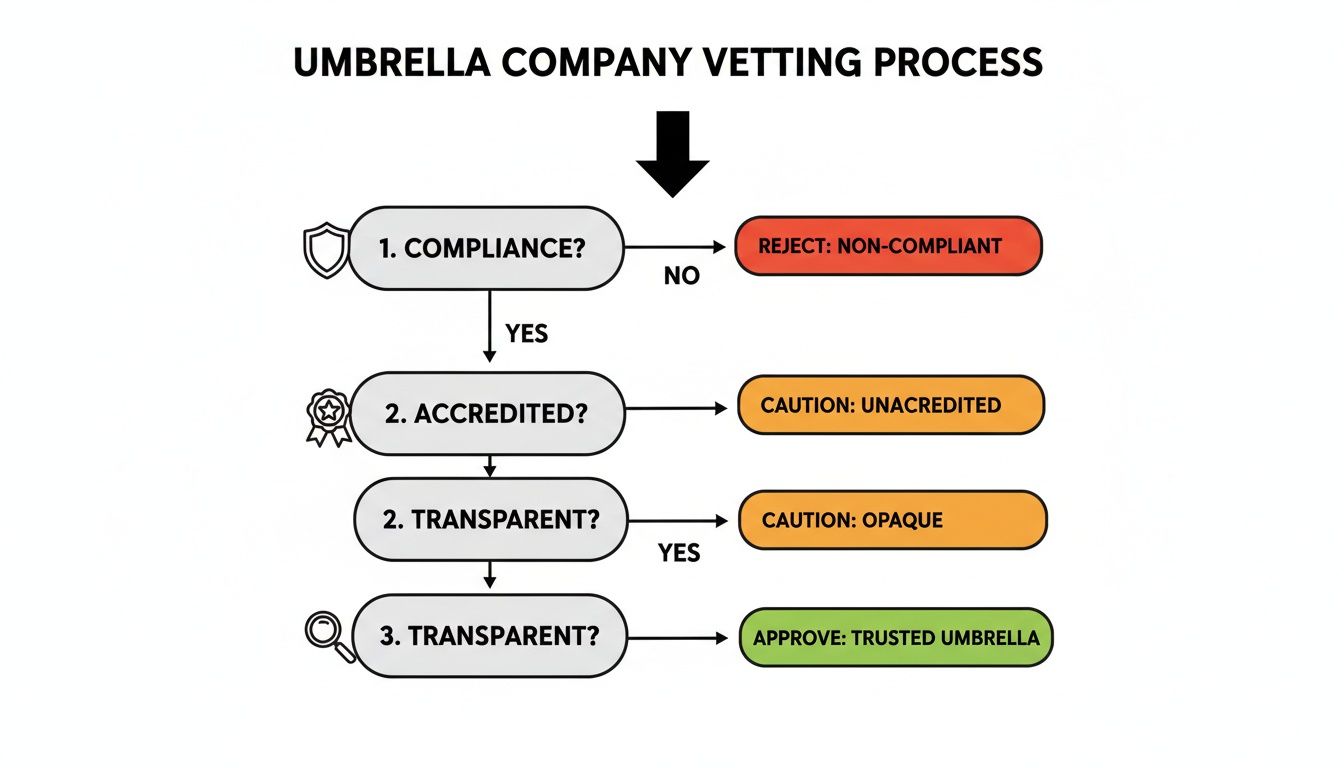
This process reinforces a simple truth: a compliant, accredited provider with transparent practices is the only safe choice.
Key Question to Ask: "Can you walk me through your onboarding process? What is your track record for on-time payments, and can you guarantee I will be paid the same day you receive funds from my agency?"
Pension Contributions and Options
As an employee of the umbrella company, you are legally entitled to be auto-enrolled into a workplace pension. Every compliant provider must offer this, contributing a minimum percentage of your earnings alongside your own contributions.
The quality of this provision, however, can differ significantly. Some providers stick to the basic government-mandated scheme (like NEST), while others give you access to more flexible private pension schemes with better investment options.
A major differentiator is their approach to salary sacrifice. This is an incredibly tax-efficient method for boosting your pension pot, as contributions are taken from your gross pay before tax and National Insurance are deducted. If long-term saving is a priority for you, this feature should be high on your list.
Key Question to Ask: "Which pension scheme do you use? Crucially, do you offer a salary sacrifice arrangement to make my contributions more tax-efficient?"
Customer Support and Dedicated Contacts
When you have a question about your payslip or tax code, you need a fast, clear answer from someone who knows what they are talking about. The quality of a provider's customer service can make or break your experience.
The best umbrella companies give you a named account manager or direct access to a small, knowledgeable team. This means you are not re-explaining your situation every time you call. Being stuck in a generic call centre queue is a frustrating waste of your time.
When weighing them up, consider:
- Accessibility: Can you easily reach them by phone and email during business hours?
- Expertise: Does the person on the other end actually understand contractor payroll inside and out?
- Personalisation: Will you have a dedicated contact, or will you be passed from pillar to post?
Key Question to Ask: "Will I get a dedicated account manager? What are your typical response times for phone and email queries?"
Technology and Online Portals
In this day and age, a decent online portal is non-negotiable. This is your hub for submitting timesheets, viewing payslips, and checking your details. A clunky, outdated system turns simple administration into a real headache.
When you are looking at a provider's technology, check if their portal is:
- Intuitive: You should not need a user manual to find your latest payslip.
- Mobile-Friendly: The ability to manage your account from your phone is essential when you are working on-site or on the go.
- Secure: The portal holds a lot of sensitive data, so it must be protected with robust security measures.
Many providers will happily give you a demo of their portal before you commit. Take them up on the offer, it is the best way to get a real feel for whether their system will work for you.
Key Question to Ask: "Can you show me a demo or screenshots of your online portal? Is it fully functional on mobile and properly secure?"
Sector Specialisation
While most compliant umbrellas can handle contractors from any industry, some have built up real expertise in specific fields like IT, healthcare, or education.
This specialisation can be a huge plus. The provider will already be familiar with the contract terms, working practices, and specific compliance hurdles in your line of work. They often have long-standing relationships with the main recruitment agencies in your sector, which can make everything run that much smoother. It is not a deal-breaker, but it is certainly a valuable bonus.
Key Question to Ask: "Do you have a lot of experience with contractors in my industry? How does that experience benefit the contractors you work with?"
How to Run Your Own Comparison in Minutes

Now that you have a solid framework for what to look for, it is time to put it into action. This is where you can conduct a quick, effective, and personalised UK umbrella company comparison with our free tool, turning your checklist into a shortlist of vetted, compliant providers without spending hours digging through websites.
We built our comparison portal to cut through the noise. It only lists accredited companies, so you are starting from a safe baseline. From there, you can filter based on what truly matters for your specific contract. Here’s how to get a result that is right for you in just a few clicks.
Step 1: Start with Your Contract Details
First things first, plug in the basics of your assignment. This initial information is crucial because it allows our system to instantly filter out irrelevant options and show you only those that are a genuine fit for your situation.
You will just need to enter three key details:
- Your Contract Rate: Pop in your daily or hourly rate. This helps generate illustrative take-home pay figures, making the comparisons financially meaningful.
- IR35 Status: Is your contract inside or outside IR35? This is a critical filter that determines the required payroll structure.
- Industry Sector: Choose your line of work, whether it is IT, healthcare, or engineering. This helps us point you towards providers with specialist experience in your field.
Simply defining these three things moves you from generic, overwhelming lists to a genuinely useful, bespoke comparison.
Step 2: Use Our Filters to Refine Your Search
Once you have entered your details, you will see a list of suitable umbrella companies. Now you can get more specific and apply filters to find your ideal match, using the framework we have already discussed.
Think of these filters as your way of telling the tool what your priorities are. You can sort and refine the results based on:
- Margin (Fee): Instantly compare each company’s weekly or monthly fixed margin. Sorting from lowest to highest is a great way to spot the most cost-effective options at a glance.
- Accreditation: While we only list accredited providers, you can filter for just FCSA or Professional Passport members if your agency or client requires one specifically.
- Pension Options: This is a big one. You can look for providers offering salary sacrifice pensions, which is a key filter for any contractor looking to maximise their tax-efficient savings.
This is where you take control, prioritising what is important to you beyond just the headline fee.
Step 3: Compare Providers Side-by-Side
Our comparison table is designed for absolute clarity, letting you analyse the most important details in one simple view. It makes your UK umbrella company comparison straightforward and fast.
This side-by-side format means you can directly evaluate things like the weekly margin, key benefits, and accreditation status without juggling multiple browser tabs or spreadsheets.
By presenting pre-vetted, compliant providers in a clear, filterable format, our tool removes the risk and administrative headache from your decision. It is about giving you the confidence that every option you see is a safe one.
From this screen, you can click through to read more detailed reviews, check specific perks like their insurance cover, and get a better feel for each company. If you want to understand exactly how the numbers add up, our handy PAYE vs umbrella calculator provides a full breakdown. We aim for total transparency so you can make your choice with confidence.
Warning Signs and Red Flags to Avoid
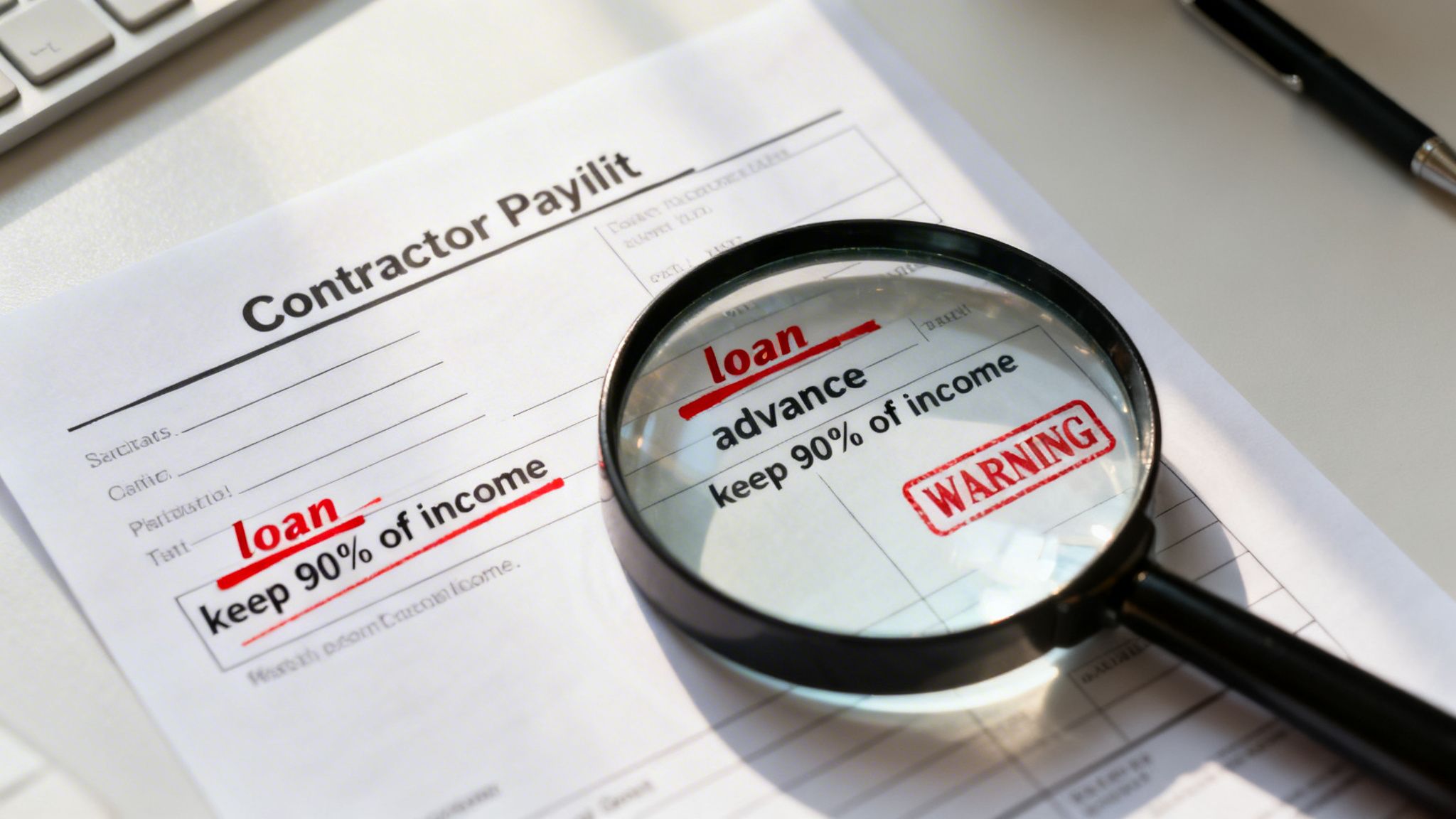
When you are comparing umbrella companies, spotting the bad actors is just as important as finding the good ones. The market is unfortunately littered with rogue providers and disguised remuneration schemes, all dangling the promise of higher pay. Fall for one, and you could be exposed to enormous financial and legal risks down the line.
Think of this as your field guide to spotting trouble. Knowing these red flags is your single best defence against a non-compliant arrangement and the huge, unexpected tax bill from HMRC that inevitably follows.
Unrealistic Take-Home Pay Promises
The oldest trick in the book is the promise of ridiculously high take-home pay. If you see an umbrella company advertising that you can keep 85%, 90%, or even 95% of your income, your alarm bells should be ringing loudly.
Here is the reality: every compliant umbrella company in the UK must process your earnings through PAYE. After they deduct income tax, National Insurance, and other legal contributions, you can realistically expect to take home between 60% and 75% of your gross rate. Anything significantly higher than that is not just suspicious; it is a clear signal of a tax avoidance scheme.
The 'Loan' or 'Advance' Payment Structure
So, how do they create these fantasy take-home figures? Usually, it is with a deceptive payment model. You will find a small fraction of your earnings is paid as a 'salary' through PAYE, but the lion's share is paid to you disguised as something else entirely.
This non-taxed chunk might be described on your payslip as a:
- Loan
- Credit
- Advance
- Investment return
- Annuity
This is the textbook definition of a disguised remuneration scheme. HMRC's stance on this is unwavering: these payments are income and are fully taxable. Getting involved with a scheme like this, even unknowingly, can leave you personally liable for all the unpaid tax, plus interest and hefty penalties, often years after the fact. We cover this in more detail in our guide to finding a tax-efficient umbrella company in the UK.
If your payslip shows a small 'salary' and a large, non-taxed second payment, you are almost certainly involved in a tax avoidance scheme. You must stop using that provider immediately to limit your liability.
Understanding Mini Umbrella Company (MUC) Fraud
Another nasty model to be aware of is Mini Umbrella Company (MUC) fraud. This is a complex web spun purely to abuse government schemes like the Employment Allowance and VAT Flat Rate Scheme, which are intended for genuine small businesses.
In a MUC setup, you are shuffled through a series of tiny, newly formed limited companies. Each one employs just a few contractors before being dissolved, making it nearly impossible for HMRC to chase down the unpaid taxes. While you might not be actively participating in the fraud, your association with it puts you in a very risky position.
Other Critical Red Flags to Watch For
Beyond the big, headline-grabbing schemes, there are other, more subtle signs that a provider is not playing by the rules. Keep your eyes peeled for these signals as you compare your options.
- Offshore Locations: Is your money being funnelled through accounts in the Isle of Man, the Channel Islands, or another offshore jurisdiction? This is a classic tax avoidance tactic.
- Lack of Accreditation: If a company avoids being vetted by professional bodies like the FCSA or Professional Passport, you have to ask why. It usually means they cannot or will not meet the strict compliance standards.
- Overly Complex Payslips: Your payslip should be clear and easy to follow. If it feels intentionally confusing, it probably is. A compliant company has nothing to hide and will provide a transparent breakdown.
- Unusual Onboarding: Being asked to sign multiple or strange-looking contracts, especially any that mention loans or involve obscure third-party entities, is a massive red flag.
By staying vigilant and treating these warning signs seriously, you can effectively weed out the risky providers. This leaves you free to focus on what really matters: finding a trustworthy and compliant partner for your contracting career.
From Shortlist to Signature: Making the Final Choice
You have done the hard work, wading through the options and comparing the details. Now you should have a solid grasp of what makes a good umbrella company, and you are ready to make a final decision. This last step is all about turning your careful research into a choice you can be truly confident in.
The best way forward is to narrow your options down to your top two or three contenders. Working with a long list at this stage is just confusing. By focusing on a couple of front-runners, you can stop comparing on paper and start getting a real feel for who they are.
Time to Pick Up the Phone
Now it is time to see if the reality matches the marketing. Give each of your shortlisted companies a call. This is your chance to test their customer service first-hand before you sign anything. See how they handle your questions, are they helpful and clear, or are you getting a vague sales pitch?
Think of it as a final interview, but you are the one in charge. A quick, friendly, and knowledgeable response is a great sign of what you can expect once you are on their books.
After you have spoken with them, take a moment. How do you feel? A good umbrella company will leave you feeling reassured and understood, not cornered or pressured into a quick decision. Trust your gut instinct.
A Final Checklist for a Safe Decision
Before you sign on the dotted line, run through this final checklist. It summarises the most critical points from this guide and will help you avoid any last-minute mistakes.
- Stick to the Accredited: Do not even consider an umbrella that is not accredited by the FCSA or Professional Passport. It is the single best indicator of compliance.
- Look for Clear, Simple Fees: A legitimate provider operates on a straightforward, fixed margin. Their payslips should also be easy to follow, not filled with confusing deductions.
- Watch Out for Unrealistic Returns: If you are promised a take-home pay of over 75%, walk away. It is a massive red flag for a non-compliant tax avoidance scheme that will land you in hot water.
- Check Your Employment Rights: Make sure you get statutory holiday pay, access to a workplace pension, and statutory sick pay as standard. These are not optional extras.
You now have everything you need to choose wisely. You can use our free comparison tool to put this checklist into practice and find a compliant, trustworthy partner for your contracting career.
Your Questions Answered
Choosing an umbrella company can bring up a lot of questions. It is a big decision, after all. To give you a bit more clarity, we have answered some of the queries that pop up most often when contractors are doing their homework.
Is The Cheapest Umbrella Company The Best Choice?
It is tempting to go for the lowest margin. But honestly, it is rarely the best move. When you are comparing umbrella companies, compliance and the quality of their service should be your top priorities, not just saving a few pounds each week.
A company offering a rock-bottom fee might look great on paper, but it could be a major red flag for a tax avoidance scheme, leaving you exposed to serious financial risk down the line. Look for providers with accreditation from FCSA or Professional Passport. This is your proof that they have been independently audited and are committed to doing things by the book. A reliable, supportive service is always worth a slightly higher, transparent margin for the peace of mind it brings.
What Is The Difference Between FCSA And Professional Passport?
Think of the FCSA (The Freelancer & Contractor Services Association) and Professional Passport as industry watchdogs. They are both highly respected, independent bodies that audit UK umbrella companies to make sure they are following all the rules. Spotting one of their logos is a key sign that a provider is trustworthy.
While their auditing methods and codes of conduct have their own nuances, their purpose for you, the contractor, is identical. They provide independent assurance that a company is operating compliantly. This protects you from the risks of getting tangled up with a dodgy operator. Seeing either logo means you are in safe hands.
How Do I Switch Umbrella Companies?
If you are not happy with your current provider, switching is surprisingly simple. You do not have to wait for your contract to end.
Here is how it usually works:
- Pick your new umbrella. Use a trusted comparison tool to find a compliant, accredited company that fits your needs.
- Give notice to your old one. You will need to contact your current umbrella and request your P45.
- Tell your recruitment agency. Let your agent know you are making a change and give them the details of your new umbrella company.
- Get set up with the new company. Your new provider will walk you through their sign-up process. They will use your P45 to make sure your tax code is correct from day one.
How Is My Holiday Pay Calculated?
As a formal employee of your umbrella company, you are entitled to 28 days of paid holiday per year. This works out as 12.07% of your gross taxable income.
You will typically be given two ways of handling this:
- Accrued (or 'Rolled-Up'): This is the most common and transparent method. The 12.07% is put aside from each payslip into a pot, ready for you to draw from when you take time off.
- Advanced (or 'Rolled-In'): With this option, the 12.07% is added to your pay each week or month. It gives you the cash upfront, but it does mean you will not get paid when you actually take a holiday.
Any good umbrella company will give you a clear choice between the two and make sure your payslip clearly shows how your holiday pay is being managed.
Ready to find the right fit? With UmbrellaCompany.com, you can compare FCSA-accredited providers in just a few minutes. Use our free tool to make a choice you can feel confident about. Start your umbrella company comparison.


