


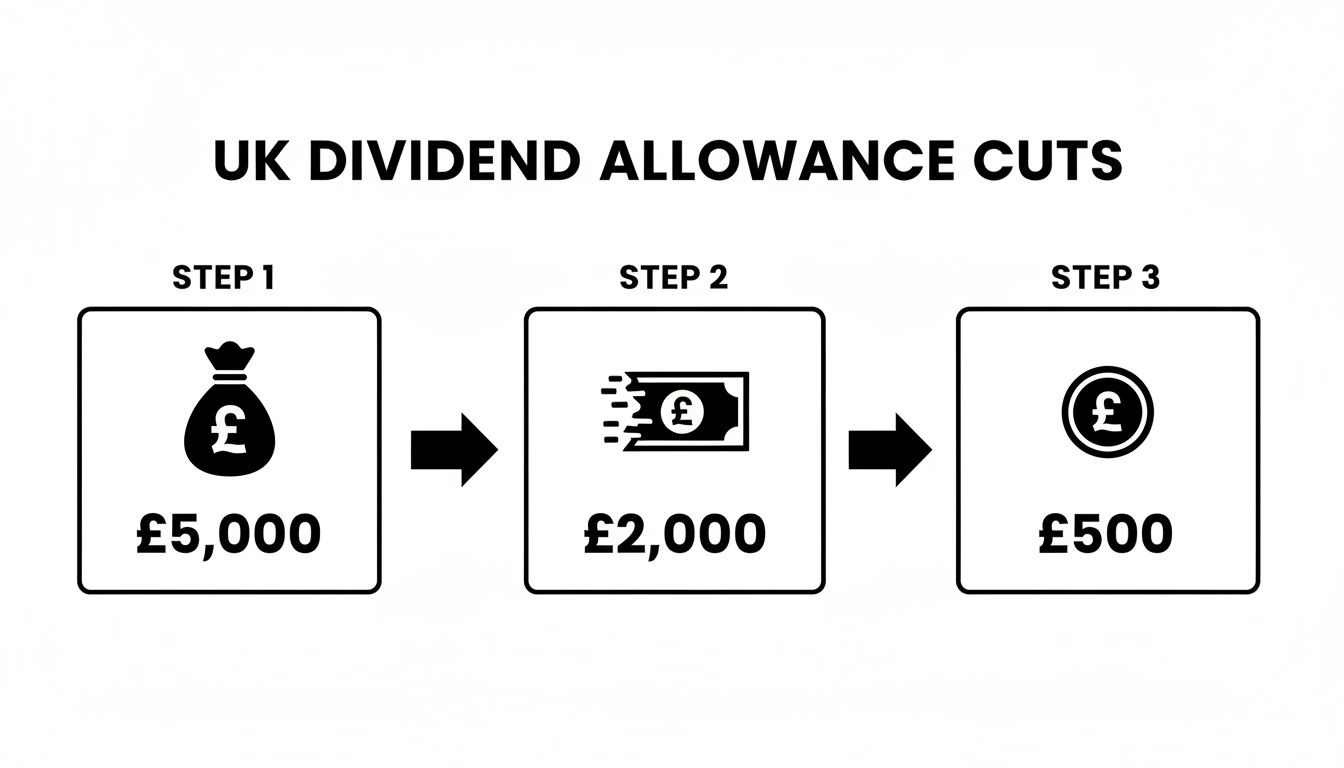
If you're a contractor running your own limited company, the UK dividend allowance is a figure you absolutely need to know. It is the amount of dividend income you can receive each year without paying tax on it. However, the goalposts have moved recently. Government cuts have slashed this allowance from a generous £5,000 down to just £500, a change that directly impacts your take-home pay.
This guide explains what the dividend allowance is, how the recent changes affect you, and what steps you can take to plan your finances effectively.
Understanding the UK Dividend Allowance for Contractors

Most contractors draw money from their company using a classic low-salary, high-dividend strategy. The dividend allowance is a cornerstone of this approach, letting you receive a portion of your company's profits completely tax-free, regardless of your other earnings.
It is easy to misunderstand how this works. This is not an 'allowance' that reduces your total taxable income. It is much better to think of it as a 0% tax band specifically for dividends. Your first part of dividend income falls into this 0% band, and anything you take above it is taxed at the relevant rate for your income level.
How the Dividend Allowance Works in Practice
For the 2024/25 tax year, the dividend allowance is just £500. This drastic reduction requires contractors to be much smarter about tax planning.
Here is a simple breakdown of what that means for you:
- A 0% tax rate: Your first £500 in dividends is taxed at 0%.
- It still uses your tax bands: Crucially, this £500 still counts towards your income tax bands. This determines the tax rate you will pay on dividends above the £500 allowance.
- It is separate from your Personal Allowance: The good news is this is on top of your Personal Allowance (the standard £12,570 for 2024/25), which covers your total income before any tax is due.
Imagine your salary uses up your entire Personal Allowance. If you then draw £10,000 in dividends, the first £500 is tax-free. The remaining £9,500 will be subject to dividend tax. Achieving the right balance is now more important than ever, and our guide can help you weigh the pros and cons of salary versus dividends.
UK Dividend Allowance and Tax Rates at a Glance (2024/25)
To give you a quick reference, here are the key figures for the current tax year.
| Tax Year | Dividend Allowance | Basic Rate | Higher Rate | Additional Rate |
|---|---|---|---|---|
| 2024/25 | £500 | 8.75% | 33.75% | 39.35% |
These rates apply to any dividend income that falls within the corresponding income tax bands, after you have used up your Personal Allowance and the £500 dividend allowance.
Dividend Tax Rates for 2024/25
Once you have gone past your £500 allowance, any further dividends are taxed according to your overall income. These rates are still lower than standard income tax, which is why dividends remain a popular option for most limited company directors.
HMRC always treats your dividend income as the 'top slice' of your earnings. Your total income from all sources, such as salary, rent, and savings interest, is added up first to determine which tax band your dividends will fall into.
For the 2024/25 tax year, the rates you will pay on dividends above the allowance are:
- Basic Rate: 8.75%
- Higher Rate: 33.75%
- Additional Rate: 39.35%
We will explore some practical examples with calculations later to show you exactly how this works.
How the Dividend Allowance Has Changed Over Time
To understand why tax planning for contractors has become so much trickier, you need to look at the history of the UK dividend allowance. It has not just been tweaked; it has been systematically reduced, which has completely changed the tax efficiency of running a limited company.
This journey shows a clear shift in government policy, one that has a direct impact on how much profit you can actually take home. What was once a generous tax break for small business owners is now a minor relief, making careful financial planning more critical than ever.
The Shift from Tax Credits to a New Allowance
Before 2016, the system was completely different. Dividends came with a notional 10% tax credit already attached. For basic-rate taxpayers, this credit conveniently settled their entire tax bill on dividends, meaning they had nothing extra to pay. It was a simple and highly efficient model for most limited company directors.
Then, in April 2016, the government removed this system and introduced the new Dividend Allowance. The stated goal was to simplify things, but it marked a massive change for contractors who had built their financial plans around the old rules.
When it first launched, the new allowance seemed generous enough. It started at £5,000 for the 2016/17 tax year, which was a big departure from the old tax credit system. However, this high starting point did not last long, and a series of deep cuts soon began. You can read more about this taxation shift and the initial reaction from tax experts.
The Great Dividend Squeeze: A 90% Reduction
That initial £5,000 allowance gave directors a decent buffer, but the government quickly started reducing it. This period is often called the 'dividend squeeze' for its direct, painful impact on the take-home pay of small business owners.
Here is a quick timeline of the cuts:
- 2016/17: The allowance was introduced at £5,000.
- 2018/19: It was reduced by 60% down to £2,000.
- 2023/24: It was halved again to £1,000.
- 2024/25: It was halved once more, landing at just £500.
In just eight years, the UK dividend allowance has been cut by a staggering 90%. This rapid decline has pushed hundreds of thousands of small business owners and investors into paying dividend tax for the very first time.
The government's reasoning for the cuts was to make the tax system fairer and raise money for public services. For contractors, however, the reality was a significant tax hike on their main source of income.
What This Means for Contractors Today
This history has real-world consequences for your finances. With the allowance now at a minimal £500, the classic low-salary, high-dividend model is not as tax-efficient as it used to be. Every pound of dividend income you draw above this tiny threshold is now hit with tax.
This squeeze forces you to rethink your profit extraction strategy. Simply taking dividends without a clear plan can lead to an unexpected tax bill and less money in your pocket. It highlights why it is so important for contractors to be proactive and strategic about their tax affairs. At UmbrellaCompany.com, we provide the guidance and resources to help you navigate these changes effectively.
How to Calculate Your Dividend Tax Bill
Understanding dividend tax calculations is the best way to avoid a surprise from HMRC and keep your cash flow in check. Let's break down how it all works, step by step.
The first thing to get right is the UK dividend allowance. It is not a straightforward deduction from your income; it is a 0% tax band. This means the first £500 of your dividends is tax-free, but critically, it still uses up a portion of the tax band it sits in.
As you can see, this tax-free buffer has been reduced dramatically in recent years.
That shrinking allowance makes it more important than ever for contractors to understand exactly how their tax is calculated.
The Stacking Principle: How HMRC Views Your Income
To work out your dividend tax, you need to think like HMRC. They view your dividend income as the very last portion of your total earnings, added on top of everything else. This is often called the ‘stacking’ principle.
Imagine your income is a set of building blocks. HMRC stacks them in a specific order to see which tax band they fall into:
- First, non-savings income: Your salary is the foundation. It fills up your Personal Allowance (£12,570 for 2024/25) and then starts to fill the basic rate band.
- Next, savings income: Any interest you earn from savings is stacked on top of your salary.
- Last, dividends: Your dividend income is placed right at the top of the pile.
This order is absolutely crucial. It means your salary can easily push your dividend income into a higher tax band, leading to a bigger tax bill than you might expect. Getting this right is the cornerstone of good tax planning. For a deeper dive, see our guide on how to pay yourself dividends in the most efficient way.
A Worked Example
Let's run through a typical scenario to see how this works in practice. We will assume a contractor takes a small salary and the rest as dividends.
Scenario: A contractor pays themself a salary of £12,570, using up their full Personal Allowance for the 2024/25 tax year. They then take £40,000 in dividends.
Here is how the tax bill is calculated:
Step 1: Calculate total income
- Salary: £12,570
- Dividends: £40,000
- Total Income: £52,570
Step 2: Allocate income to tax bands
- The £12,570 salary is completely covered by the Personal Allowance. No income tax is due on this part.
- That leaves the full £40,000 of dividend income to be taxed.
Step 3: Apply the dividend allowance
- The first £500 of dividends is covered by the allowance and is taxed at 0%.
- This £500 uses up the first part of the basic rate tax band.
Step 4: Tax the remaining dividends
- After the allowance, £39,500 (£40,000 – £500) of dividends still needs to be taxed.
- The basic rate band ends at £50,270. Since the salary already used £12,570 of this, there is £37,700 of room left in the basic rate band (£50,270 – £12,570).
- The first £37,700 of the remaining dividends falls into the basic rate band, taxed at 8.75%.
- The final £1,800 (£39,500 – £37,700) is pushed over the threshold into the higher rate band. This portion is taxed at 33.75%.
Notice how easily a portion of the dividends can be pushed into a higher tax bracket. Even though the total income is only just over the higher rate threshold, some of it is now being taxed at a much higher rate.
- Step 5: Add it all up
- Tax on the first £500 of dividends: £0
- Tax on the next £37,700 of dividends: £37,700 x 8.75% = £3,298.75
- Tax on the final £1,800 of dividends: £1,800 x 33.75% = £607.50
- Total Dividend Tax Bill: £3,906.25
This step-by-step approach removes the guesswork. You can see exactly how HMRC treats every pound you earn, which is the key to planning ahead and managing your finances effectively.
Comparing Contractor Take-Home Pay Before and After the Cuts
It is one thing to talk about percentages and allowances, but seeing the real-world impact on your bank balance is what truly matters. To show you exactly what these UK dividend allowance cuts mean for your pocket, let’s run through a couple of practical, worked examples.
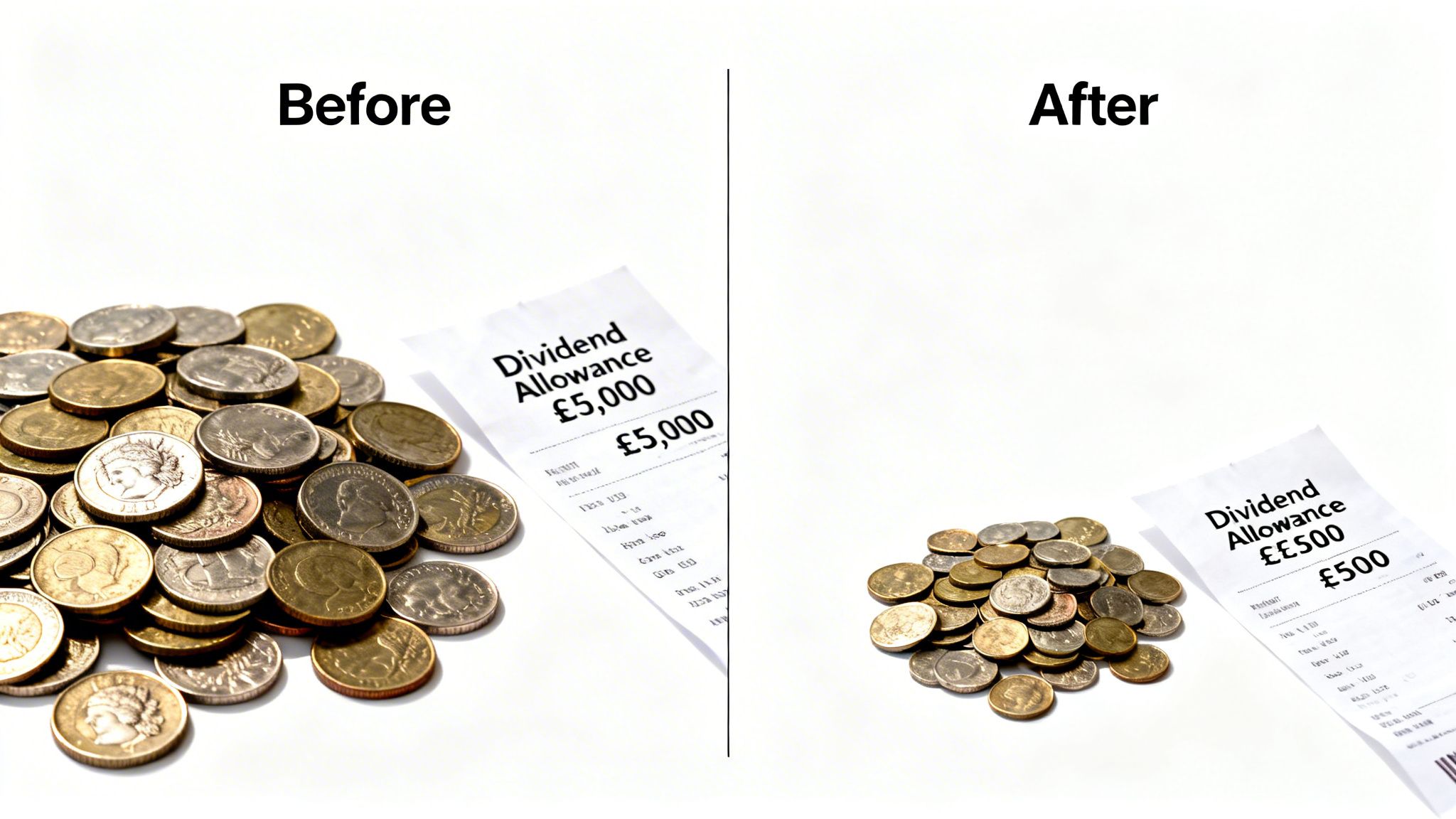
We will look at two very common scenarios for limited company contractors: one whose income keeps them in the basic-rate tax band, and another who is a higher-rate earner. These comparisons will highlight just how much more tax contractors are paying on dividends today compared to just a few years ago.
Example One: A Basic-Rate Contractor
First up is Alex, a contractor who runs their own limited company. Alex draws a tax-efficient salary of £12,570, which is neatly covered by their Personal Allowance. On top of this, they take £10,000 in dividends.
Let's see how the tax bill on this exact income has changed.
Back in the 2017/18 Tax Year:
- The Dividend Allowance was £5,000.
- The first £5,000 of dividends was completely tax-free.
- The other £5,000 was taxed at the basic rate of 7.5%.
- Total Tax Bill: £5,000 x 7.5% = £375
Fast-Forward to the 2024/25 Tax Year:
- The Dividend Allowance is now just £500.
- Only the first £500 of dividends is tax-free.
- The remaining £9,500 is taxed at the new basic rate of 8.75%.
- Total Tax Bill: £9,500 x 8.75% = £831.25
For drawing the exact same income, Alex now pays £456.25 more in tax. The tax bill has more than doubled, purely because of the reduced allowance and the small rate increase.
Example Two: A Higher-Rate Contractor
Now for Ben, a higher-earning contractor. Ben also takes a salary of £12,570, but draws a much larger dividend of £45,000, pushing his total income well into the higher-rate tax band.
In the 2017/18 Tax Year:
- Dividend Allowance was £5,000.
- First £5,000 of dividends: tax-free.
- Next £32,500 taxed at the basic rate of 7.5%.
- Final £7,500 taxed at the higher rate of 32.5%.
- Total Tax Bill: (£32,500 x 7.5%) + (£7,500 x 32.5%) = £4,875
In the 2024/25 Tax Year:
- Dividend Allowance is £500.
- First £500 of dividends: tax-free.
- Next £37,200 taxed at the basic rate of 8.75%.
- Final £7,300 taxed at the higher rate of 33.75%.
- Total Tax Bill: (£37,200 x 8.75%) + (£7,300 x 33.75%) = £5,718.75
In this case, Ben’s tax bill has jumped by an extra £843.75. As you can see, no matter your earnings, the shrinking allowance directly chips away at your take-home pay.
Over the last decade, the government has dramatically reshaped dividend taxation. This relentless combination of reduced allowances and increased rates has hit company directors hard. With the allowance cut by 90%, even small profit extractions are now getting caught in the tax net. You can learn more about how dividend tax bills have risen dramatically in recent years.
How Dividend Tax and IR35 Affect Your Working Structure
For contractors, the rules around the UK dividend allowance are not just a line item on a tax return. They are woven into the very fabric of your IR35 status and how you structure your work. Whether you are deemed ‘inside’ or ‘outside’ IR35 directly affects the most efficient way to pay yourself.
The government's recent, aggressive cuts to the dividend allowance have shaken things up. For contractors operating ‘outside IR35’ through a Personal Service Company (PSC), the classic low-salary, high-dividend model is now much less effective.
With the allowance reduced to just £500, almost every pound you draw as a dividend now gets taxed. This has narrowed the financial gap between running a PSC and using other models, forcing many contractors to take a hard look at their setup.
The Impact of an 'Outside IR35' Status
When your contract is confirmed as 'outside IR35', you have control. You can manage your company’s finances and withdraw profits through a mix of salary and dividends. This is where the dividend allowance used to give you a decent tax-free buffer.
That buffer has all but disappeared. The tiny £500 limit means you have to be much more strategic.
Here is what you now need to consider:
- Profit Extraction: Any dividend payment over the £500 threshold will be taxed, which eats directly into your take-home pay.
- Tax Planning: You need to be far more careful about when and how much you pay yourself in dividends. A poorly timed payment could easily push you into a higher tax bracket.
- Compliance: With profits squeezed, some contractors might be tempted by non-compliant schemes. It is more important than ever to stick with reputable, FCSA-accredited providers.
For a complete picture of your responsibilities when working outside the rules, our detailed guide explains how IR35 works for contractors.
Why Dividend Tax Still Matters for 'Inside IR35' Contractors
If your contracts fall 'inside IR35', you will most likely be paid through an umbrella company. They handle your income like a standard salary, deducting PAYE tax and National Insurance. So, you might think dividend tax is no longer your problem.
This may not be the case. For many contractors, it is still a key part of their financial picture.
You might still have a PSC, perhaps now dormant, with profits built up from previous 'outside IR35' contracts. If you decide to draw that money out, it will be as a dividend, triggering a tax bill based on the current rates and the minimal £500 allowance.
It also extends beyond your contracting work. Do you have a personal portfolio of shares? Any dividends from those investments are caught by the exact same rules, making the allowance cut relevant to your wider personal finances.
HMRC's own figures show a stark trend. The number of people paying dividend tax is set to reach 3.7 million in 2024/25. That is more than double the number from just two years ago. This surge is affecting contractors, whether it is through their PSC or personal investments.
This shift shows just how many people the reduced UK dividend allowance is pulling into the tax net. You can read more about how these tax allowance cuts are affecting savers.
Ultimately, whether you are inside or outside IR35, these changes prove one thing: robust, compliant, and well-planned financial management is no longer a nice-to-have, it is a necessity.
Strategic Tax Planning for Savvy Contractors
With the UK dividend allowance hitting a new low, just pulling profits from your company without a proper plan is no longer a smart move. Protecting your hard-earned income now requires proactive financial planning.
The good news is, there are still some very effective ways to structure your finances. By thinking ahead, you can make informed choices that improve your tax position and let you keep more of what you earn. This means looking at the whole picture, not just your dividends.
Optimising Your Salary and Dividend Mix
For contractors working outside IR35, the classic low-salary, high-dividend model is still a valid approach, but the balance needs a rethink. The aim is to find that sweet spot where you make full use of your tax-free allowances without accidentally pushing yourself into a higher tax bracket.
Here are the key strategies to think about:
- Use Your Allowances: Ensure your director's salary uses your full Personal Allowance (£12,570 for 2024/25). It is the most tax-efficient money you can take.
- Watch the Tax Bands: Plan your dividend withdrawals carefully to keep your total income within the basic-rate tax band if possible. A single large dividend could easily tip you over the edge, resulting in a much bigger tax bill.
- Timing is Everything: Dividends are taxed in the year they are paid, not when your company earned the profit. Spreading a large dividend payment across two tax years can be a clever way to manage your income and avoid a tax spike.
We explain this in much more detail in our guide on how to structure dividends for tax savings.
Exploring Tax-Efficient Alternatives
As taking dividends becomes less attractive from a tax perspective, it is worth looking at other ways to grow your wealth. These methods can work alongside your dividend income and offer serious long-term benefits.
A savvy contractor diversifies their financial strategy. Relying solely on dividends is like putting all your eggs in one basket, especially when the taxman keeps making the basket smaller. Exploring ISAs and pensions is crucial for long-term security.
Consider adding these powerful tools to your financial plan:
- Pensions: Making pension contributions is one of the best tax-saving moves you can make. Your company can pay in directly, which reduces its Corporation Tax bill, and the funds grow free from capital gains and income tax.
- ISAs (Individual Savings Accounts): Any growth or dividends earned inside a Stocks and Shares ISA are completely tax-free. With the standard dividend allowance now just £500, this makes an ISA an excellent place for your investments.
Crucial Compliance and Record-Keeping
None of this planning works without a solid foundation of good compliance. Getting the paperwork right is not just about ticking boxes; it is a legal requirement that protects both you and your company.
Always remember these two things:
- Declare and Pay on Time: Any dividend income you receive over the £500 allowance must be declared to HMRC on a Self Assessment tax return. Your tax bill is usually due by 31st January after the tax year ends.
- Keep Meticulous Records: Every dividend payment needs to be backed up by board meeting minutes and a proper dividend voucher. This paperwork proves the dividend is legal and was authorised correctly.
Navigating this new tax reality requires forward-thinking. At UmbrellaCompany.com, we are here to provide the compliant, expert solutions you need to maximise your contract income.
Your Dividend Questions, Answered
The rules around the UK dividend allowance can seem tricky, especially for contractors juggling different income streams. Let's tackle some of the most common questions to give you clear, straightforward answers.
Do I Need to File a Self Assessment for My Dividends?
If your dividend income for the tax year goes over the £500 allowance, you have to declare it to HMRC. For most contractors and limited company directors, this will mean filing a Self Assessment tax return.
This applies even if you also have PAYE employment. Any dividend income above the tax-free allowance needs to be officially reported. If your dividends are on the lower side (under £3,000), you might be able to ask HMRC to simply adjust your tax code. For anything more substantial, however, a tax return is standard practice.
Does the Dividend Allowance Affect My Personal Allowance?
No, it does not. The dividend allowance is completely separate from your Personal Allowance. It is helpful to think of them as two different tax-free pots.
Your Personal Allowance (£12,570 for 2024/25) is the amount of income you can earn from all sources before paying any tax. The dividend allowance is an extra, specific 0% tax band that applies only to your dividend income. This means you can use your full Personal Allowance and still get up to £500 in dividends tax-free in the same year.
Are Dividends from an ISA Taxable?
No, they are not. A key benefit of investing through a Stocks and Shares ISA is that any dividends or capital gains you earn inside the ISA wrapper are completely shielded from UK tax.
The UK dividend allowance is irrelevant for your ISA investments because that income is already tax-sheltered. This makes ISAs a powerful planning tool for contractors, giving you a way to grow investments without having to worry about the shrinking dividend allowance.
Can I Use My Spouse's Allowance to Lower Our Tax Bill?
Yes, this is a legitimate and often very effective tax planning strategy for married couples and civil partners. If your spouse pays tax at a lower rate, or has not used up their own Personal Allowance or dividend allowance, it can be highly beneficial.
By making a genuine, outright gift of some dividend-paying shares to them, the income that follows is taxed at their lower rate. This can make a real difference to your household’s overall tax liability. Before you do anything, however, we strongly recommend getting professional financial advice to make sure it is structured correctly and is the right move for your circumstances.
The landscape for contractor taxation is always changing, and the recent cuts to the UK dividend allowance are a prime example. Understanding these rules is the first step towards smarter financial planning and protecting your take-home pay. By staying informed and planning ahead, you can continue to operate tax-efficiently.
At UmbrellaCompany.com, we give contractors the tools and information needed to handle complex tax rules. Our comparison service helps you find compliant and trusted umbrella companies that fit your needs. Compare trusted umbrella companies today with UmbrellaCompany.com.


