


Deciding to become a contractor is the first step. The next, and arguably one of the most important, is choosing how you are going to operate. This is your business structure, and it is the foundation of your contracting career in the UK.
Your choice of a type of company or engagement model will shape everything from your take-home pay and tax obligations to the amount of admin on your plate. Getting it right from the start saves a lot of headaches later on. This guide will explain the main structures to help you make an informed decision.
A Quick Guide to Contractor Company Structures

While it might seem daunting, there are really only four main ways contractors work in the UK. Each one defines your legal and financial relationship with your clients, your agency, and HMRC.
We have written this as a quick introduction to each path. We will give you a snapshot of the options so you can start to see which one aligns with your goals, your tolerance for paperwork, and your contract’s circumstances.
The Four Main Ways to Work
The structure you pick is not just a label. It has real-world consequences for tax, personal liability, and how you deal with regulations like IR35. Here are the four models you will come across most often:
- Umbrella Company: You become an employee of the umbrella company. They manage all your invoicing, tax, and National Insurance deductions via PAYE. It is a straightforward, low-admin choice.
- Limited Company (PSC): You are the director of your own company, a separate legal entity. This can be more tax-efficient but comes with a lot more responsibility and paperwork.
- Sole Trader: You and the business are one and the same. It is the simplest way to get started, but it also means you are personally responsible for any business debts.
- Agency PAYE: You are employed directly by your recruitment agency for the contract’s duration. They deduct tax and NI at source, much like a permanent employee.
To help you see the differences more clearly, we have created a quick comparison.
At a Glance Comparison of UK Contractor Structures
This table offers a bird's-eye view of how the four main contractor structures stack up against each other, helping you quickly spot the best fit for your situation.
| Engagement Type | Best For | Admin Level | IR35 Suitability |
|---|---|---|---|
| Umbrella Company | Contractors on inside IR35 roles; those wanting minimal admin. | Very Low | Ideal for 'inside IR35' contracts. |
| Limited Company (PSC) | Higher-earning contractors on 'outside IR35' roles seeking tax efficiency. | High | Best for 'outside IR35' contracts. |
| Sole Trader | Freelancers and self-employed individuals with multiple small clients. | Low | IR35 does not typically apply. |
| Agency PAYE | Short-term contractors or those new to contracting seeking simplicity. | Very Low | A compliant option for 'inside IR35' contracts. |
Each path is suited to different types of work and contractors. Understanding these key differences is the first step toward making a confident choice.
Your choice of business structure is fundamental. It influences everything from your tax obligations to your personal liability, so it is vital to understand the differences from the outset. Choosing correctly sets a solid foundation for your entire contracting career.
The IR35 status of your contract is often the biggest deciding factor. For instance, if your contract is 'inside IR35', an umbrella company is usually the most practical route. If it is 'outside IR35', running your own limited company could be more financially rewarding. We cover these options in much more detail in our comprehensive guide to business structures for contractors.
In the next few sections, we will dive deeper into each of these models. By the end, you will have the clarity you need to pick the right structure for your contracting journey.
Working with an Umbrella Company

If the thought of managing company accounts and tax returns feels like a headache you could do without, an umbrella company is a refreshingly straightforward option. We help you think of it as having your own payroll department that handles all the admin, letting you get on with your actual contract work.
This model has become a go-to for many contractors, especially for contracts that fall inside IR35. You essentially become an employee of the umbrella company for the duration of your assignment. It is a neat setup that blends the freedom of contracting with the stability and legal protections of being an employee.
How an Umbrella Company Works in Practice
The whole process is designed to be as simple as possible. Once you have secured a contract and agreed your rate with the client or agency, the umbrella company takes over to handle the paperwork.
It usually follows a simple, repeating cycle:
- You become an employee: You sign an employment contract with your chosen umbrella company.
- They sign a business contract: The umbrella company then contracts with your recruitment agency (or sometimes the end client) to supply your services.
- You submit your timesheets: Each week or month, you send your approved timesheets to the umbrella company to show the hours you have worked.
- They invoice for your work: The umbrella company then bills the agency for the work you have done.
- You get paid: After the agency pays the invoice, the umbrella company processes your pay. They deduct all the necessary taxes, like PAYE and National Insurance, plus their fee. The remaining salary lands directly in your bank account, and you get a proper payslip.
This structure means you never have to worry about calculating your own taxes or making payments to HMRC. It is all managed for you, keeping you fully compliant.
The Key Benefits of Using an Umbrella Company
Besides being incredibly simple, the umbrella route offers a few other big wins for contractors. Perhaps the most significant is creating a continuous employment record.
Because you remain an employee of the same umbrella company even as you move between different clients and contracts, you build up a stable employment history. This can be a huge help when applying for a mortgage or loan, as lenders much prefer to see that kind of consistency.
A compliant umbrella company effectively removes the burden of running a business. It is a direct route into contracting that ensures you get all the statutory employment rights you are entitled to.
Other major benefits include:
- Statutory Employment Rights: As an employee, you get access to sick pay, maternity/paternity leave, and holiday pay.
- Simple Tax and NI: All your tax and National Insurance are handled at source through PAYE, just like a permanent job. No more surprise tax bills.
- Minimal Admin: There are no company accounts to file or Corporation Tax returns to stress over. Your main task is just submitting your timesheets on time.
- IR35 Sorted: For any work deemed inside IR35, using an umbrella company is one of the most compliant and hassle-free ways to get paid.
Choosing a Compliant Provider
While the model is simple, picking the right provider is critical. The fee an umbrella company charges for its service is called their margin. This is a fixed weekly or monthly amount taken from your earnings before tax is calculated.
The most important thing to check is compliance. You should always choose an umbrella company that is accredited by a professional body like the FCSA (The Freelancer & Contractor Services Association) or Professional Passport. This accreditation is your assurance that the provider has been independently audited and meets the highest industry standards.
It is your best protection against tax avoidance schemes that could land you in hot water with HMRC down the line. Our guide on using an umbrella company as a freelancer has more tips on what to look for.
Operating as a Limited Company

For many experienced contractors, forming a limited company is the default way to work. In contracting circles, this is often called a Personal Service Company (PSC), and it means you are not just a self-employed individual, you are the director of your own company.
This structure puts you firmly in control. You make the decisions and manage the business's direction. But with that control comes a range of legal and financial duties that cannot be overlooked.
Legal Separation and Your Responsibilities
When you incorporate a limited company, you create a business that is legally separate from you. This is a crucial distinction. The company can own assets, sign contracts, and incur debts in its own name, which offers a layer of protection for your personal finances.
As the director, you have a legal duty to act in the company’s best interests. This is not a passive role; it involves specific administrative tasks you must handle throughout the financial year.
Your primary duties as a company director include:
- Filing Annual Accounts: Preparing and submitting statutory accounts to Companies House each year.
- Company Tax Return: Filing a CT600 form with HMRC to report the company’s profit and calculate its Corporation Tax liability.
- Confirmation Statement: Annually confirming to Companies House that the information they hold about your company is up to date.
- VAT Returns: If your turnover goes above the £90,000 threshold, you must register for VAT and submit regular returns.
Paying Yourself: A Mix of Salary and Dividends
One of the biggest attractions of running a limited company is the potential for tax efficiency. You do not draw a simple salary like a PAYE employee. Instead, you typically pay yourself through a small salary combined with dividends.
Most directors take a low salary, set just below the threshold for National Insurance contributions. The company’s remaining profits (after Corporation Tax and other expenses) are then paid out to you as dividends. Because dividends are taxed at a lower rate than salary income, this can significantly increase your take-home pay.
Running a limited company offers the potential for significant tax efficiency, but this is almost entirely dependent on your contracts being outside IR35. This structure gives you the control and financial rewards of a true business owner.
This tax-efficient model works best when your contracts are confirmed as being outside IR35. If an engagement is deemed inside IR35, the tax benefits are almost entirely wiped out, as your income will be taxed at source, much like an employee’s salary.
Navigating IR35 and Associated Costs
As a director, you are responsible for managing the company’s IR35 compliance. For any contracts you undertake with small private-sector clients, the legal responsibility for determining IR35 status rests with you. An incorrect determination can lead to an expensive HMRC investigation and a substantial tax bill.
There are also running costs to consider when operating a PSC. These are all legitimate business expenses, but they need to be factored into your financial planning.
Typical costs include:
- Accountancy Fees: It is strongly advised to appoint a specialist contractor accountant. They will manage your company accounts, tax returns, and provide essential compliance advice.
- Business Insurance: You will need professional indemnity and public liability insurance as a minimum to operate safely.
- Software and Subscriptions: This can include accounting software, professional body memberships, and other business tools.
For those prepared to take on these duties, a limited company is an exceptionally rewarding and professional way to contract. To explore the protections offered by this setup, see our guide on the advantages of a limited liability company.
Understanding Sole Trader and Agency PAYE
Beyond the world of limited and umbrella companies, you will encounter two other common ways to work as a contractor: setting up as a sole trader or working through agency PAYE. While both get you contracting, they sit at opposite ends of the spectrum when it comes to risk, admin, and how you are perceived by clients.
One offers maximum simplicity but with serious personal risk. The other gives you employee-like security but can hinder your long-term contracting career. Knowing the difference is crucial to choosing the right type of company structure for your situation.
The Sole Trader Model Explained
Going down the sole trader route is, on the surface, the most straightforward way to work for yourself in the UK. Legally, you and your business are the same entity. This means after paying tax, all the profits are yours to keep.
Getting started is as simple as telling HMRC you are self-employed. But this simplicity comes with a huge catch, and it is a big one: unlimited liability.
As a sole trader, you have unlimited liability. If your business gets into financial difficulty or someone takes legal action against it, your personal assets (like your house and savings) are on the line.
This level of personal exposure is precisely why professional contracting with larger companies rarely happens on a sole trader basis. Most agencies and end clients simply will not engage with sole traders because of the risk and the messy IR35 implications.
This model is a much better fit for freelancers who juggle multiple small clients (think graphic designers or writers) rather than a project-based IT contractor working for a single large organisation. You can find out more on what is involved in our guide on when to register as self-employed.
Working Through Agency PAYE
The second option, Agency PAYE, makes you a temporary employee of the recruitment agency that found you the role. It is an extremely common setup, especially for short-term or temporary gigs.
In practice, it works just like a regular job. The agency adds you to their payroll, and every payday they handle all the PAYE tax and National Insurance deductions for you. The net amount simply lands in your bank account.
Key features of Agency PAYE include:
- Zero Admin: All your tax and compliance is handled for you. No invoicing, no business accounts, no self-assessment headaches.
- Employment Rights: You get statutory rights for the duration of the contract, like minimum wage and holiday pay.
- Complete Simplicity: It is the most hands-off way to contract. You just do the work and get paid.
Agency PAYE is simple and safe, but it has a major downside compared to using an umbrella company. Your employment is tied to that one agency and that one contract. When the contract ends, your employment ends too.
This means you cannot build a continuous record of employment if you work through different agencies for each role. For contractors looking to get a mortgage or a loan, this patchy employment history can be a real problem, as lenders want to see stability.
An umbrella company solves this by acting as your continuous employer across all your different contracts and agencies. For career contractors, this makes the umbrella a far more strategic choice.
Choosing the Right Structure for Your Career
Deciding how you will operate as a contractor is one of the first, most important choices you will make. What works brilliantly for one person might be entirely wrong for another, so there is no single "best" answer.
It all comes down to your personal circumstances, your contracts, your pay rate, and how much admin you are willing to handle. We will break down the key things to consider so you can pick the right type of company for your contracting career.
Start With Your IR35 Status
Before you do anything else, you need to understand the likely IR35 status of your contracts. The Intermediaries Legislation (IR35) is how HMRC determines if you are a genuine independent business or a ‘disguised employee’ for tax purposes. This one factor can often make the decision for you.
- Inside IR35: If a contract is deemed ‘inside IR35’, you are treated as an employee for tax. In this case, using an umbrella company or going with agency PAYE is the most compliant and hassle-free option, as they handle all your tax deductions.
- Outside IR35: If your work is genuinely ‘outside IR35’, you are operating as a proper business. This opens the door to running your own limited company (PSC), which offers the potential for greater tax efficiency and control over your finances.
This decision tree helps to visualise how your IR35 status immediately points you towards certain structures.
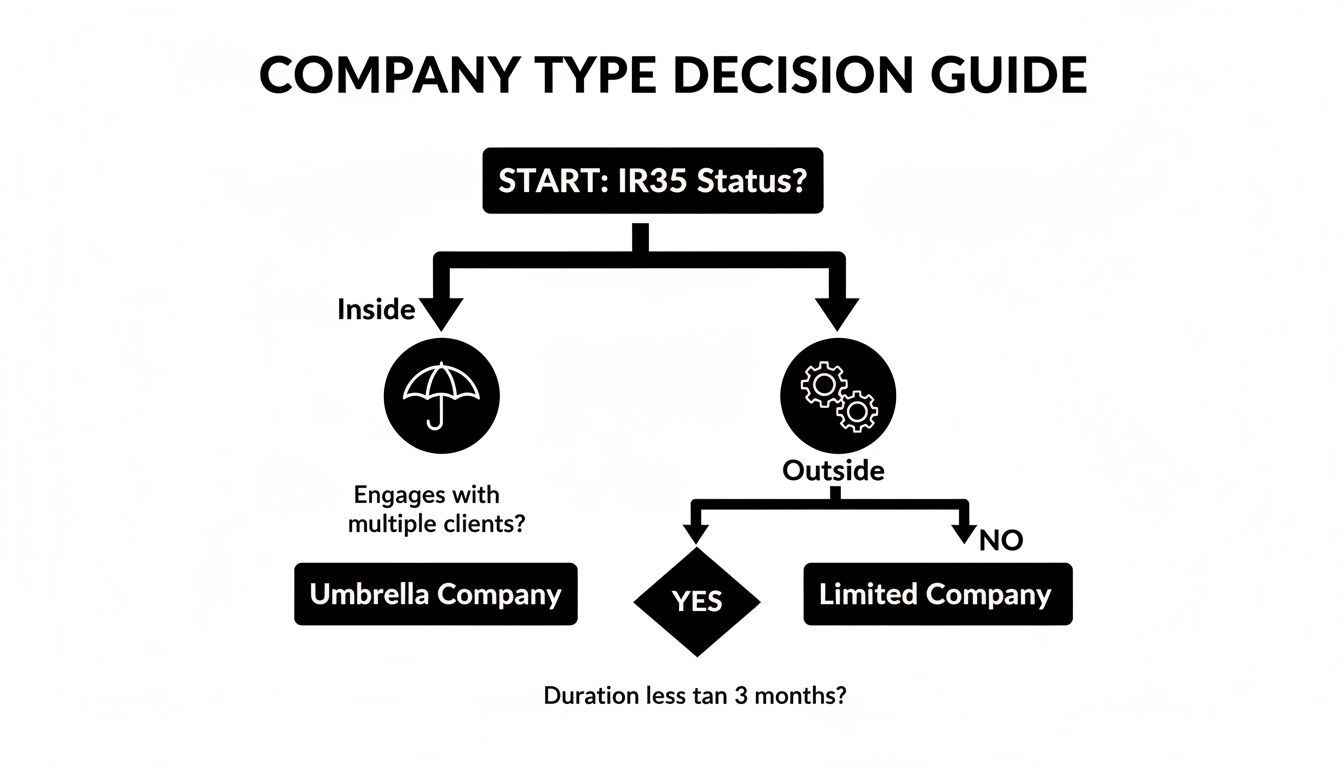
As you can see, an 'inside IR35' determination strongly suggests an umbrella company for its compliance and simplicity. An 'outside IR35' status, on the other hand, makes a limited company a viable and often more profitable choice.
Factor In Your Income and Contract Duration
After IR35, your day rate and the length of your contracts are the next big signposts. A contractor earning a high daily rate on a long-term project outside IR35 will almost certainly find a limited company to be the most advantageous route. The accountancy fees and administrative work are easily outweighed by the potential tax savings you can make by paying yourself through a mix of salary and dividends.
On the other hand, if you are taking on shorter assignments that fall inside IR35, the simplicity of an umbrella company is hard to beat. You can get set up in a matter of hours, the admin is practically zero, and you can switch between contracts without the headache of managing company accounts.
Your daily rate and contract length are strong indicators. High rates and long-term contracts outside IR35 favour a limited company, while shorter, inside IR35 roles suit an umbrella structure perfectly.
Consider Your Appetite for Admin and Risk
The final piece of the puzzle is personal: how much admin are you prepared to do, and what is your comfort level with business risk?
Running a limited company makes you a company director, and that comes with legal responsibilities. You have to be organised enough to handle your accounts, file Corporation Tax returns, and ensure your company stays compliant. A good accountant does the heavy lifting, but the buck ultimately stops with you.
If you would rather just get on with your work, submit a timesheet, and know you will be paid correctly, an umbrella company is a much better fit. It takes all the administrative burden and compliance risk off your shoulders.
Decision Matrix Which Structure Is Right for You?
We have created this table to weigh the key factors when deciding on your company structure. It provides a clear summary to help you assess each option against your personal circumstances.
| Factor to Consider | Umbrella Company | Limited Company / PSC | Sole Trader / Agency PAYE |
|---|---|---|---|
| Typical User Profile | Contractors on inside IR35 roles, those new to contracting, or anyone wanting minimal admin. | Career contractors on high daily rates with long-term, outside IR35 contracts. | Freelancers with many small clients (Sole Trader) or those on very short-term gigs (Agency PAYE). |
| Income Potential | Reliable net pay, but lower than an optimised PSC due to PAYE taxes. | Highest take-home pay potential for outside IR35 work through tax-efficient salary and dividend structure. | Varies. Agency PAYE is taxed like an employee. Sole trader profits are taxed via Self Assessment. |
| Admin & Responsibility | Very low. Your main job is submitting timesheets. The umbrella handles the rest. | High. You are a company director with legal duties for accounts, tax, and compliance. | Low (Sole Trader) to Zero (Agency PAYE), but sole traders have unlimited personal liability. |
| Risk Level | Very low. The umbrella company shoulders the employment and tax compliance risks. | Moderate. You are responsible for IR35 status determination (on some contracts) and overall business viability. | High (Sole Trader due to unlimited liability) to Very Low (Agency PAYE). |
By honestly answering these questions and weighing each factor, you can confidently choose which type of company structure will serve as the best launchpad for your contracting career.
How to Get Started and Find a Compliant Partner
Once you have settled on the right structure for your contracting career, it is time to make it a reality. We will walk you through the practical steps to get you up and running, whether you are joining an umbrella company or forming your own limited company.
The aim here is to get you started on solid, compliant footing. Following the right process from day one and choosing the right partners is the best way to ensure a smooth journey.
Finding a Compliant Umbrella Company
If you have decided an umbrella company is the way to go, your first and most important task is to find a provider you can trust. It is absolutely vital to partner with one that is fully compliant with UK tax law; this protects you from nasty surprises from HMRC later on.
The easiest way to do this is to pick a provider accredited by a recognised professional body. Look for accreditations from FCSA (The Freelancer & Contractor Services Association) or Professional Passport. Think of this as a quality mark, showing the company has passed independent audits for compliance and ethical standards.
Choosing an FCSA or Professional Passport accredited umbrella company is the most reliable way to avoid non-compliant tax avoidance schemes. These accreditations are a clear mark of quality and financial security.
Getting set up is usually a quick and painless process. You will typically just need to have a few documents ready:
- Proof of identity (e.g., your passport)
- Proof of address (like a recent utility bill)
- Your National Insurance number
- Bank details so they can pay you
- Your P45 from your last job, if you have it
Forming a Limited Company
Setting up a limited company, or PSC, is a bit more involved because you are creating a distinct legal entity. Your first official step is to incorporate the company with Companies House, which is the UK's official registrar of companies.
You can do this yourself, but we strongly advise appointing a specialist contractor accountant right from the start. They will not just handle the company formation for you; their real value is in providing crucial advice on how to run your business in a tax-efficient and compliant way.
An accountant will guide you through the essential setup tasks, which include:
- Appointing Directors and Shareholders: This defines the legal ownership and management structure of your company.
- Opening a Business Bank Account: You are legally required to keep your company's finances separate from your personal money.
- Arranging Business Insurance: Professional Indemnity and Public Liability insurance are nearly always mandatory conditions in client contracts.
- Setting up a Payroll Scheme: Even if you are the only employee, you will need a proper PAYE scheme to draw a salary.
Frequently Asked Questions
Even after weighing up the options, a few common questions often pop up. We will tackle some of the final queries we hear from contractors to help you move forward with confidence.
Can I Switch From an Umbrella Company to a Limited Company?
Yes, absolutely. Many contractors start out with an umbrella for its sheer simplicity. It is a great way to dip your toe into contracting, especially for your first contract or if you know you will be working inside IR35.
It is very common to form a limited company later on as your contracting career finds its feet. This switch often makes sense when you land a long-term role that is clearly outside IR35. The transition itself is straightforward, and a good specialist accountant can handle setting up your new company and winding down your umbrella arrangement without any fuss.
Which Type of Company Is Best for IR35?
There is no single “best” type of company for IR35. The right structure is the one that fits the IR35 status of your specific contracts.
- Inside IR35: If your work consistently falls inside IR35, an umbrella company is the most compliant and hassle-free path. They take care of all the PAYE tax and National Insurance deductions for you.
- Outside IR35: For contracts genuinely outside IR35, a limited company almost always offers better tax efficiency and a higher take-home pay, though it does come with more admin.
What Is the Biggest Risk of Being a Sole Trader?
The single greatest risk of operating as a sole trader is unlimited liability. This is not just a bit of jargon; it means that legally, there is no separation between you and your business.
If your business gets into debt or faces legal trouble, your personal assets (like your house or your savings) could be on the line to settle those liabilities. It is the main reason most professional UK contractors and recruitment agencies steer clear of this setup for corporate work.
Ready to find a compliant and trusted umbrella company? The UmbrellaCompany.com comparison tool makes it easy to compare FCSA and Professional Passport accredited providers tailored to your rate and sector. Start your comparison today.


