


Picture this: you have landed a great contract, but it's on the other side of the country. The train fares to get there and the hotel you stay in are what the industry calls travel and subsistence (T&S) expenses.
For contractors, these costs are a fact of life, but knowing what you can and cannot claim can feel like navigating a minefield. This guide explains the key rules, what is claimable, and how to manage your expenses correctly, ensuring you remain compliant with HMRC.
What Are Travel and Subsistence Expenses?
Although often grouped together, travel and subsistence are two separate categories of expenses you might incur while working on a temporary contract. Getting the distinction right is the first step to managing your claims correctly and staying on the right side of HMRC.
We find it helps to think of it simply: travel covers the cost of your journey to a temporary workplace, while subsistence covers your basic living costs, like food and lodging, while you are there.
Defining Travel Expenses
Travel expenses are the costs of getting from your home to a temporary place of work. Crucially, this cannot be your regular, everyday commute. The journey must be purely for business purposes.
Common examples of allowable travel costs include:
- Business Mileage: Using your personal vehicle for business travel, claimed at HMRC’s approved mileage rates.
- Public Transport: Any fares for trains, buses, planes, or ferries required to get you to the client’s site.
- Associated Costs: Other charges incurred during your journey, such as parking, road tolls, or congestion fees.
The key thing to remember is that the workplace must be temporary. Travel to a permanent workplace is just commuting, and that is not a claimable expense.
Defining Subsistence Expenses
Subsistence costs are the essentials you need to cover when your work requires you to be away from home, particularly overnight. This is not for your daily sandwich at lunchtime; it is for costs you only have because you are away for work.
Key Takeaway: Subsistence claims are designed to reimburse you for the extra expense of living away from home for a job. They are not meant to cover your normal, day-to-day living costs.
Subsistence expenses typically include:
- Overnight Accommodation: The cost of a hotel or a short-term rental if your work requires an overnight stay.
- Meals: Reasonable costs for an evening meal or other food and drink linked to your overnight business trip.
The rules around claiming travel and subsistence have become much stricter in recent years, especially with the changes to IR35. At UmbrellaCompany.com, our job is to help you understand these regulations, so you can be confident that every expense you claim is fully compliant.
Understanding the Core HMRC Rules for Expenses
To claim any travel and subsistence, you first need a solid grasp of the rules set by HM Revenue & Customs (HMRC). Getting these wrong can be costly, so it pays to understand the fundamentals from the outset. We believe learning the rules of the game before you start playing is the only way to stay compliant.
Two concepts are absolutely critical here: the '24-month rule' and the definition of a 'temporary workplace'. Together, they determine whether your journey is a claimable business expense or just a regular, non-deductible commute.
This decision tree helps simplify the process of figuring out if your journey might qualify.
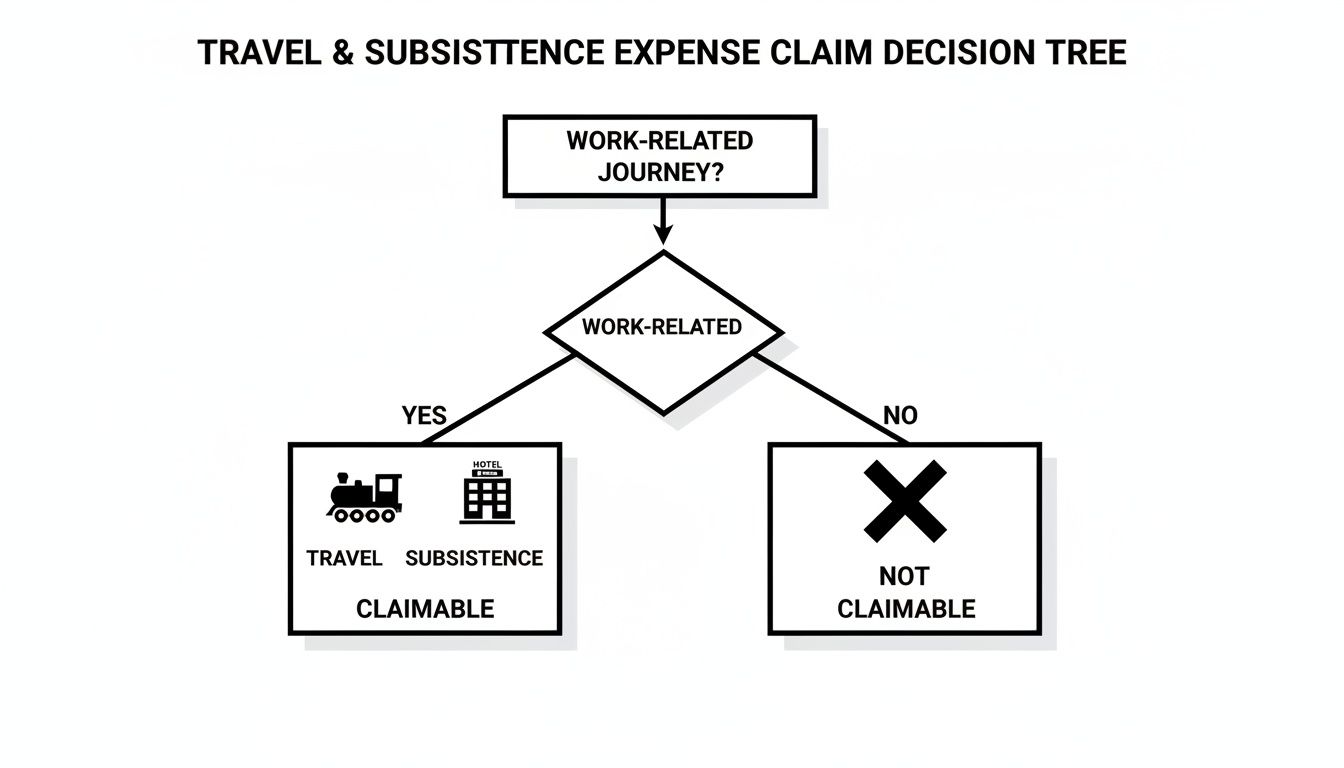
As you can see, the first question is always whether the travel is genuinely for your work. If it is not, you cannot claim. It is as simple as that.
The Temporary Workplace and 24-Month Rule
HMRC considers a workplace temporary only if you expect to be based there for less than 24 months. If you know from day one that a contract will last longer, or if it gets extended beyond that two-year point, that site legally becomes a permanent workplace.
Once a client site is classed as permanent, any travel to and from it is seen as an ordinary commute. From that moment on, you can no longer claim tax relief on your travel or subsistence costs for that journey. It is a hard and fast rule.
Key Rule: A workplace is only temporary if your attendance is for a limited time or for a specific task. If you spend over 40% of your working time at the same site, and this lasts (or is expected to last) more than 24 months, it is permanent.
For instance, say you are on a 12-month contract which is then extended by another 12 months. The 24-month rule kicks in the day you accept that extension, not when you physically hit the two-year mark. Your travel expenses become non-claimable from that day forward.
The Impact of Supervision, Direction, or Control (SDC)
Even if your workplace is temporary and falls within the 24-month rule, there is another major hurdle: Supervision, Direction, or Control (SDC). This test is all about how much autonomy you really have in your role.
If your client tells you how, when, and where to do your work, you are almost certainly subject to SDC. A simple way we suggest thinking about it is to ask yourself, "Am I being managed in the same way as one of the client's permanent employees?"
Under HMRC rules, if SDC is present, you cannot claim tax relief on home-to-work travel and subsistence. This applies no matter how long your contract is or where it is located. For contractors using an umbrella company, this is an especially critical point to understand.
These rules have a huge financial impact across the contracting sector. After a post-COVID rebound, ONS figures show business travel spending hit £26.4 billion in 2023, up 22% from 2022. With around 525,000 UK freelancers working via umbrella companies, and average annual subsistence claims sitting at roughly £1,800, that adds up to a staggering £945 million sector-wide. Getting the rules right is clearly big business, as you can see from wider travel trends and statistics.
Getting to Grips with Allowable Expenses
We have covered the official HMRC rules, but what does that actually mean for your day-to-day expenses? Knowing exactly which travel and subsistence costs you can claim is the key to maximising your take-home pay without falling foul of the taxman. We will now break down what is generally allowed and what is not.
This is not just a minor detail; for thousands of UK contractors, getting this right makes a huge difference. According to HMRC's own data for the 2022/23 tax year, over 1.2 million self-employed people claimed a massive £4.5 billion in T&S allowances. That works out to an average of £3,750 per person.
That figure was a 12% jump from the £4.01 billion claimed the year before, which shows just how vital these claims are to a contractor's bottom line.
What Travel Costs Can You Claim?
When your trip to a temporary workplace counts as legitimate business travel, a whole range of costs suddenly become claimable. The reimbursement is there to cover the extra money you would not have spent otherwise.
Here is what typically gets the green light:
- Business Mileage: Using your own car or van for business trips is a big one. HMRC has an approved mileage allowance of 45p per mile for the first 10,000 business miles in a tax year, then 25p per mile after that.
- Public Transport: Your train ticket, bus fare, or even a flight to get to that temporary site are all fully claimable.
- Other Travel Necessities: Do not forget the smaller items. Things like parking fees, road and bridge tolls, and congestion charges you have to pay on your business journey can all be claimed back.
What you absolutely cannot claim for is your regular commute. Any journey to a permanent workplace, a site you attend day in and day out, is just considered normal travel, not a business expense. If you run your own PSC, the rules are similar, but it is always wise to get familiar with the specifics of limited company travel expenses.
What Subsistence Costs Are Allowable?
Subsistence is all about the costs of food, drink, and a place to sleep when you are working away from your permanent home. The golden rule here is that the expense has to be "wholly and exclusively" for your work.
Key Insight: You can really only claim for subsistence if your work forces you to stay overnight somewhere. The costs also have to be reasonable. HMRC is not going to look kindly on a claim for a five-course meal at a Michelin-starred restaurant.
These are the usual allowable subsistence costs:
- Overnight Accommodation: The bill for a hotel, B&B, or a short-term rental is claimable when you have to stay away from home for a contract.
- Meals and Incidentals: The cost of an evening meal and breakfast when you are staying overnight is also perfectly fine to claim.
You cannot claim for the sandwich you buy for lunch at your usual work site. HMRC sees that as an everyday living cost, not a specific business expense. For a deeper dive into managing these kinds of finances, our guide to accounting for consultants is a great resource.
To make this crystal clear, we have created a quick comparison of what is generally in and what is out.
Allowable vs Non-Allowable Contractor Expenses
This table gives a straightforward look at what you can and cannot usually claim as a contractor.
| Expense Category | Allowable Examples (Tax-Deductible) | Non-Allowable Examples (Not Tax-Deductible) |
|---|---|---|
| Travel | Mileage for journeys to a temporary workplace, train tickets to a client site, and parking fees for a business meeting. | Your daily commute to a permanent workplace, fines for speeding or parking, and travel for personal reasons. |
| Subsistence | A hotel room for an overnight stay near a client's site, and the cost of an evening meal while staying away from home. | Lunch purchased near your normal place of work, coffee and snacks during the day, and entertaining clients. |
| Other | Business phone calls, and fees for professional training directly related to your contract. | Everyday clothing, childcare costs, and costs for entertaining yourself, like cinema tickets or gym passes. |
While this table is a great starting point, remember that your personal eligibility always comes down to your contract and whether you are subject to SDC. A compliant umbrella company is your best bet for getting expert guidance to make sure every single claim you make is legitimate and above board.
How Compliant Umbrella Companies Handle Expenses
When you work through a compliant umbrella company, they act as a crucial check and balance for your expenses. Their job is to make sure any claims you make for travel and subsistence are handled correctly, keeping you in line with HMRC rules and saving you a major administrative headache.
We typically handle everything through an online portal. Think of this as your single point of contact for submitting, tracking, and managing all your business costs. It creates a clean, clear record of every claim from start to finish.
The Expense Claim Process Step by Step
Working with a reputable umbrella company turns what could be a messy process into a simple, repeatable one. Here is what it looks like in practice:
You incur an expense: You travel to your temporary workplace and pay for a legitimate business cost, like a train fare or a night in a hotel. The golden rule is to always get a clear, itemised receipt.
You submit the claim: Next, you log into your umbrella company’s portal. You will upload a photo or scan of your receipt and fill in the key details, for example, the date, the amount, and what the expense was for.
Verification and approval: The umbrella’s compliance team then gets to work. They will review your claim, checking it against the latest HMRC rules to confirm it is a valid business expense and that you have supplied the right proof.
Reimbursement in your pay: Once approved, the expense is paid back to you from your assignment income. Crucially, this happens before income tax and National Insurance are deducted, which has the effect of increasing your net take-home pay.
This straightforward approach takes the guesswork out of the equation, giving you confidence that your finances are being managed professionally.
Key Takeaway: A compliant umbrella company is your safeguard. They vet your expenses against strict HMRC criteria, stopping you from accidentally making a non-compliant claim. This protects you from the risky schemes out there that promise unrealistic returns by bending the rules.
If you are new to this way of working, our guide on how an umbrella company works gives a full rundown.
The Financial Impact of Compliant Claims
Getting expenses right really matters. According to figures from the Association of British Travel Agents (ABTA) and HMRC, UK domestic business trips hit 142 million in 2024. Within that, freelancers claimed a massive £2.1 billion in related subsistence, with the average claim per umbrella user estimated at £1,400.
For certain costs, you might claim using official per diem rates published by HMRC. These are fixed daily allowances for meals and small incidental costs, which can make things simpler as you do not always need a receipt for every single purchase. Your umbrella company will be able to tell you if and when you can use them.
This is why choosing a provider accredited by a body like the FCSA or Professional Passport is so important. It is a stamp of approval that signals the company operates to the highest industry standards. It ensures they will never push you to claim for things you are not entitled to or use dodgy expense models that could land you in hot water with HMRC. It is all about making your life as a contractor simpler and safer.
How IR35 Status Affects Your Expense Claims
When it comes to claiming for travel and subsistence, your IR35 status is everything. This single piece of legislation completely redefines what HMRC considers your 'workplace', and that directly impacts which costs you can and cannot claim. Getting this wrong can land you in hot water, so it is vital to understand the difference.
Inside IR35: The Rules for Employees
If your contract is deemed ‘inside IR35’, you are treated as an employee for tax purposes, plain and simple. This has a major consequence for your expenses, as HMRC sees your client’s site as your permanent place of work.
That means your journey from home to the client site is just an ordinary commute. You cannot claim tax relief on your mileage, train fare, or the lunch you buy while you are there. It is viewed no differently than a permanent staff member travelling to their usual office.
In this situation, an umbrella company acts as a straightforward payroll service. We will handle all the PAYE tax and National Insurance calculations to keep you compliant, but those T&S claims are off the table.
Outside IR35: Greater Flexibility for Business Owners
The picture changes completely when you are working ‘outside IR35’. Here, you are genuinely self-employed, running a business that provides a service to a client. Because of this, your client’s site is classed as a temporary workplace.
This classification is the key that unlocks a much wider range of legitimate expense claims. Suddenly, that journey from your home to the client's office is considered business travel.
Key Distinction: Inside IR35 treats you like an employee, making travel to your client's site a non-claimable commute. Outside IR35 treats you as a business owner travelling to a temporary work location, making those costs claimable business expenses.
Since you are now travelling for business, you can claim tax relief on:
- Travel Costs: This covers mileage if you use your own car, as well as train tickets, bus fares, or any other transport you need to get there.
- Subsistence Costs: If you are required to stay overnight for the job, your accommodation and the cost of reasonable meals are also claimable.
Why Your IR35 Determination Is So Important
You must get an IR35 status determination for every single contract you take on. Never assume that just because one job was outside IR35, the next one automatically will be. It is the specific working practices of each engagement that matter.
For contractors juggling multiple projects, this means your ability to claim expenses can literally change from one month to the next. It is a critical area of compliance to get right. For a deeper dive, our complete guide on IR35 for contractors is well worth a read.
Ultimately, your IR35 status draws the line in the sand for what is possible with expense claims. For inside IR35 roles, the rules are tight and restrictive. For outside IR35 contracts, you have much more flexibility, as long as you play by the rules and keep perfect records.
Record-Keeping Best Practices for Contractors
Think of good record-keeping as your first line of defence in an HMRC audit. It is not about just shoving receipts into a shoebox and hoping for the best. It is about building a clear, organised story for every single business expense you claim. This discipline is absolutely crucial for anyone claiming travel and subsistence, as it provides the proof you need to back up every claim.

Your records are the evidence that proves your claims are legitimate. If HMRC ever decides to look into an expense, having a complete and detailed record can resolve the query quickly and without any stress. It shows that each cost was genuine, reasonable, and directly related to your work.
What to Record for Every Expense Claim
For every expense you claim, you need to be able to answer the 'who, what, when, where, and why'. Getting this level of detail down removes any doubt and creates a trail that will stand up to scrutiny. We always suggest using our online portal or a trusted app to keep everything logged securely in one place.
Make sure you have the following for each claim:
- The date of the expense: When did you actually spend the money?
- The reason for the expense: What was the specific business purpose? For example, "Travel to temporary client site in Manchester for project meeting."
- The amount spent: This has to match the receipt perfectly.
- An original, itemised receipt: A simple credit card slip often is not enough. You need proof of exactly what you bought.
- For travel, extra details: This means logging your start and end points, the purpose of the trip, and the number of business miles travelled.
Keeping this much detail might feel like a bit of a chore at first, but it quickly becomes a habit that saves you time in the long run. It is a fundamental part of good financial management, and our guide on accounting for contractors covers more tips on this.
Our Best Practice Advice: Do not let your expense claims build up. Get into the habit of submitting them regularly, either at the end of each week or each month. This simple routine avoids that last-minute panic, cuts down on mistakes, and makes sure you get your money back promptly.
Why Digital Tools Are Your Best Friend
The days of wrestling with faded paper receipts and complicated spreadsheets are thankfully over. Modern digital tools, including the portal we provide at UmbrellaCompany.com, have completely changed the game for contractor expense management.
Using a digital system means you can:
- Capture receipts on the spot: Just snap a photo of your receipt with your phone and upload it straight away. No more lost or damaged bits of paper.
- Automate your records: Many apps can scan the receipt and automatically pull out key details like the date, vendor, and amount, saving you manual data entry.
- Access records from anywhere: Your entire expense history is kept securely in the cloud. It is there whenever you need it, whether that is for your own reference or for an HMRC inspection.
By adopting these simple record-keeping habits, you will build a solid, stress-free system for managing your travel and subsistence expenses. It gives you peace of mind, ensures you stay compliant, and makes the whole process of managing your finances much smoother.
Your Travel and Subsistence Questions, Answered
When you get down to the nitty-gritty of travel and subsistence (T&S), specific questions always pop up. We get these from contractors all the time, so we have put together some straightforward answers to the most common queries we hear.
Can I Claim for My Lunch If I Am Not Staying Overnight?
This is a big one, but the answer is almost always no. HMRC sees your daily lunch as a personal choice, not a business cost. If you are just travelling to your usual client’s office for the day, you cannot claim tax relief on your sandwich and coffee.
The game changes completely if you have to stay away from home overnight for work. When that happens, the cost of your evening meal and other reasonable meals, including your lunch the following day, can be claimed as part of your subsistence. The vital difference is that the expense is a direct result of being away from home for work.
What Happens If I Lose a Receipt?
It is frustrating when a receipt goes missing, but all is not necessarily lost. Your first port of call should be to get a duplicate. Most hotels, train companies, and larger restaurants can usually issue a copy if you know the date and have your payment details handy.
If getting a duplicate is a non-starter, you should still record the expense. Log every detail you can remember: the date, the exact amount, who you paid, and what it was for. Crucially, add a note explaining why the receipt is missing. While HMRC will always prefer an original receipt, a detailed log backed up by a bank statement can sometimes suffice, though it is never a guarantee.
Our Advice: Get into the habit of snapping a photo of every receipt on your phone. Upload it straight to your umbrella company's portal. This creates an instant digital backup, and you will never have to panic about a lost bit of paper again.
How Does the 24-Month Rule Work If I Have More Than One Client?
The 24-month rule is applied to each workplace separately. So, if you are working for Client A in Bristol and, at the same time, have a contract with Client B in Leeds, each site gets its own 24-month clock. The time you spend in Bristol has no bearing on the clock for your Leeds contract.
Be careful, though. If you work at different sites for the same client within the same geographical area, HMRC may treat this as a single workplace. For instance, flitting between two of a client’s London offices would likely be viewed as one permanent location once you know you will be there for over 24 months.
Can I Claim for Attending an Interview or a Training Course?
It really depends on the situation. Here is how it breaks down:
Interviews: As a rule, you cannot claim for the cost of travelling to an interview for a new contract. HMRC considers this part of the cost of finding work, not doing work.
Training: You can claim for a training course, but only if it is to update or maintain a skill you already have and need for your current contract. Training to learn a completely new skill to land future roles, however, is not a claimable expense.
As you can see, the eligibility to claim always comes back to the same core ideas: the specifics of your contract, your IR35 status, and the quality of your records.
At UmbrellaCompany.com, we specialise in helping contractors find the perfect, compliant umbrella company to manage their payroll and expenses with confidence. Compare trusted providers in minutes and ensure you are always on the right side of HMRC.
Find your ideal umbrella company today at UmbrellaCompany.com


