


Let's talk about the bottom line. When you're weighing up term life insurance, the first question is always: "How much is this going to cost me?" You will see average figures around £32 per month, and some policies can start from as little as 20p a day. But the real answer depends entirely on you.
This guide will explain what drives the cost of term life insurance, what factors you can control, and how you, as a contractor, can secure the right cover for your family.
Think of term life insurance as a financial backstop for your family, set up for a fixed number of years. It’s a straightforward agreement designed to pay out if the worst happens.
Understanding Your Term Life Insurance Cost

For contractors, getting a handle on term life insurance costs is a non-negotiable part of financial planning. It's a simple product: you pay a premium each month for a set term. If you pass away during that time, your loved ones get a tax-free lump sum.
That payout can be a lifeline, helping to clear a mortgage, cover school fees, or simply manage day-to-day bills without your income.
This is especially vital for contractors. Unlike permanent staff, you do not have a ‘death in service’ benefit from an employer, which often pays out a multiple of salary. As a contractor, you have to build that safety net for yourself.
Average Costs in the UK
So, what can you expect to pay? We've looked at the numbers. Based on an analysis of over 121,000 policies, the average cost for term life insurance in the UK for 2026 was £32.64 per month. This provided an average cover amount of £160,871.36, showing just how affordable meaningful protection can be. For the full statistics, you can see the report from Reassured.
When you dig into the details, you find two main types of policy:
- Level term insurance: The payout amount stays the same throughout the policy. This is the go-to for many families and averaged £35.52 a month.
- Decreasing term insurance: The payout reduces over time, usually in line with a repayment mortgage. This is a more budget-friendly option, averaging £29.75 a month.
These figures show that whether you're working inside IR35 through an umbrella company or via your own limited company, protecting your family is well within reach. It’s a crucial piece of the puzzle when you're mapping out your finances. For a closer look at the different kinds of protection available, have a read of our guide on insurance for contractors.
Term life insurance isn't an off-the-shelf product. The price you're quoted is a direct reflection of your life, your health, and the level of cover you need. It’s a personal price for personal peace of mind.
Coming up, we will break down exactly what insurers look at when they calculate your premium, from your age and health to your lifestyle. Here at UmbrellaCompany.com, our goal is to give you the clarity you need to make the right choice with confidence.
What Really Determines Your Insurance Premium
Ever wondered how an insurer lands on your specific premium? It is not a random number. Insurers are essentially risk analysts, building a detailed picture of you to calculate the odds of a claim being made.
Think of it like getting a fixed-rate mortgage when interest rates are low. Securing life insurance when you’re young and healthy means you can often lock in a much cheaper fixed price for the entire policy term.
The Core Factors Insurers Assess
When you apply, you will be asked a lot of detailed questions. It is vital to be completely honest here, as giving inaccurate information could invalidate your policy down the line.
Insurers use your answers to build a personal risk profile, which directly sets your monthly premium.
The main factors they look at include:
- Your Age: This is the single biggest influence. Younger applicants are statistically a lower risk, so they almost always get cheaper premiums.
- Your Health: You will be asked about your medical history, any pre-existing conditions, plus your height and weight. Insurers might also ask for permission to see your GP medical records.
- Your Lifestyle: Habits like smoking or regular heavy drinking will significantly increase your premium. A smoker can easily pay double what a non-smoker pays for the exact same cover.
- Your Occupation: Some jobs are seen as higher risk. A contractor working on a construction site will likely face a higher premium than an office-based IT consultant. For more on job-related cover, see our guide to contractor indemnity insurance.
The price you're quoted is a direct reflection of your personal risk profile. Two people of the same age can get vastly different quotes based on their health, job, and lifestyle. Understanding this shows you where you might be able to make changes to lower your costs.
How Your Policy Choices Impact Price
Beyond your personal details, the choices you make about the policy itself are just as critical in determining the final term life insurance cost.
These are the variables you have direct control over when setting up the policy.
You will need to decide on:
- The Cover Amount: This is the lump sum paid out. A policy for £500,000 will naturally cost more each month than one for £100,000.
- The Policy Length (Term): This is how long you want the cover to last. A 35-year term will be more expensive than a 20-year term because the risk period for the insurer is longer.
- The Type of Cover: As we have discussed, level term cover (where the payout amount stays the same) costs more than decreasing term cover (where the payout reduces over time, often in line with a mortgage).
By tweaking these elements, you can find the right balance between what you pay and the level of protection your family gets. It gives you control over building a safety net that fits your budget.
How Your Age And Policy Length Affect Costs
When it comes to the cost of term life insurance, one factor stands above all others: your age. Insurers base their prices on risk, and the simple truth is that younger applicants are statistically less likely to fall ill or pass away.
Taking out a policy in your 30s instead of your 50s isn't just about saving a few quid here and there. The difference can be huge. By getting covered sooner, you lock in a much lower rate for the entire length of your policy, which can save you thousands over the years.
This diagram breaks down the main things insurers look at when working out your premium.
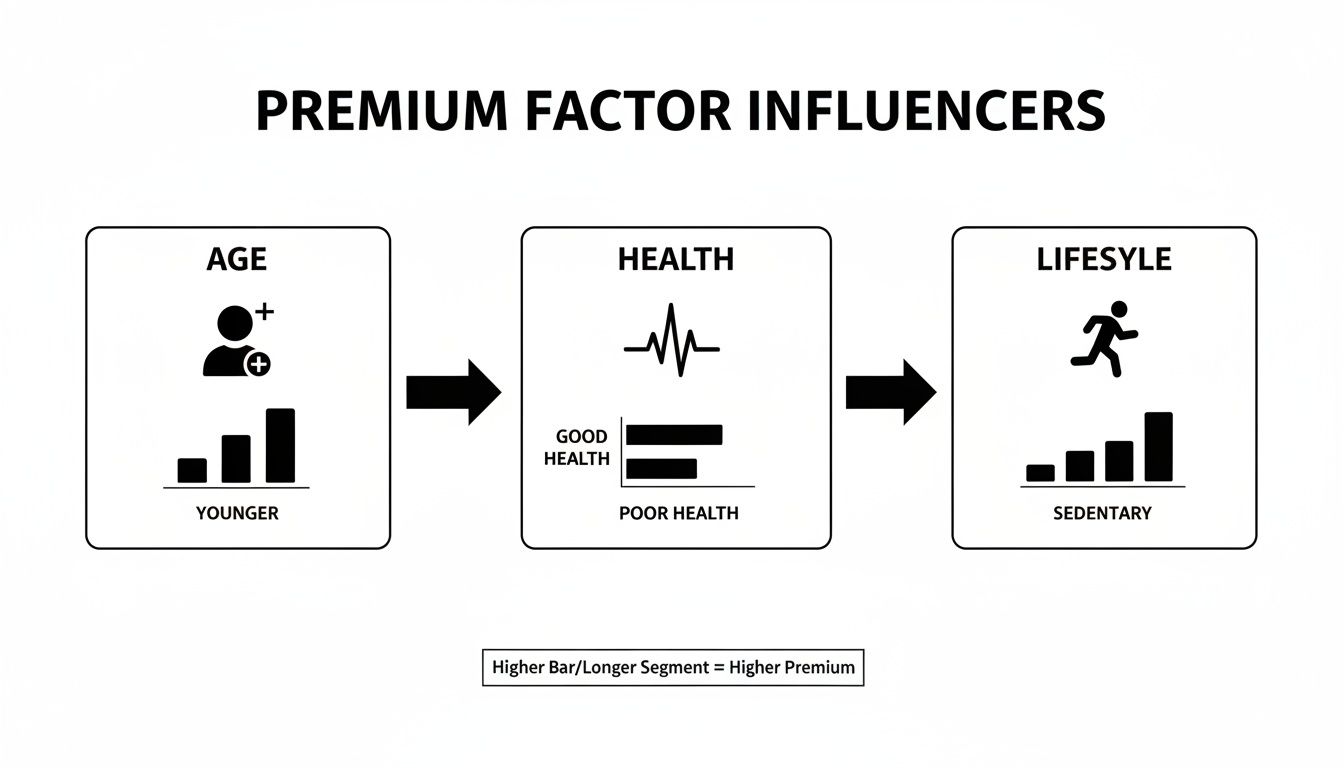
As you can see, it really boils down to your age, your current health, and your lifestyle. Understanding how these pieces fit together gives you a clearer picture of what's driving the final cost.
Illustrative Monthly Cost By Age For £250,000 Level Term
To show you what this looks like in the real world, here’s a table with some example quotes. Notice how the monthly premium for the exact same amount of cover accelerates once you move into a new age bracket.
| Age | Example Monthly Premium (25-Year Term) | Annual Cost |
|---|---|---|
| 30 | £13.50 | £162.00 |
| 40 | £27.00 | £324.00 |
| 50 | £65.00 | £780.00 |
These are just illustrations, of course, but the pattern is undeniable. Delaying your application by just a decade can easily double your premiums, and waiting another ten years can double them again.
The message is clear: the best time to buy life insurance was yesterday. The second-best time is today. Waiting even a few years can mean paying thousands of pounds more over the life of the policy.
How Policy Length Changes Your Premium
The other big factor you have control over is the policy term, which is how many years you want the cover to last. A longer term means the insurer is on the hook for a longer period, which naturally increases the statistical chance they'll have to pay out a claim.
Because of this, a longer policy will always have a higher monthly premium.
- A 20-year term is a popular choice for new parents, designed to see their children through to financial independence.
- A 35-year term might suit someone taking on a long mortgage in their late 20s, making sure the debt is covered right to the end.
While a 35-year policy will cost more each month than a 20-year one, it offers peace of mind for a much longer period. As a contractor, you might want to align the term with your expected working life, providing cover right up until you plan to retire.
The trick is to find the right balance. You need a policy that protects you during the years you need it most, without paying for extra years of cover that do not match your financial responsibilities. At UmbrellaCompany.com, we want you to have this knowledge so you can make a smart, cost-effective decision for your family's future.
Choosing Your Policy: Level vs Decreasing Term

When you start looking at term life insurance, you will soon realise it is not a one-size-fits-all product. The two most common options you'll come across are level term and decreasing term insurance. Getting to grips with the difference is crucial, because your choice directly impacts both your term life insurance cost and the protection your family actually gets.
A good way to think about it is to match the policy to your main reason for getting cover in the first place. Are you trying to replace your future income to maintain your family’s lifestyle, or is your main worry clearing a large, specific debt like a repayment mortgage? Your answer points you straight to the right type of policy.
Understanding Level Term Insurance
Level term is the simplest of the two. The amount of cover you choose at the outset, known as the payout or sum assured, stays exactly the same for the entire policy term. If you take out a £250,000 policy over 25 years, your family would receive £250,000 whether you passed away in the first year or the twenty-fourth.
This consistency makes level term insurance a fantastic choice for:
- Replacing your income: The fixed payout gives your family a reliable sum to handle daily costs and plan for the future without your salary.
- Covering an interest-only mortgage: Since the capital balance on this type of mortgage doesn't go down, a level payout ensures the whole debt can be wiped clean.
- Providing for family milestones: It can help cover big costs down the line like university fees, a wedding, or simply leaving a meaningful inheritance.
Because the insurer’s potential payout never gets smaller, the premiums for level term cover are generally higher than for decreasing term. You are paying for that solid, predictable financial safety net.
How Decreasing Term Insurance Works
In contrast, decreasing term insurance is built for a very specific job: covering a large debt that reduces over time. The classic example is a standard repayment mortgage. With this policy, the payout amount shrinks each year, designed to roughly track your outstanding mortgage balance as you pay it off.
The core idea behind decreasing term cover is that your need for a massive payout reduces as your debt gets smaller. This makes it a very cost-effective way to protect your family home without paying for cover you might not need in 20 years' time.
This clever structure means the premiums are usually much lower. In fact, decreasing term cover can be 15-20% cheaper than an equivalent level term policy, which is a big plus for contractors and freelancers managing a variable income. It offers targeted protection for your biggest liability without the higher cost.
The type of policy you go for is one of the single biggest factors in your final term life insurance cost. UK figures consistently show decreasing term policies are the more affordable option. For example, data from Claybrooke highlights that for a typical profile, a decreasing term policy might average £31.83 a month, whereas a level term policy for the same person could be £37.02. While you can find basic policies starting from as little as £9.72 a month, this comparison shows how the structure directly affects the price. You can explore more insights on the average cost of life insurance to see how these figures break down further.
Life Insurance For Umbrella Company Contractors
If you're working as a contractor through an umbrella company, you might wonder how that unique setup affects getting life insurance. We talk to contractors about this all the time, so let's clear up the confusion.
The simple answer is that insurers are completely used to the contracting model. In fact, being employed by an umbrella company gives you a consistent payroll history and formal payslips, making your life a lot easier.
Proving Your Income Is Simpler
When you apply for cover, an insurer needs to see what you earn to make sure the policy amount makes sense. As an umbrella employee, this is straightforward.
Your payslips will clearly show your gross pay and all the standard deductions, exactly like a permanent employee's. This clean, verifiable income record gives insurers the confidence to approve your policy without any fuss.
Your status as an umbrella company employee is a real strength, not a weakness. It creates a clear paper trail for your earnings, which simplifies the whole application and shows insurers you're financially stable.
The Critical Need For Personal Cover
One of the biggest shifts when moving from permanent work to contracting is losing the ‘death in service’ benefit. This is a common perk where a company’s own insurance pays out a multiple of your salary to your family if you pass away.
As a contractor, you are now responsible for creating that safety net yourself. Without a personal life insurance policy, your loved ones could be left with no financial support. This means getting your own cover isn't an optional extra; it is an essential part of your financial plan.
What About IR35?
The Off-Payroll working rules (IR35) are all about your tax status for a specific contract. While IR35 has a big impact on your pay, it does not change the fact that you need to sort out your own financial protection.
Whether a contract is inside or outside IR35, your family’s need for security is exactly the same. The term life insurance cost is a personal expense, completely separate from your employment tax. Your main job is to make sure you have enough cover, no matter what your IR35 status is on a project. If you want to get more into the weeds on this, our guide on choosing an umbrella company for freelancers has more detail.
Ultimately, being an umbrella contractor puts you in a great position to get competitive life insurance. You have the freedom of contracting paired with the solid admin of formal employment, a mix that insurers know and trust. The key is simply to take responsibility for plugging the gap left by not having traditional employee benefits.
How To Secure The Best Term Life Insurance Quotes
Finding the right life insurance policy does not need to be a shot in the dark. With a bit of a strategy, you can get competitive quotes and lock in cover that actually fits your budget and what your family needs.
This guide will walk you through the practical steps to getting the best value for your term life insurance cost, with a few extra pointers for contractors and umbrella company workers.
Step 1: Work Out How Much Cover You Need
Before you even think about looking for quotes, you need to know what you're aiming for. The right level of cover is entirely personal; it hinges on your family's specific financial commitments. A common rule of thumb is to aim for a policy worth around 10 times your annual income, but a more tailored calculation will give you a much more accurate figure.
To get to your ideal number, consider these points:
- Outstanding Debts: Add up your mortgage, any car loans, credit card balances, and other major debts you'd want paid off.
- Future Family Costs: Think about day-to-day living expenses, but also factor in future school or university fees and childcare.
- Final Expenses: Don't forget to include an amount for funeral costs, which can easily run into several thousand pounds.
- Subtract Existing Assets: Deduct any savings, investments, or death-in-service benefits from other employment that your family could fall back on.
The final figure you arrive at is the amount of cover you should be looking for.
Step 2: Gather Quotes From The Right Places
Once you have your target figure, it’s time to shop around. Never just accept the first quote you see. To find the best term life insurance cost, you need to compare what the market can offer.
You have three main options:
- Independent Financial Advisers (IFAs) or Specialist Brokers: These experts can search a wide range of insurers and give you personalised advice. This is especially helpful for contractors whose income streams can look complicated to a standard provider.
- Comparison Websites: These are a great starting point for getting a quick snapshot of prices from multiple providers all at once.
- Direct from Insurers: You can also go straight to the websites of the big insurance companies like Aviva, Legal & General, or Royal London.
Honesty is non-negotiable. When you fill out your application, you must be completely truthful about your health, lifestyle, and your job. Giving inaccurate information, even by accident, can result in your policy being declared void just when your family needs it most.
Step 3: Prepare For Your Application
Insurers offer lower premiums to people they see as lower risk. You can't change your age, but you can take steps to present yourself in the best possible light. If you have some time before you apply, making small health improvements can make a big difference.
For example, lowering your blood pressure or BMI, or quitting smoking for at least 12 months, can have a significant impact on the quotes you get. It shows the insurer you're actively managing your health. Having a clear and consistent record of your earnings is also vital, which is where working through a compliant umbrella company can help. To get a better handle on this, have a look at our guide on how to read your payslip to understand how your income is documented.
Your Frequently Asked Questions
When you’re a contractor thinking about life insurance, a few specific questions pop up time and time again. We have heard them all. Here are some straightforward answers to help you weigh up your options and make a decision with confidence.
Can I Get Cover With A Pre-Existing Medical Condition?
Yes, in most cases, you can still get life insurance even with a pre-existing condition. Insurers are well-versed in assessing all sorts of health profiles, from common issues like diabetes or high blood pressure to more serious illnesses like a previous cancer diagnosis.
The most important thing is to be completely upfront on your application. Do not hide anything. The insurer will probably ask for more information and may want to see your GP records to get the full picture. After their review, they might:
- Offer you a standard policy with no changes.
- Charge a higher premium to account for the added risk.
- Add an exclusion to your policy, which means it would not pay out if death was a direct result of that specific condition.
Even if it nudges up the term life insurance cost, having some protection in place is almost always a better bet than having none at all.
Is The Policy Payout Taxable?
This is a great question, and the news is good. In the UK, life insurance payouts are almost always paid out completely free of tax. If your policy is for £250,000, your beneficiaries get the full £250,000. Simple as that.
There is, however, one crucial step you should take: writing your policy 'in trust'.
Writing a policy in trust is a straightforward legal step that separates the payout from your personal estate. This means the money goes straight to your beneficiaries without getting caught up in probate. Crucially, it also means the payout isn't considered for Inheritance Tax purposes. Taking a few minutes to do this can save your family a huge amount of money and stress down the line.
Should We Get A Joint Policy Or Two Single Ones?
Couples often wonder about this. A joint policy covers two people but only pays out once, usually on the first death. After that, the policy is finished, leaving the surviving partner with no cover. They might be a bit cheaper initially, but they offer far less security in the long run.
Two separate single policies, on the other hand, provide much more robust protection. If one partner passes away, their policy pays out, but the surviving partner’s policy continues. This ensures both people are covered independently, giving your family a double layer of financial security for whatever comes next. For most contractors, two single policies offer far better value and peace of mind.
At UmbrellaCompany.com, we specialise in helping contractors like you navigate these important financial decisions. Our platform makes it easy to compare and choose compliant umbrella companies that fit your needs, giving you the solid foundation to build your financial security. Visit us at https://umbrellacompany.com to get started.


