


Dipping into your company’s funds through a director’s loan can feel like a convenient perk of running your own business. It offers a flexible way to access money when you need it.
But be warned: you need to get to grips with the tax on directors loans. If you don’t repay it on time, HMRC can hit your company with a hefty Corporation Tax charge. And if the loan is over £10,000, you could be facing a personal tax bill, too.
Understanding Director's Loans and Their Tax Treatment

So, what exactly is a director's loan? It's any money you take from your company that is not a salary, dividend, or a reimbursement for a business expense. Think of it as borrowing from your own business – a useful source of short-term cash, but one that comes with strict tax rules.
In this guide, we will explain what you need to know, from the critical tax charges to your repayment options, so you can handle the process without any nasty surprises.
We will cover two key areas:
- The Section 455 tax charge that your company could face.
- The personal tax headache known as a Benefit in Kind (BIK).
The Section 455 Charge on Your Company
The main tax consequence of a director's loan falls on your limited company, not you personally (at first). This is the big one.
If a loan is still outstanding more than nine months and one day after your company's year-end, your business is liable for a Section 455 tax charge. This is a special rate of Corporation Tax, currently set at a painful 33.75% of the unpaid balance.
The good news is that this tax is temporary. Once you fully repay the loan, your company can reclaim the Section 455 tax from HMRC. It is a cash flow hit you will want to avoid in the first place.
Personal Tax and the Benefit in Kind (BIK)
On top of the company's potential tax bill, you might find yourself with one of your own.
If your total loan balance goes above £10,000 at any point during the tax year and you are not paying interest on it (or paying it at a rate below HMRC's official rate), it is treated as a Benefit in Kind.
In HMRC's eyes, an interest-free loan is a perk of your employment, just like a company car. You will have to pay income tax on the value of this benefit, which is calculated based on the interest you should have paid.
Getting these rules right is a core part of being a limited company director. If you are just starting out, our guide on changing from a sole trader to a limited company can provide some essential background.
Director's Loan Tax At a Glance
To quickly recap the key tax events, here’s a simple breakdown.
| Tax Type | When It Applies | Current Rate (2025/26) | Key Takeaway |
|---|---|---|---|
| Section 455 Tax | Loan is unpaid 9 months + 1 day after company year-end. | 33.75% | This is a company tax that can be reclaimed after the loan is repaid. |
| Benefit in Kind (BIK) | Loan exceeds £10,000 and is interest-free or low-interest. | Your personal income tax rate | This is a personal tax on the value of the 'interest-free' benefit. |
This table shows the two separate tax issues at play. One impacts your company’s cash flow, while the other hits your personal tax return. Understanding both is crucial.
Understanding the Section 455 Corporation Tax Charge

When it comes to the tax on directors loans, the single biggest issue you need to get right is the Section 455 charge. This is a powerful anti-avoidance rule HMRC uses to stop directors from treating their company like a personal piggy bank, dipping in for large, tax-free loans instead of taking a proper salary or dividend.
Think of it as a hefty, temporary deposit HMRC demands from your company. It is their way of ensuring that any money you take out is eventually taxed, one way or another.
How Is Section 455 Tax Triggered?
The rule hinges on a simple, unforgiving deadline. A Section 455 charge is triggered if a director's loan is still outstanding nine months and one day after your company’s financial year ends.
That deadline is non-negotiable. Repaying the loan just one day late means the tax charge applies. This is why meticulous bookkeeping and planning ahead are absolutely vital if you are considering taking a loan.
The rate for this charge is deliberately punishing. It is tied to the higher rate of dividend tax, making it a serious financial blow.
The Section 455 tax rate is currently 33.75% of the outstanding loan balance. For a £20,000 loan that is not repaid on time, this means your company would have to pay an eye-watering £6,750 in tax to HMRC.
This payment can cause major cash flow headaches for a small business. It can tie up funds that could be used for growth, investment, or simply paying bills.
A Quick Example of Section 455 in Practice
Let’s run through a practical example to see how this works.
- Company Year-End: Your company’s financial year ends on 31st March.
- Loan Taken: You take a director's loan of £15,000 on 1st July 2024.
- Repayment Deadline: You must repay the loan within nine months and one day of the year-end (31st March 2025). This gives you until 1st January 2026 to clear the balance.
What happens next depends entirely on your actions:
- Scenario A (No Tax): You repay the full £15,000 on or before 1st January 2026. Perfect. No Section 455 tax is due.
- Scenario B (Full Tax): You do not manage to repay any of the loan by the deadline. Your company now owes Section 455 tax of £5,062.50 (£15,000 x 33.75%).
- Scenario C (Partial Tax): You repay £5,000 but still have £10,000 outstanding. Your company must pay tax on the remaining balance: £3,375 (£10,000 x 33.75%).
As you can see, the charge is directly linked to the amount left unpaid after the clock runs out.
The Good News: It’s Refundable
Here’s the one silver lining: the Section 455 charge is refundable. It is not a permanent penalty but a temporary measure to get your attention and ensure tax compliance.
Once you fully repay the director's loan that triggered the charge, the company can reclaim the Section 455 tax it paid to HMRC. But do not expect the cash back straight away. The timing of the refund is a crucial detail.
Your company cannot reclaim the tax in the same year it was paid. The reclaim can only be made nine months and one day after the end of the accounting period in which you repaid the loan.
For instance, if you repay the loan in the financial year ending 31st March 2027, you can only submit your reclaim to HMRC from 1st January 2028. This long delay means your company's cash will be locked up with HMRC for a significant time. This is why avoiding the charge in the first place is always the best strategy.
Managing this charge is a key responsibility of being a director. If you are weighing up the admin load that comes with running a limited company, you may find our article on limited company accountant fees useful for understanding the costs of getting professional help.
The Personal Tax Trap: When Your Loan Becomes a Benefit in Kind
It is not just your company that needs to worry about the taxman when you take out a director's loan. You have to think about your personal tax bill, too. This is where something called a Benefit in Kind (BIK) comes into play, and it is a common tripwire for contractors.
Think of it this way: HMRC sees a cheap or interest-free loan from your own company as a perk, just like a company car or private medical cover. If your loan balance goes over £10,000 at any point in the tax year, and you are not paying a decent rate of interest on it, HMRC decides you have received a taxable benefit.
When this happens, you personally owe income tax on the value of that "benefit." The loan has to be reported on a P11D form, and your company gets a bill for Class 1A National Insurance on the same amount. It is a double whammy.
How Is the Benefit in Kind Tax Calculated?
The calculation is all about the "benefit" you get from not paying a commercial interest rate. HMRC has an official rate of interest it uses to work this out. For the 2025/26 tax year, this rate is 2.25%.
Your taxable benefit is the amount of interest you would have paid at this official rate, minus any interest you actually paid. If you paid nothing, the benefit is simply the full amount calculated using HMRC's rate.
If you borrowed from a high street bank, you would be paying interest. By borrowing from your company for free, you have gained an advantage. HMRC simply wants its cut of that advantage.
This tax is paid through your annual Self-Assessment tax return. It is completely separate from the Section 455 charge on your company, and it applies even if you repay the loan in time to avoid the corporation tax hit.
A Step-by-Step BIK Calculation Example
Let's walk through an example to see how the numbers stack up. Imagine you are a director paying the higher rate of income tax (40%).
You borrow £20,000 from your company and the full amount is outstanding for the entire tax year. You do not pay any interest back to the company. With the official rate at 2.25%, the tax implications are worked out like this:
Here’s a breakdown of how the tax is calculated.
| Calculation Step | Example Value | Explanation |
|---|---|---|
| 1. Calculate the Taxable Benefit | £20,000 x 2.25% = £450 | The value of the BIK is the loan amount multiplied by the official interest rate. |
| 2. Calculate Your Personal Tax | £450 x 40% = £180 | As a higher-rate taxpayer, you owe 40% income tax on the BIK value. |
| 3. Calculate Company's Class 1A NICs | £450 x 13.8% = £62.10 | Your company must pay Class 1A National Insurance on the value of the benefit. |
| Total Cost | £180 + £62.10 = £242.10 | This is the combined tax cost to you and your company for the year. |
As you can see, even a straightforward loan creates real tax costs for both you and your business. The BIK tax is a recurring charge, so you will face this bill every single year the loan is outstanding and over the £10,000 threshold. Without a plan to manage or repay it, the costs can quickly add up.
How to Report and Pay Tax on Your Director's Loan
Getting the paperwork right for a director's loan is crucial. It is not just good bookkeeping; it is about staying on the right side of HMRC. Both you and your company have distinct reporting duties, so let’s break down exactly who needs to do what, and when.
We will cover your company’s Corporation Tax return, the supplementary forms for any Section 455 tax, and what you need to declare on your personal Self-Assessment for any benefit-in-kind.
Company Reporting for Director's Loans
The main reporting responsibility falls on your limited company. This is all handled through your annual Corporation Tax return, known as the CT600. You must declare any director's loans that are still outstanding at your company's year-end on this form.
If the loan is still unpaid nine months and one day after your year-end, it triggers a Section 455 tax charge. This means you have an extra step: completing and filing a supplementary form called the CT600A. This is where you will calculate the S455 tax you owe.
The process is straightforward:
- File the CT600A form: This details the outstanding loan and calculates the 33.75% tax charge.
- Pay the S455 tax: This is due on the same day as your main Corporation Tax bill. If you miss the deadline, HMRC will charge interest.
Getting this wrong can flag your company for a closer look from the taxman. For more on this, a good HMRC investigation guide is well worth a read.
Reclaiming Your Section 455 Tax Payment
The good news about Section 455 tax is that it is not a permanent loss. Once the director's loan has been fully repaid, your company can reclaim the tax it paid.
But the timing here is key. You can only submit your claim to HMRC nine months and one day after the end of the accounting period in which you repaid the loan. This delay is exactly why it’s always best to repay the loan and avoid the charge in the first place. It is much better for your company's cash flow. To get the money back, your accountant will update your company tax return for the year the loan was settled.
Personal Tax Reporting for Benefits in Kind
Now for the personal side. If your loan goes over £10,000 at any point and you are not paying a commercial rate of interest, a personal tax liability is created. This is a taxable benefit-in-kind.
Your company must report this benefit to HMRC by filing a P11D form.
A P11D is simply the form a company uses to tell HMRC about any non-cash benefits it has provided to its directors or employees. The value of this benefit is then used to calculate personal tax for you and National Insurance for the company.
At the same time, you need to report the exact same benefit-in-kind figure on your personal Self-Assessment tax return. This ensures you pay the right amount of income tax on the benefit you have received from the interest-free loan.
This flowchart shows how the personal tax side kicks in.
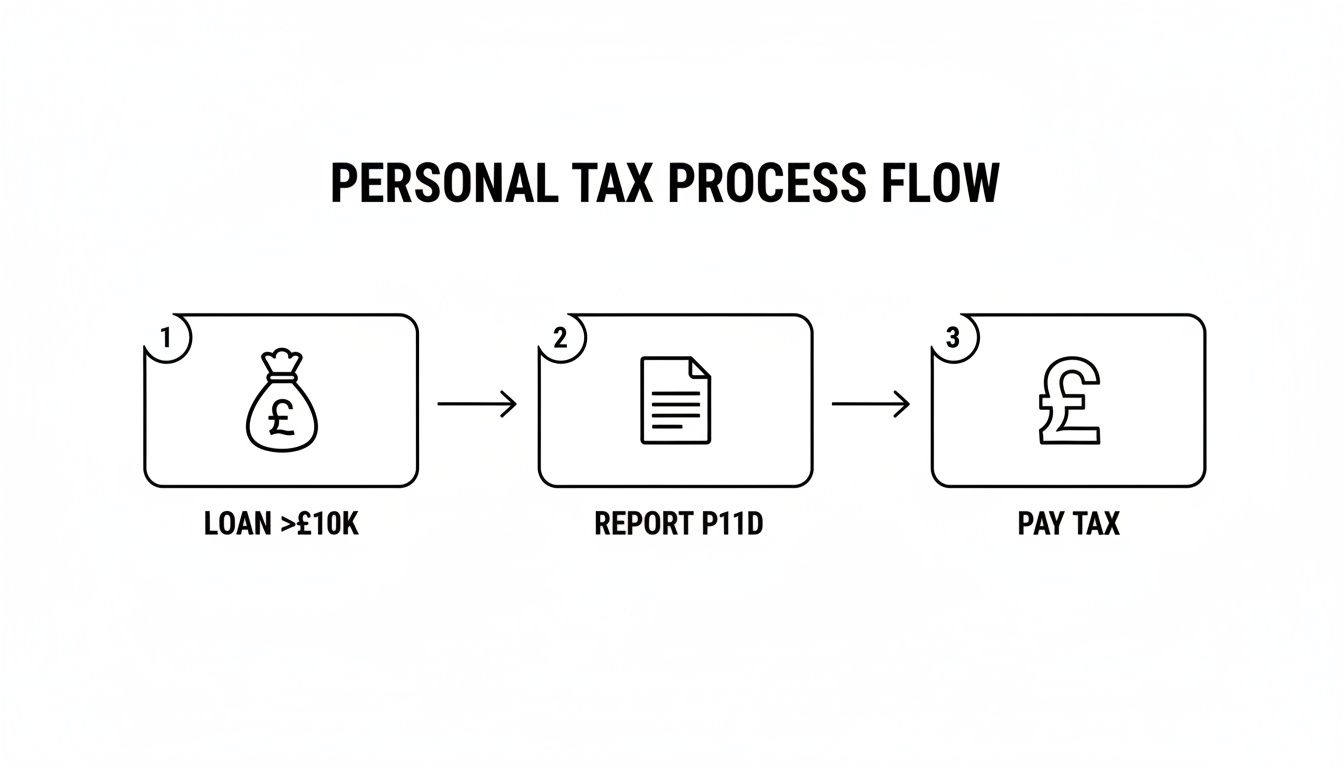
As you can see, once you cross that £10,000 threshold, the reporting duty is automatic and leads directly to a tax bill for you, the director.
Handling this admin is a standard part of running a limited company. Many contractors find it helpful to budget for professional support, and our guide on limited company accountant fees can give you a clear idea of what to expect.
Effective Ways to Repay Your Director's Loan and Avoid Tax

The secret to managing a director's loan is simple: have a clear repayment plan from the start. Knowing how you will clear the balance before you even borrow the money is the smartest way to steer clear of the costly Section 455 charge and any personal tax headaches.
Thankfully, there are several ways to settle your loan. Each route has its own financial effects, so it is crucial to pick the one that works for your company’s health and your own tax position.
Let's walk through the most common and effective strategies.
Three Ways to Repay Your Loan
The most straightforward methods involve clearing your director’s loan account with funds that are officially allocated to you. This ensures the transaction is properly documented and completely above board in the eyes of HMRC.
Here are your main options:
- Declare a Dividend: You can vote to pay yourself a dividend from your company's post-tax profits. Instead of the cash hitting your personal bank account, it is used to repay the loan on paper. This is a very popular method for contractors.
- Take a Salary or Bonus: You can pay yourself an extra salary or a one-off bonus. After PAYE tax and National Insurance are deducted, the net amount is used to reduce the loan balance.
- Use Personal Savings: The simplest option. You just transfer money from your personal bank account back into the company, returning what you borrowed. No extra tax is involved.
Which is best? It really depends on your company's profitability and your personal tax bracket. If your company has plenty of retained profits, a dividend is often the most tax-efficient route. Our guide on how to pay myself dividends breaks this down in more detail.
Key Takeaway: Always, always document the repayment. A board minute for a dividend or a clear bank transfer reference is your best defence if HMRC ever comes knocking.
The ‘Bed and Breakfasting’ Anti-Avoidance Trap
HMRC is wise to directors trying to bend the rules. One of the best-known traps is called ‘bed and breakfasting’, and it is a costly mistake to make.
This is where a director repays their loan just before the nine-month deadline, only to take out a similar amount again shortly after the new financial year starts. HMRC sees this for what it is: an attempt to dodge the tax, not a genuine repayment.
To stop this, strict anti-avoidance rules are in place. If you repay a loan of over £5,000 and then take out a new loan of a similar amount within 30 days, HMRC will likely ignore the repayment. They will treat the original loan as if it was never cleared, hitting you with the Section 455 tax charge.
The 30-day rule is a hard-and-fast red line you do not want to cross. HMRC also uses an 'intentions' test. If you repay your loan but always planned to re-borrow the funds soon after, they can still apply the charge, even if the new loan is taken out more than 30 days later.
Avoiding the Benefit-in-Kind Tax
While the Section 455 charge gets all the attention, do not forget about the personal tax implications. As we have mentioned, loans over £10,000 can trigger a benefit-in-kind (BIK) tax charge if they are interest-free.
You have two simple ways to avoid this personal tax bill:
- Keep the Loan Below £10,000: The easiest tactic is to make sure your outstanding loan balance never tips over the £10,000 threshold at any point during the tax year.
- Charge Interest at the Official Rate: If the loan has to be over £10,000, your company should formally charge you interest. As long as the rate is at or above HMRC’s official rate (currently 2.25% for 2025/26), you are in the clear.
By charging the official rate of interest, you remove the "benefit" in HMRC’s eyes. You must actually pay this interest to the company, and the company needs to declare it as income.
This is exactly why putting a formal loan agreement in place is always a good idea. It documents the terms, interest rate, and repayment schedule, proving to HMRC that it is a legitimate, commercial arrangement. A little bit of admin here can save you a lot of tax and stress down the line.
Is an Umbrella Company a Simpler Alternative?
If the rules around director’s loans sound like a lot of hard work, you are not wrong. Keeping track of every pound, calculating interest, and getting your head around forms like the CT600A and P11D is a significant administrative chore.
That is all before you even get to making repayments on time to dodge those hefty tax charges. For a busy contractor, the headache and risk tied to the tax on directors loans can easily outweigh the benefits. It is no wonder many look for a different way to operate.
The Straightforward Umbrella Approach
This is where an umbrella company can offer a much simpler path. When you join an umbrella, you effectively become their employee. That simple change means the entire concept of a director's loan – and all the tax headaches that come with it – vanishes completely.
The day-to-day process is incredibly straightforward:
- You send your timesheets to the umbrella company.
- They sort out the invoicing with your client or agency.
- All your tax and National Insurance is handled through PAYE (Pay As You Earn).
- You are paid your net salary, just like any other employee.
Put simply, you do not have to give a second thought to a Section 455 charge, benefit-in-kind rules, or wrestling with complicated year-end reports. Your tax is sorted correctly every single time you are paid.
For contractors who value simplicity and want complete confidence in their compliance, the umbrella model provides real peace of mind. It lets you get on with your work, knowing the financial admin is being handled properly.
If this hassle-free approach sounds like a better fit, it is worth exploring how an umbrella company for freelancers can support your contracting career. You get the freedom of contracting without the heavy administrative burden of running your own limited company.
Frequently Asked Questions About Director's Loan Tax
Even with a good grasp of the basics, the tax rules for director's loans can feel a bit tricky. Here are some quick answers to the questions we hear most often from contractors, which should help clear things up.
What Happens If I Cannot Repay My Director’s Loan on Time?
If you miss the repayment deadline, the most immediate problem is for your company. It will have to pay a Section 455 tax charge of 33.75% on whatever balance is still outstanding. This payment is due alongside your regular Corporation Tax and can create a serious dent in your company's cash flow.
The moment you think you might struggle to repay, talk to your accountant. They can help you map out a plan for the tax bill and see if there are other ways to manage the debt before it becomes a bigger issue.
Can I Write Off a Director’s Loan?
Yes, your company can decide to write off the loan. Be warned, though, as this choice triggers its own set of tax consequences. The company usually will not get Corporation Tax relief on the written-off amount.
For you, HMRC views the forgiven loan as a taxable distribution, much like a dividend. You will need to declare the full value on your Self-Assessment tax return and pay personal income tax on it.
Is There a Legal Limit on a Director’s Loan?
There is no hard legal cap on the amount a director can borrow. However, the size of the loan does matter, as it brings different rules into play.
- Any loan over £10,000 is automatically treated as a Benefit-in-Kind (BIK) unless you are paying interest at HMRC’s official rate.
- Particularly large loans tend to draw more attention from HMRC. They will want to be sure it is a genuine loan and not just a disguised salary payment.
How Does My IR35 Status Affect Director’s Loans?
Director's loans are a tool for limited companies. If your contracts are determined to be inside IR35, most of the tax advantages of running your own company disappear anyway.
For many contractors in this position, switching to an umbrella company becomes a much simpler and more compliant way to get paid. This completely sidesteps the complexities of director's loans, S455 tax, and benefit-in-kind reporting.
If you want to leave the complexities of director's loans and IR35 compliance behind, UmbrellaCompany.com can help. Use our free comparison tool to find a trusted, compliant umbrella company in minutes. Find your ideal umbrella company today.


