


An HMRC letter has a way of stopping your day.
You might be between client calls, checking your payslip from an umbrella company, or sorting invoices from older contracts. Then the brown envelope lands. It may be routine. It may be a request for records. It may be the start of a deeper enquiry. Either way, most contractors have the same first thought. What will this cost me to deal with properly?
That’s where tax investigation insurance starts to make sense. Not as a dramatic worst-case product, but as a practical form of backup when HMRC asks questions and you need specialist help to answer them.
Introduction Why HMRC Enquiries Are a Growing Concern
For self-employed professionals, tax risk rarely feels urgent until HMRC gets in touch.
A contractor can do everything they believe is right, keep records, use payroll correctly, rely on an accountant, and still face an enquiry. HMRC enquiries can start because of a discrepancy, a sudden change in income, third-party data, or a random compliance check. That uncertainty is exactly why so many people find the process unsettling.

Why contractors feel this more sharply
Contractors often have more moving parts than permanent employees.
You may have worked through a limited company in the past, moved to an umbrella company for current assignments, filed self-assessment returns, claimed expenses in earlier years, or dealt with IR35 status decisions across different contracts. Each of those details can affect what HMRC wants to review.
That matters even if your current arrangement feels straightforward. If you’re paid through PAYE now, earlier tax years can still attract attention. If you want a refresher on the off-payroll rules that sit behind many of these questions, this guide to IR35 for contractors is a useful starting point.
The wider market shows demand is rising
The concern isn’t imagined. The global tax insurance market, which includes UK HMRC enquiry defence, recorded 1,917 submissions in 2025, a 25% year-on-year increase from 1,526 in 2024, and 232 bound policies, a nearly 30% year-on-year rise, according to Euclid Transactional’s 2025 tax insurance market update. That growth was linked to greater regulatory complexity, including post-IR35 enforcement in the UK.
That doesn’t mean every contractor will face a serious investigation. It does mean more people are deciding they’d rather have cover in place before a problem starts.
Practical rule: Tax investigation insurance isn’t about expecting trouble. It’s about making sure one HMRC letter doesn’t force you to handle a technical dispute alone.
There’s also a useful parallel from the US. If you want a plain-English look at how tax audits feel from the taxpayer’s side, What Is an IRS Audit and How Do You Survive One gives a good sense of why preparation matters, even though the system is different from HMRC’s.
What Exactly Is Tax Investigation Insurance?
The simplest way to think about tax investigation insurance is this. It’s a policy that helps pay for the professional costs of defending or managing an HMRC enquiry.
That means the fees charged by qualified advisers, such as accountants or tax specialists, who deal with HMRC on your behalf. It’s similar in spirit to the legal expenses add-on you might see with motor or home insurance. The insurer isn’t there to make the tax issue vanish. It’s there to fund expert help when you need someone to handle the process properly.
What it is designed to do
When HMRC opens an enquiry, the immediate financial pressure often isn’t the final outcome. It’s the cost of responding.
Someone has to review records, prepare explanations, correspond with HMRC, gather supporting documents, and sometimes challenge a point of law or status. For a contractor, that work can become expensive long before any conclusion is reached.
Tax investigation insurance exists to absorb those professional fees, subject to the policy terms.
The point many people misunderstand
This cover does not pay the tax you owe if HMRC decides more tax is due.
That distinction matters. Many contractors hear the word “tax insurance” and assume it protects the tax bill itself. In most cases, tax investigation insurance protects the cost of representation, not the underlying liability.
A separate product may exist for tax liabilities in certain circumstances, but that is a different conversation and applies in a narrower set of situations.
The best way to read the product name is this. “Investigation” is the key word, not “tax”.
A plain-English comparison
Here’s a quick comparison that helps clear up the confusion.
| Product | Main purpose | Pays for |
|---|---|---|
| Tax investigation insurance | Help during an HMRC enquiry | Professional fees, specialist advice, representation |
| Tax liability insurance | Protect against a defined tax liability risk in specific circumstances | The insured liability, if the policy responds |
If you’re comparing products that mention status disputes and enquiry support, it’s worth understanding how they sit alongside IR35 insurance, because some policies are broader and some are tightly focused on off-payroll risk.
Why this matters for contractors
Contractors often sit in the grey areas that trigger questions.
You may have contracts that were assessed inside or outside IR35. You may have changed trading structure. You may have umbrella income now, but historical company income from earlier periods. In that setting, paying for specialist help out of pocket can be a nasty surprise.
Tax investigation insurance is there to make sure that, if HMRC comes calling, you’re not choosing between proper representation and preserving cash flow.
What Your Policy Typically Covers and Excludes
A good policy can be very useful, but it’s only useful if you know what’s inside it.
This is the part that deserves careful reading. Policy wording can vary, and the details matter more than the headline.
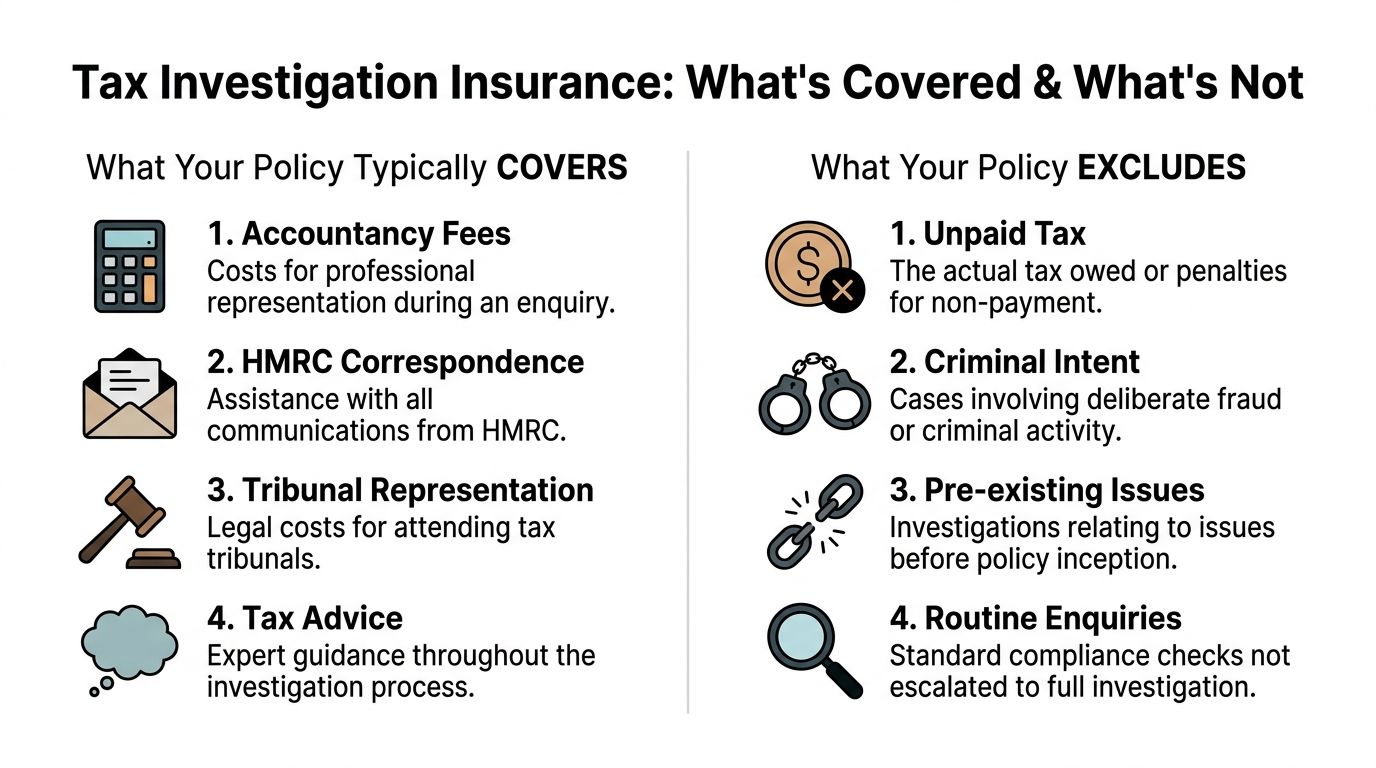
What policies often cover
For UK contractors, tax investigation insurance policies often provide up to £250,000 per claim for professional fees, and a standard investigation into a limited company’s tax affairs can exceed £4,000 to £5,000, according to Twine’s guide to key insurances for freelancers and contractors. That same source notes that specialist intervention can improve outcomes by bringing experienced support into the process.
In practical terms, cover often includes:
- Accountant or tax adviser fees. If HMRC opens an enquiry and your adviser has to respond, prepare records, draft explanations, and represent you, those professional costs are often the core benefit.
- Support with HMRC correspondence. Many policies cover the work involved in handling letters, information requests, and follow-up questions from HMRC.
- Representation during more complex disputes. Some policies extend to tribunal support or formal representation, subject to the wording and any conditions.
- Expert tax advice during the enquiry. This can be one of the most valuable parts, especially where the issue turns on judgement rather than a simple arithmetic mistake.
- IR35-related enquiry support. Some contractor-focused policies include help with status disputes or related compliance questions.
What this means in practice
A contractor using a limited company may be asked for contract documents, working practices, bank records, payroll details, or explanations around income treatment.
A contractor working through an umbrella company may still need support if HMRC looks at earlier years, side income, or questions linked to previous arrangements. The umbrella setup doesn’t erase personal tax history.
If you’re reviewing your wider protection package, it’s also sensible to look at the broader range of contractor insurance in the UK, because tax cover solves a different problem from professional indemnity or public liability.
What policies often exclude
Disappointment starts here, so it’s better to be clear upfront.
Most policies exclude some or all of the following:
- The actual tax due. If HMRC decides you underpaid tax, the policy won’t settle that amount for you.
- Penalties and interest. Unless the wording says otherwise, assume these sit outside standard enquiry defence cover.
- Deliberate fraud or criminal conduct. Insurers won’t support conduct that was knowingly dishonest.
- Known problems that existed before the policy started. If the issue was already underway, or you had reason to expect it, cover may not respond.
- Routine tax return preparation. Your annual filing work is not the same as a defended enquiry.
- Very limited forms of compliance contact. Some lower-cost policies only respond once HMRC’s contact reaches a certain threshold.
Check the trigger point. Some policies react to any formal enquiry. Others only respond when HMRC escalates beyond basic correspondence.
The key question for IR35 users
The biggest trap for contractors is assuming that “tax enquiry cover” automatically means “strong IR35 cover”.
It might. It might not.
An IR35 dispute can involve questions about employment status, control, substitution, mutuality of obligation, contract terms, and actual working practices. That is more specialised than a routine review of figures on a return. If your work history includes outside IR35 contracts, ask specifically whether the policy covers status challenges and related defence costs.
Costs and True Benefits of Protection
Many people ask the cost question first, and that’s sensible.
For many small businesses and freelancers in the UK, annual premiums for tax investigation insurance start as low as £75, which is less than 21p per day or £6.25 per month, according to Markel’s tax investigation insurance information. The same source notes that many policies cover professional fees for enquiry defence without an excess.
Why the price can vary
That starting point is helpful, but it isn’t a universal quote.
Insurers price the policy around things like:
- Your business structure, such as sole trader, partnership, or company
- Turnover and income levels
- Your profession or sector
- The kind of cover included, such as whether it is enquiry defence only or part of a wider package
- Any additional services, including specialist support or legal expenses options
The £75 example in the source is based on a specific business profile. That’s why you should treat online prices as indicators, not promises.
Why many contractors decide it’s worth it
The value isn’t just the premium versus the potential fee bill.
It’s the fact that an HMRC enquiry consumes attention fast. Someone has to organise records, understand what HMRC is asking, respond within deadlines, and decide how much to disclose and how to frame it. If you do that alone, you risk mistakes. If you hand it to a specialist, you protect both your time and your position.
Here’s where the benefit becomes practical:
- You keep working. Instead of turning evenings and weekends into a tax defence exercise, you can stay focused on client delivery.
- You get experienced representation. A specialist knows how HMRC enquiries tend to progress and what evidence matters.
- You reduce panic decisions. People under pressure often send too much, too little, or the wrong documents.
- You gain emotional breathing room. That matters more than many people expect.
One useful test: If an HMRC letter arrived tomorrow, would you be comfortable paying for expert support yourself, immediately, without disrupting your finances?
If the answer is no, a modest annual premium can feel less like an optional add-on and more like sensible business housekeeping.
Do Contractors and Freelancers Need This Insurance?
The short answer is that some contractors need it more urgently than others, but many benefit from it.
The better question is not “Do all contractors need tax investigation insurance?” The better question is “How exposed am I if HMRC asks detailed questions about my work, my status, or my past returns?”

If you work through a limited company
This group has the clearest case for cover.
A personal service company creates more areas that HMRC may review, such as corporation tax, dividend extraction, salary levels, expenses, VAT, payroll, and IR35 status. Even if your records are strong, the scope of a possible enquiry is wider than it is for someone with one source of PAYE employment income.
If you’ve had a mix of inside and outside IR35 contracts over time, the risk becomes more nuanced. HMRC may focus not just on what you earned, but on how the engagement was structured and whether the status decision was sound.
If you’re inside IR35 now
A lot of contractors assume they don’t need to think about tax investigation insurance because they now work inside IR35 through PAYE.
That can be a mistake.
Your current arrangement may reduce risk on current earnings, but it doesn’t remove questions about earlier periods. HMRC can still review historical contracts, previous company years, or transitions between working models.
If you use an umbrella company
Umbrella working often lowers the complexity of current payroll because tax and National Insurance are handled through PAYE.
That helps, but it doesn’t make every tax risk disappear. You may still have:
- Earlier limited company years that remain open to review
- Self-assessment obligations for other income
- Property income or investments
- A side business or freelance work outside the umbrella arrangement
- Personal self-assessment issues not caused by umbrella payroll
That’s why umbrella users shouldn’t dismiss tax investigation insurance out of hand.
Why IR35 changes the picture
A major knowledge gap still exists around IR35. Contractors often know that insurance may cover investigation costs, but they don’t fully understand how IR35 enquiries differ from standard tax probes, including the added complexity of status determinations, deemed employment risks, and settlement discussions, as noted by IT Contracting’s discussion of tax investigation insurance for contractors.
That point deserves emphasis. An IR35 dispute is not just a check of figures. It can become an argument about the reality of your working relationship.
You may need to evidence:
- Control, meaning who directed the work and how closely
- Substitution, meaning whether someone else could do the work
- Mutuality of obligation, meaning whether there was an ongoing expectation of work and acceptance
- Actual working practices, not just the contract wording
- Historical records, emails, statements of work, and client communications
That’s a different type of defence than explaining an expense claim.
An IR35 enquiry can ask, in effect, “Were you in business on your own account, or were you working like an employee?” That is why specialist cover matters.
A practical way to decide
Think about your recent work history, not just your current setup.
You’re more likely to benefit from tax investigation insurance if any of these apply:
- You’ve switched structures. For example, from limited company to umbrella.
- You’ve worked outside IR35 before and would struggle to defend status without specialist help.
- You have several income streams. The more moving parts, the more likely an enquiry becomes technical.
- You file self-assessment returns and need confidence that someone can step in quickly.
- You value certainty. Some people prefer to avoid the financial shock of professional defence costs.
Good tax habits still matter. Keeping contracts, payslips, expense records, and correspondence in order will always help. If you also want to tighten up the basics around allowable claims, this guide to tax write-offs for freelancers is a practical companion read.
When it may feel less urgent
If all your income is straightforward PAYE, with no side business, no property income, no recent self-assessment complexity, and no historical company structure, the need may be lower.
Even then, lower risk doesn't mean zero risk. This means the value decision is more personal.
How Umbrella Companies and Tax Insurance Work Together
Many contractors get confused here.
A compliant umbrella company handles payroll, deducts tax and National Insurance through PAYE, and gives you the administrative simplicity that many professionals want when working inside IR35. For current assignment income, that reduces a lot of day-to-day tax friction.
What the umbrella setup helps with
When your earnings are processed through PAYE, there is less room for the kinds of reporting issues that can arise in a personal service company.
Your payslip shows deductions. Your employment income is processed in a structured way. That can lower the chance of certain disputes on that income stream.
If you’re weighing whether this model fits your way of working, this guide to an umbrella company for freelancers explains the practical setup.
What it doesn’t remove
An umbrella company doesn’t become your personal shield for every tax issue in your life.
Its payroll processes relate to the income it pays you. It doesn’t cover:
- Historic tax years before you joined
- Income from an old limited company
- Rental income
- Dividends, savings, or investments
- A side business or freelance work outside the umbrella arrangement
- Personal self-assessment issues not caused by umbrella payroll
That’s why umbrella users shouldn’t dismiss tax investigation insurance out of hand.
Company insurance versus your insurance
Another common misunderstanding is thinking that the umbrella company’s business insurances automatically protect the contractor personally in every tax dispute.
They don’t serve the same purpose.
The umbrella company’s own insurance arrangements are there to protect the business and its operations. Your need for tax investigation insurance is personal. It exists to fund expert support if HMRC asks questions about your tax affairs.
The umbrella company can simplify your current pay. It cannot replace personal enquiry defence for your wider tax position.
Where the two work well together
Used together, they can create a cleaner risk position.
The umbrella arrangement can reduce complexity for current contract income. Tax investigation insurance can provide a backstop for the parts of your tax life that still sit with you personally. For many contractors, especially those who’ve changed working models over time, that combination makes more sense than relying on one solution alone.
Your Checklist for Choosing the Right Policy
Once you decide to look seriously at tax investigation insurance, comparison becomes easier if you ask the same set of questions every time.

Questions worth asking before you buy
- Does it cover IR35 disputes specifically. Don’t assume “tax enquiry” automatically includes the full range of status-related work.
- What is the indemnity limit. Check whether the policy limit feels suitable for your work history and risk profile.
- Is there an excess. Some policies have none, but don’t assume that applies across the market.
- Who handles the enquiry. Ask whether support comes from specialist tax advisers, accountants, or a panel chosen by the insurer.
- Does it include previous tax years. Some policies can include earlier periods if your tax affairs are up to date when cover starts.
- What events trigger the cover. Clarify whether the policy responds to a formal HMRC enquiry, a compliance check, or only more advanced disputes.
- Are tribunal costs included. If a matter escalates, you’ll want to know where the protection stops.
- What is excluded. This is often more important than the sales summary.
What to do if HMRC contacts you
A claims process goes more smoothly if you act early.
- Read the letter carefully and note any deadlines.
- Tell your adviser or insurer quickly. Late notification can create avoidable problems.
- Don’t send a rushed response before checking the wording and scope of HMRC’s request.
- Gather records calmly. Contracts, payslips, returns, and correspondence are often the first things needed.
Conclusion Securing Your Financial Peace of Mind
Tax investigation insurance is easiest to appreciate before you need it.
For contractors and freelancers, value lies in having expert support ready when HMRC starts asking questions. That support can matter whether you trade through a company, work through an umbrella, file self-assessment returns, or carry a mix of current and historical tax positions.
Remember this key point: This cover is about the cost of defending an enquiry, not paying the tax itself. Once that distinction is clear, it becomes much easier to judge whether the premium feels worthwhile for your circumstances.
If your working life includes IR35 decisions, changing engagement models, or multiple income streams, tax investigation insurance can be a sensible layer of protection. It won’t remove every risk, but it can make a difficult process far more manageable.
If you’re reviewing your contractor setup and want a compliant payroll partner that fits your circumstances, Umbrella Company helps you compare trusted umbrella companies quickly and clearly. It’s a practical place to start if you want to simplify your working arrangement and make sure the right protections are in place around it.


