


For UK contractors running their own limited company, the ultimate goal is finding the most tax-efficient way to get paid. The tried-and-tested method is a mix: a small salary topped up with larger dividend payments. This structure is smart because it keeps your National Insurance Contributions to a minimum while making the most of the different tax allowances and rates available to you.
Structuring Your Pay for Maximum Tax Efficiency

Let's be honest, the UK tax system can feel like a maze. But once you understand the main routes available, you can significantly boost your take-home pay. This guide cuts through the noise and compares the two paths most contractors and freelancers take: operating through your own limited company or working under an umbrella company.
We will break down how each one works, where the benefits lie, and what potential traps to watch out for.
By the end of this article, you will have a much clearer idea of which setup aligns with your earnings, your IR35 status, and just how much admin you are willing to take on.
Limited Company vs Umbrella Company At a Glance
The decision often boils down to a simple trade-off: do you want to maximise your income, or minimise your paperwork? A limited company gives you the potential for greater tax planning, while an umbrella company offers the straightforward simplicity of being an employee.
| Feature | Limited Company (Salary & Dividend) | Umbrella Company (PAYE) |
|---|---|---|
| Control | Full control over business finances | No control; you are an employee |
| Tax Efficiency | High potential via salary/dividend mix | Lower; taxed as a standard employee |
| Administration | High (payroll, accounts, tax returns) | Very low (handled by the provider) |
| IR35 Suitability | Best for contracts outside IR35 | Best for contracts inside IR35 |
| Employment Rights | None (you are a director) | Full (holiday pay, sick pay) |
Finding the Optimal Salary Level
For the 2025/26 tax year, a popular and effective strategy is to set your director’s salary right at the personal allowance threshold of £12,570. Why this amount? It’s high enough to qualify you for state benefits linked to National Insurance Contributions (NICs), but low enough that you will not pay any income tax on it.
This approach continues to be the most efficient route, even with upcoming changes to employer NICs. It is always worth staying on top of the latest guidance on the optimal director salary strategy for 2025-26 to be sure.
Making the right call on your payment structure requires a bit of planning. For those who want to connect with expert advice quickly, an AI phone answering service for tax preparers can make the process much smoother. Here at UmbrellaCompany.com, we give you the tools to compare compliant providers and make an informed choice.
The Limited Company Director Salary and Dividend Strategy
https://www.youtube.com/embed/d76YUs95qNQ
Running your own limited company gives you serious control over your finances, and with that comes some powerful opportunities for tax planning. The classic, most effective strategy for directors is to blend a small, regular salary with larger dividend payments drawn from company profits. It is the cornerstone of paying yourself tax-efficiently as a UK contractor.
This approach works by splitting your income into two streams, each taxed very differently. By keeping your salary low, you minimise your National Insurance Contributions (NICs), a tax that simply does not apply to dividends. This structure gives you the flexibility to take money out of the business in a way that genuinely maximises what you keep.
Finding Your Optimal Salary Level
The trick to making this work is setting your director's salary at just the right level. For most, the sweet spot aligns with the annual Personal Allowance, which stands at £12,570 for the 2025/26 tax year.
Paying yourself a salary of £12,570 hits several key targets:
- No Income Tax: The entire salary is covered by your tax-free Personal Allowance.
- Qualifying for State Benefits: Crucially, this salary is high enough to count as a qualifying year for your State Pension and other benefits, but you will not actually pay any employee's NICs on it.
- Reduces Corporation Tax: Your salary is a legitimate business expense, which lowers your company's profit and, therefore, its Corporation Tax bill.
The company will have to pay a small amount of employer's NICs on the portion of your salary between the Secondary Threshold and the Personal Allowance. But even with that small cost, the overall tax saving makes this structure the go-to choice for most directors.
Understanding How Dividends Work
After you have paid your salary and covered all other business expenses and Corporation Tax, any leftover profit can be paid out to shareholders as dividends. This is where the real tax-efficiency of a limited company shines.
Unlike a salary, dividends are not subject to National Insurance at all. That single fact creates a huge saving for both you and your company. Dividends do have their own tax rates, of course, but they are lower than the equivalent income tax bands.
Key Insight: The main advantage of the salary and dividend model is avoiding National Insurance Contributions on the bulk of your earnings. This simple difference can easily save you thousands of pounds every year compared to taking everything as a salary through PAYE.
Dividend Allowances and Tax Bands
Everyone gets a tax-free Dividend Allowance. For the 2025/26 tax year, this allowance is £500, meaning the first £500 of dividends you receive are completely tax-free.
Once you have used that up, the tax you pay on further dividends depends on your total income for the year. The rates are much friendlier than income tax on salary:
- Basic Rate: 8.75%
- Higher Rate: 33.75%
- Additional Rate: 39.35%
To work out your dividend tax, you just add your dividend income on top of your other income (like your director's salary). That total figure determines which tax band your dividends fall into. For a more detailed breakdown, have a look at our guide on how to structure dividends for tax saving in the UK.
To put this into perspective, let’s compare how a £60,000 income might look for a contractor using a limited company versus an umbrella company.
Payment Structure Comparison for £60,000 Income
| Payment Structure | Gross Income | Key Deductions | Estimated Take-Home Pay | Administrative Burden |
|---|---|---|---|---|
| Limited Company (Salary/Dividend) | £60,000 | Corporation Tax, small Employer's NICs, Dividend Tax | ~£47,500 | High – Requires running payroll, filing accounts, and tax returns. |
| Umbrella Company | £60,000 | Umbrella Margin, Employer's NICs, Apprenticeship Levy, Income Tax, Employee's NICs | ~£39,500 | Low – The umbrella company handles all tax and admin. |
This table gives you a clear snapshot of the trade-off. While the limited company route offers a significantly higher take-home pay, it comes with a much greater administrative load.
The Administrative Responsibilities
That higher take-home pay does not come for free. Being a company director means you are legally on the hook for managing your company's finances properly.
This includes:
- Running Payroll: You will need to register as an employer and run a PAYE scheme for your own salary.
- Filing Accounts: Annual accounts must be prepared and filed with Companies House.
- Corporation Tax Return: You have to submit a company tax return (CT600) to HMRC each year.
- Self Assessment: You will need to file a personal Self Assessment tax return to declare your salary and dividend income.
These are not small tasks. They demand meticulous record-keeping and a sharp eye on deadlines. It is why so many contractors hire an accountant to handle the heavy lifting, ensuring everything is compliant while they focus on their actual work. Just remember to factor that accountancy fee into your calculations when weighing this up against simpler models.
How Umbrella Companies Offer a Simpler Alternative

For contractors who find the administrative weight of a limited company a bit much, there is a far simpler route. An umbrella company gives you a compliant and hassle-free way to manage your earnings, taking the burden of running a business completely off your shoulders.
When you join one, you effectively become their employee. This single shift in status transforms your responsibilities. Forget about chasing invoices, running payroll, or filing tax returns. The umbrella company handles all of that for you, providing a payslip just like any permanent employee would receive.
How Your Pay Is Processed
The whole process is built for simplicity. You submit your timesheets to the umbrella company, they invoice your client, and once the payment lands, they run your payroll. But it is vital to understand that your day rate is not what you will see in your bank account.
Before your taxable salary is calculated, several deductions are made from the total amount your client pays. This is a crucial difference from traditional employment, where the employer covers these costs behind the scenes.
These deductions typically include:
- The Umbrella Company Margin: This is their fee for the service, usually a fixed weekly or monthly amount.
- Employer’s National Insurance Contributions (NICs): As your legal employer, the umbrella has to pay this.
- Employer Pension Contributions: This covers the mandatory workplace pension scheme.
- The Apprenticeship Levy: A tax on UK employers that funds new apprenticeships.
Once these employment costs are taken off, the remainder becomes your gross taxable salary. From there, standard employee deductions like Income Tax and your own employee NICs are made. The final figure is your net pay. To get a better handle on the basics, we suggest reading our guide on what an umbrella company is and how the model works.
The Trade-Off Between Simplicity and Take-Home Pay
This structure means your take-home pay will nearly always be lower than what you might achieve through a tax-optimised limited company. The main reason for this gap is that all employment costs have to be covered from your contract rate.
But the real value of an umbrella company is not just measured in pounds and pence. Its biggest draw is the complete removal of administrative stress and financial risk.
Key Takeaway: An umbrella company swaps potentially higher earnings for simplicity, compliance, and full employment rights. You trade some tax efficiency for peace of mind and freedom from the legal duties of a company director.
Gaining Employment Rights and Security
One of the most powerful benefits of this model is gaining a continuous employment record and access to full statutory rights, something limited company directors simply do not get.
As an employee of the umbrella company, you are entitled to:
- Statutory Sick Pay (SSP): Support if you are too unwell to work.
- Statutory Holiday Pay: You accrue paid time off based on the hours you work.
- Maternity, Paternity, and Adoption Pay: Access to statutory leave and pay.
- A Workplace Pension: You will be auto-enrolled into a pension scheme.
This unbroken employment history can also be a huge help when applying for mortgages or loans, as lenders tend to look more favourably on it than the often-variable income of a company director. For many contractors, especially those on shorter-term roles or working inside IR35, this security makes an umbrella company the most sensible choice for their circumstances.
Choosing Your Payment Method: A Situational Analysis
Deciding on the most tax-efficient way to pay yourself in the UK is not a one-size-fits-all deal. Far from it. The right structure hinges entirely on your professional goals, your financial situation, and, frankly, how much admin you are willing to put up with.
This section offers a practical, real-world analysis to help you make that call. We will walk through a few common contractor scenarios to highlight when a limited company really shines and when an umbrella company just makes more sense.
When To Choose A Limited Company
A limited company often emerges as the most profitable route for contractors who tick a few specific boxes. If any of the following sound like you, this structure is probably your best bet for maximising what you take home.
Think about going down this road if you are:
- Working Outside IR35: This is the big one. The salary and dividend model is only genuinely tax-efficient for contracts that fall outside the scope of the off-payroll working rules.
- Earning A Higher Income: Generally, contractors pulling in over £35,000 to £40,000 a year will see the most significant financial perks. At this level, the tax savings start to properly outweigh the administrative costs.
- In It For The Long Haul: If you see yourself contracting for the foreseeable future, setting up a limited company is a sound investment. It provides a stable and flexible foundation for your business.
- Comfortable With Administration: You have to be ready to manage company accounts, run payroll, and file tax returns, or be happy to pay an accountant to do it all for you.
Scenario One: The Experienced IT Contractor
An IT contractor lands a 12-month project outside IR35 with a day rate of £500. With annual earnings hitting around £120,000, the limited company route is a clear winner. By taking a small salary and the rest in dividends, their take-home pay will be thousands of pounds higher than if they used an umbrella company. The accountant's fee is a small price to pay for such a hefty tax saving.
This decision tree gives you a visual on how tax allowances apply to different income streams, which is a key part of your planning.
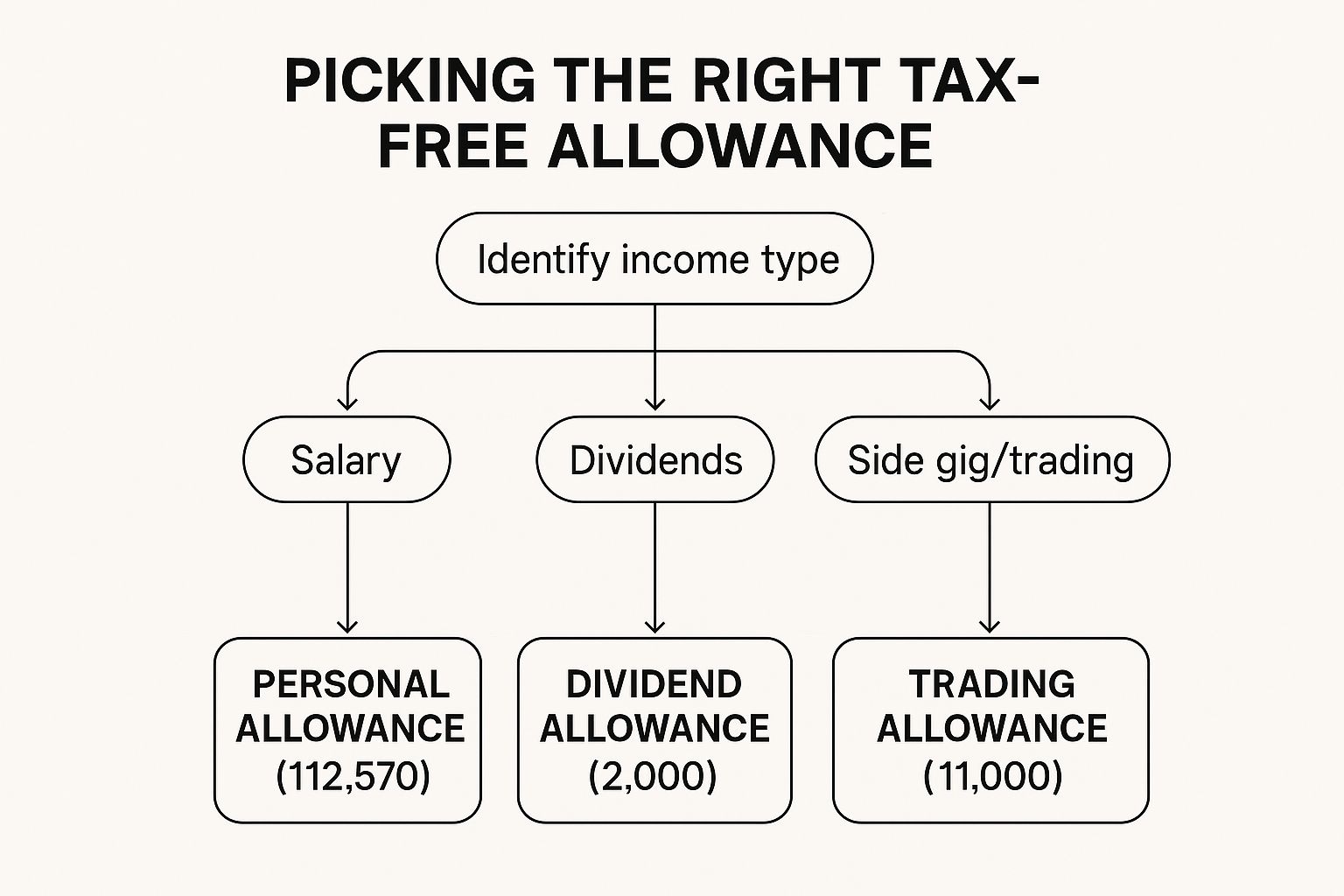
Getting to grips with these core allowances is the first step toward building a tax-efficient payment strategy that fits your unique mix of salary, dividends, or other earnings.
When An Umbrella Company Is The Right Call
While a limited company can boost your earnings, an umbrella company offers a simpler, safer, and often more practical alternative in many situations. It is the go-to choice for compliance and pure ease of use.
This model is the perfect fit if you are:
- Working Inside IR35: If your contract is determined to be inside IR35, an umbrella company is the most straightforward and compliant way to get paid. It ensures the correct tax and NICs are sorted at source.
- On A Short-Term Contract: For gigs lasting just a few weeks or months, the hassle and cost of setting up and running a limited company probably is not worth it. An umbrella company lets you hit the ground running.
- New To Contracting: If you are just dipping your toes into the contracting world, an umbrella company is a low-risk way to test the waters without the full commitment of being a company director.
- Seeking Employment Benefits: If you need a continuous employment record for something like a mortgage application, or you value benefits like sick pay and holiday pay, the umbrella model gives you that security.
For a deeper dive into how these factors influence your final earnings, you can explore our analysis of which payroll solution gives the highest take-home pay.
Scenario Two: The Public Sector Project Manager
A project manager takes on a 6-month contract with a government department, which is deemed inside IR35. For them, an umbrella company is the only logical option. It guarantees full IR35 compliance, provides them with employment rights, and requires zero admin from their side. The slightly lower take-home pay is a fair trade for complete peace of mind.
Contractor Payment Method Decision Matrix
Choosing your payment method is a strategic decision. This matrix can help clarify which path aligns best with your circumstances.
| Decision Factor | Limited Company (Salary & Dividend) | Umbrella Company |
|---|---|---|
| IR35 Status | Best for Outside IR35 contracts to maximise tax efficiency. | The compliant and standard choice for Inside IR35 contracts. |
| Income Level | Most beneficial for earnings over £35,000-£40,000 per year. | Suitable for all income levels, especially lower or variable earnings. |
| Contract Length | Ideal for long-term contracts (6+ months) where setup costs are justified. | Perfect for short-term gigs or if you switch contracts frequently. |
| Admin Preference | Requires hands-on management or hiring an accountant. | Minimal admin; just submit timesheets and the rest is handled for you. |
Ultimately, by carefully weighing your contract's IR35 status, your expected earnings, and your personal priorities, you can select the structure that best supports your financial health and professional journey.
Using Pensions to Enhance Your Tax Efficiency

Once you have got the basics of your payment structure sorted, it is time to look at some of the smarter ways to boost your tax efficiency. For UK contractors, one of the most powerful tools in your arsenal is the pension scheme. It is much more than just a savings pot for the future; it is a brilliant way to reduce your tax bill right now.
Making clever use of pension contributions means you can lower your immediate tax liabilities while building a solid financial bedrock for retirement. It is a cornerstone of any serious long-term financial plan.
Pension Contributions for Limited Company Directors
If you run your own limited company, you can make employer pension contributions straight from your business bank account into your personal pension. This is an incredibly tax-efficient way to pay yourself, as the contribution counts as an allowable business expense.
What does that mean in practice? The entire amount is deducted from your company's profits before Corporation Tax is calculated, which shrinks your company's tax bill. The money moves from your business to you personally, completely free of Corporation Tax, Income Tax, and National Insurance.
Key Insight: Employer pension contributions are one of the very few ways to get money out of your company and into your personal name with 0% tax. It sidesteps Corporation Tax, dividend tax, and NICs altogether.
This route is particularly good for high earners because it is not hit by the same tapering rules that affect personal contributions. It is a hugely effective method for both growing your retirement fund and sharpening your company's tax position. For more ideas, have a look at our guide on the best ways to reduce tax as a contractor in the UK.
Salary Sacrifice for Umbrella Company Employees
Do not think you miss out just because you are working through an umbrella company. You can still use pensions to your advantage through something called salary sacrifice. It is a simple arrangement where you agree to swap a portion of your gross salary for a non-cash benefit, in this case, an employer pension contribution.
You just agree to reduce your gross pay, and your umbrella company pays that exact amount directly into your pension. Because this is all done before tax is worked out, your taxable income drops, saving you money on both Income Tax and National Insurance. It is a really valuable strategy for umbrella contractors that often gets overlooked.
Mitigating High-Income Tax Traps
Pensions become even more essential as your income climbs, especially if you earn over £100,000. Once you cross this threshold, your tax-free Personal Allowance starts to get whittled away. It is reduced by £1 for every £2 you earn above this level.
This creates a nasty, hidden effective marginal tax rate of up to 60% on your earnings between £100,000 and £125,140. The good news is you can legally sidestep this punitive tax trap. By making pension contributions, you can bring your taxable income back below the £100,000 mark and get your full Personal Allowance back.
- For Limited Company Directors: Make a larger employer pension contribution from the business.
- For Umbrella Employees: Increase your salary sacrifice amount.
Using your pension strategically not only helps you avoid that punishing tax rate but also gives your retirement savings a massive, tax-efficient boost. While it is easy to focus on today's pay, understanding the benefits of starting to save for retirement early is vital for long-term financial health. By weaving pension planning into your payment strategy, you can take proper control of your finances, both now and for the future.
Your Top Questions Answered
Choosing between an umbrella company and your own limited company is one of the biggest decisions a contractor has to make. Getting it right can make a huge difference to your finances, so it is natural to have questions.
We have pulled together some of the most common queries to give you clear, straightforward answers.
Is a Limited Company Always the Most Tax-Efficient Option?
Not always, no. It is a common misconception. While running a limited company often leads to the highest take-home pay for contractors with a healthy income working outside IR35, it also comes with much more admin and higher costs. You are the director, and that means you are legally on the hook for the company's affairs.
For any contract that falls inside IR35, an umbrella company is almost always the smarter, more compliant choice. The "most efficient" route truly depends on a mix of your IR35 status, your income, and how much time you are willing to spend on paperwork.
The classic mistake is to fixate on the headline take-home pay figure without accounting for the real-world costs. Once you factor in accountancy fees, software subscriptions, and your own time spent on admin, the picture can look very different.
How Does IR35 Affect My Payment Decision?
IR35 is the single biggest factor here. If your contract is deemed 'inside IR35', HMRC sees you as an employee for tax purposes. That means you have to pay income tax and National Insurance Contributions (NICs) just like a regular employee.
This is precisely the scenario umbrella companies were designed for. They handle all the PAYE deductions for you, making sure you stay on the right side of HMRC without any of the hassle.
If you tried to use your limited company for an inside-IR35 contract, the tax benefits would simply evaporate. You would have to pay yourself a 'deemed salary' that accounts for all the relevant taxes, which completely negates the advantages of the usual salary-and-dividend model.
Can I Switch Between an Umbrella and a Limited Company?
Yes, absolutely. Contractors do this all the time as their work changes. This kind of flexibility is one of the great things about contracting.
It is entirely possible you might use an umbrella company for a six-month public sector role that is inside IR35, then switch back to your limited company for a new private sector project that is clearly outside IR35.
The process is pretty simple:
- Keep your limited company: There is no need to shut it down. You can just make the company dormant while you are working through an umbrella.
- Wake it up when you need it: As soon as you land a new outside-IR35 contract, you can reactivate your company and get back to the salary and dividend structure.
This approach lets you stay agile, always using the most suitable and tax-efficient structure for each contract you take on.
At UmbrellaCompany.com, we specialise in helping contractors find the right compliant payroll solution. Our comparison service makes it easy to choose a trusted provider that suits your specific needs, ensuring you can focus on your work with complete peace of mind. Compare FCSA-accredited providers with us today. Find your perfect match at https://umbrellacompany.com.


