


When you see the phrase "tax efficient umbrella company" populating your search results, it can be easy to get the wrong idea. We want to be clear: in the UK contracting world, true tax efficiency is not about finding sneaky loopholes. It is about full compliance with HMRC regulations.
A genuinely "tax-efficient" provider is one that processes your pay correctly through the PAYE system. They ensure all the correct Income Tax and National Insurance Contributions are deducted and paid on time, exactly as they would be for a permanent employee.
So, What Does Genuinely Tax Efficient Mean?
Contracting can be a minefield of confusing terms, and 'tax efficient' is one of the biggest. Many contractors mistakenly believe it is about finding a clever way to slash their tax bill. For a UK umbrella company, however, it is all about compliance, security, and simplicity, not bending the rules.

Think of a compliant umbrella company as your employer for the duration of your contract. This structure is designed to take the administrative burden off your shoulders and make sure your tax affairs are handled properly from day one.
The Role of a Compliant Umbrella Company
At its core, a legitimate umbrella company's job is to manage your payroll professionally. They handle the calculations and all deductions required by law, taking a huge weight off your mind. It is a straightforward and transparent process.
Here is what a good, compliant provider does:
- Becomes Your Employer: They will issue you with a proper contract of employment, which means you get statutory rights like sick pay and holiday pay.
- Runs PAYE: They deduct your Income Tax and National Insurance from your earnings and pay it directly to HMRC for you.
- Handles the Admin: This includes invoicing your agency or end client, chasing payments, and providing you with a clear, detailed payslip for every payment.
The real benefit here is peace of mind. Working with a compliant umbrella company protects you from future tax investigations, surprise bills, and the severe penalties that come with non-compliant tax avoidance schemes.
Why Compliance is Your Best Friend
It is tempting when you see schemes promising ridiculously high take-home pay, but these are huge red flags. Real tax efficiency comes from working with HMRC's rules, not against them.
Choosing a compliant provider means your finances are in safe hands, letting you focus on what you do best (your contract work) without the worry of legal trouble. Grasping this simple principle is the most important first step you can take. To dive deeper into the basics, our guide on what is an umbrella company is a great place to start.
The Dangers of Non-Compliant Schemes
When you search for a "tax efficient" umbrella company, you will inevitably find schemes that misuse that phrase. These non-compliant providers promise incredibly high take-home pay, often by promoting disguised remuneration or mini-umbrella company fraud. Getting involved in these arrangements is a direct path to financial trouble.
At their core, these schemes are designed to sidestep paying the correct amount of tax. They might pay you a tiny salary through PAYE and top it up with a non-taxable 'loan' or 'grant' that you are told you will never have to repay. This is illegal tax avoidance. HMRC is constantly investigating and shutting down these operations, leaving the contractor responsible for all the unpaid tax.
Spotting The Red Flags
The biggest giveaway is an offer of take-home pay that sounds too good to be true, often promoted at 85% or even higher. A fully compliant umbrella company processes your entire income through PAYE. After all legitimate deductions, your net take-home pay will realistically be between 60% and 75%, depending on your tax code.
Keep an eye out for other warning signs:
- Vague or confusing payslips that do not clearly show where every penny has gone.
- Payments arriving from multiple, unfamiliar company names.
- Pressure to sign agreements you do not fully understand.
- A lack of accreditation from respected bodies like the FCSA or Professional Passport.
The graphic below shows you exactly what a financial breakdown from a compliant provider should look like.
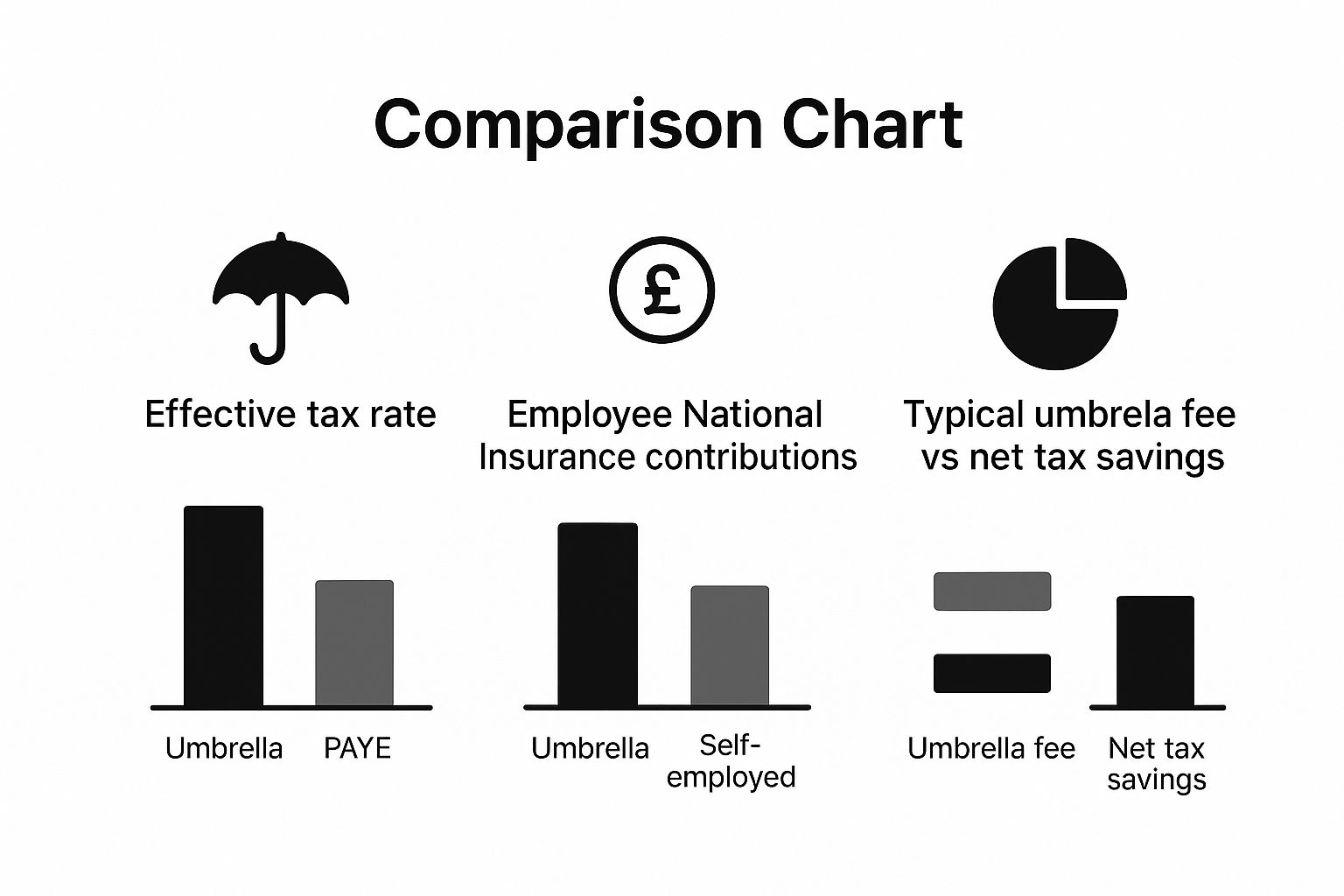
It is a clear illustration of how a legitimate umbrella company operates within the rules, ensuring everyone stays on the right side of HMRC.
The Legislative Clampdown on Non-Compliance
The scale of this problem is huge. During the 2022–2023 tax year, around 700,000 workers in the UK used umbrella companies. Worryingly, it is estimated that at least 275,000 of them were involved with non-compliant outfits, costing the public purse an estimated £500 million in lost taxes.
HMRC's stance is clear: the responsibility for unpaid tax ultimately rests with the individual. If your umbrella company is found to be non-compliant, you could be hit with a massive bill for back-taxes, interest, and penalties years down the line.
To tackle this, new legislation is introducing joint and several liability from 6 April 2026. This is a game-changer. It means recruitment agencies, and even end clients, will become financially responsible for unpaid taxes in their supply chain. This industry-wide clampdown makes it more crucial than ever to partner with a fully compliant provider.
Understanding your position, especially around IR35, is a vital piece of the puzzle. For a straightforward breakdown, check out our guide explaining what IR35 is. Choosing the right, compliant partner protects not just you, but everyone involved in your contract.
How a Compliant Provider Calculates Your Pay
Understanding your payslip is the best way to confirm your taxes are being handled correctly. A transparent, compliant umbrella company will always provide a full breakdown showing exactly how they get from the contract rate to your take-home pay. This is not a complex mystery; it is a straightforward process governed by HMRC rules.
It all starts with the assignment rate. This is the total amount your agency pays the umbrella company for your work. You need to think of this figure as the complete cost of employing you, which is much more than just your wages.

The Legitimate Deduction Process
From that top-line assignment rate, a compliant provider first deducts the costs of employment. These are the costs they are legally required to cover as your employer, plus their own margin for running your payroll.
Here is the standard order of deductions you should see on any legitimate payslip:
- The Umbrella Margin: This is the company's fee for their service. It should always be a clear, fixed amount, not a percentage of your earnings.
- Employer’s National Insurance: As your legal employer, the umbrella company must pay this. It is a non-negotiable statutory cost.
- Employer’s Pension Contributions: This is another legal requirement under auto-enrolment rules.
- The Apprenticeship Levy: If the umbrella company has a payroll bill over £3 million a year, they are required to pay this levy.
Once these employment costs are taken off, the remaining amount becomes your gross pay. This is the figure that your personal Income Tax and Employee's National Insurance are calculated on.
Crucial point: Employer's National Insurance is a cost of employment. It must always be deducted from the assignment rate before your gross pay is calculated. Any provider telling you otherwise is waving a massive red flag.
A Practical Example of Pay Calculation
Let's walk through a quick example to see how this works in practice. Imagine your weekly assignment rate is £1,000.
- Assignment Rate: £1,000.00
- Less Umbrella Margin: -£25.00
- Less Employer's NI & Pension: -£130.00 (approximate)
- Equals Your Gross Pay: £845.00
- Less Your Income Tax & Employee NI: -£200.00 (approximate)
- Equals Your Net Take-Home Pay: £645.00
This simple breakdown shows exactly why promises of 85% take-home pay are unrealistic. It is just not legally possible. For a more accurate forecast based on your specific rate, it is worth using a reliable umbrella company calculator.
Remember, these figures can change. For instance, from 6 April 2025, the Employer National Insurance rate is set to increase, which will affect the overall costs. A good provider will manage these statutory changes seamlessly, keeping you fully compliant with PAYE.
Legitimate vs Non-Compliant Payslip Deductions
Understanding your payslip is your best defence against a non-compliant scheme. A quick glance can often tell you whether you are with a compliant provider or one that is putting you at risk. Here is a comparison of what you should see versus what should raise alarm bells.
| Deduction Type | What You Should See (Compliant) | What to Watch Out For (Non-Compliant) |
|---|---|---|
| Employment Costs | Employer's NI, Employer's Pension, Apprenticeship Levy. Clearly deducted from the assignment rate before gross pay. | These costs are hidden, missing, or mysteriously low. The provider might claim you do not need to pay them. |
| Your Pay Structure | One single payment of taxable salary, clearly identified as "Gross Pay" or "Taxable Pay". | Your pay is split into multiple parts, often labelled as a "loan", "annuity", "grant", or some other creative, non-taxable description. |
| Tax Deductions | PAYE Income Tax and Employee's National Insurance calculated on your full gross pay. | Very low or no tax deductions. The payslip might only show tax paid on a tiny portion of your income, like the National Minimum Wage. |
| Umbrella Margin | A fixed, transparent fee (e.g., £25 per week). | A fee that is a percentage of your earnings, or unusually high/low fees designed to disguise the nature of the scheme. |
| Take-Home Pay Percentage | A realistic figure, typically around 60-70% of the assignment rate, depending on your tax code. | An unbelievably high take-home pay promise, often 80%, 85%, or even 90%. |
In short, if your payslip looks too good to be true, it almost certainly is. A compliant payslip will be straightforward, showing all the necessary deductions clearly and transparently. Anything less, and you should be asking serious questions.
Vetting Your Umbrella Company for Compliance
Choosing your umbrella company is not just another box to tick on your contracting to-do list; it is a critical financial decision. Partnering with a non-compliant provider, even by accident, can land you in serious trouble with HMRC.
That is why you must do your homework before signing anything. A little due diligence now can save you a world of financial pain and protect your professional reputation down the line.
The single most reliable sign of a trustworthy umbrella company is an accreditation from a recognised professional body. These organisations act as the industry's independent watchdogs, making sure their members follow the rules and operate to the highest ethical standards.
Look for Professional Accreditations
When you are weighing up your options, the very first thing to check for is a seal of approval from either the FCSA (The Freelancer & Contractor Services Association) or Professional Passport.
These are not just logos for a website. To become accredited, companies must go through rigorous, independent audits every single year.
An accredited provider has had its entire operation put under the microscope and given the all-clear. It means their payroll processes, expense policies, and contracts are fully compliant with UK tax and employment law. This simple check is your best defence against getting involved in a disguised tax avoidance scheme. If a firm is not accredited, you have to ask why.
Choosing an FCSA or Professional Passport accredited firm gives you peace of mind. It means independent experts have scrutinised their processes and confirmed they are compliant. For us, it is a non-negotiable mark of quality.
Key Questions to Ask Any Potential Provider
Accreditation is a great start, but you should also feel confident enough to ask some direct questions about how they operate. A transparent, compliant provider will have nothing to hide and will give you clear, straightforward answers.
If you get vague responses or feel like you are being pressured, see it as the huge red flag it is and walk away.
Before you commit, make sure you get solid answers to these questions:
- What is your exact weekly or monthly margin? This should always be a fixed, flat fee, never a percentage of your invoice value. A percentage fee can create an incentive for them to inflate your earnings with non-compliant additions.
- Can you confirm all my pay will be processed through PAYE? There should be no talk of loans, grants, annuities, or other complicated payment methods. Every penny of your income must be subject to standard UK tax and National Insurance.
- What insurance cover is included as standard? You need to check the levels of Professional Indemnity, Public Liability, and Employers' Liability insurance. Ensure they are high enough to satisfy the requirements of your contracts.
- How often will I be paid? Make sure their payment schedule (whether it is weekly, fortnightly, or monthly) aligns with when your agency or client pays. This is crucial for keeping your cash flow consistent.
Taking the time to properly vet a potential provider is a vital step. It is how you ensure you partner with a genuinely tax efficient umbrella company in the UK that puts your compliance and financial security first.
Legally Maximising Your Take-Home Pay
You will hear the term “tax efficient” used frequently, and unfortunately, it is often a smokescreen for non-compliant schemes. However, genuine tax efficiency is not about avoidance; it is about smart, legal financial planning that helps you keep more of your hard-earned money.
As a contractor, there are perfectly legitimate ways to structure your finances, all while staying on the right side of HMRC. It is about making your money work harder for you, securing both your immediate cash flow and your long-term financial health.

Workplace Pensions: A Smart Strategy
One of the most effective and straightforward ways to boost your tax efficiency is by contributing to a workplace pension through your umbrella company. This is an excellent, HMRC-approved method for saving for the future while reducing your tax bill today.
Here is how it works. When you contribute to a pension, the money is taken from your gross earnings before tax is calculated. This is often called a 'salary sacrifice' arrangement, and it delivers two powerful benefits:
- Tax Relief: Your contributions get tax relief at your highest rate of income tax. So, if you are a higher-rate taxpayer, every £80 you contribute is topped up to £100 by the government.
- Reduced NI: Because your contributions lower your gross pay, you also end up paying less in National Insurance.
It is a win-win situation. You are building a retirement fund and reducing your taxable income at the same time.
Understanding Business Expenses
Claiming business expenses is another area where contractors can legally improve their take-home pay, but you must know the rules. The rules are strict. The main one to understand is HMRC’s framework on Supervision, Direction, or Control (SDC).
Simply put, if your client has the right to supervise, direct, or control how you do your work, you generally cannot claim tax relief on travel and subsistence for your daily commute. Since most contractors working through an umbrella company fall under SDC, claiming your daily train fare or lunch is almost always not allowed.
A compliant umbrella company will always carry out a thorough SDC assessment before they let you claim any expenses. If a provider tells you to claim whatever you want without this check, it is a massive red flag. They are putting you at risk, not themselves.
So, what can you claim? Legitimate claims are usually for specific costs you incur while doing your job, like travel between different client sites during an assignment, not your regular commute. We have more ideas in our guide covering the best ways to reduce tax as a contractor in the UK.
Ultimately, the best way to maximise your income is to have a steady stream of projects. Getting your client pipeline sorted is fundamental, and it starts with solid strategies for getting consulting clients. When you combine consistent work with smart financial planning like pension contributions and compliant expense claims, you build a very strong foundation for a successful contracting career.
Your Top Umbrella Company Tax Questions, Answered
When you are new to the world of umbrella companies, it is completely normal to have a few questions, especially when it comes to tax and how you get paid. Let's provide some clear, straightforward answers to the queries we hear most often from UK contractors. This should give you a solid idea of what to expect from a fully compliant provider.
Is a Promise of 85% Take-Home Pay a Red Flag?
Yes, it is a massive one. If you see any company offering a take-home pay figure that is much higher than the typical 60-70%, you are almost certainly looking at a non-compliant tax avoidance scheme. Our advice is to avoid them.
These schemes are often built on disguised remuneration tactics. They typically work by paying you a small, legally-required salary through PAYE and then funnelling the rest of your earnings to you as an untaxed "loan" or "grant" that they claim you will never have to repay.
HMRC is constantly on the hunt for these arrangements and has a strong track record of shutting them down. When they do, it is you, the contractor, who is left with the bill. That means paying all the unpaid tax, plus interest and significant financial penalties, sometimes years after you were paid.
Remember, real tax efficiency comes from working with a compliant company, not by trying to exploit loopholes.
Can I Claim Travel Expenses Through an Umbrella Company?
For the vast majority of contractors, the answer is no. Since HMRC introduced the rules on Supervision, Direction, or Control (SDC), tax relief on your daily commute and any related subsistence costs has been disallowed.
If an umbrella company tells you to claim these expenses without carrying out a proper SDC assessment for your specific contract, treat it as a serious warning sign. They are not following the rules.
The only time expenses are generally legitimate is for costs you incur travelling between different client sites during an assignment, not your regular journey to and from your main place of work. A compliant provider will be crystal clear about this distinction from day one.
A compliant umbrella company’s job is to ensure you pay the right amount of tax, not to find non-compliant ways to reduce it with illegitimate expense claims. Always be sceptical of a provider who seems too relaxed about expense rules.
How Does an Umbrella Company Work with IR35?
Using an umbrella company is the simplest and most common way to handle contracts that are deemed 'inside IR35'. It is an effective solution because the umbrella company becomes your direct employer. They process all your income through the PAYE system, which automatically satisfies all of HMRC’s IR35 requirements.
This structure lifts the entire compliance burden from your shoulders. All the necessary Income Tax and National Insurance contributions are calculated and paid correctly on your behalf. It means you can take on inside-IR35 roles with complete peace of mind, knowing you will not face a stressful HMRC investigation in the future.
What is the Umbrella Company's Margin?
The margin is the fee the umbrella company charges for its services, which include running your payroll, managing your contract administration, and ensuring you are paid on time. It is how they generate their revenue.
This fee should always be a fixed weekly or monthly amount. Crucially, it is deducted from the gross contract value before any taxes are calculated. Every other deduction, like tax and National Insurance, are statutory payments that go straight to HMRC. The margin is the only portion the umbrella company keeps.
A transparent, trustworthy provider will always show this charge as a clear, separate line item on your payslip. You should be able to see exactly what you are paying for their service without any confusion.
Navigating your contracting career requires a partner you can trust. At UmbrellaCompany.com, we provide the tools and resources to compare accredited, compliant providers, ensuring your finances are always in safe hands. Find your perfect umbrella company with us today.


