


That jumble of letters and numbers on your payslip is your tax code. It might look cryptic, but it is a simple instruction from HMRC to your employer, in this case, your umbrella company. It tells them exactly how much of your income is tax-free.
This guide will explain what your tax code means, how it is calculated, and what to do if you think it is wrong. For any contractor paid via an umbrella company, this little code is a big deal. It is the key that determines how much tax gets deducted from your earnings through the Pay As You Earn (PAYE) system, which directly shapes your take-home pay. Getting it right from the start is absolutely essential for keeping your finances on track.
Understanding Your Contractor Tax Code
If you have ever been stumped by your tax code, you are in good company. Many contractors find them confusing at first, but they follow a surprisingly straightforward logic. The best way to think of it is as a shorthand summary of your personal tax situation, sent directly from HMRC to your umbrella company’s payroll team.
At UmbrellaCompany.com, we see this code as the bedrock of accurate pay. It is designed to make sure the right amount of Income Tax is taken from your contract payments throughout the tax year, which runs from 6th April to 5th April. Its main job is to stop you from paying too much, or too little, tax on your hard-earned income.
Breaking Down the Code: Numbers and Letters
A standard UK tax code is made up of two parts: a number and a letter.
- The Numbers: This part usually shows your tax-free Personal Allowance, which is the amount you can earn before you start paying any Income Tax. To get the number, HMRC takes your allowance and removes the last digit. For the 2024/2025 tax year, the standard Personal Allowance is £12,570, which is why the most common number you'll see is 1257.
- The Letter: The letter at the end gives more context about your tax situation. By far the most common is L, which simply means you are entitled to the standard tax-free Personal Allowance.
Put them together, and you get 1257L. This code tells your umbrella company that you have the standard allowance, and they will factor this into every payroll run. This all ties into the PAYE system, and if you want to dig deeper, our guide on how the PAYE system operates is a great place to start.
A correct tax code is the foundation of a hassle-free contracting career. It ensures your tax deductions are accurate from day one, helping you avoid unexpected tax bills or the lengthy process of reclaiming overpaid tax from HMRC.
Why Your Tax Code Matters So Much
For a contractor, an accurate tax code is crucial for healthy cash flow. If your code is wrong, it can cause some real headaches. An emergency tax code, for example, often means you will pay far too much tax at the start, putting a serious squeeze on your take-home pay until it is sorted.
On the flip side, an incorrect code that leads to you underpaying tax might feel fine at first, but it can result in a nasty surprise bill from HMRC down the line.
That's why it is always smart to check the tax code on your payslip, especially when you start a new contract or if your personal circumstances change. While your umbrella company will always apply the code HMRC provides, it is ultimately your responsibility to make sure it is the right one for you.
The Surprising History of UK Income Tax
To really get to grips with your tax code, it helps to know where it came from. The PAYE system we use today was not dreamed up overnight; it is the result of centuries of tweaks and changes, starting with a deeply unpopular ‘temporary’ measure to fund a war. Seeing how tax collection has evolved shows exactly why the system works the way it does for contractors today.
The story starts in the late 18th century, a time of major conflict for Britain. The government needed a reliable way to fund its military campaigns, which led them to a bold and, at the time, outrageous idea: a tax on what people actually earned.
From Wartime Levy to Permanent Fixture
In 1799, Prime Minister William Pitt the Younger rolled out the UK's first-ever income tax. It was sold as a temporary fix to pay for the Napoleonic Wars. It was not just a flat rate either; it was progressive, designed to take more from the wealthiest. People were furious, seeing it as a massive invasion of privacy, and it was quickly scrapped in 1816 once the war was over. You can read more about this pivotal moment in the history of UK taxation.
But the idea did not stay dead for long. By 1842, Prime Minister Sir Robert Peel brought it back, this time for good. He had to plug a hole in the budget after cutting other controversial tariffs. From that point on, income tax became a central part of Britain's public finances.
What started as an emergency fund for cannons and warships grew into the backbone of funding for everything from roads and schools to the NHS. This shift from a temporary patch to a permanent system set the stage for modern tax collection.
Of course, this permanent tax needed an efficient way to be collected, especially as more and more people entered the workforce. The original approach relied on individuals declaring their own income, which, as you can imagine, was often inconsistent and a nightmare to manage. A better way was needed.
The Birth of Pay As You Earn (PAYE)
The biggest leap forward came, once again, during a major war. In 1944, right in the middle of the Second World War, the government introduced the Pay As You Earn (PAYE) system. This was a game-changer. It moved the responsibility for collecting tax from the individual to their employer.
Instead of people facing a huge tax bill at the end of the year, employers were now required to deduct tax straight from their employees' wages on payday. This clever move guaranteed a steady, reliable stream of income for the government and made the whole process far more efficient.
This bit of history is directly relevant to how you work as a contractor. When you work through an umbrella company, you are legally their employee. That umbrella company uses the very same PAYE system to deduct your Income Tax and National Insurance contributions, just like any other employer would.
The system is structured this way for a reason. The need for consistent and efficient tax collection from a diverse workforce is what led to PAYE. It is this system that allows umbrella companies to offer a compliant, straightforward way for contractors like you to handle your taxes, ensuring you pay the right amount at the right time.
How HMRC Calculates Your Contractor Tax Code
Your tax code is not a random jumble of letters and numbers; it is a specific instruction from HMRC to your umbrella company, telling them exactly how much tax to deduct from your pay. Getting to grips with how it is calculated is the best way to spot if something has gone wrong.
The whole thing starts with one critical figure: your Personal Allowance. This is the foundation for almost every standard tax code in the UK.
The Starting Point: Your Personal Allowance
You can think of your Personal Allowance as a head start for the tax year. It is the amount you can earn without paying a single penny of income tax. For the current 2024/2025 tax year, the standard Personal Allowance is £12,570.
To get the number part of your tax code, HMRC simply takes this figure and chops off the last digit.
So, £12,570 becomes 1257. Add the letter 'L' (which just means you are entitled to the standard allowance), and you get the most common tax code in the UK: 1257L.
If your financial life is pretty straightforward, this is probably the code you will have. But all sorts of things can lead HMRC to tweak this starting figure, which is when you will see a different code on your payslip.
The way we pay tax has come a long way. We have moved from simple, manual declarations to this far more detailed, automated system.
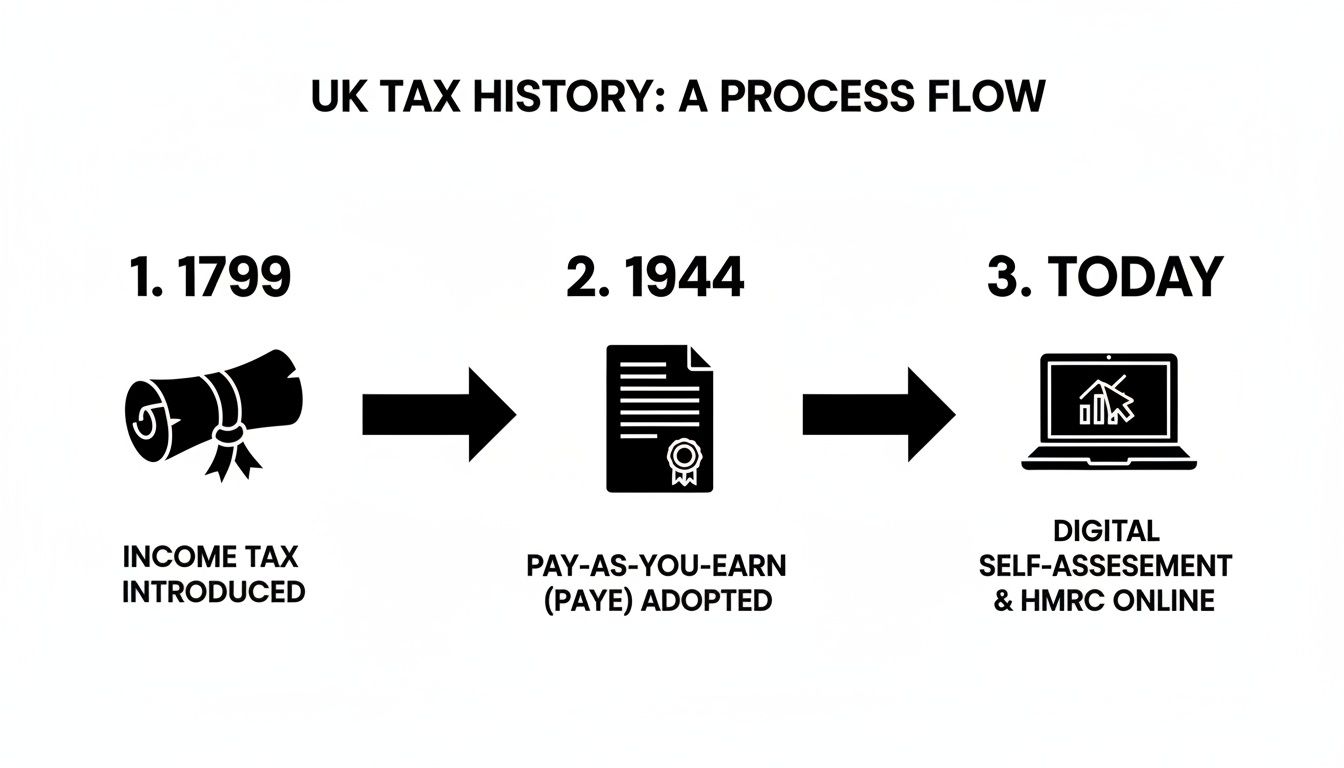
This journey from the first income tax in 1799 to today’s digital calculations shows just how much has changed.
How Your Allowance Gets Adjusted
Your Personal Allowance is not set in stone. HMRC will adjust it up or down based on other income you have, or tax you owe from previous years. It is their way of making sure you pay the right amount over the year, without any nasty surprises.
Here are a few of the most common reasons your tax-free allowance might be reduced:
- Underpayment from a Previous Year: If you did not pay enough tax last year, HMRC might "code out" the difference. They do this by shrinking your tax-free allowance for the current year, letting you pay back what you owe in small, manageable chunks with each payslip.
- Taxable Employment Benefits: Had a previous job that came with perks like a company car or private medical cover? The cash value of those benefits reduces your tax-free allowance.
- Taxable State Benefits: Some state benefits, like the State Pension, are taxable. HMRC will lower your Personal Allowance to account for that income and make sure the tax gets collected properly.
Let's walk through a quick example to see it in action.
Example Calculation
Imagine a contractor, Sarah, has the standard £12,570 Personal Allowance. But HMRC knows she underpaid £500 in tax last year and they want to collect it through her pay this year.
- First, HMRC works out how much of her income needs to be taxed to get that £500 back. Assuming Sarah is a basic rate taxpayer (20%), they divide the underpayment by the tax rate: £500 / 20% = £2,500.
- Next, they reduce her Personal Allowance by that amount: £12,570 – £2,500 = £10,070.
- Finally, they create her new tax code by removing the last digit: 1007L.
This new code tells her umbrella company that only the first £10,070 she earns is tax-free. As a result, she pays a bit more tax on her earnings each month, steadily repaying the £500 she owes. This is all a core part of the PAYE system, and you can dive deeper into the mechanics in our guide on how PAYE is calculated.
Once you understand these adjustments, your tax code stops being a mystery and becomes a logical summary of your financial situation.
Decoding the Letters and Numbers on Your Payslip
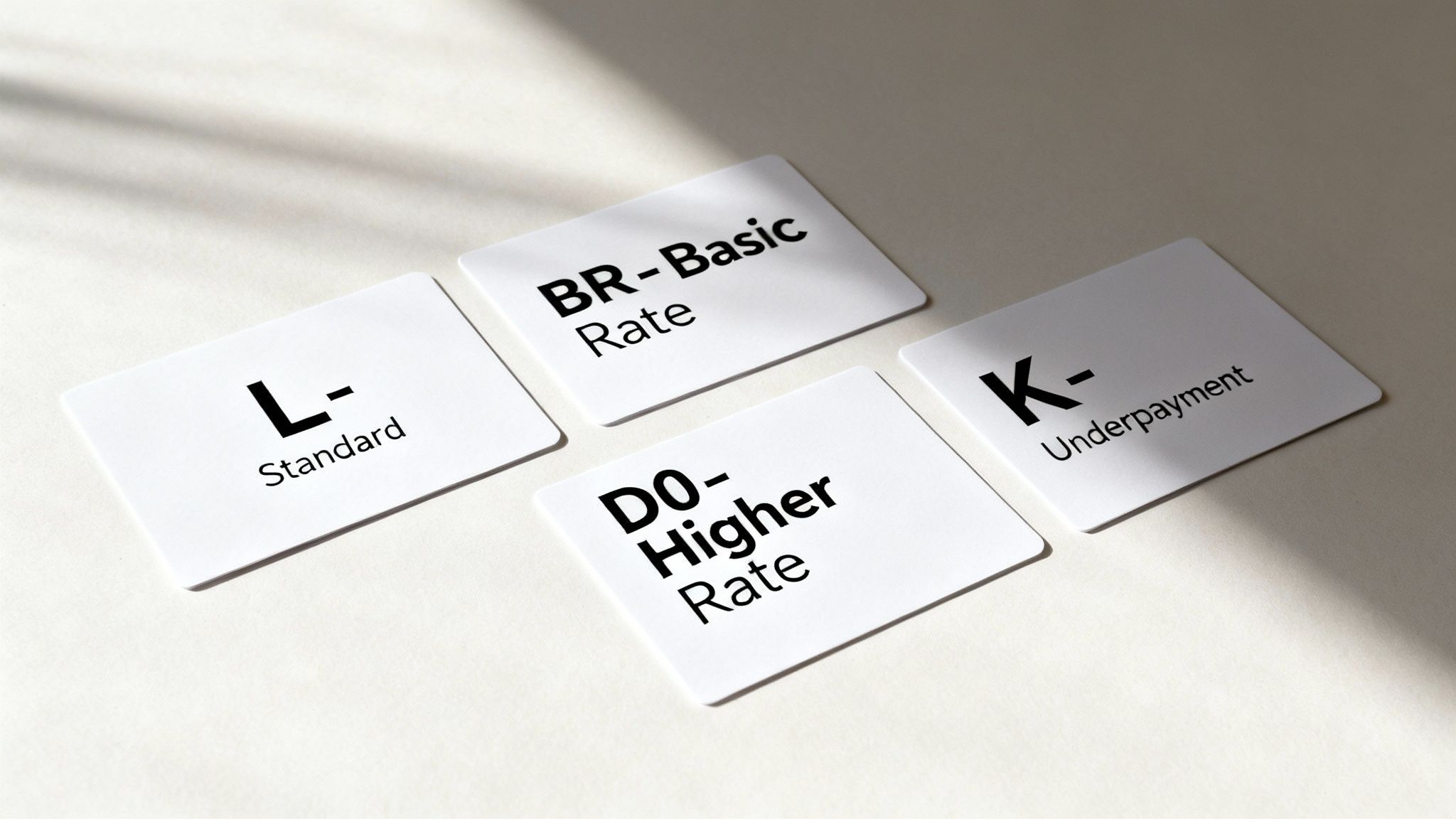
Your tax code tells a surprisingly detailed story about your financial life. While the numbers are all about your tax-free Personal Allowance, it is the letters that add the crucial context. For any contractor wanting to stay on top of their finances, getting to grips with what each letter means is a must.
Each letter suffix gives HMRC a shortcut to understanding your tax situation. For umbrella company contractors, these letters directly instruct how your pay is processed through PAYE, so it's vital to know what they signify.
Common Tax Code Letters and Their Meanings
That letter on your tax code is far from random; it is a specific instruction about how your tax should be handled. Most contractors will only ever see one of a handful of common letters, and each has a very clear job.
Here is a breakdown of the letters you are most likely to come across:
- L – This is the one you will see most often. It simply means you are entitled to the standard tax-free Personal Allowance. If you have one contract and no other odd bits and pieces, your code will almost certainly be 1257L.
- M – This tells HMRC you have received a transfer of 10% of your partner’s Personal Allowance through the Marriage Allowance scheme.
- N – The flip side of 'M'. This means you have transferred 10% of your Personal Allowance to your partner.
The letters M and N are purely for the Marriage Allowance. This scheme lets a spouse or civil partner hand over £1,260 of their Personal Allowance to their partner, but only if they earn less than the allowance and their partner is a basic-rate taxpayer.
Other letters signal that tax needs to be taken at a set rate, with no tax-free allowance applied at all. This usually happens when you have more than one contract on the go.
- BR – This stands for Basic Rate. It instructs your employer to tax you at the basic rate, currently 20%, from the very first pound you earn. You will typically see this on a second contract, as your Personal Allowance is usually used up by your main source of income.
- D0 – This code tells your employer to deduct tax at the Higher Rate (40%). It's used for second jobs or pensions when your total income pushes you well into the higher tax bracket.
- D1 – Similar to D0, this code means tax should be taken right away at the Additional Rate, which is 45%.
Understanding these letters is a massive part of learning how to read your payslip properly.
Understanding Special and Emergency Tax Codes
Beyond the everyday letters, you might bump into codes that point to more unusual circumstances. One of the most important ones to understand is the 'K' code, which can be a bit of a shock if you are not expecting it.
The 'K' Code Explained
A K code is basically a negative tax code. It pops up when the deductions HMRC needs to make (for things like unpaid tax from a previous year or taxable company benefits) are actually bigger than your Personal Allowance. This means not only do you have no tax-free income, but you also owe tax on more than you actually earn.
The numbers in a K code work in reverse. Instead of showing an allowance, they show how much extra income needs to be taxed. For instance, a code of K500 tells your employer to add an extra £5,000 (£500 x 10) to your taxable income for the year. It's HMRC's way of gradually collecting tax you owe without taking it all in one big hit.
Emergency Tax Codes (W1, M1, X)
When you start a new contract, especially with an umbrella company, HMRC might not have your up-to-date details. If that is the case, you could be put on a temporary emergency tax code to make sure you pay some tax rather than none at all.
Common emergency codes you might see are:
- 1257L W1 (Week 1)
- 1257L M1 (Month 1)
- 1257L X
These codes give you a slice of your Personal Allowance but do not take into account any tax you have already paid that year. This often means you overpay tax until HMRC sends out your correct code. Getting it fixed is usually simple, just make sure your new umbrella company has your P45 from your last role or that you have filled out a starter checklist.
What to Do When Your Tax Code Seems Wrong
Getting your tax code right is crucial. An incorrect one can leave you overpaying tax and short on cash, or underpaying and facing a surprise bill down the line. It is a financial headache you just do not need.
Spotting a mistake early and knowing exactly how to fix it can save you a world of hassle. At UmbrellaCompany.com, we want to give you a clear, simple roadmap to get things sorted out fast.
It is surprisingly easy for a tax code to become outdated. Common triggers are starting a new contract, finishing an old one, or a change in things like company benefits. Sometimes, HMRC's records just have not caught up with your life, leading them to issue a code that no longer fits your circumstances.
Your First Step: Check Your Details
Before you pick up the phone, the very first thing to do is confirm your suspicions. Is the code actually wrong?
The easiest way to check is by logging into your HMRC personal tax account online. This service gives you a clear view of the information HMRC holds on you and, crucially, explains how they calculated your code in the first place.
If you do not have an online account, you can also find your tax code on your payslip from us, a P45 from a previous role, or a P60 end-of-year tax summary. Compare the code you see with what you expect it to be. If it looks off, it is time to take action.
Who to Contact to Fix Your Tax Code
This is probably the most important thing to understand: only HMRC can change your tax code.
While we, as your umbrella company, have a legal duty to apply the tax code HMRC sends us, we have absolutely no authority to alter it ourselves. It is a strict rule that ensures the tax system is managed centrally and consistently for everyone.
So, to get any errors corrected, you must contact HMRC directly. You can do this by:
- Using their online service: This is often the quickest method, right through your personal tax account.
- Calling them: You can phone the HMRC income tax helpline to speak directly with an adviser.
Getting Ready to Speak with HMRC
To make the process as smooth and painless as possible, get your ducks in a row before you get in touch. Having some key information ready will help the HMRC adviser understand your situation and make the necessary changes without delay.
Be prepared to provide:
- Your National Insurance number.
- Details of your estimated total earnings for the tax year.
- Information about any other income sources, like a pension or rental income.
- The tax code you believe is incorrect and a simple explanation of why you think it is wrong.
Once HMRC agrees your code is incorrect, they will issue a new one. They send this notification to you and directly to our payroll department at the same time. We will then apply the updated code to your very next payment, making sure your tax deductions are correct from that point forward.
If you have been on an incorrect code for a while, especially a temporary or emergency one, getting it fixed should be a priority. You can find out more about these in our guide on what to do if you are on an emergency tax code. Taking control of the situation means you pay the right amount of tax and can keep your finances in good order.
Common Tax Code Questions from Contractors
To wrap things up, we will tackle some of the most frequent questions we hear from contractors. Getting your head around tax codes can feel like a bit of a minefield, but once you understand the answers to these common queries, you will feel much more in control of your finances.
Each question here is based on a real-world scenario you might face as a contractor. Think of this as your quick-reference guide for any tax code troubleshooting.
Why Did My Tax Code Suddenly Change?
It is always a bit jarring to see your tax code change part-way through the tax year, but it is usually a sign that HMRC is actively tweaking your record to keep your tax payments on track. A mid-year change is not necessarily a mistake; more often than not, it is a direct response to new information they have received.
There are a few common reasons why this happens:
- Catching up on past tax: If you underpaid tax in a previous year, HMRC might lower your tax-free allowance in the current year to gently collect what is owed. This is much better than getting a large, unexpected bill down the line.
- A change in your estimated income: HMRC calculates your code based on what they think you will earn all year. If you suddenly start earning more (or less), they will adjust your code to reflect this new reality.
- Old information being updated: If you previously had benefits in kind, like a company car or private medical insurance, HMRC might still be using that old information. Once their records catch up to your current situation, your code will change.
A change is not automatically a red flag. It is simply HMRC’s way of making sure your tax deductions are as accurate as possible throughout the year, saving you from any nasty surprises later on.
What Is an Emergency Tax Code?
An emergency tax code is a temporary code an employer or umbrella company has to use when they do not have enough information from HMRC to issue the correct one. Its main job is to make sure you pay some tax rather than none at all while your details are being sorted out.
These codes often end in W1 (week 1) or M1 (month 1) and work on what is called a 'non-cumulative' basis. In simple terms, this means your tax is calculated only on what you have earned in that single pay period, ignoring any tax you have already paid during the year. This very often results in you paying more tax than you should.
An emergency tax code is a temporary measure, not a permanent problem. The good news is that it is usually straightforward to fix, and any tax you have overpaid will be automatically refunded once your correct code is applied.
To get it sorted, all you need to do is give your new employer the right information. Handing over your P45 from your last role or filling out a "starter checklist" usually gives HMRC everything they need to issue your proper code, which we can then apply to your very next payslip.
Can My Umbrella Company Change My Tax Code?
This is a really important one, and a question we get asked all the time. The answer is a clear and simple no. An umbrella company’s role is to apply the tax code that HMRC gives us. We have no authority whatsoever to change it.
This rule is there for a very good reason. It ensures the UK tax system is managed centrally and consistently by HMRC, who are the only authority on all tax matters. We simply act on their instructions to keep you compliant.
If you are convinced your tax code is wrong, you must contact HMRC directly to get it reviewed. Once they have looked into it and agree a change is needed, they will issue a new code to both you and us at the same time. We will then apply the updated code to your future payments.
How Does Working on Multiple Contracts Affect My Tax Code?
As a contractor, it is not unusual to be juggling more than one assignment at once. When you do this, HMRC organises your tax codes to make sure you pay the right amount of tax overall and, crucially, that you do not get your Personal Allowance more than once.
Here is how it usually pans out:
- Your Main Gig: HMRC will typically allocate your full tax-free Personal Allowance (which is what a code like 1257L represents) to what it views as your main source of income. This is often your first or highest-paying contract.
- Your Other Contracts: For any other assignments you have on the go, HMRC will issue a BR (Basic Rate) code. This tells your other employers or umbrella companies to deduct tax at the basic rate of 20% from the very first pound you earn, with no tax-free allowance.
This system is designed purely to stop you from accidentally getting multiple tax-free allowances, which would leave you with a hefty tax bill to pay at the end of the year. By using the BR code, HMRC makes sure your total tax is calculated correctly across everything you earn.
Understanding your tax code puts you in control of your earnings. It helps you ensure you are paying the right amount of tax and allows you to plan your finances with confidence. At UmbrellaCompany.com, we are committed to making your contracting journey as smooth as possible. We provide the tools and support to help you compare and find the perfect, compliant umbrella company for your needs.


