


Earning a £100,000 salary is a fantastic milestone. But as anyone on a high income knows, the number on your contract is not the number that hits your bank account. For a typical employee, that £100k gross salary works out to around £66,400 a year after tax, or roughly £5,533 each month.
In this guide, we will break down what happens behind the scenes. You will learn how tax, National Insurance, and your employment status affect your net pay, giving you a clearer picture of your finances.

What a £100k Salary Really Looks Like
Hitting that six-figure mark puts you in an exclusive club in the UK, and it is an achievement worth celebrating. But the figure you see on your offer letter is your gross salary, the total before anyone, especially HMRC, takes their slice. What you are really interested in is your take-home pay (or net pay), and the gap between the two can be surprisingly wide.
Once you cross the £100,000 threshold, you are in a more complex tax situation. It is not just about paying a higher rate; your tax-free Personal Allowance actually starts to shrink, meaning more of your income is taxed.
Key Factors That Reduce Your Gross Pay
So, where does all that money go? At UmbrellaCompany.com, our job is to make these numbers make sense. A few mandatory deductions are responsible for the biggest reduction in your £100k salary:
- Income Tax: This is the big one. Earning £100k means a good chunk of your income is taxed at the higher rate, currently 40%.
- National Insurance Contributions (NICs): These are the mandatory payments funding state benefits like the NHS and your State Pension.
- Pension Contributions: While you have some control over this, auto-enrolment means you are likely paying in. It lowers your immediate take-home pay but is essential for your future.
- Student Loan Repayments: If you have one, these deductions are taken automatically once you earn over the threshold.
How Your Employment Status Affects Your Pay
This is where things get really interesting. How you work completely changes the maths. A PAYE employee, an umbrella company contractor, and a limited company director will all end up with a different net figure from the same £100,000 headline rate.
For contractors, it is even more complicated because the advertised day rate has to cover things an employer would normally pay for, like Employer's NI. This makes a direct, like-for-like comparison tricky.
Earning £100,000 a year puts you well ahead of the curve. You are earning more than 96% of UK workers, with the median full-time salary sitting just over £39,000. You can find more fascinating insights into UK earnings over at The Salary Sphere.
This guide will walk you through each scenario with clear, practical examples. We will cut through the jargon, show you the real impact of deductions, and give you a clear picture of what your take-home pay on £100k looks like, so you can plan with total confidence.
How UK Taxes Chip Away at Your £100k Salary
To get a real handle on your take-home pay on 100k, you first need to understand the deductions that will show up on your payslip. Seeing how these work is the key to understanding why your gross salary and what you actually receive are two very different numbers.
When you earn a salary in the UK, HMRC uses the Pay As You Earn (PAYE) system to collect tax and other contributions for public services. The three main deductions that shrink your gross pay are Income Tax, National Insurance Contributions (NICs), and the tapering of your Personal Allowance.
What Is The Personal Allowance?
Almost everyone in the UK gets to earn a certain amount of money each year completely tax-free. This is your Personal Allowance. For the 2024/2025 tax year, the standard Personal Allowance is £12,570.
That means the first £12,570 of your income has a tax rate of zero. But this is where it gets tricky for higher earners, and it is a crucial detail for anyone on a £100,000 salary.
The £100k Personal Allowance Trap
This is one of the most misunderstood parts of the UK tax system. Once your 'adjusted net income' tips over the £100,000 mark, your tax-free Personal Allowance starts to shrink.
The rule is straightforward but has a massive impact: for every £2 you earn over £100,000, your Personal Allowance is cut by £1.
This reduction continues until the allowance disappears completely, which happens once your income hits £125,140. While someone earning exactly £100k keeps their full £12,570 allowance, if a bonus or pay rise pushes you even slightly over, it starts to get clawed back. This is why a small pay rise over £100k can sometimes feel like it is not worth it.
How UK Income Tax Really Works
The UK has a progressive tax system, which simply means the more you earn, the higher the rate you pay on parts of your income. It is a common myth that if you are in the 40% tax bracket, you pay 40% on everything you earn. That is not how it works.
Think of it like filling different buckets with your salary. You fill the first bucket at a 0% rate, the next one at 20%, and only then do you start pouring into the 40% bucket.
Here are the Income Tax bands for England, Wales, and Northern Ireland for the 2024/2025 tax year:
- Personal Allowance: Up to £12,570 is taxed at 0%.
- Basic Rate: From £12,571 to £50,270, you pay 20%.
- Higher Rate: From £50,271 to £125,140, you pay 40%.
- Additional Rate: Anything over £125,140 is taxed at 45%.
Because a £100,000 salary falls deep into the higher-rate band, a big slice of your earnings is taxed at 40%. This, more than anything, explains the significant difference between your gross and net pay.
Do Not Forget National Insurance Contributions
Alongside Income Tax, you also have to pay National Insurance Contributions (NICs). This money goes towards funding state benefits like the State Pension, Jobseeker's Allowance, and the NHS.
For employees, these are called Class 1 NICs. The rate was cut in January 2024, which gave most people a slight boost in their take-home pay.
For the 2024/2025 tax year, employees pay 8% on earnings between £12,570 and £50,270. On any earnings above £50,270, the rate drops to just 2%.
Understanding these three core deductions is the first essential step. The interplay between the tax bands, National Insurance rates, and that sneaky Personal Allowance trap all combine to determine your final take-home pay on 100k. At UmbrellaCompany.com, we help contractors make sense of these numbers every day.
Now, let's put these rules into practice and run through a real-world calculation.
Calculating Take-Home Pay for a PAYE Employee
We have covered the theory. Now, let's get our hands dirty and see what a £100,000 salary actually looks like once the taxman and pension providers have had their share.
We will start with a straightforward PAYE employee on a £100,000 gross annual salary. This gives us a solid baseline to compare against later when we dive into the world of contracting.
This breakdown will walk you through exactly how that headline salary figure gets whittled down. For this example, we will use the 2024/2025 tax rates for England and assume a standard 5% workplace pension contribution.
Step 1: Adjusting for Your Pension
First things first, we account for pension contributions. This is a crucial step because your pension savings are taken from your salary before tax is calculated. It is a handy way to get tax relief and boost your retirement pot at the same time.
- Gross Annual Salary: £100,000
- Employee Pension Contribution (5%): £5,000
- Your Taxable Income: £95,000
That £95,000 figure is the magic number HMRC uses to work out your Income Tax bill. Understanding this is key, and if you want a deeper dive, our guide on how PAYE works is a great place to start.
Step 2: Calculating Income Tax
Next up, Income Tax. We apply the UK tax bands to our taxable income of £95,000. Because this is under the £100,000 cliff edge where the Personal Allowance starts to disappear, you get to keep the full £12,570 tax-free.
- Personal Allowance: £12,570 at 0% = £0
- Basic Rate: (£50,270 – £12,570) = £37,700 at 20% = £7,540
- Higher Rate: (£95,000 – £50,270) = £44,730 at 40% = £17,892
Add those figures together, and you have your total annual tax deduction.
Total Annual Income Tax: £7,540 (Basic Rate) + £17,892 (Higher Rate) = £25,432
Step 3: Working Out National Insurance
Now for National Insurance Contributions (NICs). Unlike with Income Tax, NICs are calculated on your gross salary, before any pension deductions are made.
- Earnings below £12,570: £0 at 0%
- Earnings from £12,571 to £50,270: £37,700 at 8% = £3,016
- Earnings above £50,270: (£100,000 – £50,270) = £49,730 at 2% = £994.60
This gives us the total NICs for the year.
Total Annual NICs: £3,016 + £994.60 = £4,010.60
Your Final Take-Home Pay on £100k
The final step is the easiest. We just subtract all those deductions from the original gross salary to see what you are actually left with.
- Start with Gross Salary: £100,000
- Subtract Income Tax: – £25,432
- Subtract National Insurance: – £4,010.60
- Subtract Pension: – £5,000
Let's see the final numbers.
- Annual Net Pay: £100,000 – £25,432 – £4,010.60 – £5,000 = £65,557.40
- Monthly Net Pay: £65,557.40 / 12 = £5,463.12
And there you have it. A £100k salary translates to just over £65.5k in your pocket after all the standard deductions. It is a sobering thought, but one every high-earner needs to be familiar with.
Calculating Pay Through an Umbrella Company
If you are a contractor, understanding an umbrella company payslip is one of the most important things you can do. The maths works differently from a standard PAYE role, and it is crucial to see exactly how your £100,000 contract rate boils down to what actually lands in your bank account. This process is the compliant, standard way of handling contracts that fall inside IR35.
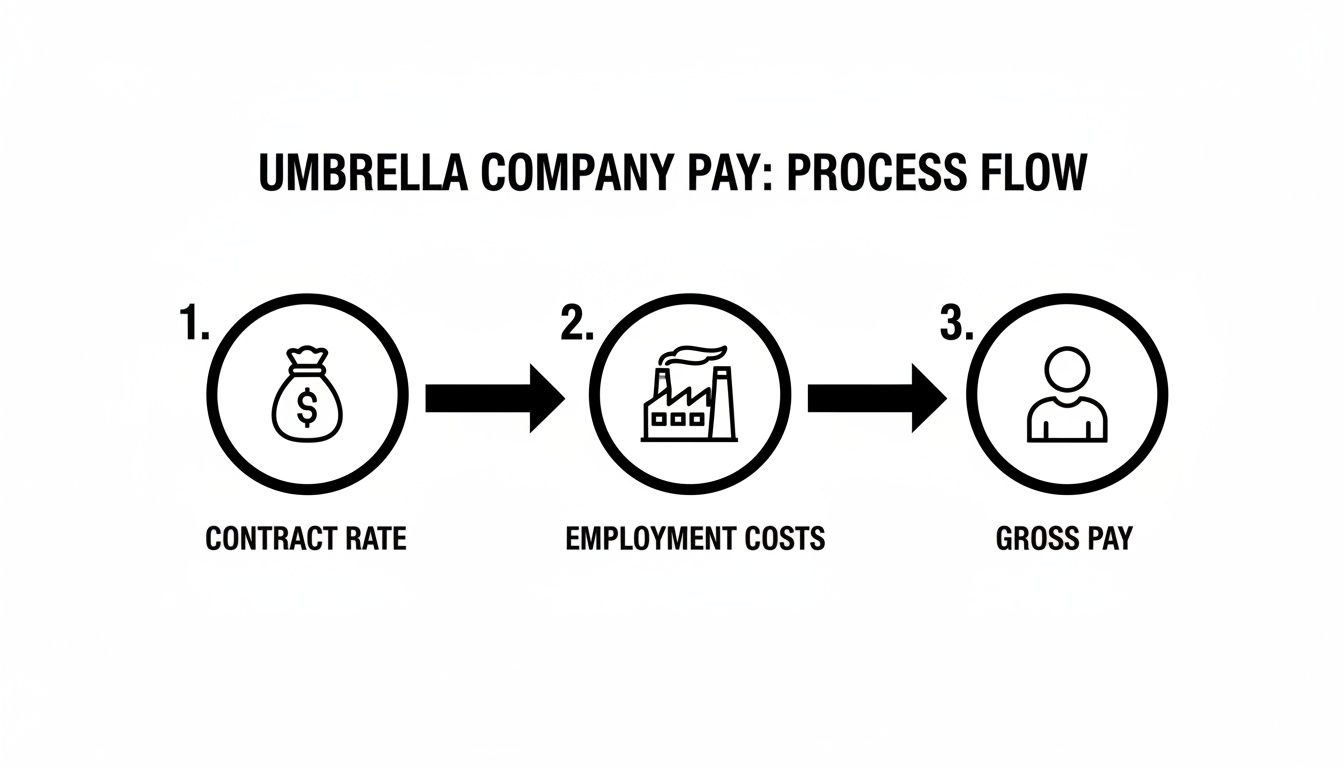
The first thing to grasp is a really key concept: the initial contract value, often called the assignment rate, is not your salary. It is a larger pot of money that has to cover all the employment costs first, things a traditional employer would normally pay on top of your salary. With an umbrella company, these are simply deducted from that assignment rate before your personal tax is worked out.
The Key Umbrella Company Deductions
When you work with a proper, compliant umbrella company, your payslip will show a clear breakdown from the assignment rate down to your gross pay. It is not about money being unfairly taken from you. Instead, the umbrella is just processing the necessary employment costs on your behalf, keeping everything above board with HMRC.
Here are the main deductions you will see coming off the assignment rate:
- The Umbrella Margin: This is simply the fee the umbrella company charges for its services. It is a fixed amount, usually taken weekly or monthly, and covers all the admin, payroll, insurance, and HR support.
- Employer’s National Insurance: This is a big one. It is the contribution an employer has to make to HMRC. For the 2024/2025 tax year, it is 13.8% on earnings above the £9,100 annual threshold.
- The Apprenticeship Levy: This is a UK tax on employers that is used to fund apprenticeship schemes. It is calculated at 0.5% of the annual pay bill.
- Employer’s Pension Contributions: The mandatory employer part of your workplace pension is also paid from the assignment rate.
Once these employment costs are sorted, what is left over becomes your gross pay for tax purposes. From this point on, the calculation looks almost identical to the PAYE example we have already walked through.
A Step-by-Step Umbrella Calculation
Let’s run the numbers for our £100,000 assignment rate. For this example, we will assume a weekly umbrella margin of £25 (£1,300 for the year) and standard pension contributions (5% from you, 3% from the employer).
- Start with the Assignment Rate: £100,000
- Deduct Umbrella Margin: £100,000 – £1,300 = £98,700
- Deduct Employer's NI (13.8%): £98,700 / 1.138 = £86,731.11 (This gives us the remaining fund after the NI is covered). The NI amount itself is £11,968.89.
- Deduct Apprenticeship Levy (0.5%): £86,731.11 / 1.005 = £86,299.61. The Levy amount works out to £431.50.
- Deduct Employer's Pension (3%): £86,299.61 / 1.03 = £83,786.03. The employer pension contribution is £2,513.58.
This final figure, £83,786.03, is now your gross pay. This is the number that your personal tax and National Insurance will be based on.
Your gross pay under an umbrella will always be lower than the headline contract rate. This is not because you are earning less, but because that rate includes the employment costs the umbrella must legally pay for you. This transparency is the hallmark of a compliant provider.
From Gross Pay to Take Home Pay
Now we just apply the standard employee deductions to your gross pay of £83,786.03:
- Employee Pension (5%): £83,786.03 * 0.05 = £4,189.30
- Taxable Income: £83,786.03 – £4,189.30 = £79,596.73
Next, we work out the Income Tax on that taxable figure:
- Personal Allowance: £12,570 at 0% = £0
- Basic Rate: (£50,270 – £12,570) = £37,700 at 20% = £7,540
- Higher Rate: (£79,596.73 – £50,270) = £29,326.73 at 40% = £11,730.69
- Total Annual Income Tax: £7,540 + £11,730.69 = £19,270.69
And finally, your own National Insurance contribution on the full gross pay:
- Earnings from £12,571 to £50,270: £37,700 at 8% = £3,016
- Earnings above £50,270: (£83,786.03 – £50,270) = £33,516.03 at 2% = £670.32
- Total Annual Employee NICs: £3,016 + £670.32 = £3,686.32
The Final Umbrella Net Pay
To get the final take-home figure, we just subtract all the personal deductions from your gross pay.
- Start with Gross Pay: £83,786.03
- Subtract Income Tax: – £19,270.69
- Subtract Employee NICs: – £3,686.32
- Subtract Employee Pension: – £4,189.30
- Annual Net Pay: £83,786.03 – £19,270.69 – £3,686.32 – £4,189.30 = £56,639.72
- Monthly Net Pay: £56,639.72 / 12 = £4,719.98
This breakdown really highlights why you cannot compare a £100k permanent salary with a £100k contract rate like-for-like. The numbers tell a different story. It also shows why picking the right partner is so important, which is why we offer a comprehensive umbrella companies comparison tool to help you find a compliant provider with a fair margin.
Calculating Your Pay as a Limited Company Director
If you are a contractor operating outside IR35, running your own limited company is often the most tax-efficient way to handle your earnings. It gives you far more control than other routes, but it also comes with more admin. This path is only open for contracts genuinely determined to be outside the scope of IR35.
The classic strategy here is to pay yourself a small, tax-friendly director's salary and then draw the rest of the company's profits as dividends. This combination can seriously boost your take-home pay on £100k compared to just taking a straight salary. But before you can pay yourself a penny, the company has its own tax bills to settle first.
The process is quite different from working through an umbrella company, where employment costs are deducted before you even see your gross pay.
With a limited company, you are dealing with company profits and taxes first, which is a whole different ball game. Let's break it down.
Company Taxes and The Director's Salary
The first slice from your £100,000 revenue is not for you, it is for the taxman, in the form of Corporation Tax. But before you work that out, you can deduct legitimate business costs from your revenue, and that includes your own salary.
A very common and smart way to do this is to pay yourself a salary right up to the National Insurance threshold. For the 2024/2025 tax year, this is £12,570.
- This salary is just enough to get you credits for your State Pension and other benefits, but you will not actually pay any Income Tax or National Insurance on it.
- Crucially, it is also an allowable business expense for your company. This lowers the company's profit, which in turn reduces its Corporation Tax bill.
So, for our £100,000 example:
- Company Revenue: £100,000
- Director's Salary (Expense): – £12,570
- Remaining Profit: £87,430
The company now pays Corporation Tax on this profit. The main rate is currently 25%.
Corporation Tax Due: £87,430 x 25% = £21,857.50
After HMRC takes its cut, the money left over is what is available for you to take out as dividends.
Understanding Dividend Tax
Dividends are simply payments made to shareholders (that's you!) from the company's profits after Corporation Tax has been paid. They are taxed completely differently from a salary, which is where the real tax efficiency kicks in.
Here are the dividend rules for the 2024/2025 tax year:
- Dividend Allowance: You get the first £500 of dividends completely tax-free.
- Basic Rate: You will pay 8.75% on any dividends that fall within the basic rate tax band.
- Higher Rate: This jumps to 33.75% for dividends in the higher rate band.
- Additional Rate: And it is 39.35% for anything in the additional rate band.
Remember, your director's salary has already used up your tax-free Personal Allowance, so pretty much all your dividends (after the small £500 allowance) will be subject to tax.
A Worked Example: Putting It All Together
Let's pull all those numbers together and see what the final take-home pay looks like.
- Profit After Corporation Tax: £87,430 – £21,857.50 = £65,572.50. This is the maximum you can draw as a dividend.
- Your Total Personal Income: £12,570 (salary) + £65,572.50 (dividend) = £78,142.50.
Now, let's work out the personal tax on this. Your salary is covered, so we only need to look at the dividends.
- Tax-Free Dividend: £500 at 0% = £0
- Dividends in Basic Rate Band: (£50,270 – £12,570 salary – £500 allowance) = £37,200 is taxed at 8.75%, which is £3,255.
- Dividends in Higher Rate Band: (£65,572.50 – £500 allowance – £37,200 already taxed) = £27,872.50 is taxed at 33.75%, which is £9,406.80.
- Total Dividend Tax: £3,255 + £9,406.80 = £12,661.80.
Your Final Take-Home Pay
So, what does that leave in your pocket?
- Total Gross Income: £78,142.50
- Less Dividend Tax: – £12,661.80
- Annual Net Pay: £65,480.70
- Monthly Net Pay: £5,456.73
This approach can lead to a significantly higher take-home figure, but you have to weigh that against the extra responsibility of running a company. You can play around with different salary and dividend levels using our limited company take-home calculator to see how the numbers change.
Optimising Your £100k Pay With Pensions
Once we have sorted the basic tax and National Insurance, two other big players can change your final take-home figure: pensions and student loans. While student loan deductions are a fixed part of the deal, your pension contributions are a powerful (and completely legitimate) way to slash your tax bill. This is especially true if you are a higher-rate taxpayer.
Making smart use of your pension can genuinely transform your net pay from a £100,000 salary. By upping your contributions, you can lower your taxable income, win back your full Personal Allowance, and sidestep that notorious 60% effective tax trap. Let's see how that works.
Escaping the 60% Tax Trap With Pension Contributions
As we touched on earlier, the moment your income ticks over £100,000, your tax-free Personal Allowance starts to shrink. It is this vanishing allowance that creates a painful effective tax rate of 60% on every pound you earn between £100,000 and £125,140. Luckily, pension contributions offer a simple way out.
When you pay into a pension, you get tax relief from the government. That money you put away reduces your ‘adjusted net income’, the number HMRC looks at to decide if your Personal Allowance gets tapered. If you contribute enough to pull that figure back under the £100,000 mark, you reclaim your full £12,570 tax-free allowance.
Let’s see it in action:
Imagine your gross salary is £105,000. Your adjusted net income is over the threshold, so you would normally lose £2,500 of your Personal Allowance. But, if you make a gross pension contribution of £5,000, your adjusted net income drops to exactly £100,000. Just like that, your Personal Allowance is fully restored, saving you a hefty chunk of tax.
This is easily one of the most effective ways to boost your take-home pay on 100k. At UmbrellaCompany.com, we always guide people towards the most tax-efficient way to pay yourself, and pensions are a cornerstone of any solid strategy.
How Student Loans Affect Your Pay
If you have an outstanding student loan, you can expect another automatic deduction from your payslip once you earn over a certain amount. What you repay hinges on which Student Loan Plan you are on.
- Plan 1: You repay 9% on anything you earn above £24,990 a year.
- Plan 2: You repay 9% on anything you earn above £27,295 a year.
- Plan 4: You repay 9% on anything you earn above £31,395 a year.
- Postgraduate Loan: You repay 6% on anything you earn above £21,000 a year.
These repayments are calculated on your gross income before tax, so they can take a noticeable bite out of your monthly net pay. On a £100k salary, you could be looking at an extra deduction of several hundred pounds every month, depending on your plan.
Understanding these elements is crucial for proper financial planning. While student loans are a fixed obligation you cannot change, your pension is a flexible tool. By strategically increasing your contributions, you are not just saving for the future, you are actively improving your financial situation right now.
Your Questions on £100k Take-Home Pay Answered
Understanding a six-figure salary often throws up a few questions. To give you some clarity and confidence, we have tackled some of the most common queries we get from contractors and employees earning £100k.
We have kept the answers straightforward, reinforcing the key points from this guide.
Why Does My Take-Home Pay Feel So Much Lower Than My £100k Salary?
The short answer is that you have hit the 60% effective tax trap. For every £2 you earn between £100,000 and £125,140, HMRC takes away £1 of your tax-free Personal Allowance. Losing this allowance is like paying an extra 20% tax on that slice of your income.
When you add that onto the 40% higher rate of Income Tax you are already paying, you are looking at a 60% hit. Add National Insurance on top, and you can see why your net pay takes a significant dip.
How Can I Legally Boost My Take-Home Pay?
The single most effective move you can make is to increase your pension contributions. Every pound you put into your pension lowers your taxable income, which is the number HMRC actually uses to work out your tax bill.
The real magic happens when your contributions pull your 'adjusted net income' back under the £100,000 threshold. Do that, and you reclaim your entire Personal Allowance, unlocking a hefty tax saving. For contractors, it is also crucial to work with a compliant umbrella company that charges a fair, transparent margin.
Should I Use an Umbrella or a Limited Company for a £100k Contract?
This all comes down to your IR35 status, there is no way around it. If your contract is deemed 'inside IR35', then an umbrella company is your best bet. It is the compliant, hassle-free option where they handle all the tax headaches for you.
On the other hand, if your work is genuinely 'outside IR35', a limited company could be more tax-efficient. Just be aware that this route loads you with a lot more admin and legal responsibility. We always recommend getting professional advice to be certain about your IR35 status before you decide.
Making the most of a £100k salary or contract rate is all about smart planning and having the right support. At UmbrellaCompany.com, our entire focus is on helping contractors find payroll solutions that are compliant, fair, and efficient.
You can compare trusted, accredited umbrella companies in just a few minutes and find a partner that genuinely puts your financial well-being first. Find the right umbrella company for you.


