


Understanding your true take-home pay is vital for any UK contractor to gain financial control. A quality take-home pay calculator is the fastest way to see how an impressive contract rate translates into money in your bank account after all deductions. This guide will show you how to use one to budget effectively, compare offers, and plan your finances from day one.
Quickly Estimating Your Contractor Take-Home Pay
As a contractor, you learn quickly that the headline figure on a contract offer is never what you actually receive. A host of deductions must be accounted for before that money lands in your personal bank account. Getting your head around these is crucial for managing your money and avoiding any nasty surprises on your first payday.

The main deductions that come off your gross contract value include:
- Income Tax: This is calculated based on HMRC’s tax bands for the current tax year.
- National Insurance Contributions (NICs): Both the employee's and the employer's portions are deducted from the funds.
- Umbrella Company Margin: This is the fee your umbrella company charges for managing your payroll and administration.
- Pension Contributions: Any payments you choose to make into a workplace pension.
Putting the Numbers into Practice
So, how does this actually play out? Let's take a contractor earning a solid £35,000 gross annual contract value through an umbrella company in the 2024/25 tax year.
A quick calculation shows they would pocket around £28,720 after all deductions. That means £6,280 goes towards taxes and other costs. This works out to an effective tax and deductions rate of about 17.9%, factoring in the £12,570 Personal Allowance that shields the first part of your income.
This simple example shows just how big the gap between your gross contract value and net pay can be. Guessing or using a rough estimate can easily throw your budget off track.
A classic mistake new contractors make is forgetting about employer's National Insurance and the Apprenticeship Levy. These are legitimate employment costs that, for umbrella company employees, are deducted from the overall contract value before your personal gross pay is calculated. Any compliant umbrella will do this as standard.
Using a purpose-built tool takes all the guesswork out of it. You can plug in your specific day rate, working hours, and other details to get a much more accurate forecast of your earnings.
To give you a better idea, here’s a quick snapshot of what your take-home pay might look like at different contract values for the 2024/25 tax year.
Estimated Take-Home Pay at Different Contract Rates (2024/25)
This table shows a snapshot of estimated annual take-home pay for a contractor using an umbrella company at various gross contract values, illustrating the impact of UK tax deductions.
| Annual Gross Contract Value | Estimated Annual Take-Home Pay | Effective Tax & Deductions Rate |
|---|---|---|
| £35,000 | £28,720 | 17.9% |
| £50,000 | £38,450 | 23.1% |
| £75,000 | £53,980 | 28.0% |
| £100,000 | £67,860 | 32.1% |
These figures are estimates, but they clearly show how the proportion of deductions increases as your earnings rise and you move into higher tax brackets.
For a detailed breakdown based on your specific situation, you can use our own payroll calculator to see your take-home pay. It’s designed specifically for UK contractors and gives you a clear, transparent summary of every single deduction.
A Breakdown of Your Payslip Deductions
When you first look at a contractor payslip, it can seem like a complex puzzle of numbers and terms. But once you understand what each deduction is for, you’ll feel much more in control of your finances. Let’s walk through what’s taken from your gross pay and why.
We’ll cover everything from the 2024/25 Income Tax bands and National Insurance to the often-misunderstood employer costs that are part of your contract rate.

It's not just about tax, either. We'll also look at how umbrella company margins, pension contributions, and student loans affect that final number that hits your bank account. Knowing this information inside out means you can spot any issues and ensure there are no nasty surprises.
Income Tax: The Biggest Slice
Almost without fail, the largest single deduction from your pay will be Income Tax. Your umbrella company collects this for HMRC based on a system of progressive tax bands.
For the 2024/25 tax year in England, Wales, and Northern Ireland, you have a Personal Allowance of £12,570. This is the amount you can earn before paying a penny of Income Tax. It’s worth remembering, though, that this allowance shrinks by £1 for every £2 you earn over £100,000.
Once you’re past your Personal Allowance, your earnings are taxed at the following rates:
- Basic Rate: 20% on earnings from £12,571 to £50,270.
- Higher Rate: 40% on earnings from £50,271 to £125,140.
- Additional Rate: 45% on earnings over £125,140.
Keep in mind that Scotland has its own unique set of Income Tax bands and rates. Any good take home pay calculator for the UK should automatically adjust for this if you tell it you work there.
Getting to Grips with National Insurance
National Insurance Contributions (NICs) fund state benefits, including the NHS and your State Pension. As an employee of an umbrella company, two different types of NICs are factored into your pay.
First, there’s Employee's National Insurance. This is what you pay, and it comes directly out of your gross pay. For 2024/25, this is set at 8% on earnings between the Primary Threshold and the Upper Earnings Limit, falling to 2% on anything you earn above that.
Then you have Employer's National Insurance, which is a frequent source of confusion for new contractors. Because the umbrella company is your legal employer, they are legally required to pay this on your earnings. It’s a standard cost of employment, calculated at 13.8% on your earnings above the Secondary Threshold for 2024/25. This cost is deducted from the assignment rate paid by your client or agency.
Key Takeaway: The contract rate you agree with your client needs to be high enough to cover all employment costs, which includes Employer’s NICs and the Apprenticeship Levy. A compliant umbrella company will always show these clearly on your pay reconciliation.
Other Key Deductions
Beyond the big two, a few other items will reduce your gross pay down to your final take-home figure. It's crucial to factor these in when you're forecasting your income.
- Apprenticeship Levy: Another standard employment cost, this is charged at 0.5% of the employer's total annual pay bill over £3 million. The umbrella pays this to HMRC, and the cost is covered by the funds from your contract rate.
- Umbrella Company Margin: This is simply the fee your umbrella company charges for its services, like processing your payroll and handling all the admin. It's usually a fixed amount, either weekly or monthly.
- Pension Contributions: If you’re enrolled in a workplace pension (and you should be!), your contributions will be deducted from your pay before tax is calculated, which gives you a nice bit of tax relief.
- Student Loan Repayments: If you have an outstanding student loan, repayments will be taken automatically once your income goes over the relevant threshold for your specific loan plan (e.g., Plan 1, Plan 2).
Understanding every single line on your payslip is genuinely empowering. For a more detailed look at decoding these documents, check out our full guide on how to read a payslip in the UK.
How to Accurately Forecast Your Earnings With a Take-Home Calculator
A good take-home calculator is more than just a novelty; for any serious contractor, it's an essential bit of kit for financial planning. It helps you move past rough estimates to get a clear picture of your potential earnings, letting you make financial decisions with real confidence.
Getting started is simple. Most calculators just need a few key details about your contract to give you a reliable forecast.
The Basic Details You’ll Need
To get a decent initial calculation, you will want to have some basic information about your contract and personal situation handy. The more accurate you are here, the better the result.
As a minimum, be ready with:
- Your Contract Rate: You can enter this as either a day rate or an annual salary.
- Hours/Days Worked: Pop in the number of days you work a week and your hours per day.
- Your Location: You will need to specify if you work in Scotland or the rest of the UK, as this changes your Income Tax bands.
This initial information is enough for the tool to work out your gross earnings and apply the standard tax and National Insurance that corresponds to your income. It gives you a solid baseline for what to expect.
Adding More Detail for a Sharper Forecast
For an even more precise figure, look for calculators that let you input more advanced details. These options tailor the calculation to your specific financial circumstances, accounting for deductions that go beyond the usual tax and NI.
These advanced fields often include:
- Pension Contributions: You can enter the percentage of your salary you're putting into a pension. This immediately shows you the tax relief benefit you get from saving for retirement.
- Student Loan Plan: Select which student loan plan you’re repaying (e.g., Plan 1, Plan 2, Plan 5). The calculator will then use the correct repayment threshold and rate.
- Your Tax Code: If you have a non-standard tax code (the default is usually 1257L for 2024/25), entering it will adjust your Personal Allowance accordingly.
Using these details turns the tool from a simple estimator into a genuinely powerful financial planning resource. You can see, in real-time, how tweaking your pension contributions or finally clearing a student loan will affect the money hitting your bank account.
Running Different Scenarios to Plan Ahead
This is where a take home calculator uk really shows its value. It lets you model different scenarios to see how certain choices might play out for your finances. You could, for instance, compare two different contract offers (one with a higher day rate but a longer commute) to see which one is actually more profitable after all is said and done.
Here’s a powerful technique: work backwards. If you have a monthly net income target in mind, you can use a calculator to figure out the gross contract value you need to secure to hit it. This is incredibly useful when you're negotiating rates for a new project.
Let's say a UK contractor wants to clear £3,000 net per month through an umbrella company. They would need to land a gross annual contract of around £48,000 in 2024/25. This is because after factoring in basic rate tax, employee's NI, and the all-important employer's NI costs, a £50,000 gross contract actually results in about £37,556 net pay. That’s a take-home percentage of roughly 75.1%.
By modelling different contract lengths and day rates, you can also forecast your total earnings for the tax year. This helps you see if you're likely to tip over into the higher rate tax bracket, giving you time to prepare for the change in deductions. For a detailed look at how your take-home pay might change based on your IR35 status, you can explore our inside vs outside IR35 calculator. It provides a clear comparison to help you understand the financial implications of your employment status.
Umbrella vs Limited Company vs PAYE: What's the Real Difference in Your Pocket?
Deciding how you will operate as a contractor is not just a bit of admin, it has a massive impact on your take-home pay and how much paperwork you will be buried under. Let's run through some real-world examples to show you the financial reality of working through an umbrella company, your own limited company, or as a standard PAYE employee.
By using the same contract value for each scenario, you will see exactly how things like employment costs, fees, taxes, and benefits chip away at your gross rate. We will break it all down so you can see which path actually makes sense for you.
First, a Quick Refresher on Your Options
Before we get into the nitty-gritty of the numbers, it’s worth quickly recapping how these three setups actually work. Each has its pros and cons, and the right choice often comes down to your contract's IR35 status, how much you dislike paperwork, and your career goals.
PAYE (Pay As You Earn): This is the classic permanent employee setup. Your employer sorts all your tax and National Insurance, you get a net salary, and you’re covered by full employment rights like holiday and sick pay from day one. Simple and secure.
Umbrella Company: Think of this as being a 'contractor with an employer'. The umbrella company employs you for your contract's duration, handling all the payroll headaches. It’s a straightforward, low-admin route, especially popular for contracts that fall inside IR35.
Limited Company: Running your own Personal Service Company (PSC) gives you the most control and financial upside, particularly for contracts outside IR35. You’re the director, managing everything from invoicing to taxes. It’s the most tax-efficient way to work but comes with the heaviest admin burden.
This diagram gives you a bird's-eye view of how your day rate gets whittled down to your net pay.
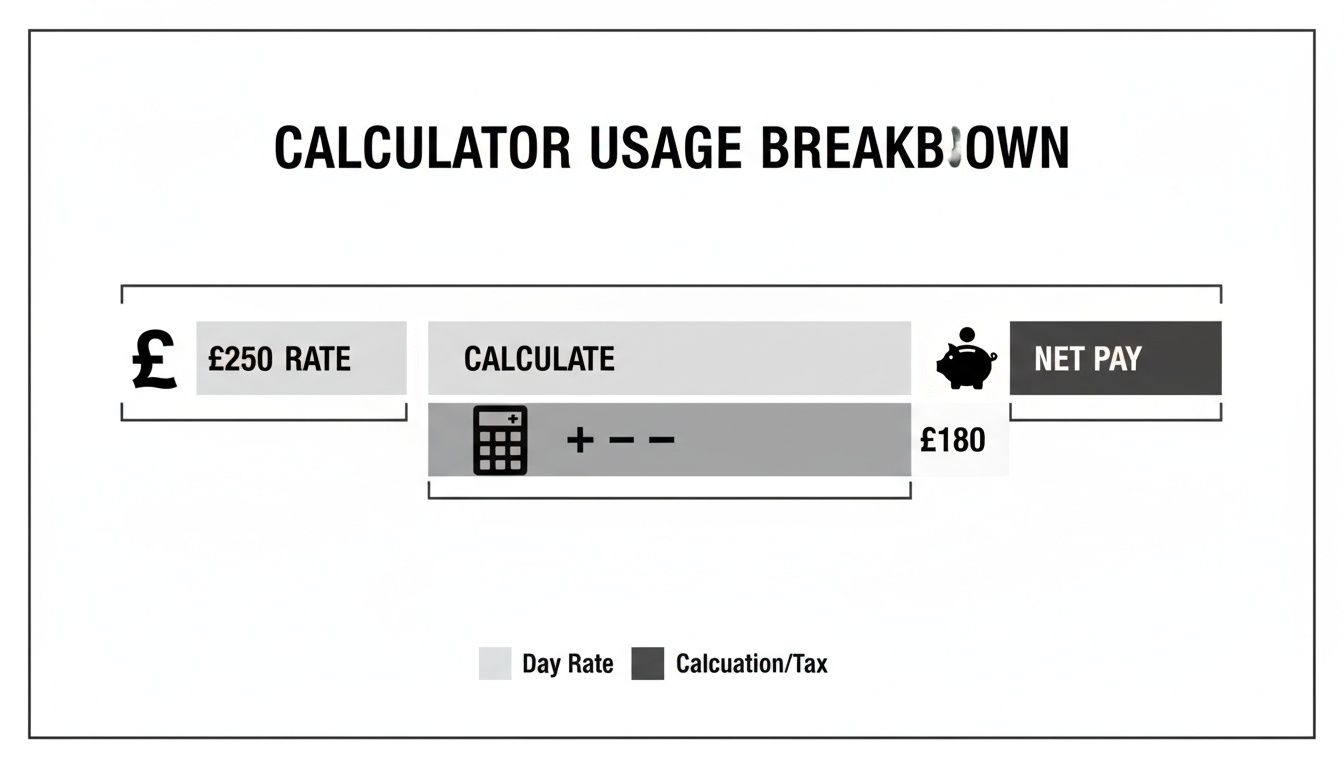
As you can see, once you have agreed on a rate with a client, there is a whole chain of deductions that have to happen before the money actually lands in your personal bank account.
The £60,000 Contract Test: A Side-by-Side Look
Let's put some real numbers to this. We’ll take a £60,000 annual contract and see how the take-home pay stacks up across the different working structures, using the tax rates for the 2024/25 tax year.
If you’re working through an umbrella company on a £60,000 contract, you can expect to see roughly £43,500 in your pocket after all is said and done. That means about £16,500 goes to the taxman and other costs. The 42% marginal rate really starts to sting once you earn over £50,270 (that’s 40% tax + 2% NI). Plus, don't forget the 13.8% Employer's NI, a hefty chunk that comes out of the contract rate.
A key thing to remember: the 'assignment rate' an umbrella contractor gets has to cover everything – your gross pay, Employer's NI, the Apprenticeship Levy, and the umbrella's margin. This is why a contractor’s day rate always looks so much higher than a permanent employee’s equivalent salary.
Now for the direct comparison.
Comparison of Net Pay: Umbrella vs Limited Co vs PAYE (£60,000 Contract)
Here’s a comparative breakdown showing the estimated annual take-home pay for a £60,000 contract value across different operating structures in the UK for the 2024/25 tax year.
| Operating Structure | Key Considerations | Estimated Annual Net Pay |
|---|---|---|
| PAYE (Permanent Employee) | Salary is £60k. Full employment rights. Employer pays their NI separately. No admin for the employee. | ~£44,740 |
| Umbrella Company (Inside IR35) | £60k contract value includes all employment costs. Minimal admin. Continuous employment rights. | ~£41,550 |
| Limited Co (Outside IR35) | Tax-efficient via salary and dividends. Full business control and admin responsibility. Highest potential net pay. | ~£47,800 |
| Limited Co (Inside IR35) | The 'deemed salary' calculation applies, removing most tax advantages. Significant admin for little financial gain. | ~£40,900 |
Disclaimer: These figures are just estimates. Your actual take-home pay can change based on things like your pension contributions, claimable expenses, and accountant fees.
So, Which Path Should You Take?
The table makes it pretty clear: running a limited company for an outside-IR35 contract gives you the highest take-home pay. But it’s not free money, it comes with the trade-off of being responsible for everything, from Corporation Tax returns to managing dividends.
On the other hand, an umbrella company offers simplicity and total compliance. It’s an excellent choice for inside-IR35 roles or for any contractor who just wants a simple life without the financial admin. The net pay is lower than a PSC outside IR35, but for many, that's a price worth paying for peace of mind.
A permanent PAYE role offers the most security but the least flexibility. And as you can see, trying to run an inside-IR35 contract through your limited company is often the worst of all worlds, you get the tax hit of an employee combined with the admin of a company director.
The best way forward? Use a reliable take home calculator for the UK to plug in your own numbers and see which scenario works best for you.
Choosing the Right Umbrella Company to Maximise Pay
So, you have run the numbers through a take home calculator uk and have a forecast of your earnings. That's a great start, but the next decision is just as crucial: picking the right umbrella company. They are not all created equal, and your choice directly affects your final pay packet.
It's not just about the weekly fee. The margin they charge, how efficiently they run payroll, and (most importantly) their compliance with HMRC rules all play a massive part. Get it wrong, and you could face lower net pay or, far worse, get tangled up in a risky tax avoidance scheme. Understanding what to look for helps you find a trustworthy partner who pays you correctly and keeps you on the right side of the law.

This is about more than just comparing weekly fees; it’s about looking at the entire service to find one that truly fits your needs as a contractor.
Look for Accreditations First
Before you even think about the fees, check for professional accreditations. In the UK contracting world, the two most respected stamps of approval come from the FCSA (Freelancer & Contractor Services Association) and Professional Passport. These organisations do not just run membership clubs; they conduct rigorous, independent audits to verify that an umbrella company operates legally and ethically.
Choosing an accredited provider is your best safety net. It's a clear signal that the company:
- Processes payroll in full compliance with all HMRC regulations.
- Provides all your statutory employment rights, like holiday and sick pay.
- Issues transparent payslips and clear reconciliation statements.
If an umbrella company isn't accredited, you have to ask why. While it does not automatically mean they are breaking the rules, accreditation is the gold standard for trust and reliability.
Comparing Umbrella Company Margins
The most obvious difference you will see between providers is their margin, the fee they take for their services. This is usually a flat amount deducted from your earnings each week or month. A competitive weekly margin in today's market is typically between £20 and £30.
Be wary of providers advertising unusually low margins or "no-fee" introductory offers. Sometimes these are just tactics to lure you in before other, less obvious charges appear. Any reputable umbrella will be completely upfront about their fee structure from day one.
Here's the bottom line: the margin is the only legitimate income an umbrella company should make from processing your pay. If a provider promises take-home pay that seems too good to be true, it almost certainly is. They could be using a non-compliant model, which might leave you facing a massive tax bill from HMRC down the road.
When you compare, find out exactly what that margin covers. Does it include business insurances, access to an employee benefits portal, or a dedicated account manager? Getting a clear picture of the full service helps you properly assess the value you're getting. Our guide on how to choose the best umbrella company in the UK dives deeper into making this critical decision.
Spotting the Red Flags of Non-Compliant Schemes
Unfortunately, the market still has a few operators running disguised remuneration schemes designed purely to avoid tax. Getting involved with one, even by accident, can lead to huge future tax bills and serious penalties.
Keep an eye out for these classic red flags:
- Promises of suspiciously high take-home pay, like 80%, 90%, or more.
- Strange payment methods involving loans, annuities, credit, or investment schemes.
- Any mention of an offshore or non-UK element in their payment structure.
- A complete lack of FCSA or Professional Passport accreditation.
Your best defence is simple: stick with established, accredited providers. A compliant umbrella company will always deduct the correct PAYE tax and National Insurance contributions. It’s the only way to ensure you meet all your legal obligations while maximising your pay safely and responsibly.
Answering Your Contractor Pay Questions
Working as a contractor means getting to grips with a new way of being paid. It's natural to have questions, especially when you first start looking at payslips and using online calculators. We've answered some of the most common queries we see to give you a clearer picture of your earnings.
Getting these details straight will help you use a take home calculator uk with more confidence and understand exactly where your money is going.
How Accurate Are Online Take-Home Pay Calculators?
This is a question we hear all the time. The short answer is that good, reputable calculators are very accurate for most standard scenarios. They are built using the latest HMRC tax and National Insurance rates, which makes them a reliable tool for estimating your earnings. They’re great for comparing different contract offers or getting a feel for your yearly income.
It’s important to remember, though, that the figure you see is always an estimate. Your actual, final take-home pay can be slightly different.
This is because the calculation can be affected by your personal circumstances:
- Your tax code: A non-standard tax code (anything other than the default 1257L for 2024/25) will change your personal allowance.
- Pension contributions: How much you choose to contribute directly impacts your taxable income.
- Student loan repayments: The threshold for repayments varies depending on which plan you are on (Plan 1, 2, 4, or 5).
- Other deductions: Things like workplace charity giving can also adjust the final amount.
Think of a calculator as a strong guide for financial planning, not a legally binding figure that will match your payslip to the penny.
Why Does My Payslip Show Employer's National Insurance?
If you are new to using an umbrella company, this is one of the most common points of confusion. Seeing a deduction for Employer’s National Insurance on your reconciliation statement can be a shock if you are not expecting it. Rest assured, this is a standard, fully compliant part of how umbrella employment works.
The umbrella company acts as your legal employer. This means they are responsible for paying Employer’s National Insurance Contributions (NICs) to HMRC on your earnings. This cost, along with the Apprenticeship Levy, has to be covered.
These employment costs are funded from the assignment rate the umbrella company is paid by your agency or end client. The deductions are made from this total contract value before your own gross pay is calculated for PAYE tax.
Any compliant umbrella company will list these deductions clearly on your pay reconciliation statement. This transparency is a key sign of a trustworthy provider and shows all legal obligations are being met correctly.
Can I Claim Expenses to Increase My Take-Home Pay?
The rules on business expenses for umbrella contractors have tightened significantly over the last few years. Following the introduction of Supervision, Direction, or Control (SDC) rules, most contractors working through an umbrella can no longer claim tax relief on their day-to-day work expenses.
This specifically affects costs like:
- Daily travel from your home to your main client site.
- Subsistence costs like food and drink during a normal working day.
HMRC now views these as ordinary commuting costs, just like those of a permanent employee, so they are not tax-deductible. While there might be rare situations where you can claim for other genuine business expenses (like travel to a temporary workplace that is not your main site), it is not a common scenario for most umbrella contractors.
It is absolutely vital you only work with an umbrella company that follows HMRC's rules to the letter. Be extremely cautious of any provider promising you can claim for everyday travel or lunches, this is a major red flag for a non-compliant scheme that could put you at risk of a future HMRC investigation.
At UmbrellaCompany.com, we are committed to providing you with the clear, accurate information you need to thrive as a contractor. Our tools and guides are designed to give you confidence in your financial decisions.
Ready to find a compliant, trustworthy umbrella partner? Use our free comparison tool to get started in just a minute. Compare top UK umbrella companies.


