


An IR35 take-home calculator is a seriously useful tool. It cuts through the complexity and shows you what you will actually have in your bank account from a contract once all deductions are sorted.
This guide explains how to use a take home calculator for IR35 effectively. You will learn how your IR35 status impacts your pay, what information you need for an accurate calculation, and how to avoid common mistakes.
The calculator works out your net pay based on one crucial factor: whether your contract is deemed 'inside' or 'outside' IR35. This single determination completely changes your tax obligations.
How IR35 Status Impacts Your Contractor Pay

Understanding your IR35 status is the first and most important step. It dictates how your income is processed before it lands with you. The difference between an 'inside' and 'outside' determination is a fundamental distinction in how HMRC views your working relationship with a client.
An ‘outside IR35’ status confirms you are operating as a genuine, independent business. You will invoice your client through your limited company, handle your own business taxes like Corporation Tax, and have the freedom to pay yourself a mix of salary and dividends. This is almost always the more tax-efficient route, meaning higher net retention.
On the other hand, being deemed ‘inside IR35’ means that, for tax purposes, you are treated like an employee. This triggers a series of deductions from your day rate before you see a penny, including Income Tax and National Insurance Contributions (NICs), all handled through a PAYE system.
The Financial Difference Between Inside and Outside IR35
To put it bluntly, the impact of IR35 on your take-home pay can be huge. Let's look at a quick example. A contractor earning £96,000 a year on an outside IR35 contract might take home around £62,669 for the 2025/26 tax year.
If that same contract is inside IR35, the deductions for PAYE tax and NICs will take a significant bite out of that figure. This highlights why getting an accurate status determination is so financially important.
When a contract falls inside IR35, the most common and compliant way to get paid is through an umbrella company. Here at UmbrellaCompany.com, we make this process straightforward by acting as your employer. We take care of all the PAYE deductions, making sure you stay on the right side of HMRC while you get on with your work.
Using an umbrella company for an inside IR35 contract takes all the administration and tax headaches off your plate. It also provides the stability of employment rights, like holiday pay and a workplace pension, while guaranteeing all your tax obligations are met.
Below is a simple table to illustrate the difference based on a common daily rate.
Inside vs. Outside IR35 Pay at a Glance
| Scenario | Gross Annual Revenue | Estimated Annual Take-Home Pay | Effective Tax Impact |
|---|---|---|---|
| Outside IR35 | £115,000 | ~£75,000 | Lower (paid via salary & dividends) |
| Inside IR35 (Umbrella) | £115,000 | ~£65,000 | Higher (PAYE tax & NICs deducted) |
Note: These are simplified estimates for a contractor on a £500 daily rate, working 46 weeks a year. Actual figures will vary.
As you can see, the difference is substantial, highlighting why understanding your status from the outset is non-negotiable for financial planning.
Why a Calculator Is Your First Step
An IR35 take-home calculator is the perfect starting point for any contractor. It gives you a clear, numbers-based forecast of your earnings under both scenarios. Just enter your day rate and a few contract details, and you will instantly see the financial reality of an inside versus an outside IR35 status.
This allows you to:
- Properly evaluate new contract offers with a realistic idea of your income.
- Plan your personal finances and household budget with much more confidence.
- Truly understand the net value of your services after all deductions are made.
Having this knowledge gives you the power to make much smarter decisions. To get a better feel for the practicalities, have a look at our guide on what happens if you’re inside IR35. It is designed to help you walk into any new contract with your eyes wide open.
The Inputs That Make or Break Your Calculation

Any take home calculator for IR35 is only as good as the information you provide. To get a truly reliable estimate, the details you enter are everything. Think of it less as a rough guess and more as a powerful financial planning tool, but its accuracy depends entirely on what you provide.
Getting these inputs right from the start is the key to a realistic forecast.
The most obvious starting point is your contract rate, whether you charge by the day or the hour. This is the top-line figure from which everything else is deducted. You also need to enter your working pattern, like how many days you expect to work each week, so it can calculate a realistic gross income for the period.
Your Personal Financial Details
Beyond the contract basics, a good calculator will need more personal information to tailor the illustration to your life. These are the details that directly impact how much tax and National Insurance you will pay.
Make sure you have these to hand:
- Your Tax Code: Most people are on the standard 1257L code (for 2024/25), but if HMRC has given you a different one, you must use it. A wrong tax code will throw the whole calculation off.
- Pension Contributions: If you plan to pay into a pension, this is a big one. Pension contributions are usually tax-deductible, so including them is vital for an accurate picture.
- Student Loan Repayments: You will need to know which plan you are on (e.g., Plan 1, Plan 2). The repayment thresholds and percentages differ, affecting your final net pay.
- Existing Income: If you have other earnings within the same tax year, you need to declare them. This ensures you are placed in the correct tax bracket from the get-go.
Forgetting these details often leads to a nasty surprise, as your take-home pay can end up being much lower than the initial estimate. To get a better feel for how these deductions work, check out our guide on how PAYE is calculated.
Scenario-Specific Information
Finally, the calculator needs to know about your specific working arrangement, particularly when you are trying to compare working inside vs. outside IR35.
If you are working inside IR35 via an umbrella company, you will need to enter their margin. This is the weekly or monthly fee they charge for their payroll services and it comes directly off your gross contract value.
A crucial point for inside IR35 calculations: your day rate also has to cover Employer’s National Insurance and the Apprenticeship Levy. A trustworthy calculator will factor these statutory costs in automatically, but it is something many contractors forget.
For an outside IR35 calculation, the focus shifts to your anticipated business expenses. These are the legitimate costs your limited company incurs, which can be claimed to reduce your Corporation Tax bill and boost your overall financial efficiency. The more accurate your data, the clearer and more dependable the final picture will be.
Breaking Down an Inside IR35 Payslip
When a contract lands 'inside IR35', your earnings are handled much like they would be in a traditional job. Your gross contract value is funnelled through a PAYE (Pay As You Earn) system before it ever hits your bank account, a process typically managed by an umbrella company.
The best way to get a clear picture of this is to run the numbers through a take home calculator for IR35. It cuts through the confusion, showing you all the deductions upfront and giving you a realistic net pay figure.
Knowing exactly where your money goes is crucial for managing your finances, so let's walk through what actually happens to your day rate.
The Key Deductions Explained
First things first, the contract rate you agree is not what you take home, nor is it your gross pay for tax purposes. It is the total sum the client or agency pays for your services, and this has to cover all the employment costs before your own salary is even calculated.
These are the costs that come off the top:
- Employer's National Insurance: This is a big one, currently sitting at 13.8%. It is a statutory employment cost that gets paid directly to HMRC.
- The Apprenticeship Levy: A UK tax on employers designed to fund apprenticeship training, charged at 0.5% of the annual pay bill.
- Umbrella Company Margin: This is simply the fee the umbrella company takes for handling your payroll. It is a fixed amount, usually charged either weekly or monthly.
Only after these costs are settled is your gross pay for tax calculated. From that figure, your personal tax and NI contributions are then deducted.
Your Personal Tax and National Insurance
Once we have your gross taxable pay, the deductions will look familiar to anyone who has been a permanent employee in the past.
Your payslip will show deductions for:
- Income Tax: We work this out using your personal tax code against the current tax bands set by HMRC.
- Employee's National Insurance: This is your own contribution towards state benefits, calculated as a percentage of your earnings.
- Workplace Pension Contributions: If you are opted into a pension scheme, your contributions will be taken from your gross pay.
These calculations can get complicated, which is why we offer comprehensive support to help you make sense of your payslip. For a more detailed look, our guide on PAYE and umbrella companies offers some extra clarity.
The Impact of IR35 Reforms on Take-Home Pay
The shift towards more inside IR35 determinations has sent ripples across the contracting world, hitting many in the wallet. Since the off-payroll working rules rolled out to the private sector in April 2021, a huge number of contractors have seen their status change overnight.
Research shows that after the reforms, an estimated 70% of contractors were moved inside IR35 by their clients. That is a massive jump from just 15% before the changes. As a result, many contractors have reported a net income drop somewhere between 25-40%, thanks to the higher tax burden of being treated as an employee. You can dig into these findings over at the impact of IR35 on ITContracting.com.
This highlights just how vital it is to use an accurate take home calculator for IR35 before you even think about accepting a contract. It gives you a clear, real-world preview of what you will actually earn, so there are no nasty surprises down the line and you can plan your finances with complete confidence.
Calculating Your Pay Outside IR35
Working outside IR35 often means more financial control and better tax efficiency, but it definitely comes with more administration. When your contract is genuinely outside IR35, you will be running your finances through your own limited company, which completely changes the game for calculating your take-home pay.
Instead of your income hitting a PAYE system right away, it lands in your business account first. This means you have business-level taxes to sort out before you can think about paying yourself. Understanding this is the key to maximising what you keep while staying on the right side of HMRC.
This diagram shows the basic flow from your gross day rate to your final net pay.
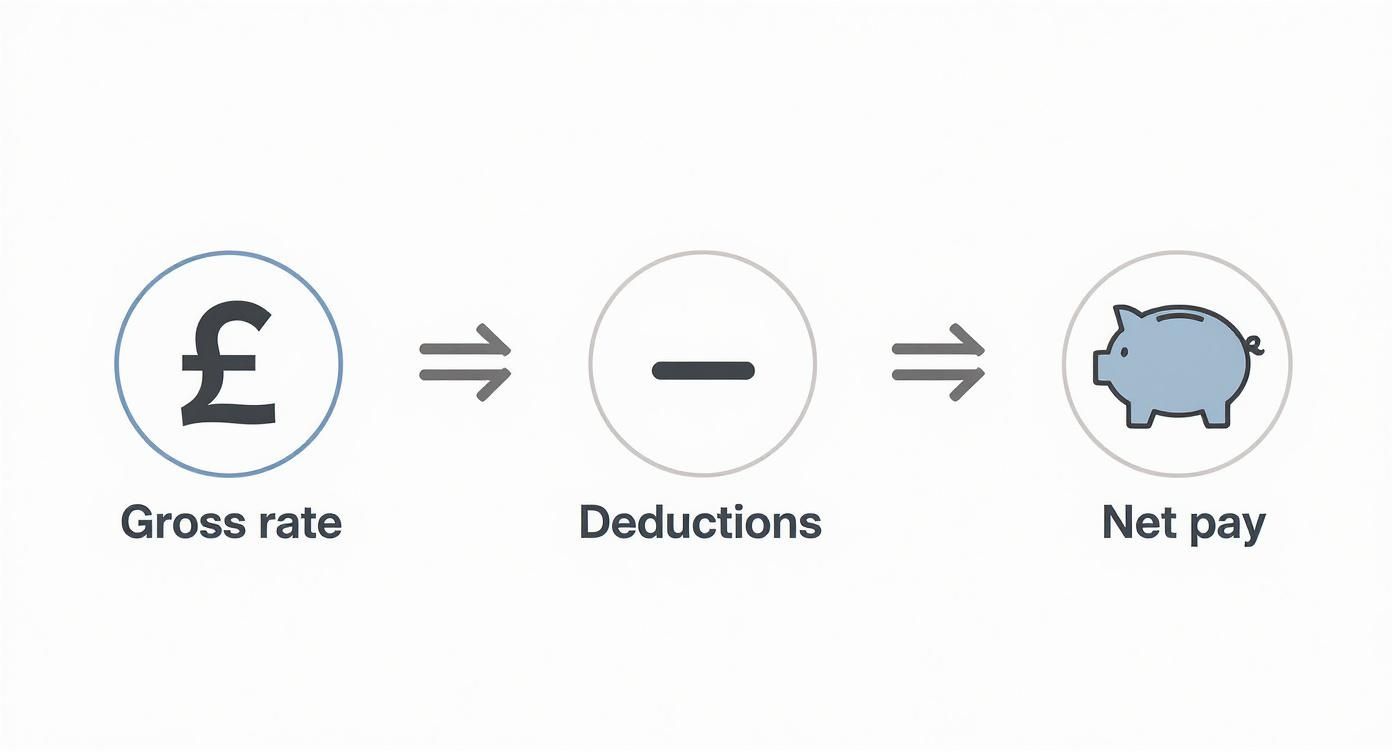
As you can see, deductions are a major step between earning your rate and pocketing your pay, which makes understanding each one essential.
The First Hurdle: Corporation Tax
Before you can pay yourself a single penny, your limited company has to settle its own tax bill. All the cash you invoice for lands in your company’s bank account. Once you have deducted any legitimate business expenses, the profit that is left is subject to Corporation Tax.
This is the main tax your business pays directly to HMRC. It is the first critical deduction you need to factor into any outside IR35 calculation. Only after this is paid can you decide how to take the remaining, post-tax profits out of the business for yourself.
How to Structure Your Personal Income
For most contractors, the go-to, tax-efficient way to pay yourself from a limited company is by taking a low salary combined with dividends. We design this structure to keep your personal tax and National Insurance liabilities to a minimum.
Here is a quick breakdown of how it works:
- A Small Director's Salary: You pay yourself a modest salary. It is usually just enough to qualify for state benefits like the State Pension but low enough that you pay little to no Income Tax or National Insurance.
- Tax-Efficient Dividends: The leftover profit in your company (after Corporation Tax) can be paid out to you, as a shareholder, through dividends.
This two-pronged approach is standard practice for a reason (it is a perfectly legitimate way to structure your income efficiently when you're outside IR35).
The core idea is to draw most of your income through dividends, which are not subject to National Insurance contributions. This single factor is what makes operating outside IR35 significantly more tax-efficient than being inside IR35.
Figuring out the tax on your dividends is a crucial part of any outside IR35 calculator. Dividend income gets its own tax-free allowance and has specific tax bands that are lower than the rates for regular income.
The complete tax picture for an outside IR35 contractor has a few moving parts. For example, on a gross revenue of £96,000, a contractor could be looking at a Corporation Tax bill of around £17,290 for the 2025/26 tax year. After that, pulling dividends out could attract another £11,000 or more in dividend tax, depending on how much you decide to take.
To get a precise forecast, our limited company take-home calculator is built to handle these specific variables. It gives you a clear view of how your gross contract value actually translates into personal income after all the business and personal taxes are dealt with.
Common Mistakes When Using Pay Calculators
While a take home calculator for IR35 is an essential tool for any contractor, it is only as reliable as the numbers you feed it and the assumptions it makes. Probably the biggest mistake you can make is treating the result as a guaranteed figure rather than a well-informed estimate.
These tools are brilliant for comparing contract offers and for financial forecasting. But there are a few common pitfalls that can paint an inaccurate picture of your net pay if you are not careful. Recognising these is the key to using a calculator effectively and avoiding nasty financial surprises down the line.
One of the most frequent errors is relying on a calculator that uses outdated information. Tax bands, National Insurance thresholds, and pension rules change every year. Using a tool that is not updated for the current tax year will give you a completely incorrect result from the get-go. Here at UmbrellaCompany.com, we make sure our calculators are always current.
Overlooking Hidden and Variable Costs
It is easy to focus on the headline figures like Income Tax and National Insurance, but the smaller, less obvious deductions really add up. Many contractors forget to account for costs that are specific to inside IR35 arrangements when they are entering the numbers.
These often-missed deductions include:
- The Apprenticeship Levy: This is a 0.5% tax on an employer's pay bill, which gets deducted from your contract rate before your gross pay is even calculated. It is a small percentage, sure, but it makes a difference over a year.
- Umbrella Company Margins: You have to enter the correct weekly or monthly margin for the umbrella company you plan to use. Guessing this figure or leaving it out will definitely skew your net pay calculation.
- Workplace Pension Contributions: If you plan to contribute to a pension, you must include this. Forgetting to factor in your contributions will make your estimated take-home pay appear artificially high.
Not Planning for Downtime
Another classic oversight is assuming you will work every single possible day of the year. Contracting life often involves gaps between projects, not to mention holidays or sick days. A reliable take home calculator for IR35 will allow you to specify the number of weeks you actually plan to work.
A calculator provides a snapshot based on a consistent work pattern. It is crucial to adjust for non-working periods to create a realistic annual budget and avoid overestimating your income.
Failing to account for even a few weeks on the bench can create a huge gap between the calculator’s estimate and your actual annual earnings. Our advice is to always be conservative with your working weeks to get a more accurate financial forecast.
Ultimately, a pay calculator is your first step, not your final answer. It provides an excellent illustration, but it cannot replace personalised advice. We always recommend discussing your illustration with one of our specialists. They can consider your unique financial circumstances and help you build a solid, reliable financial plan for the year ahead.
Got Questions? We've Got Answers
It is only natural to have questions when you are trying to figure out IR35 and what it means for your wallet. We get it. We have put together some straightforward answers to the questions we hear most often from contractors just like you.
Using an IR35 take-home calculator is a great starting point, but let's dig into the details.
Why Is My Take-Home Pay So Much Lower Inside IR35?
This is the big one, and it catches a lot of contractors out. When your contract is deemed 'inside IR35', we treat your earnings just like a permanent employee's salary for tax purposes. This means you are paying Income Tax and employee's National Insurance through a PAYE system, usually handled by your umbrella company.
But here is the crucial bit that often gets missed: employer's National Insurance contributions (13.8%) and the Apprenticeship Levy (0.5%) are also deducted directly from your day rate. These are employment costs that have to be paid, and they come out of the pot before your gross pay is even calculated. That is the single biggest reason for the significant drop in your net pay compared to an outside IR35 gig.
Can I Still Claim Expenses If My Contract Is Inside IR35?
In a word, rarely. When you are inside IR35, HMRC sees you as an employee for tax purposes, and the rules on expenses get very tight. A regular employee cannot claim tax relief for their daily commute or their sandwich at lunch, and the same logic applies here.
A compliant umbrella company can process some very specific, allowable expenses, but the scope is extremely limited. It is a world away from working outside IR35, where your limited company can offset a wide range of legitimate business costs against its Corporation Tax, which is a much more tax-efficient way to operate.
How Accurate Is an Online IR35 Take Home Calculator?
A good online calculator is your best friend for getting a solid estimate of your earnings. But it is vital to remember that it is just that: an estimate. The accuracy really comes down to two things: the quality of the numbers you enter and whether the tool is using the latest tax and National Insurance rates.
A calculator gives you a financial snapshot, not a binding contract. Real-world factors like your specific tax code, student loan repayments, and pension contributions will all tweak that final take-home figure.
Our advice is to always use a reputable calculator that you know is kept up-to-date, like ours. For a completely personalised illustration that is built around your exact circumstances, the best next step is always a proper chat with one of our specialists. They can help you build a financial plan that truly reflects your situation.
Ready to see what your real take-home pay looks like? Use our free, up-to-date calculator for an accurate illustration in minutes. For expert guidance and compliant umbrella solutions, trust UmbrellaCompany.com.


